

7 Ways to Support Daily Mindfulness with Breeze Mental Health (Review)
Mindfulness is for everyone. Our Breeze Mental Health Review will prove it. Learn how you can use a mental health app to boost your spiritual health in tiny, but essential steps.
Table Of Contents
Mindfulness is undeniably a go-to practice to boost mental and spiritual health. An extensive review published in Frontiers in Public Health showed that short mindfulness practices daily significantly reduce symptoms of depression and anxiety, while improving productivity [1]. But if you’re a beginner, how do you get down to mindfulness?
Beginners might feel the urge to get straight into long meditation sessions and wait for transcendence. Unfortunately, this path most likely will lead to burnout. There is a more effective and pleasant way to start introducing mindfulness by only slightly adhering to your habits.
If you’re constantly on your phone but would like to live a more authentic life, this article is for you. It reviews Breeze Mental Health and how you can use it as a mindfulness sidekick.
Short Review of Breeze Mental Health
Breeze Mental Health is a self-discovery app designed to support emotional awareness as a way to personal growth. With more than 14 million downloads, it’s available on both iOS and Android. The main features are:
- Journaling
- Quizzes and tests
- Mood trackers
- Mindfulness exercises
- Routine builder
- Affirmations
The app doesn’t position itself as a clinical solution, but as a guide with users leading their own self-discovery. The average rating of Breeze across platforms fluctuates from 3.7 to 4.2. In reviews, users highlight how the app’s features gave them tools to gain new knowledge about themselves.
For example, an anonymous user on TrustPilot wrote, “Its a great way to gain insight on myself and other who were curious about life events” [2]. These insights are used to understand how events in our lives impact emotional reactions: ” It’s easy to see how my moods change over time, and it’s really helped me connect the dots between my emotions and life events” [3].
7 Daily Mindfulness Tools in Breeze Mental Health
1. Breathing Exercises
Everyone who wanted to get into mindfulness started with breathing exercises. And that’s fair because active breathing manipulation in stressful moments significantly reduced anxiety, according to the research [4]. Breeze Mental Health offers breathing exercises in the form of a game called “Mindful Breathing.”
“Mindful Breathing” offers short breathing exercises that guide your attention. When you open the game, you follow a dot that turns into a circle. This circle pulsates and instructs you when to breathe in and breathe out.
Sessions are intentionally brief and can be repeated as many times as needed throughout the day. This short format makes breathing exercises affordable in terms of time, suitable for use during work breaks or before sleep.
2. Mindful Listening
Mindful listening is technically not Breeze’s feature, but a mindful exercise that can be done with Breeze Mental Health. The game “Calming Waters” allows users to choose different soundscapes and interact with water. While you play with water, you also hear flowing music that resembles the sounds of nature.
In our review of Breze Mental Health, we found that this activity is great for people who need sensory input, especially in terms of sounds. It taps into reconnection with nature. One explanation why many people don’t know who they are and where they’re heading is that we have disconnected from natural habitats. Breeze fills in this gap.
Although listening sounds simple, it is actually one of the hardest mindfulness skills to practice because the mind wants to wander. Breeze makes this easier by keeping the experience lightly interactive. You are not passively consuming sound; you are engaging with the water.
3. Deep Seeing
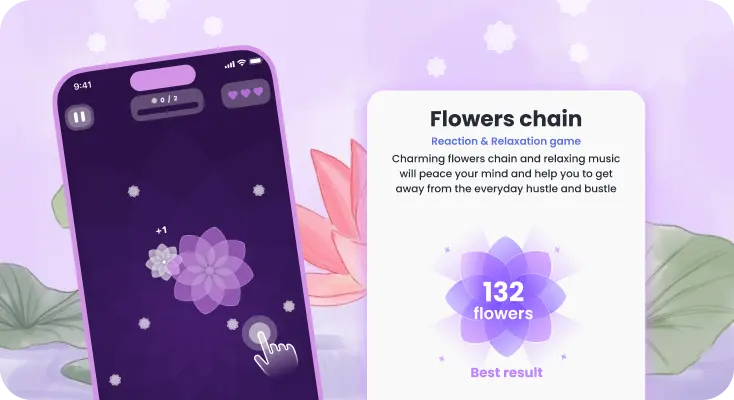
Social media and multitasking are something that fragments our attention and ability to see things. The exercise of deep seeing retrains this ability. One way to introduce deep seeing without significantly disrupting the already existing routine is to try Breeze’s Flower Chain game.
The Flower Chain is a game where you catch flowers with calming music in the background. It’s active enough to hold your interest but slow enough to rebuild the ability to focus sustainably. There is no pressure to win and vibrations, music, colors engage the feelings on all levels.
In Breeze mental health reviews, this game got praise from people who struggle with concentration. For such people, traditional mindfulness practices can be overwhelming. And Breeze, instead of forcing stillness, allows for the practice of mindfulness through engagement.
4. Mirror Talk (Affirmations)
Mirror Talk in Breeze is built around affirmations. Affirmations can be viewed as empty positivity, but Breeze makes them evidence-based.
The idea behind this mindfulness practice is simple: the way you speak to yourself shapes how you feel, behave, and interpret reality. The brain does not see the difference between the perceived reality in your thoughts and actual reality. Hence, thoughts become physical.
Unfortunately, simply repeating or rereading affirmations doesn’t work because it feels forced and fake. Speaking Breeze’s affirmations out loud tricks your brain into thinking someone else teaches you. It’s especially helpful for people who tend to people-please or depend on external validation.
From a mental health standpoint, repeated self-statements gradually weaken rigid negative beliefs. When practiced consistently, affirmations interrupt automatic self-criticism and replace it with compassion.
5. Reflective Gratitude
Breeze has three tiers of journaling:
- Calm Anxiety
- Release Worry
- Foster Gratitude
The latter is perfect to become more mindful of the good things happening around. In the routine, people are more likely to worry about plans and the future, but might ignore small or big positives that surround them. That’s why Breeze’s gratitude journaling can become a game-changer.
Users are not forced to intentionally look for something good. Guided prompts already indicate where good things can be hidden. For example, “How did you overcome one challenge today?” “What did you do today for your tomorrow’s self?” “What is one thing not related to your performance that makes you proud today?”
This practice supports mindfulness by increasing awareness of both strengths and vulnerabilities. It helps anchor mindfulness in daily life by reconnecting you with your internal experience instead of comparison.
6. Authentic Living
Although Breeze Mental Health doesn’t have a feature that directly defines your values and shows you what to do to live accordingly, it has all the tools needed for you to do it. One of the best features for this aim is the habit builder.
Instead of focusing on efficiency or achievement, Breeze’s habit builder encourages users to build routines around their energy levels and real-life limitations. It’s very different from traditional to-do lists that reinforce perfectionism. In such to-do lists, when you miss a day, the whole system feels like a failure.
According to Breeze Mental Health reviews, habits here do not feel like obligations. But something that allows to celebrate progress over perfection. An essential component of living an authentic life that you continue to choose every day.
7. Building Confidence
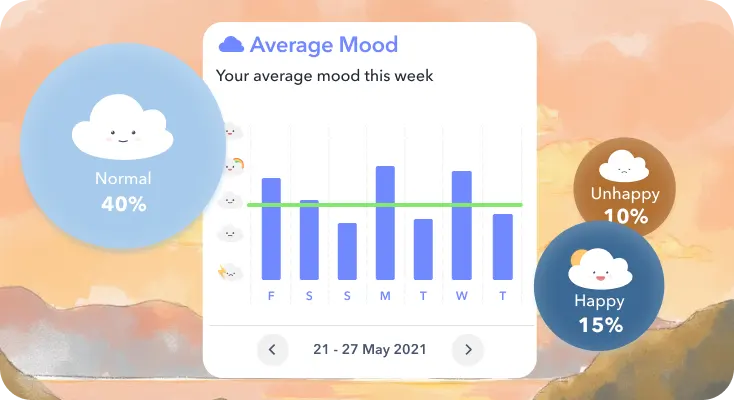
One unobvious feature of Breeze that can help users build confidence through mindfulness is the mood tracker. It allows for entering mood, feelings (over 50 available), activities of said day, photos, and short notes. By keeping a log of mood, people start to learn what influences those emotions.
How can this boost confidence? Mood tracking turns emotions into data. Also, while you enter your emotions, you reflect. These few minutes are a surface-level mindfulness practice that you might not even notice. When emotions make sense, they become less threatening.
In Conclusion
Daily mindfulness doesn’t have to feel like an obligation anymore. Its effectiveness is undeniable, especially if you approach it intentionally. Thanks to digital tools, like Breeze Mental Health, practicing mindfulness daily becomes part of a routine like opening Instagram or opening a work laptop.
If you don’t feel like using the features and reviews of Breeze Mental Health to boost your mindfulness, you can still use the exercises described. It’s possible to do them without digital exposure. The main thing is to do them gradually to prevent burnout and save positive experiences about meditation.
Sources:
- The efficacy of mindfulness-based interventions on mental health among university students: a systematic review and meta-analysis. Frontiers in Public Health. November 2023.
- It’s a great way to gain insight on… Trustpilot Review of Breeze Wellbeing. November 2025.
- Breeze’s data visualization for mood… Trustpilot Review of Breeze Wellbeing. January 2025.
- A systematic review of brief respiratory, embodiment, cognitive, and mindfulness interventions to reduce state anxiety. Frontiers in Psychology. June 2024
Blog Categories:
About the Author: