Solar Plexus Chakra Symbol – Meaning, Tattoos and Downloads
Solar Plexus Chakra symbol meaning, tattoos, and downloads. Learn Manipura symbol for power and identity.
The solar plexus chakra (Manipura) explained: meaning, location, yellow color, symbol, fire element, mantra RAM, function, balanced vs blocked signs.
The solar plexus chakra, or Manipura ("city of jewels"), is the third of the seven main chakras. In chakra tradition it sits in the upper belly, between the navel and the breastbone. Its color is yellow and its element is fire, and modern chakra teachings link it with confidence, willpower, self-esteem and the energy to act.
Solar Plexus Chakra at a Glance
Manipura · the third chakra
The solar plexus chakra is the third of the seven chakras. Its Sanskrit name is Manipura, and in English it is also called the third chakra, the 3rd chakra, the solar chakra or the navel chakra. It sits above the root and sacral chakras on the map of the chakras in the body, and it is the chakra of fire: where the sacral chakra is about feeling, the solar plexus chakra is about doing.
In chakra teachings it is the center of personal power. It is linked with confidence, self-worth, willpower, decisions and the strength to follow through on them. When people say their solar plexus chakra is balanced, they usually mean that they trust themselves, can set limits and can act without needing someone else's approval first.
Chakras are not physical organs, and there is no scientific evidence that they exist as structures in the body. They come from yoga and Tantra, and many people use them as a map for confidence, stress and habits. This page explains what the solar plexus chakra means in the traditional texts and in modern chakra books, and links to a detailed page for each part of solar plexus chakra practice.
Manipura is a Sanskrit word made of mani, "jewel" or "gem", and pura, "city" or "place". It is usually translated as "city of jewels" or "lustrous gem". Some texts explain the name by the brightness of this chakra: like a jewel, it shines with the heat of the fire element. It is pronounced roughly "mah-nee-POO-rah". Older yoga books also call it the nabhi chakra, the navel chakra.
In the Tantric diagrams this is the region of fire. Fire gives heat, light and movement, and it transforms whatever it touches, the way food is turned into energy. That is the picture teachers use for this chakra: the inner fire that turns intention into action.
The solar plexus chakra represents your sense of self and your personal power. In modern teaching it stands for confidence, self-esteem, willpower, responsibility, ambition and the right to make your own choices. It is the part of the chakra system that says "I can". These meanings come mainly from modern chakra psychology. The traditional texts describe the chakra by its element, fire, and by its symbols.

In modern chakra books, the solar plexus chakra is responsible for how you use your energy. When it is balanced, teachers say you can make decisions, keep promises to yourself, say no without guilt and recover from setbacks. When it is out of balance, you either feel powerless and stuck, or you push too hard, try to control everything and burn out.
It is also linked with digestion, in the body and in a wider sense: how well you take in food, experiences and criticism and turn them into something useful. Some teachers connect it with the stomach, liver, pancreas, gallbladder and small intestine. These links come from chakra books, not from medicine, and stomach pain or digestive problems should be checked by a doctor.
In verses 19-21 of the Sat-Chakra-Nirupana, a 16th-century Tantric text translated by Arthur Avalon in The Serpent Power (1919), Manipura is placed at the root of the navel. It describes a lotus with ten petals the color of heavy rain clouds, and inside it a red triangle, the region of fire. The seed syllable is RAM, carried by a ram, the animal of the fire god. The deities are Rudra, an old form of Shiva, and the goddess Lakini.
The text says that meditating on this lotus gives the power to create and to destroy, and the yogi is described as gaining full knowledge of the body. Modern teachers keep the fire and the brightness of the jewel, and read them as strength, will and self-trust.
The solar plexus chakra is located in the upper belly, between the navel and the bottom of the breastbone. Most modern books place it a little above the navel, in the soft area under the ribs often called the pit of the stomach. In the subtle body of yoga it sits on the central channel, the sushumna nadi, behind the navel. Swami Satyananda Saraswati, in Kundalini Tantra, places Manipura on the spine directly behind the navel, with a trigger point in front, the kshetram, at the navel itself.
Many people feel this area clearly. Nerves, excitement and fear often show up here first, as "butterflies", a knot or a sinking feeling. That is one reason teachers link this chakra with confidence and inner strength.
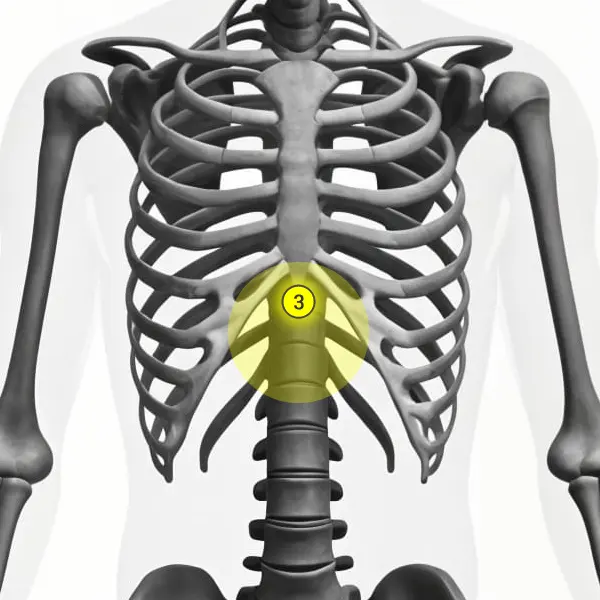
Diagram is showing where solar plexus chakra is located on your spine (yellow dot 3) and where the energy of the solar plexus chakra can be felt when you concentrate on it (transparent yellow circle)

The English name comes from anatomy. The solar plexus, also called the celiac plexus, is a real network of nerves in the upper abdomen, behind the stomach and in front of the aorta. It was named "solar" because its nerves spread out like the rays of the sun. The chakra is a different thing: an idea from yoga, not a nerve. Western authors simply borrowed the name of the nerve center because it sits in the same part of the body.
Yes. "Stomach chakra" is an informal name for the solar plexus chakra, because it sits over the stomach and is linked with digestion. If you are asking which chakra is the stomach, the answer in chakra teachings is Manipura, the third chakra. The sacral chakra sits lower, below the navel.
Chakra books connect the solar plexus chakra with the digestive organs: the stomach, liver, gallbladder, pancreas and small intestine, as well as the muscles of the core and the middle back. Its sense is sight, because the yoga texts link the fire element with sight and light. The gland most often named is the pancreas, though some teachers name the adrenal glands instead. Gland links are a modern addition and are not medically proven.
Anodea Judith connects each chakra with a stage of childhood. In her model the third chakra develops from about 18 months to 4 years old, when a child starts to say "no", wants to do things alone and discovers their own will. How that will was met, encouraged or crushed, is why teachers link early experiences of control and shame with this chakra.
These links are a way of thinking about the body, not a diagnosis. If you have stomach pain, heartburn, blood sugar problems or ongoing tiredness, see a doctor.
The solar plexus chakra color is yellow in the modern rainbow system, which gives the seven chakras the colors of the spectrum from red to violet. Yellow is the third color of the spectrum and the color of the sun, so it became the color of the third chakra, the "solar" chakra, in 20th-century chakra books.
The traditional texts paint it differently. In the Sat-Chakra-Nirupana the ten petals are the dark blue-grey of rain clouds, and the triangle of fire in the center is red. The rain cloud and the fire belong together in the old picture: the navel is where heat and water meet. So yellow is a modern choice, and it has stuck because it matches the themes of fire, light and energy.
The yellow chakra meaning follows from the color itself: yellow is a bright, warm color linked with optimism, clarity, energy and confidence. Many people use it as a reminder in their practice, for example yellow clothes, yellow foods such as bananas, corn and lemons, sitting in morning sunlight, or visualizing yellow light in the upper belly. There is no proof that color changes the chakra, but it is an easy way to bring your attention to it.
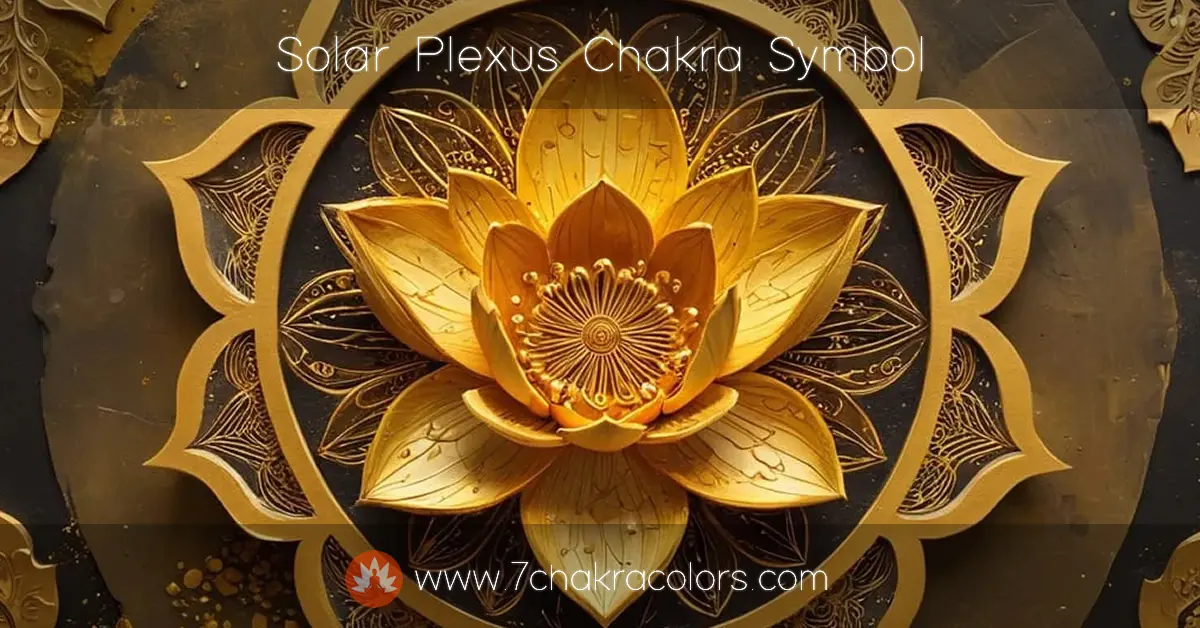
The solar plexus chakra symbol is a lotus with ten petals. On the petals are ten Sanskrit syllables: ḍaṃ, ḍhaṃ, ṇaṃ, taṃ, thaṃ, daṃ, dhaṃ, naṃ, paṃ and phaṃ. Inside the lotus is a downward-pointing red triangle, the sign of fire, with the seed syllable RAM. Many paintings also show the ram, the animal that carries the fire god.
Each part of the design has its own meaning, and it is a popular tattoo. The meaning of every part, color versions and free downloads are on our solar plexus chakra symbol page.
In sound healing, the solar plexus chakra is most often given 528 Hz, the third tone of the modern Solfeggio frequencies. Chakra tuning forks based on musical notes give it the note E instead, usually 320 Hz. Both are modern conventions: the old texts name a mantra, not a frequency. The page linked in the facts box compares the systems and lets you listen to each tone.
The characteristics of a balanced solar plexus chakra, as modern chakra teachings describe them (not diagnostic criteria), add up to quiet confidence. You make decisions and stick to them, you can take criticism without collapsing, you set healthy limits, and you have enough solar plexus chakra energy for the day. You do not need to win every argument.
When the solar plexus chakra is blocked or underactive, teachers describe low self-esteem, indecision, people-pleasing, feeling powerless, low energy and a tense or upset stomach. An overactive solar plexus chakra is the opposite picture: the need to control, anger, perfectionism, stubbornness and working until you burn out. The full lists and the causes are on our page about solar plexus chakra blocked symptoms.

Our free solar plexus chakra test asks a set of short questions about confidence, decisions, willpower, anger, control and your energy during the day. Your answers show whether your solar plexus chakra looks balanced, underactive or overactive, and which areas need the most attention.
It takes a few minutes. Be honest about the habits you would rather not have, because that is where the result is most useful. It is a starting point, not a diagnosis, and the healing and practice pages show what to do next.
When the solar plexus chakra starts to open, people often describe warmth in the upper belly, more energy, clearer decisions, less need for approval and the courage to say what they want. Old anger or frustration can come up for a while before it settles. What these changes mean, how long they last and when to see a doctor is explained on our page about solar plexus chakra opening symptoms.

Many teachers suggest that the solar plexus chakra responds best to practices that build steady inner fire: core-strengthening yoga, energizing breathing, time in sunlight, regular meals, and small decisions that you actually carry out. Each kept promise to yourself is seen as fuel for this chakra.
Our guide to solar plexus chakra healing puts a five-step start, a seven-day plan and every method in one place, with notes on how to unblock, balance and open the chakra safely. If you want to check where you stand first, start with the test mentioned above.

Each practice has its own page with full instructions. Here is a short summary of each, so you can choose where to start.
Yoga for the solar plexus chakra means core work and twists. Typical poses are Boat, Plank, Side Plank, Warrior III, Bow, Cobra and a seated twist, finished with a reclined twist to rest, often after a few rounds of Sun Salutation. Our solar plexus chakra yoga poses page explains the 8 best poses step by step, with a 15-minute sequence and the best seated position for meditation.

A solar plexus chakra meditation usually brings the attention to the upper belly and uses the image of a small fire or a yellow sun that grows brighter with each breath, sometimes with the sound RAM. Ten minutes in the morning is a good start. A full guided script is on our solar plexus chakra meditation page.
Energizing breaths are typical for this chakra: Kapalabhati, with short active exhales from the belly, and Bhastrika, the bellows breath. Do both gently, sitting down and on an empty stomach. They are not suitable in pregnancy or with high blood pressure, heart problems, epilepsy, a hernia or recent abdominal surgery; slow belly breathing is the safe alternative. Instructions and timings are on our solar plexus chakra breathing page.

Solar plexus chakra affirmations are about self-worth and willpower, for example "I am allowed to take up space" or "I make clear decisions". Choose words that feel believable today and repeat them before a task that takes courage. We have grouped solar plexus chakra affirmations by need, with a free printable list.
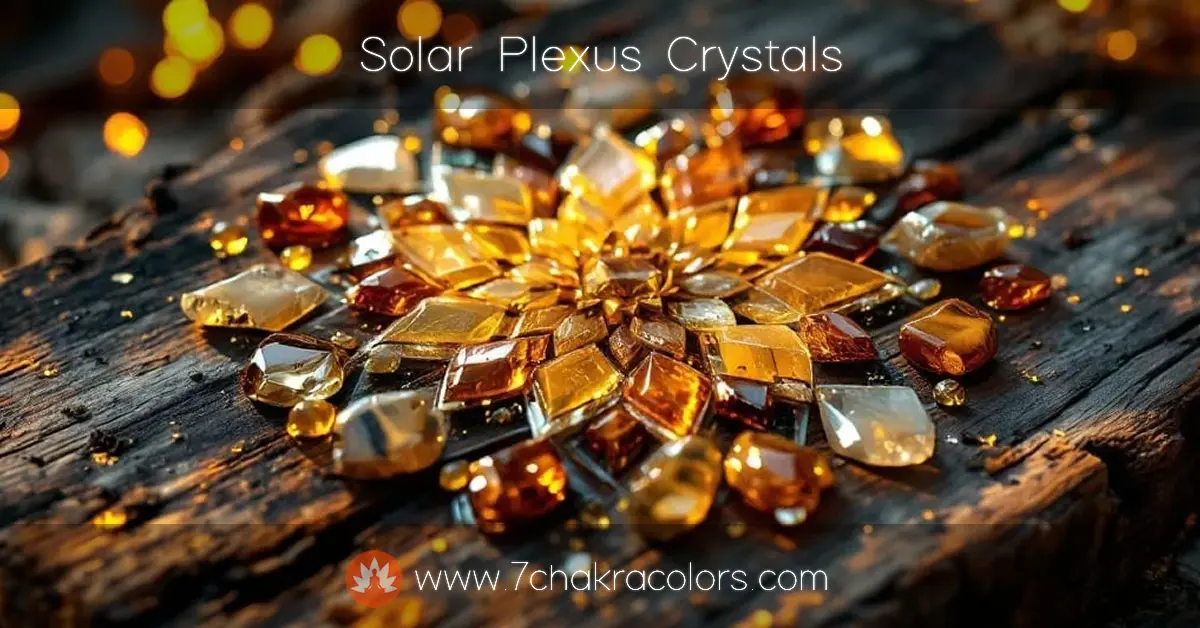
Yellow and golden stones are linked with the solar plexus chakra. The best known are citrine, yellow jasper, tiger's eye, pyrite and yellow calcite. People hold them during meditation, carry them in a pocket or place one on the upper belly while lying down. There is no scientific evidence that crystals change energy, but many people find them a useful focus. What each stone is used for and how to cleanse it is in our solar plexus chakra crystals guide.
Chanting RAM, listening to a 528 Hz tone and singing bowls tuned to E are the usual ways to work with the solar plexus chakra through sound. A strong, even tone held on the out-breath is felt in the belly and helps the mind settle. You can play the tones, compare the tuning systems and practice the solar plexus mantra on our frequency page.

Chakra teachers link the solar plexus chakra with experiences that took away a person's power: bullying, humiliation, harsh criticism, controlling relationships or being punished for having a will of your own. Many people feel this kind of stress as a tight stomach. If you live with trauma, the first step is support from a trauma-informed therapist; chakra work can only be an addition. Signs and a gentler way of working are on our page about solar plexus trauma.

In everyday life, the solar plexus chakra shows up in how you start and finish things, how you deal with pressure, whether you can say no and how you feel after a conflict. It also shows up at the table: regular meals, eating slowly and not skipping breakfast when you are stressed are simple ways teachers suggest to look after this chakra.
Many solar plexus practices are therefore ordinary acts of self-respect. Making one decision you have been putting off, finishing a small task, taking a short walk in the sun, standing up straight in a meeting, or asking for what you need can all be seen as solar plexus chakra work.
The solar plexus chakra is the confidence chakra in modern teaching. Here confidence does not mean being loud or always sure. It means having a stable sense of your own worth that does not rise and fall with every compliment or criticism. People with a balanced third chakra are described as able to say "this is what I want" and "this is where I stop" in a calm voice.
Willpower is the second theme. Teachers describe it as fire that needs the right amount of fuel: too little, and you procrastinate and give up; too much, and you force, control and exhaust yourself. The goal is steady heat, not a blaze. Small goals that are met every day are therefore seen as better solar plexus work than big plans that collapse.
Self-esteem is the third. Shame, the feeling of being wrong as a person, is often named as the main emotion that weakens this chakra. Kindness toward your own mistakes is part of the practice too.
The table below sums up the traditional and modern properties of the solar plexus chakra. Traditional properties come from the Tantric texts, the others from modern chakra books, and modern associations vary from teacher to teacher.
| Property | Traditional (Tantric texts) | Modern association |
|---|---|---|
| Sanskrit name | Manipura | Manipura, solar plexus chakra, third chakra |
| Translation | City of jewels (mani + pura) | Also "lustrous gem"; nabhi chakra, navel chakra |
| Chakra number | Third | Third |
| Location | Root of the navel | Upper belly, between the navel and the breastbone |
| Color | Petals the color of rain clouds, red triangle of fire | Yellow |
| Element | Fire | Fire |
| Sense | Sight | Sight |
| Seed mantra | RAM | RAM |
| Lotus petals | Ten: ḍaṃ, ḍhaṃ, ṇaṃ, taṃ, thaṃ, daṃ, dhaṃ, naṃ, paṃ, phaṃ | Ten-petaled yellow lotus |
| Shape | Red downward-pointing triangle | Downward triangle |
| Animal | Ram | Ram |
| Deities | Rudra and Lakini | Varies by system |
| Frequency | Not named | 528 Hz (Solfeggio), 320 Hz (note E) |
| Gland | Not named | Pancreas (some teachers: adrenal glands) |
| Planet | Not named | Sun or Mars (modern astrology, varies) |
| Stage of life | Not named | 18 months to 4 years (Anodea Judith) |
| Themes | Not named | Confidence, willpower, self-esteem, personal power, digestion |
| Crystals | Not named | Citrine, yellow jasper, tiger's eye, pyrite, yellow calcite |
| Yoga poses | Not named | Core work and twists: Boat, Plank, Side Plank, Warrior III, Bow, Cobra, seated twist |
| Mudra | Not named | Surya mudra (see chakra mudras) |
The solar plexus chakra is the third chakra in the series and the last of the three lower chakras. Below it is the sacral chakra (orange, water), whose feelings and desires the solar plexus turns into action. Above it, in the middle of the chest, is the heart chakra (green, air), the bridge to the upper chakras. Teachers often say that power without the heart becomes control, and the heart without power becomes self-sacrifice, so the two are best worked on together.
Yes. Manipura is the Sanskrit name and solar plexus chakra is the usual English one, borrowed from the solar plexus of nerves in the upper belly. Third chakra, 3rd chakra and solar chakra mean the same thing. The Sanskrit name is usually translated as "city of jewels".
In modern chakra teaching it is linked with confidence, willpower, self-esteem, decisions and digestion. The old Tantric texts describe it by its element, fire, rather than by what it controls. It is a way of thinking about personal power, not an organ that runs the body.
The sacral chakra sits below the navel and is about feelings, pleasure, creativity and the water element. The solar plexus chakra sits above the navel and is about confidence, will and the fire element. Teachers describe the sacral chakra as the place where feelings start, and the solar plexus as the place where they turn into action.
The solar plexus chakra is about your own power, will and self-esteem, and its element is fire. The heart chakra, one step higher in the center of the chest, is about love, compassion and connection, and its element is air. Teachers often say the two work best together: power guided by the heart.
Modern teachers describe steady confidence, clear decisions that you carry out, healthy limits, the ability to take criticism, and enough energy for the day without needing to control everything. These are descriptions from chakra teaching, not a diagnosis.
In modern chakra astrology the solar plexus chakra is most often linked with the Sun, because of its fire and its yellow color. Some writers name Mars instead. The Tantric texts do not link the chakra with a planet.
No. There is no scientific evidence that chakras exist as physical structures. The solar plexus chakra is a concept from yoga and Tantra that many people use to think about confidence and willpower. Stomach pain, heartburn or ongoing digestive problems should be checked by a doctor.