
Crystals for Each Chakra: The Complete Guide to Chakra Stones and Their Healing Properties
Complete guide to chakra crystals for each energy center. Learn which stones align with your Root, Sacral, Solar Plexus, Heart, Throat, Third Eye, and Crown Chakras.
Table Of Contents
Crystals are one of the most accessible entry points into chakra work, and one of the most misunderstood. People buy them because they’re beautiful. They stay because they work.
Each crystal carries what practitioners describe as a vibrational signature: a stable, measurable energetic frequency that resonates with specific areas of the body’s energy system. When a stone’s frequency aligns with a chakra’s natural range, it can help pull that energy center back toward balance, gently, consistently, without requiring you to do much more than show up.
What most crystal guides skip is that there are actually two layers to understanding any stone: the energetic and the geological. The spiritual properties practitioners have documented for centuries don’t exist in spite of the mineral science; they’re shaped by it. Crystal structure, chemical composition, trace elements, formation conditions: these factors influence how a stone interacts with energy in the same way they determine its color and hardness. Understanding both layers gives you a far more complete picture of what you’re working with.
This guide covers every chakra, the top stones for each, how to use them, and why they work. By the end, you’ll know which crystals belong in your practice and exactly how to use them.
Why Crystals Work for Chakra Healing
Your chakras are energy centers, vortices where physical, emotional, and spiritual energy intersect. Each one vibrates at a specific frequency. When life stress, emotional trauma, or energetic imbalance disrupts that frequency, the chakra moves out of its optimal range. Symptoms follow: physical, emotional, behavioral.
Crystals work through resonance. A stone with a stable vibrational frequency that closely matches a chakra’s natural range can act as a tuning fork, not forcing the chakra into alignment, but creating the frequency environment that makes alignment possible. Your body does the actual work. The stone holds the invitation open.
Color correspondence reinforces this. It’s not coincidence that red stones align with the Root Chakra, orange with the Sacral, violet with the Crown. Color is visible light frequency. The color of a crystal is a surface-level expression of its deeper energetic properties, so the color-chakra correspondence you see on every chart reflects something real about the stone’s vibrational range.
This is why practitioners use crystals in meditation (direct contact with the energy body), body layouts (simultaneous placement on all chakra points), crystal grids (geometric arrangements that amplify and direct intention), and as worn jewelry (sustained proximity throughout the day).
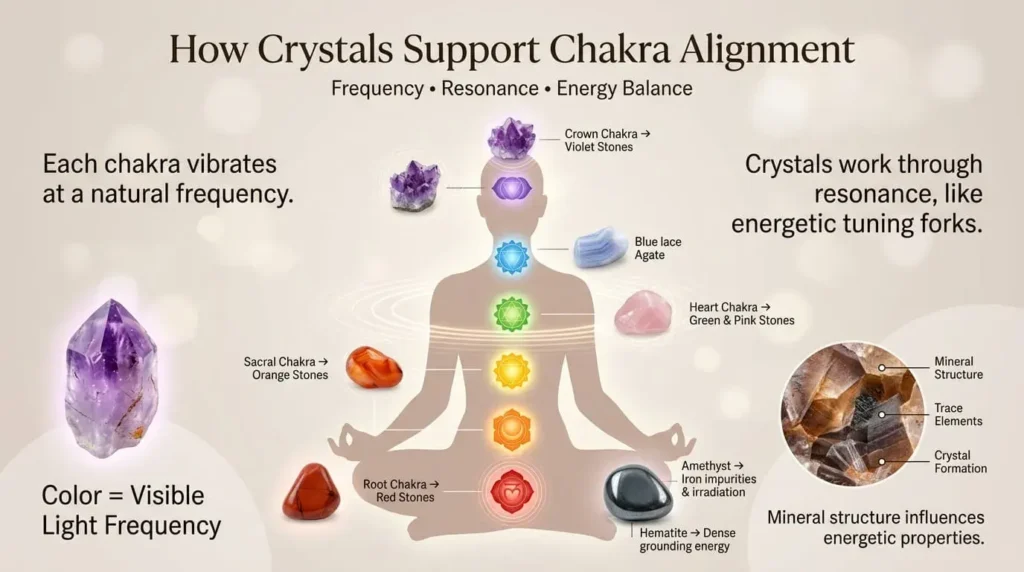
Here’s the layer most guides skip: a crystal’s geological makeup, including its mineral structure, trace elements, and formation conditions, also shapes its energetic output. Amethyst’s purple color comes from iron impurities and natural irradiation inside quartz. Hematite’s density (specific gravity 5.26, nearly twice as heavy as quartz) is part of why it grounds so effectively. The weight isn’t incidental to the experience; it is the experience. For readers who want to explore the full mineral profile behind any stone they’re working with, including hardness ratings, chemical composition, crystal system, and how to spot fakes, guide to the best root chakra crystals is a good starting point, especially if you’re building out your lower chakra collection first.
Root Chakra Crystals: Red & Black Stones for Grounding
Muladhara. Base of the spine. Governs stability, safety, physical security. When it’s open and balanced, you feel settled in your body and present in your life. When it’s blocked, anxiety runs without an off switch, the kind where you’re constantly bracing for something, even when nothing is wrong.
The Root Chakra responds best to heavy, dense, dark stones. Weight matters here. These aren’t delicate energy tools; they’re anchors.
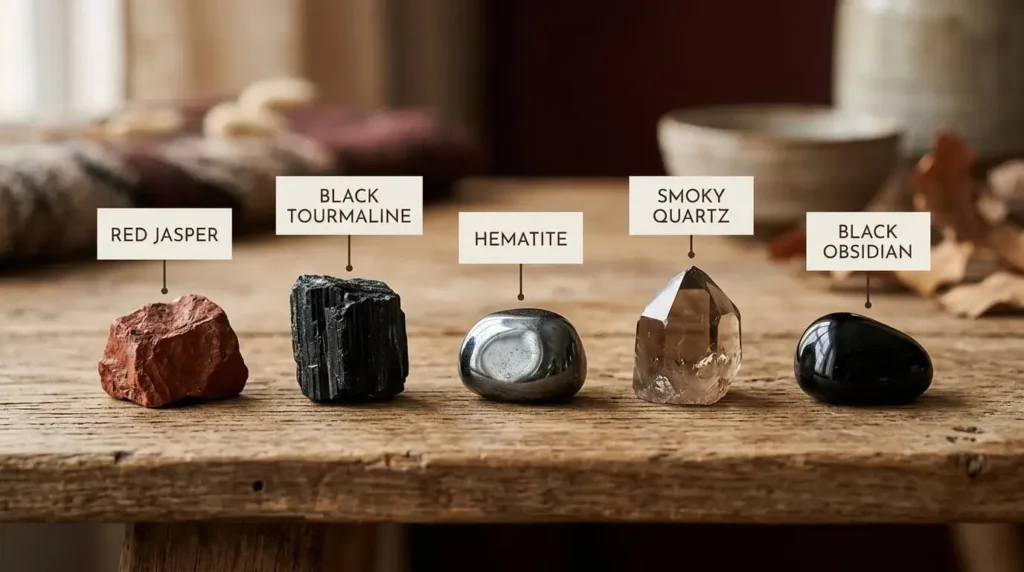
Red Jasper is the workhorse of Root Chakra work. Earthy red, opaque, composed of microcrystalline quartz with iron oxide. It’s essentially the earth’s own mineral. Energetically, it supplies steady, slow-release grounding energy rather than a jarring jolt. Hold it during meditation or place it at your feet. If you tend to feel unmoored or anxious, red jasper is a practical first choice.
Black Tourmaline is the stone for protection. Specifically electromagnetic protection: practitioners consistently report a reduction in energetic interference from screens, environments, and other people’s emotional states. Place it at the corners of a room, carry it daily, or keep it near your devices. It creates a perimeter.
Hematite is heavier than it looks. Specific gravity 5.26. That density isn’t a detail; it’s the whole mechanism. When you hold hematite, the unexpected weight forces your attention into your hand and into the present moment. It’s used as a return stone after high-vibration sessions: do your expanded energy work, then hold hematite to close the session and bring awareness back into the body. The sequence matters; use it last, not first.
Smoky Quartz transmutes. It doesn’t just absorb negative energy; it actively processes and neutralizes it. Brown-grey, ranges from nearly clear to almost black. Use it during breathwork by holding it in your hands, or place it between your feet during seated meditation. For intense clearing work, it can be buried in soil overnight and retrieved cleansed.
Black Obsidian is uncompromising. Volcanic glass formed at the edge of lava flows, with no crystal structure and a perfect conchoidal fracture. It’s used in cord-cutting practice (moving it slowly around the body to sever energetic attachments to people or situations that are draining you). It will not soften what needs to be seen. If you’re newer to Root Chakra work, start with red jasper or smoky quartz first.
Practical placement: Sit or lie down and place your chosen Root Chakra stone between your feet or at the base of your spine. Breathe deeply. Visualize a red light anchoring you through the base of your body down into the earth below. Five minutes of this, done consistently, is more effective than an elaborate one-time ritual.
Sacral Chakra Crystals: Orange Stones for Creativity & Emotion
Svadhisthana. Just below the navel. Governs creativity, pleasure, emotional fluency, and sensuality. A blocked Sacral Chakra shows up as creative paralysis, emotional numbness, or the inability to enjoy anything fully.
Orange stones are the signature here, and they’re among the most immediately accessible in crystal work.
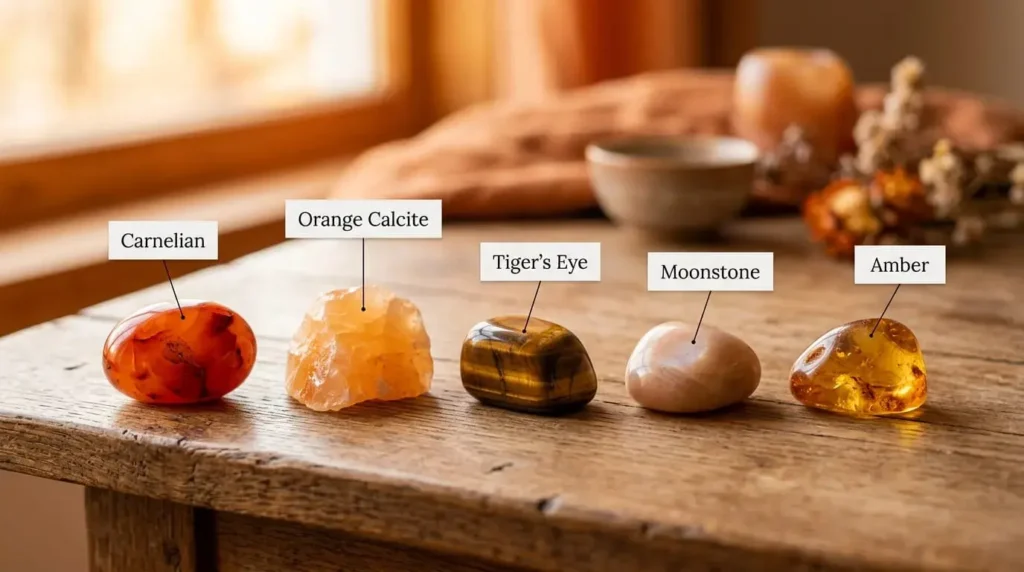
Carnelian is the action stone. Indian carnelian from the Gujarat mines, the good material, glows like it’s lit from the inside. Warm orange-red, waxy smooth. Energetically, it addresses the specific gap between knowing what you want to create and actually starting. Writers, artists, and entrepreneurs who have been planning for months without launching reach for carnelian before anything more elaborate. Keep it on your desk or carry it in your pocket; the proximity does the work more than any formal ritual. Pair it with creative intention-setting: hold it while journaling or before beginning a project you’ve been avoiding.
Orange Calcite amplifies emotional healing. Soft, bright orange, one of the gentler stones for Sacral work. Place it on the lower abdomen during meditation when emotional blocks feel stuck rather than turbulent.
Tiger’s Eye brings balance and motivation without the urgency of carnelian. Gold-brown with chatoyancy, that silky moving light across the surface. Carry it in your pocket or use it in a crystal grid when you need sustained focus rather than an initial push.
Moonstone regulates emotional cycles. Peach and cream with adularescence, the floating glow beneath the surface. Best used during moon rituals or at moments of emotional overwhelm; it supports cyclical emotional flow rather than forcing linear progress. Practitioners often start recommending moonstone to people whose practice feels like it’s doing nothing. It works slowly, sustainably, without fanfare.
Amber is technically not a crystal (it’s fossilized tree resin), but its energetic properties have been documented across cultures for millennia. Warm, golden, ancient. Hold it during creative visualization when you need warmth and optimism rather than activation.
Solar Plexus Chakra Crystals: Yellow Stones for Power & Confidence
Manipura. Upper abdomen. The seat of personal power, confidence, self-esteem, and will. When this chakra is blocked, the symptom is specific: you know what you want and can’t make yourself pursue it, or you deflect responsibility onto external circumstances rather than claiming your agency.
Yellow stones for yellow energy. The Solar Plexus doesn’t respond well to soft, gentle approaches. It wants directness.
Citrine is the first recommendation for most Solar Plexus work. Yellow to golden, one of the only crystals in the quartz family that doesn’t require regular cleansing (it doesn’t hold negative energy the way most stones do). Associated with abundance and personal power: keep it on your desk for sustained motivation, or carry it for daily confidence support. If there’s one Solar Plexus stone to start with, this is it.
Pyrite is for manifestation and sustained willpower. Metallic gold, heavy, cubic crystals. If you’ve ever held a natural pyrite cube, you understand immediately why it’s associated with abundance. The density and the visual richness of it communicate something pre-consciously. Place it on an abundance altar or on your workspace. Note: pyrite belongs where the work happens, not in rest spaces. It activates rather than calms.
Tiger’s Eye appears again at the Solar Plexus (it bridges Sacral and Solar Plexus energy effectively). Here, focus on its decision-making properties: hold it before important choices or in moments where self-doubt is competing with your judgment.
Yellow Jasper provides optimism and protective grounding energy without the intensity of pyrite. Wear it as a talisman during periods when you need steady confidence rather than peak activation.
Yellow Calcite is the gentlest option. Pale yellow, amplifying, good for confidence-building affirmation work. Use it when Solar Plexus energy feels depleted rather than blocked.
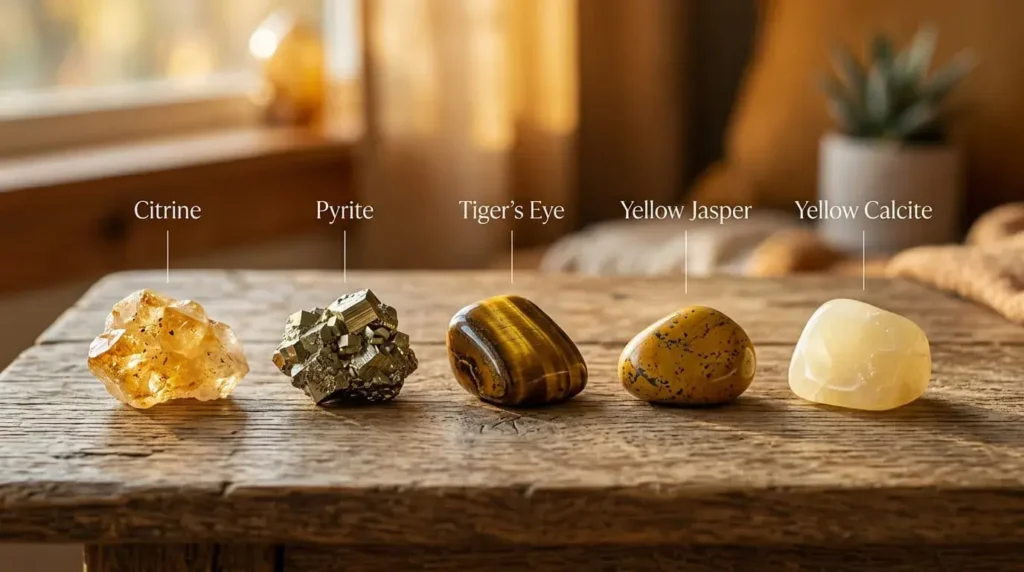
Practical placement: Place Citrine on your desk or altar in the space where you do your actual work. Its association with abundance means it reinforces intention every time you sit down. No separate ritual required.
Heart Chakra Crystals: Green & Pink Stones for Love & Healing
Anahata. Center of the chest. Love, compassion, emotional healing, self-worth. The Heart Chakra works with two color streams: green for healing, growth, and earthed love; pink for tenderness, self-compassion, and receiving.
Both matter. Most people are better at one than the other.
Rose Quartz radiates a hushed, maternal energy. Pink, translucent, microcrystalline. It doesn’t demand. It doesn’t push. It holds. After any period of emotional loss, grief, heartbreak, the slow drain of a difficult relationship, rose quartz is the first stone to reach for, not the most dramatic one. Sleep with it under your pillow, carry it in your left (receiving) pocket, or hold it during meditation. Long-term proximity is more effective than brief formal sessions with this stone.
Green Aventurine was the surprise in a grounding workshop for twenty-three people presenting as scattered and disconnected. Carnelian and tiger’s eye were on the table, the expected standbys. But everyone who picked up a piece of aventurine went quiet for a moment. Not theatrical quiet. The particular pause that happens when something moving too fast suddenly finds its pace. Aventurine provides heart opening and Earth-element grounding simultaneously, without requiring a second stone to manage the grounding separately. Wear it near the heart or carry it.
Jade attracts a specific type of client: people exhausted by intensity. Those who have tried high-vibration stones and want something that supports without demanding. Consistent pattern across a decade of practice: people who commit to jade for more than a few weeks report emotional reactivity quietly settling, stress responses becoming less hair-trigger. Use it as jewelry or carry it. Jade works best with sustained contact.
Rhodonite is for the harder emotional work: forgiveness, grief, the slow unpicking of emotional wounds. Pink with black manganese inclusions. Hold it during deliberate processing sessions rather than daily carry. It’s a specific tool, not an all-day stone.
Malachite is not a beginner’s Heart Chakra stone. Deep green, banded, occasionally toxic in raw form (always use tumbled, never make water elixirs). It surfaces what needs to surface, and it does not soften the process. The initial two weeks of working with malachite can be genuinely destabilizing: uncomfortable truths, confrontational dreams, old patterns suddenly visible and impossible to ignore. Short sessions (10–20 minutes), grounding stones within reach (black tourmaline in the other hand), and journaling immediately afterward. After three months, a different person in the ways that matter.
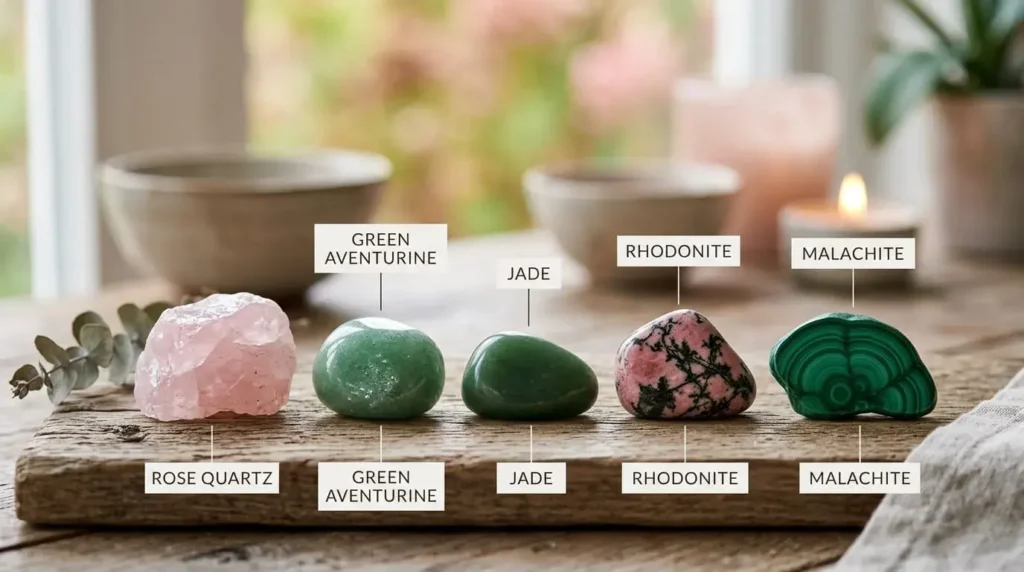
Practical placement: Create a Heart Chakra body layout by placing Rose Quartz on your chest and Green Aventurine at your sides during a 10-minute relaxation. Breathe slowly. Focus on receiving rather than sending.
Throat Chakra Crystals: Blue Stones for Communication & Truth
Vishuddha. At the throat. Communication, self-expression, the courage to say what is true. A blocked Throat Chakra doesn’t always look like silence. It can look like constant talking that never quite says the thing, or the ability to express everything except what actually matters.
Blue stones, blue energy. This is the chakra most sensitive to approach and to voice.
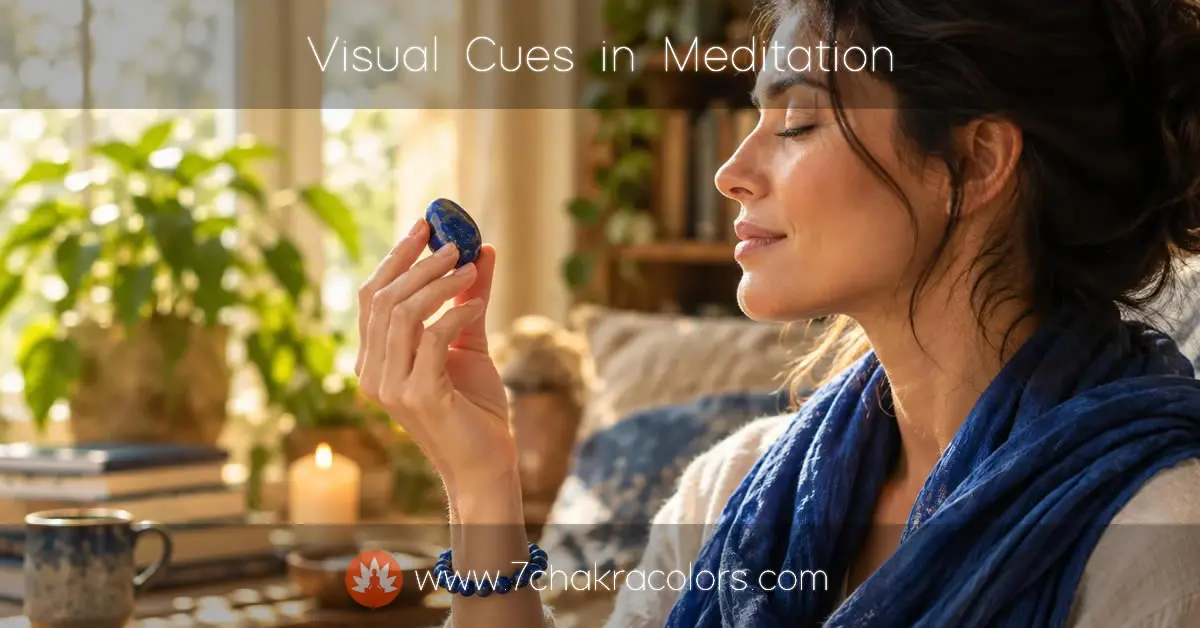
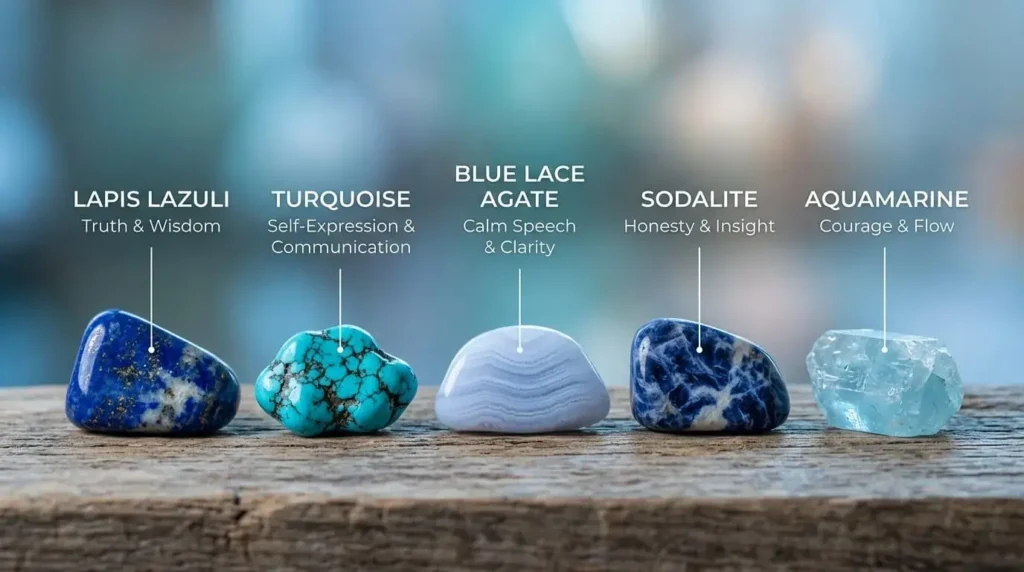
Lapis Lazuli has been used by every major civilization for five thousand years. Egyptian, Mesopotamian, Persian, Greek, Renaissance European: it spans them all. The deep saturated blue comes from lazurite content; the golden flecks are natural pyrite. High-quality specimens with minimal white calcite matrix are the most potent. Wear as a necklace near the throat, or position it within eyeline during writing sessions. The connection between lazurite proximity and clearer, more direct communication is consistent across practitioners.
Turquoise carries what can only be called ceremonial weight, the gravity that accumulates from millennia of being taken seriously by every culture that encountered it. Central Asian, Apache, Persian, Egyptian: independent civilizations consistently reached for turquoise as a protection stone for travelers and a communication stone for speakers. Wear it as a talisman. If you speak publicly, perform, or need to articulate under pressure, turquoise has a documented track record that predates written history.
Blue Lace Agate is for the nervous speaker. Pale blue, banded, one of the gentlest blue stones. If public speaking or difficult conversations trigger physical anxiety, tight throat, shallow breathing, the sensation of words getting stuck, carry Blue Lace Agate and hold it briefly before speaking. The calm it produces is quiet and practical. It won’t make you eloquent; it will help you hear your own voice clearly enough to be.
Sodalite bridges Throat and Third Eye. Blue-white, logical, grounding for the mental plane. Place it on your desk when clear thinking and clear communication need to run simultaneously.
Aquamarine is for closure and truth-telling. Natural aquamarine is far paler in person than photographs suggest. The deep Caribbean blue of most images is heavily saturated. What the real stone produces is subtler: a particular quality of calm that allows you to see what you’ve been doing without being afraid of what you see. Hold it before conversations where honesty matters most.
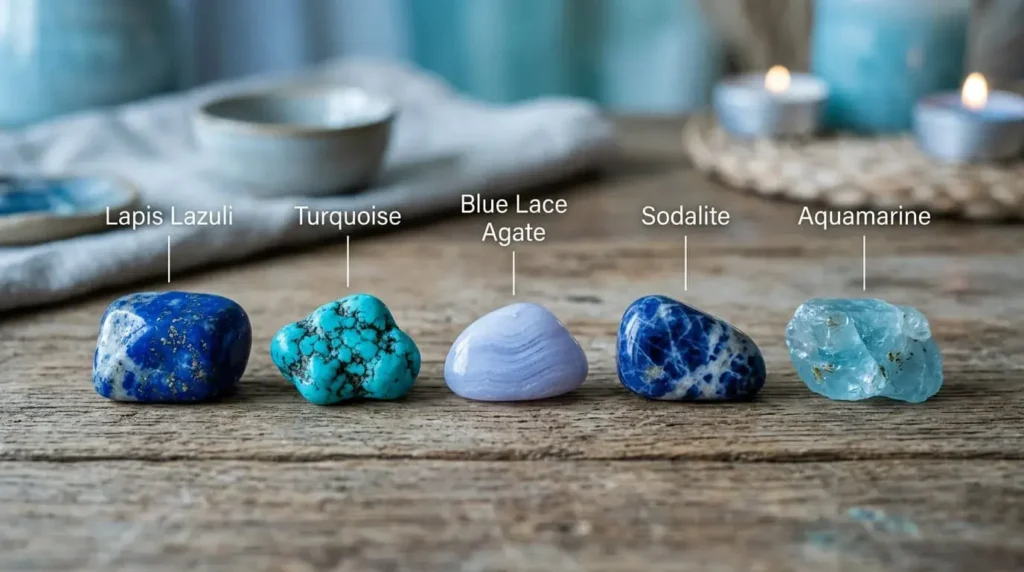
Practical tip: Before any conversation you’ve been dreading, hold your Throat Chakra stone of choice against the hollow of your throat for two minutes. State, aloud, the specific thing that needs to be said. Set it down. Have the conversation. Spoken intention activates Throat Chakra stones more directly than silent holding.
Third Eye Chakra Crystals: Indigo Stones for Intuition & Insight
Ajna. Between the eyebrows. Intuition, perception, inner vision, the ability to see clearly without distortion from ego or fear. The Third Eye doesn’t malfunction the way most chakras do. It doesn’t close exactly; it gets crowded. Mental noise, overthinking, the constant loop of analysis: these obscure the signal rather than blocking it outright.
Indigo and purple stones. Many of the most powerful are cold to the touch and heavier than they appear.
Amethyst is one of the most studied crystals in practice, and for good reason. Technically a variety of quartz colored by iron impurities and natural irradiation, the purple can range from pale lilac to deep violet depending on iron concentration and the specific irradiation conditions during formation. Energetically, it shuts down mental chatter. If you’re the type who stares at the ceiling at 2 AM replaying everything, amethyst belongs on your nightstand. For Third Eye work specifically: place it on your forehead during meditation, or keep a sphere within eyeline during deep focus sessions. The amethyst sphere and the fluorite octahedron serve different functions. Amethyst calms the nervous system; fluorite organizes the thinking. Wrong stone for the wrong problem produces no effect. If you’re wound up, reach for amethyst. If you can’t think straight, reach for fluorite.
Labradorite is a transformer. Iridescent, with a blue and gold flash that comes from light interference between structural layers (labradorescence). Energetically, it’s a psychic shield and a transition stone. Used during grief work, major life changes, and periods of sustained uncertainty. Handle with care: labradorite cleaves perfectly along its planes and will do so against a doorframe or tile floor with zero warning.
Fluorite organizes disordered thinking. Purple, green, or both in the same specimen. Cold to the touch, genuinely cold, and heavier than expected, glassy. The mechanism practitioners describe: not calming, restructuring. When scattered information needs to be processed into coherent output, when the problem is scatter rather than anxiety, fluorite is the correct tool. It absorbs rather than deflects, which means it requires more frequent cleansing than most desk stones: monthly minimum.
Sodalite brings rational clarity to intuitive work. Use it when you need inner vision that’s grounded rather than untethered, in complex decisions where both logic and gut need to contribute.
Practical tip: If the problem is anxiety, use amethyst. If the problem is mental scatter or decision paralysis, use fluorite. These address different mechanisms. Treating them as interchangeable reduces effectiveness. Keep both and reach for the right one.
Crown Chakra Crystals: Violet & White Stones for Spiritual Connection
Sahasrara. Top of the head. Higher consciousness, connection to something larger than the self, spiritual clarity. The Crown Chakra isn’t about detachment from the physical. It’s about experiencing the full range of consciousness without losing your grounding. The higher you go, the more important it is that your Root Chakra is solid.
Violet and white stones. The highest vibrational crystals in the standard practitioner toolkit.
Clear Quartz is called the master healer for a specific reason: it amplifies the energy of every stone it’s placed near and responds directly to intention. Colorless, piezoelectric (generates an electric charge under pressure, a documented physical property, not a metaphor). Use it to amplify other stones in a grid, or hold it during meditation to clarify and strengthen specific intentions. Clear Quartz at the Crown during a full-body layout ties the entire energetic field together.
Amethyst appears here again. It bridges Third Eye and Crown, serving both. At the Crown specifically, use it for divine connection and spiritual awareness rather than the mental-calming function it serves at the Third Eye.
Selenite is self-cleansing and purifying. White, translucent, formed from gypsum, with a Mohs hardness of 2, meaning it’s extremely soft. This matters enormously: never cleanse selenite in water. It will dissolve. A selenite tower left out in rain will show visible surface loss within 20 minutes. Store it away from humidity and all liquids. Its energetic function is purification and clarity; it clears space and other stones. Keep it by your bed to maintain a clean energetic environment during sleep.
Apophyllite is a high-vibration stone for advanced meditation practice. Water-clear pyramidal crystals, vitreous faces, basal cleavage planes with a distinctive pearly lustre. Unlike most crystals, apophyllite doesn’t produce an independent effect. It transmits what’s already present with greater clarity. The practitioner who arrives genuinely receptive finds it extraordinarily productive. The practitioner who arrives with a fixed agenda tends to find it frustratingly subtle. That’s the stone working as designed. Keep it in your meditation space, not your workspace.
Lepidolite contains natural lithium, the same element used in psychiatric mood stabilizers, which is not a coincidence practitioners ignore. Lilac, flaky or massive, soft (Mohs 2.5–3). Use it during sleep for calming energy, or during periods of transition and spiritual uncertainty. It doesn’t activate; it settles.
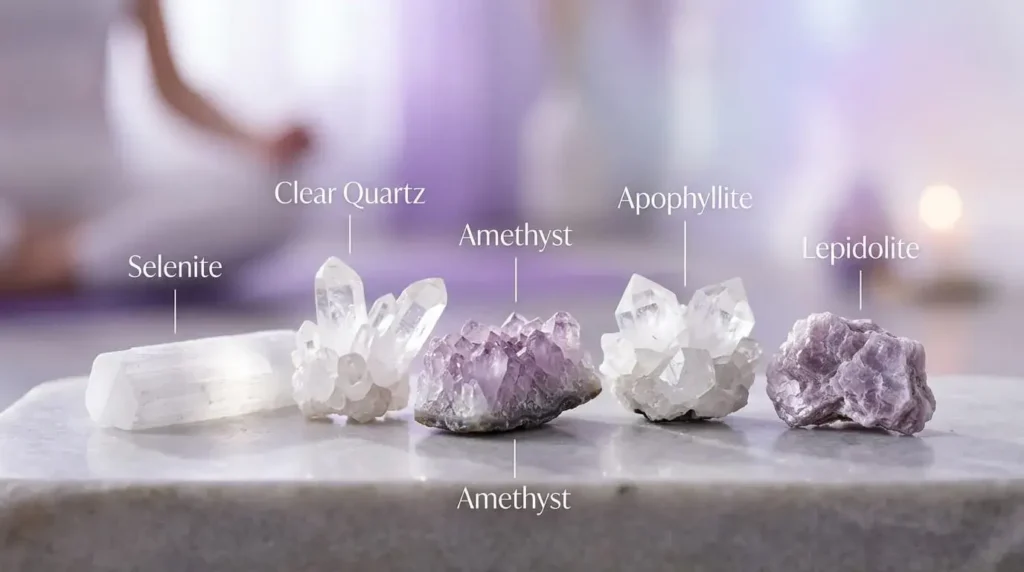
Practical tip: Clear Quartz is the ideal Crown Chakra starting stone because it amplifies intention without imposing a fixed energetic direction. Program it with a specific spiritual intention and use it consistently before introducing higher-vibration stones like apophyllite.
Chakra Stones Quick Reference Table
| Chakra Name | Primary Stones | Key Properties |
|---|---|---|
| Root Chakra (Muladhara) | Red Jasper, Black Tourmaline, Hematite, Smoky Quartz, Black Obsidian | Grounding, stability, security, protection, emotional neutralization |
| Sacral Chakra (Svadhisthana) | Carnelian, Orange Calcite, Tiger’s Eye, Moonstone, Amber | Creativity, emotional healing, pleasure, cyclical flow, warmth |
| Solar Plexus Chakra (Manipura) | Citrine, Pyrite, Tiger’s Eye, Yellow Jasper, Yellow Calcite | Personal power, confidence, manifestation, abundance, willpower |
| Heart Chakra (Anahata) | Rose Quartz, Green Aventurine, Jade, Rhodonite, Malachite | Love, compassion, healing, self-worth, forgiveness, emotional depth |
| Throat Chakra (Vishuddha) | Lapis Lazuli, Turquoise, Blue Lace Agate, Sodalite, Aquamarine | Communication, truth-telling, self-expression, clarity, courage |
| Third Eye Chakra (Ajna) | Amethyst, Labradorite, Fluorite, Sodalite | Intuition, clarity, mental organization, insight, psychic protection |
| Crown Chakra (Sahasrara) | Clear Quartz, Amethyst, Selenite, Apophyllite, Lepidolite | Spiritual connection, higher consciousness, purification, amplification |
How to Use Chakra Crystals: Five Practical Techniques
1. Crystal Body Layouts
Lie down and place stones on each chakra point simultaneously for a full-body balancing session. Start at the Root and work upward: red or black stone at the base of the spine or between the feet, orange at the sacral, yellow at the solar plexus, pink or green at the chest, blue at the throat, purple or indigo at the forehead, clear or violet at the crown. Rest for 15–20 minutes. This is the most direct way to work with the entire chakra system at once.
2. Meditation with Crystals
Hold a single stone or place it nearby. Set a specific intention related to the chakra you’re working on, spoken aloud rather than silent, especially for Throat and Sacral Chakra stones. Five minutes of focused breathing with clear intention beats twenty minutes of unfocused holding every time.
3. Crystal Grids
Arrange multiple stones in a geometric pattern to amplify chakra healing energy for a specific intention. A reliable grid for mental clarity and focus: fluorite at the center, clear quartz at the cardinal points to amplify, amethyst for depth, black tourmaline at the corners for grounded protection. Activate by connecting each stone with a clear quartz point or your fingertip.
4. Wearing Crystal Jewelry
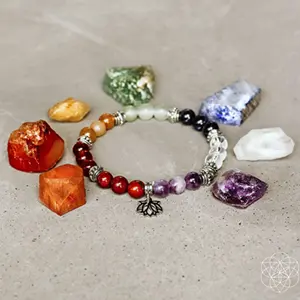
Placement matters. Necklaces are most effective for Throat, Heart, and Crown Chakras; the stone sits in proximity to the energy center throughout the day. Bracelets target Sacral and Solar Plexus. Anklets or stones carried in pockets work best for Root Chakra support. The sustained proximity of jewelry does cumulative work that formal sessions can’t fully replicate.
5. Crystal Elixirs
Water infused with crystal energy works for some practitioners and some stones. The critical rule: not all crystals are safe for direct water contact. Selenite dissolves. Malachite contains copper, which is toxic in water. Any stone with a Mohs hardness below 5 risks surface dissolution. Any stone with metallic inclusions should be avoided for water elixirs entirely. Use the indirect method (stone placed near but not in the water, or contained in a sealed glass vial submerged in the water) when in doubt.
Choosing, Cleansing, and Charging Your Chakra Crystals
How to Choose
Trust resonance first. If you’re drawn to a stone without knowing exactly why, that attraction is meaningful information. Then cross-reference: which chakra are you working on, and which stones align with both the color and the energetic property you need?
For beginners who feel overwhelmed by options: start with one chakra that feels most out of balance (take a chakra assessment quiz if you’re unsure), choose one corresponding stone, and work with it daily for two to four weeks before adding anything else. Depth with one stone beats breadth with ten.
Cleansing Methods
Every crystal absorbs energy, from you, from the environment, from previous owners if you’ve bought secondhand. Cleansing resets the stone to its baseline state.
Running water works for hard stones (quartz, jasper, agate, tiger’s eye, anything above Mohs 6). Hold the stone under cool water for 30–60 seconds and visualize the absorbed energy dissolving. Never use this method for selenite, kyanite, malachite, fluorite, or any stone below Mohs 5.
Smudging with sage or palo santo works for all stones without exception. Pass the stone through the smoke while setting the intention to clear.
Moonlight cleansing is the safest universal method. Place stones on a windowsill or outside under a full moon overnight. No risk of fading, dissolving, or water damage.
Sound cleansing via singing bowls or tuning forks works through vibration. Place stones near the bowl (not inside it) and allow the resonance to pass through the crystal.
Soil burial is particularly aligned for Root Chakra stones. Burying a stone in garden soil for 24–72 hours returns it to the earth energy it works with.
Charging Methods
Sunlight works for earth-toned and dark stones (black tourmaline, red jasper, smoky quartz, carnelian). Limit to 1–2 hours; many stones, particularly amethyst, fluorite, rose quartz, and citrine, fade permanently with prolonged UV exposure.
Moonlight is the safest universal charging method. Use it for light-colored, soft, or fade-sensitive stones.
Intention-setting while holding the stone works with any method, or alone. State the stone’s purpose clearly before placing it back in use.
A Critical Note on Water Safety
Before any water-based cleansing or crystal elixir preparation, verify the Mohs hardness and chemical composition of your specific crystal. The general rule: below Mohs 5, avoid water contact. But hardness is only part of the picture. Soluble minerals (halite, selenite), copper-bearing stones (malachite, chrysocolla, azurite), and stones with metallic inclusions all have water safety issues that hardness alone doesn’t capture. For accurate hardness ratings, chemical compositions, and formation data on any crystal in your collection, consult a detailed mineral database before using water-based methods.
Bringing It Together
Working with chakra crystals is a practice. Not a purchase. Not a one-time placement. The stones in your collection become useful over time, as you develop a feel for what each one does and when you actually need it.
Start simple: identify the one chakra that feels most out of balance right now. Choose one stone from the corresponding section above. Work with it, carry it, meditate with it, sleep near it, for two to four weeks before expanding your collection.
Take the Chakra Test if you want a structured starting point for identifying where to focus first. The Chakra Stones eBook covers 42+ crystals across all seven chakras for deeper reference.
The crystals do their work in the background of a life you’re still living. Consistent proximity and clear intention will always outperform elaborate protocol.
Frequently Asked Questions About Chakra Crystals
Which crystal should I choose if I’m completely new to chakra work?
Start with one chakra that feels most out of balance. If you’re uncertain, the Root Chakra (grounding, stability) or Heart Chakra (emotional healing) are usually the best entry points. For Root, choose Red Jasper. For Heart, choose Rose Quartz. Work with a single stone daily for 2-4 weeks before adding anything else. Depth with one stone beats breadth with ten.
Do I need to cleanse and charge my crystals before using them?
Yes, ideally. Crystals absorb energy from previous owners, transport, and storage environments. The safest universal method is moonlight cleansing: place stones on a windowsill overnight under a full moon. For charging, intention-setting while holding the stone works with any method. If you’re in a rush, spoken intention alone is enough to begin working with a stone.
Can I use water to cleanse all crystals?
No. Running water works only for hard stones above Mohs 6 (quartz, jasper, agate, tiger’s eye). Never use water for selenite, kyanite, malachite, fluorite, or stones below Mohs 5—they will dissolve or lose their surface. Moonlight cleansing is the safest universal method that works for all crystals without exception.
How do I know if a crystal is really working?
Changes are often subtle at first. You might notice a shift in how you respond to situations—pausing before reacting, remembering to breathe, feeling less anxious. Most people start noticing small shifts within 1-2 weeks of consistent daily contact. Bigger shifts in mood, focus, and emotional steadiness usually build over a month or more. Keep a journal to track what you notice.
What’s the difference between amethyst and fluorite for the Third Eye Chakra?
They address different problems. Amethyst calms the nervous system and shuts down mental chatter—use it if your problem is anxiety or racing thoughts. Fluorite organizes disordered thinking and restructures scattered information—use it if your problem is mental scatter or decision paralysis. Having both and reaching for the right one based on what you actually need is more effective than treating them as interchangeable.
Can I wear multiple chakra stones at the same time?
Yes. Stones that support different chakras don’t compete with each other. Common combinations include amethyst (Crown/Third Eye) with rose quartz (Heart), or carnelian (Sacral) with citrine (Solar Plexus). Placement matters: necklaces work best for Throat, Heart, and Crown; bracelets for Sacral and Solar Plexus; anklets or pocket stones for Root. The key is sustained proximity throughout the day.
Are crystals safe to use alongside therapy or medication?
Yes. Crystals are a supportive practice, not a treatment. They work best as a complement to professional mental health care—therapy, medication when appropriate, and the support of qualified clinicians. Crystals help you build a daily practice for slowing down and checking in with yourself, but they cannot replace professional treatment for anxiety disorders, depression, trauma, or other mental health conditions.
How often should I meditate or work with my crystals?
Consistency matters more than duration. Five minutes with a crystal every single day produces stronger results than an elaborate hour-long session once a week. Wearing crystals as jewelry provides cumulative work throughout the day. For formal meditation, 5-20 minutes with clear intention is sufficient. The goal is regular contact and consistent proximity, not elaborate ritual.
What should I do if a crystal feels heavy or uncomfortable?
Some stones bring up intense emotions or uncomfortable truths—this is actually the stone working as designed. Malachite and labradorite are known for this. If a stone feels consistently heavy or produces no response after 2-4 weeks, try cleansing it (moonlight is safest) and resuming work, or switch to a different stone from the same chakra. Trust your intuition. If something doesn’t feel right, move on.
Is there a best time of day to use chakra crystals?
The best time is when you’ll actually do it consistently. Root and grounding stones work well in the morning to set your baseline. Heart and emotional healing stones work well before bed or during moments of overwhelm. Throat Chakra stones activate best before important conversations. The most important factor is daily consistency, not the specific time of day.
*The article was crafted with the assistance of Jonathon Thompson, a crystal healing practitioner since 2013. He holds an Advanced Crystal Healing Certification and has worked with clients on energetic protection, manifestation, and boundary setting from his practice in Boulder, Colorado. He is the lead researcher and author at CrystalDatabase.com.
Blog Categories:
About the Author: