
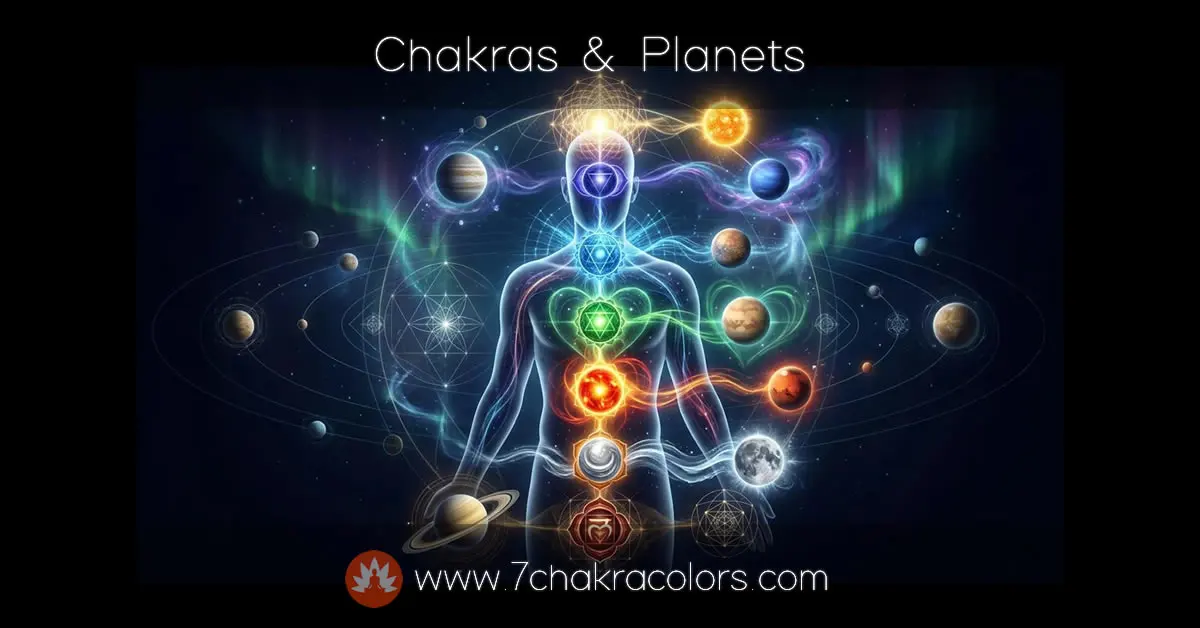
How Planetary Energy Maps onto the 7 Chakras
Pair each of the 7 chakras with a planetary theme – Saturn to Root, Sun to Crown – and use a simple weekly check-in to notice what needs attention.
Table Of Contents
Some weeks you feel scattered and there’s no clean story for why. Sleep is fine. Work is busy, sure, but not unusually so. Nothing is obviously wrong. Still, the body keeps sending small signals – a tight belly before a meeting, a flat mood after an hour of small talk, that restless urge to reorganize a drawer when what you’re actually avoiding is a conversation.
Chakras give those signals a body-centered map. Astrology gives them a sky-centered one, with themes like structure, desire, communication, and imagination. Put the two together and you get a way to name what’s loud right now – without turning either system into a rigid personality label.
What follows are prompts. Not universal rules. Keep whatever helps you notice something. Leave the rest.
One more thing before we start. You don’t need a birth chart, an app, or any working knowledge of astrology to use this. The planets here are being used as shorthand for familiar human themes – the same way you might say someone has a lot of nervous energy without meaning anything technical by it. If you already read charts, great, the layers will stack. If you don’t, nothing below stops making sense.
Saturn and the Root Chakra: Structure and Safety
The Root Chakra handles grounding, belonging, and that basic trust that life can hold you. Saturn speaks to structure, responsibility, limits, the slow work of building something that lasts. Together they ask a pretty practical question: what actually helps you feel steady enough to stand in your own life?
This pairing shows up in ordinary places. Paying a bill on time. Setting a bedtime instead of scrolling past it. Declining one extra commitment so you can catch up on the ones you already have.

Saturn at the Root isn’t about punishment. It’s about reliable support – a budget that reduces panic, a boundary that protects sleep, a morning routine that cuts the chaos before it starts. If you feel unrooted, start with one concrete foundation. Not a full life reboot. Just one thing that holds.
Moon and the Sacral Chakra: Feeling and Rhythm
The Sacral Chakra holds emotion, pleasure, creativity, movement. The Moon mirrors changing feelings, instinctive needs, natural cycles. Their shared language is fluid, which means an inner state can shift without becoming fake or untrustworthy.
That’s worth sitting with for a second. A mood that changes isn’t a mood that lied to you.
So instead of forcing a feeling to stay useful, notice its shape. Do you need rest, play, solitude, or a bit of creative mess? A Moon and Sacral check-in might look like cooking something fragrant, dancing for exactly one song, or journaling without going back to edit a single line. You’re after honest contact with what the body already knows. Not mood control.
Mars and the Solar Plexus Chakra: Drive and Assertion
The Solar Plexus Chakra connects to confidence, choice, and personal power. Mars brings heat, courage, the will to act. Together they show how you use force – directly, defensively, impulsively, or with clean focus.

If your energy feels scattered, pick one task that deserves a full push and give it that. If it feels overly sharp instead, pause before you send the blunt message or pick another fight. Ask what frustration is sitting underneath the heat. Usually there’s something.
Healthy Mars and Solar Plexus energy can say no clearly. It can ask for what’s needed. And it can move without steamrolling everyone standing nearby.
Venus and the Heart Chakra: Bond and Value
The Heart Chakra holds love, compassion, grief, connection. Venus adds attraction, reciprocity, beauty, and the whole business of giving and receiving care. Together they ask not just whom you love, but what kind of relating keeps your heart open and respected at the same time.
Because softness isn’t endless availability. Those aren’t the same thing.

Venus at the Heart can mean receiving a compliment without shrinking away from it. Answering a text with real warmth instead of the efficient version. Making your space a little more beautiful because beauty genuinely feeds you. It can also mean catching the places where you over-give to stay liked. Mutual care is the test – not how much you gave.
Mercury and the Throat Chakra: Words and Listening
The Throat Chakra covers expression, truth, clear communication. Mercury represents language, questions, learning, the exchange of information. Where they meet is conversation, and conversation runs both directions – speaking and listening both count.
Ask whether your words match what you actually feel. Then ask whether you left enough room for someone else’s meaning to land. That second one gets skipped a lot.
If you want a broader vocabulary for these symbolic qualities, this overview of planets in astrology can serve as a gentle reference rather than a set of predictions.
Neptune and the Third Eye Chakra: Imagination and Clarity
The Third Eye Chakra is tied to perception, insight, pattern recognition. Neptune brings dreams, sensitivity, mystery, and boundaries that go a bit porous. The mix can be inspiring and foggy at the same time – which is exactly the tricky part. Not every vivid impression is a clear message.
Let intuition speak. Then give it time. Write down the dream, the image, the sudden feeling, and sit with it before you act on it.

Neptune at the Third Eye invites wonder with discernment. Insight on one side, wishful thinking and mental haze on the other. Clarity usually shows up after you’ve slowed down enough to tell the two apart.
Sun and the Crown Chakra: Vitality and Meaning
The Crown Chakra points toward meaning, spiritual connection, a sense of belonging to something larger than your calendar. The Sun symbolizes vitality, presence, the central light that priorities gather around. Paired up, they ask what helps you feel awake and coherent – not just busy.
You don’t need a finished purpose statement for this. Nobody has one of those anyway.
Just notice which activities leave you more sincere and connected. A walk without headphones. A quiet sit. Honest creative work. Time with people who don’t require a performance from you. Sun and Crown energy is meaning lived through attention, not a costume of constant enlightenment.
A Simple Weekly Planet and Chakra Check-In
Ten quiet minutes, once a week. A notebook helps if you want to see patterns build over time. Move through it gently:
- Arrive. Take a few comfortable breaths and notice your body without trying to fix anything you find.
- Scan. Move your attention from Root to Crown. At each center, note one word – steady, tender, restless, quiet, open, unclear.
- Choose. Pick the chakra asking for the most honest attention. Pair it with the planet above and write the shared theme in one line.
- Ask. Form one useful question. Something like “where would a boundary create more safety?” or “what truth am I ready to say clearly?”
- Act. Choose one small response for the week. Concrete, kind, realistic.
Come back to your notes next week. Don’t grade yourself on them. You’re looking for patterns and offering yourself some care – not chasing a flawless score.
| Planet | Chakra | Shared Theme | What It Looks Like In Practice |
|---|---|---|---|
| Saturn | Root | Structure and safety | Setting a bedtime, keeping a budget, declining one extra commitment |
| Moon | Sacral | Feeling and rhythm | Journaling without editing, cooking something fragrant, dancing for one song |
| Mars | Solar Plexus | Drive and assertion | Giving one task a full push, or pausing before the blunt message |
| Venus | Heart | Bond and value | Receiving a compliment without shrinking, noticing where you over-give |
| Mercury | Throat | Words and listening | Checking that words match feeling, leaving room for someone else’s meaning |
| Neptune | Third Eye | Imagination and clarity | Writing down a dream or impression and sitting with it before acting |
| Sun | Crown | Vitality and meaning | A walk without headphones, quiet sitting, time with people who need no performance |
Keep the Map Flexible
Symbolic systems help most when they sharpen your attention instead of replacing your judgment. A pairing might feel useful one week and land as nothing much the next. That’s fine. Adjust the language, keep whatever supports reflection, and let the rest go quiet for a while.
Chakras bring awareness into the body. Planetary themes widen the frame around it. Used with curiosity, they give you a workable way to explore safety, feeling, action, love, communication, insight, and meaning.
The aim was never prediction. It’s meeting the energy that’s already here with a little more clarity – and a little more choice.
Frequently Asked Questions About Planetary Energy and the Chakras
Do I need to know astrology to use these pairings?
No. The planets here work as shorthand for familiar human themes – structure, feeling, drive, love, language, imagination, meaning. You don’t need a birth chart or an app to make use of that. If you already read charts, the layers will stack nicely and you’ll spot extra connections. If you’ve never looked at one, nothing in the pairings stops making sense. Start with the theme, not the astrology.
Are these planet and chakra pairings official or traditional?
They’re a working framework, not a fixed system. Different traditions pair planets and energy centers in different ways, and some don’t pair them at all. The version here groups them by shared theme rather than by any single lineage. Treat it as a lens for reflection. If a pairing helps you notice something honest about your week, it’s doing its job. If it doesn’t, swap it or drop it.
How do I know which chakra needs attention right now?
Usually the body flags it before the mind does. A tight belly before conversations points toward the solar plexus. A flat, guarded feeling after social time points toward the heart. Restlessness with no obvious cause often sits at the root. Run the scan from root to crown and note one word at each center – steady, tender, restless, quiet, open, unclear. Whichever word feels most true is your starting point.
What if more than one chakra feels off at the same time?
That’s normal, and it’s usually a sign they’re connected rather than a sign you have four problems. Root and solar plexus often go together, since it’s hard to act with confidence when you don’t feel steady underneath. Heart and throat overlap too. Pick the one asking for the most honest attention and work there. The others tend to loosen on their own once the loudest one gets addressed.
How often should I do the weekly check-in?
Once a week is enough, and ten minutes is enough time. Doing it daily tends to turn into monitoring, which is its own kind of anxiety. A weekly rhythm gives your notes room to show a pattern rather than a mood. Pick a consistent slot – Sunday evening, Monday morning, whenever your week has a natural seam – and use a notebook if you want to look back and see what’s been repeating.
Can a chakra and planet pairing become a personality label?
It can, and that’s the main thing to watch for. The moment “my solar plexus is weak” becomes an identity, the framework has stopped helping and started explaining you to yourself in a way that’s hard to move out of. These pairings describe what’s loud this week, not who you are. A theme that dominates one month may be quiet the next. Keep the language provisional and the map stays useful.
Is this a substitute for therapy or medical care?
No. Reflective practices like this one are for noticing patterns and choosing small responses – they aren’t treatment. Persistent anxiety, low mood, sleep problems, or physical symptoms deserve professional care from a qualified clinician. What a check-in can do is help you describe what you’re experiencing more clearly, which is genuinely useful to bring into that care. Use it alongside professional support, not in place of it.
Blog Categories:
About the Author: