
Pairing Crystal Bowl Notes With the Seven Chakra Colors
Learn how crystal bowl notes pair with the seven chakra colors, how to read a bowl’s note and cents code, and how to choose, play and care for a bowl.
Table Of Contents
Chakra charts almost all agree on the colors. Red sits down by the tailbone, violet ends up on top of the head, and the rest fall in rainbow order in between. Sound healers like to add a musical note on top of that, which is how a heart session ends up with an F crystal singing bowl on the mat and a throat session with a G. You’d think pairing crystal bowl notes with chakra colors goes back centuries. It doesn’t, really.
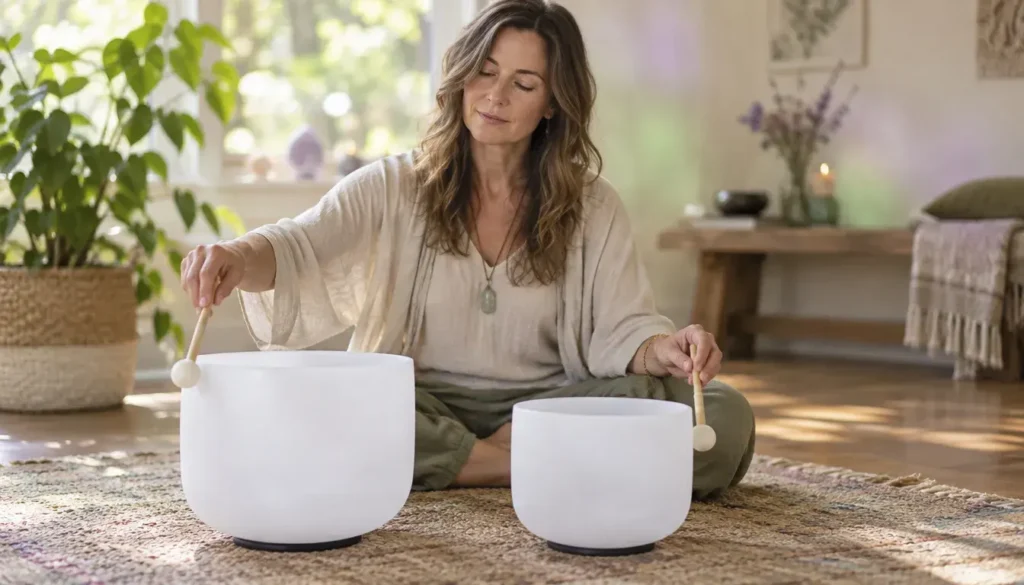
Shops that serve this practice now sort bowls the same way. Sacred Sound of the Soul keeps a chakra collection of Crystal Tones® alchemy crystal singing bowls, which the store says all match one of the chakra system areas. Worth the money? Depends how often you’ll actually play. (This is about a spiritual practice, by the way, not health care.)
Where Does the Note and Color Pairing Come From?
If you open the old Indian yoga and tantra texts hoping for a color chart, you’ll be disappointed. Each chakra is drawn there as a lotus with a set number of petals, a little god or goddess sitting in the middle and one syllable written inside. The rainbow version came along much later, out of the West, and it’s stuck so well that most people assume it was always there.
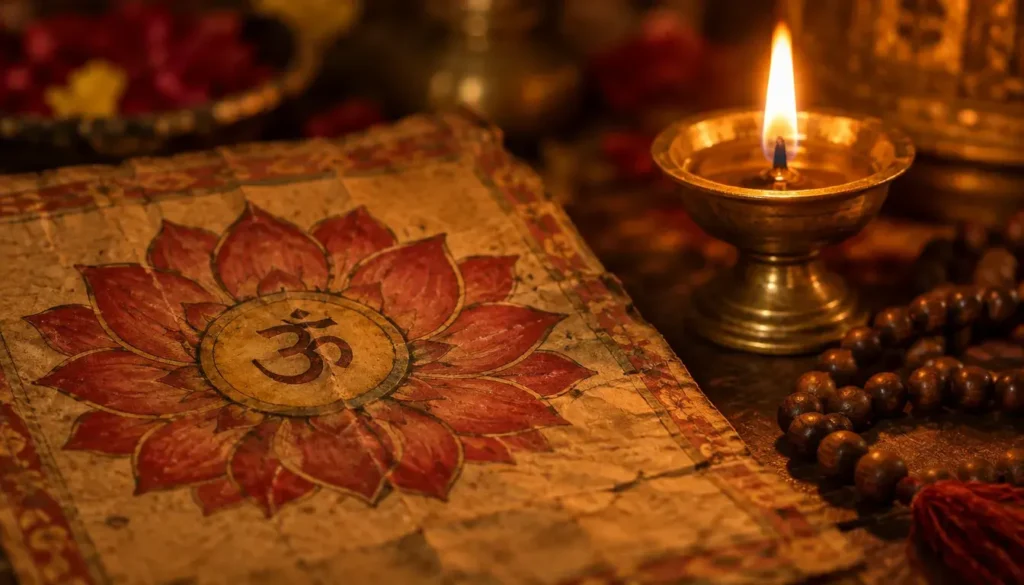
So how did sound come into it back then? Through chanting, mostly, not instruments. That syllable in the middle of each lotus is the seed syllable (people call it a bija), and you’d say it out loud: LAM for the root, then VAM, RAM, YAM and HAM as you go up, and OM once you get to the third eye. Some lineages give the crown OM again and others leave it in silence, which I rather like. People chanted those. Musical notes turned up much later, when sound teachers laid the seven natural notes of the Western scale over the seven colors. I’d call the result a handy convention rather than tradition, and that’s roughly how serious practitioners treat it.
Newton is part of this too, oddly. He’s said to have settled on seven rainbow colors, squeezing in orange and indigo, partly because a scale has seven notes. So color and music were tangled up for centuries before chakra charts got hold of them.
Which Crystal Bowl Note Matches Each Chakra Color?
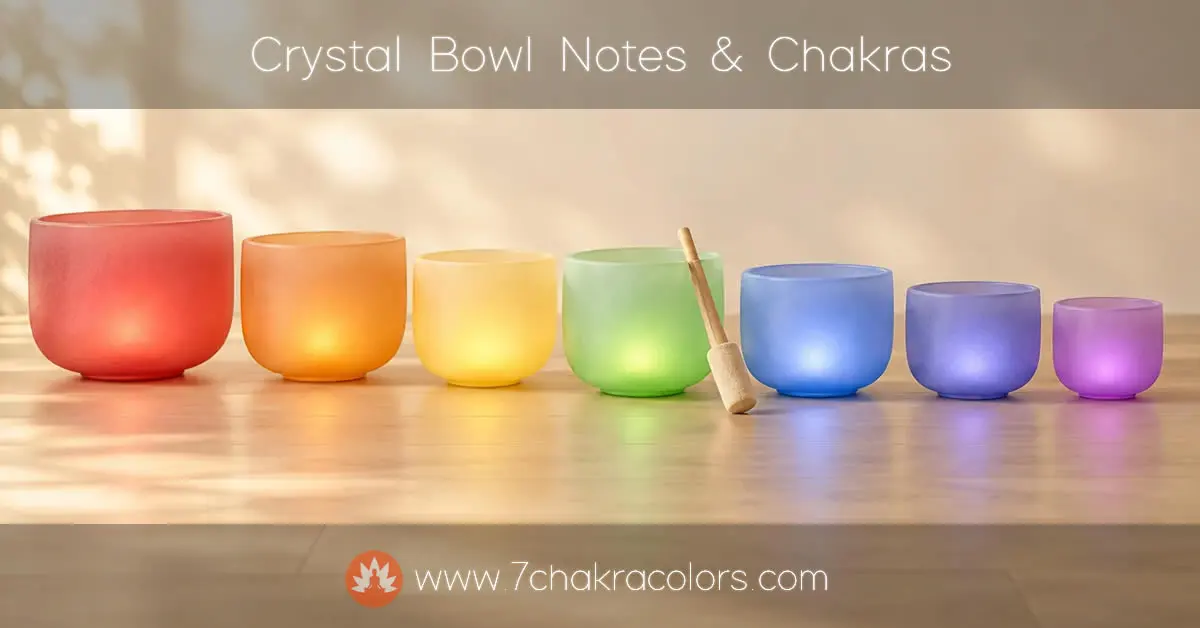
Most bowl sellers and teachers use the C major scale for this. Start on C at the root, climb one note per center, and you land on B at the crown.
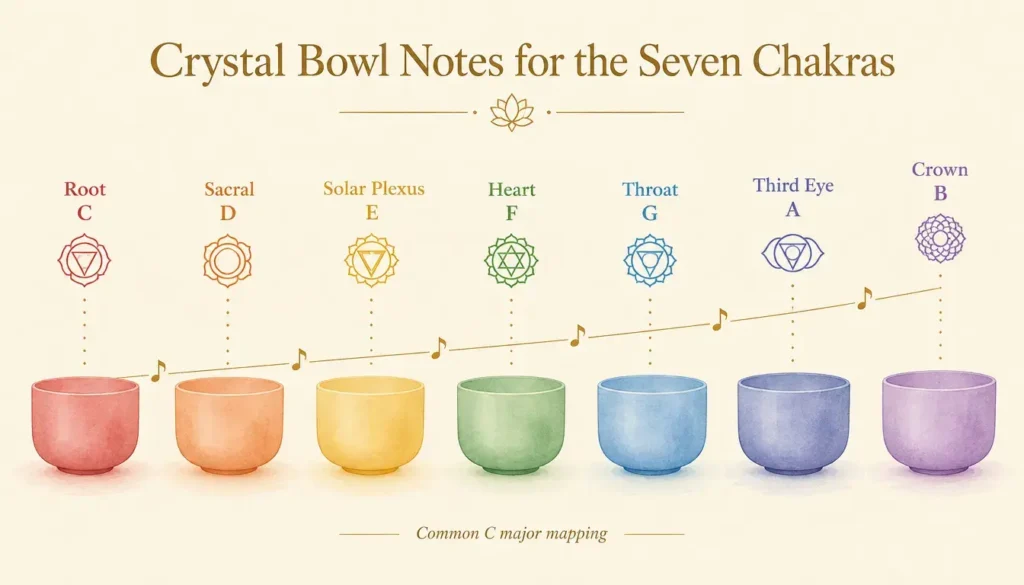
- Root, red: C
- Sacral, orange: D
- Solar plexus, yellow: E
- Heart, green: F
- Throat, blue: G
- Third eye, indigo: A
- Crown, violet: B
In hertz, a fourth-octave C is about 262 and the B at the top about 494. The A in between is the 440 Hz that orchestras tune to. Lower center, lower note. The scheme does at least have that going for it.
Some teachers use other schemes. A few start the scale on a different note, and others assign notes by personal feel. If you follow a particular teacher, use their map. Whichever map you end up with, the colors don’t move, so a chakra crystals guide will still line up with your bowls.
Would I stick to C major religiously? No. If a bowl in some other note keeps drawing you back, I’d follow that instead.
Chakra Colors, Bowl Notes and Seed Syllables Side by Side
Put the old system and the new one next to each other and it’s easier to see what was added when. The seed syllables are the traditional part. The colors and notes are the modern layer, and the pitches are rounded figures for fourth-octave bowls, which in real life drift a few cents either way.
| Chakra | Color and bowl note | Seed syllable and pitch (4th octave) |
|---|---|---|
| Root (Muladhara) | Red, played on a C bowl. | LAM. A fourth-octave C sits around 261.6 Hz, the lowest of the set. |
| Sacral (Svadhisthana) | Orange, with D as its note. | VAM, and D comes in near 293.7 Hz. |
| Solar plexus (Manipura) | Yellow. The bowl is an E. | RAM. E is about 329.6 Hz. |
| Heart (Anahata) | Green, and an F bowl. | YAM, with F at roughly 349.2 Hz. |
| Throat (Vishuddha) | Blue, on G. | HAM. G lands near 392 Hz. |
| Third eye (Ajna) | Indigo, with A as the note. | OM. A is the 440 Hz tuning note orchestras use. |
| Crown (Sahasrara) | Violet, the B at the top of the scale. | OM again or silence, depending on the lineage. B is around 493.9 Hz. |
What Do the Markings on a Crystal Singing Bowl Mean?
How Do You Read the Code on a Bowl?
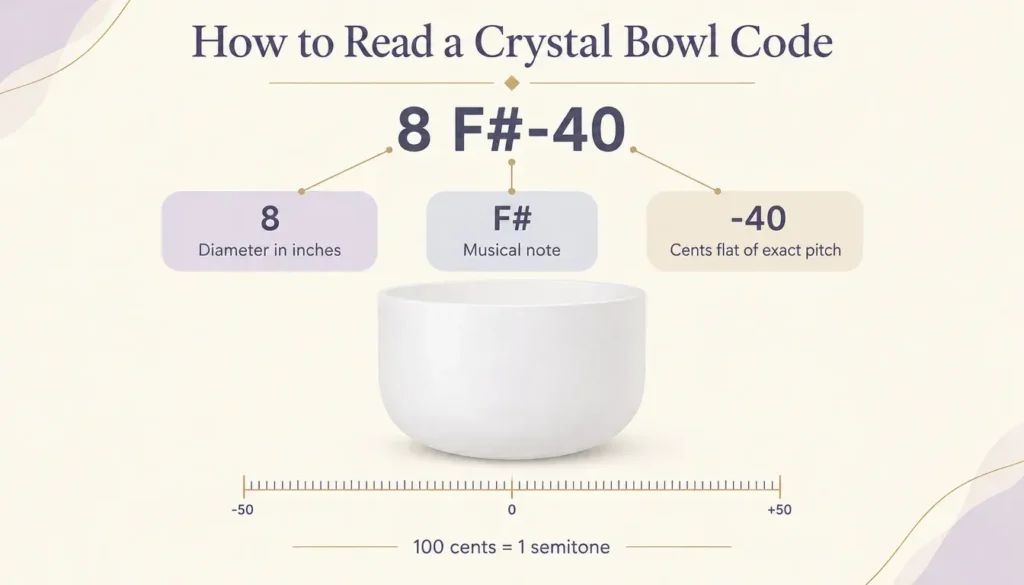
Crystal Tones bowls come with a little code that looks like a typo at first, something like 8″ F#-40. The 8 is the width in inches and F# is the note. Then there’s the -40, the part most people skip, which tells you how many cents the bowl sits off the exact pitch (minus for flat, plus for sharp).
So what’s a cent? A very thin slice of pitch. Take the gap between two neighboring piano keys and chop it into 100 bits. Each bit is a cent, and that’s how the cents scale used in tuning works, with 1,200 of them to an octave. Our F#-40 bowl, then, sits 40 bits below a true F sharp. Close, but a little low.
In hertz that’s somewhere around 361 instead of 370, assuming the bowl’s in the fourth octave like most. You can’t read the note off the diameter, by the way. Bigger bowls do tend to go lower, sure, but a thicker or thinner wall shifts things as well, so the maker just prints the note.
Why Do Cents Matter When Bowls Play Together?
Where this starts to matter is when you play more than one bowl. Sacred Sound of the Soul’s advice is to keep bowls you’ll play together within a total range of 10 to 15 cents. Its tuning guide also notes:
- 440 Hz bowls are standard concert pitch, typically within 10 cents either side.
- 432 Hz bowls typically sit around 25 to 35 cents flat.
- 528 Hz bowls typically sit around 15 to 20 cents sharp.
- Most bowls on the market fall in the 4th octave.
Does fifteen cents really matter? Yes, more than you’d guess. Strike two bowls a few cents apart and listen to the tail of the sound, and there’s a slow wobble in it, the note swelling and fading over and over. That’s called beating. The two sound waves keep lining up and then drifting out of line, and the number of swells per second is just the difference between the two frequencies. Near 440 Hz, 10 cents is about 2.5 Hz, so you’d hear two or three swells a second. Plenty of people find it pretty. My own preference is a chord that stays still, but nobody’s wrong here.
Should You Start With One Bowl or a Full Set?
A complete seven-bowl chakra set doesn’t come cheap. On the day we checked, the first page of the store’s chakra collection ran from about $1,100 to over $5,000 per bowl. Most people build a collection slowly.
So where do you begin? There are three common starting points:
- One bowl for your focus center. Pick the note tied to the center you work with most, such as F for the heart.
- A small chord. Three bowls that form a chord, such as C, E and G, give a fuller sound for group sessions.
- A matched set. Some buyers save up for all seven notes, kept within the same cents range.
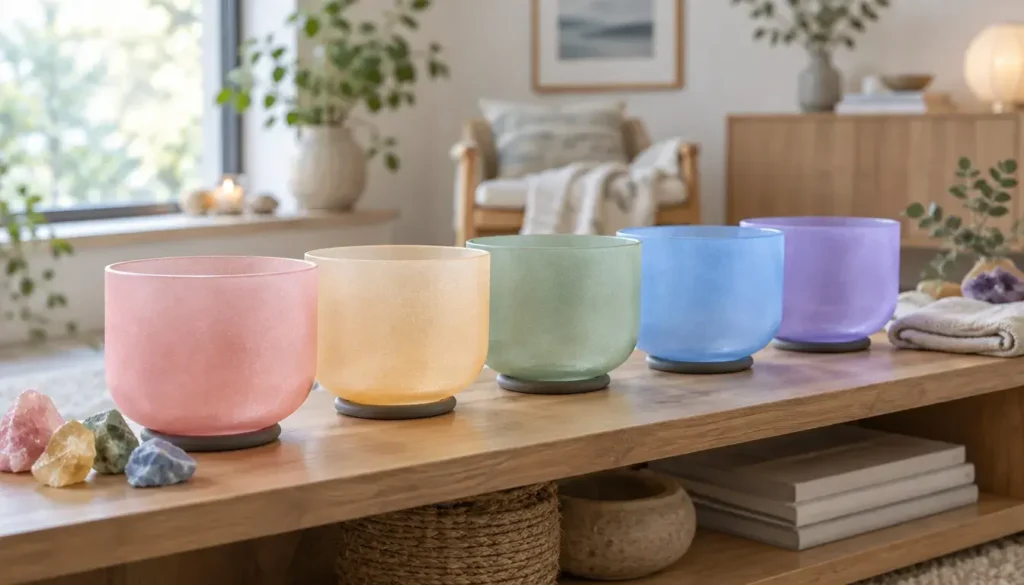
Whichever route you take, play the bowl in a calm, well-lit corner. A guide to lighting a home meditation space can help you set the room up before the first strike.
If money is tight, my vote goes to the single bowl. C, E and G together make a C major chord, which is lovely, but one note you actually play every few days beats three that sit on a shelf. A month with a single bowl also teaches you more about your own taste than any amount of reading.
Is It Better to Listen In Store or Online?
Both work, and each has its own trap. In a showroom you hear the bowl in the room, at full depth. The retailer welcomes visits to its Encinitas, California gallery by appointment.
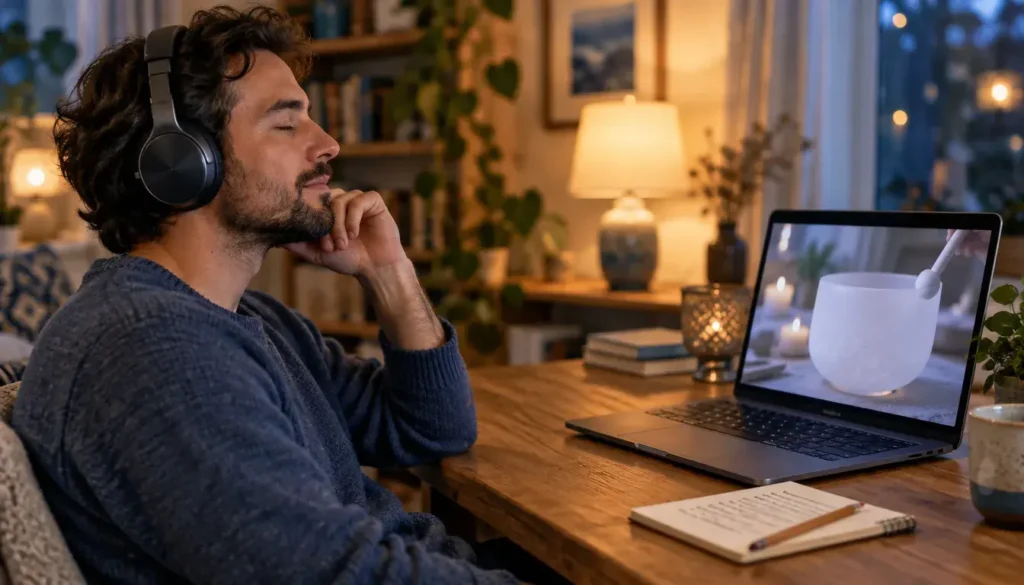
Online, every bowl in the shop has its own video, so you hear that exact instrument rather than a sample. The trap is your speaker. Laptop and phone speakers drop the low end, so a deep C can sound thin.
A few habits make online listening fairer:
- Headphones, ideally, or at least a decent full-range speaker.
- Leave the volume alone once you’ve set it. A louder clip nearly always sounds better, and that isn’t the bowl’s doing.
- Jot down each bowl’s code as you go (it’s easy to lose track of which video was which after the fifth one).
- Try to listen at the same time of day, because tired ears and rested ears don’t hear things quite the same.
Still stuck between two? The store will talk it through with you face to face, or over the phone or Zoom if you’re not near California. You also get 14 days to exchange a bowl, though shipping and insurance on the swap are yours to pay.
How Do You Look After a Crystal Bowl?
Quartz scores a 7 on the Mohs scale, so scratches aren’t much of a worry. Hard isn’t the same as tough, though. Mineral references describe quartz as a hard but brittle mineral, which is why it breaks the way glass does, along curved, shiny edges rather than in neat flat pieces. Bump it down onto a tiled floor and you can lose a chip from the rim.
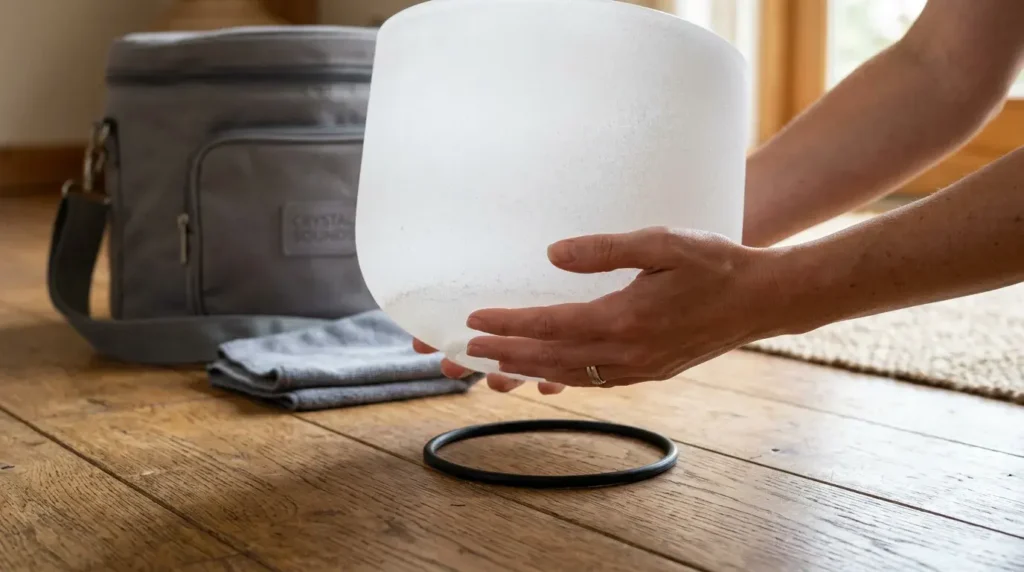
Day to day it’s easy. Both hands go under the base when you lift it (the rim is the fragile part), and the rubber ring it came with stops it creeping across a table mid-note. For cleaning, I wouldn’t bother with anything beyond a soft dry cloth. Stick to the mallet that came with it, and for storage or the car, a padded case or bag made for crystal bowls.
How Do You Play a Crystal Bowl for a Chakra?
You’ve got two ways to make a bowl sound. Tapping is the simple one: knock the side gently with the rubber-tipped mallet and let it ring, which it will, for a surprisingly long time. Rimming is fiddlier. You run a suede mallet around the outside edge, slowly and with steady pressure, and after a few turns the bowl picks up the vibration and starts to sing. If it squeaks or rattles instead, ease off a bit. I’d start with tapping.
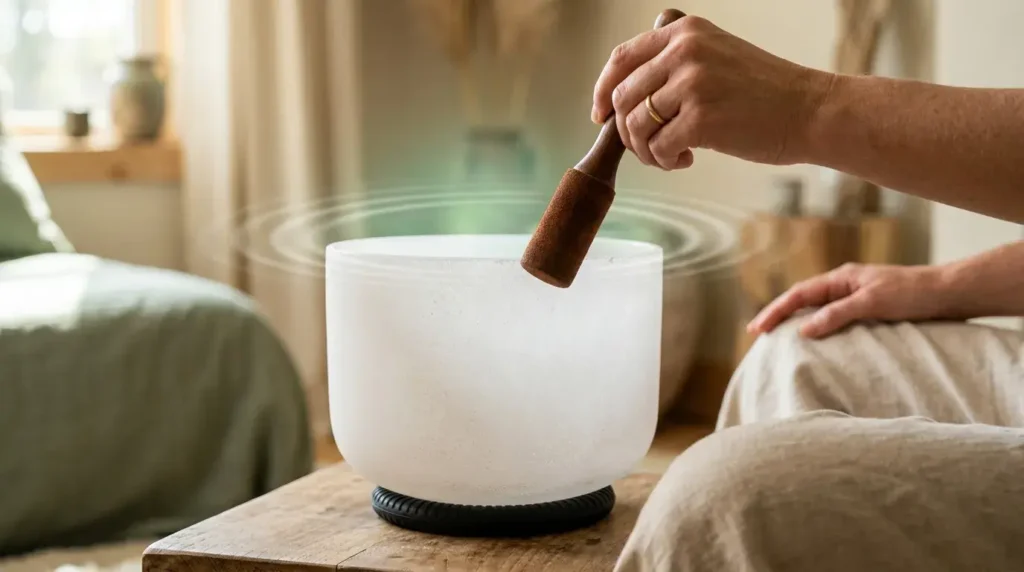
If you want something simple to try, this takes about five minutes with one bowl:
- Bowl on its ring, right in front of you, near enough to reach without leaning.
- Decide which center you’re working with and look up its note – for the heart that’s F.
- Give yourself a few slow breaths before you play anything, long enough for your shoulders to come down from around your ears.
- One soft tap. Then listen right to the end of it – the last part is so quiet you’ll wonder if you’re imagining it.
- Keep that going until your five minutes are up, tapping on the out-breath, or every few breaths if once a breath feels busy.
- Sit for a moment at the end before you reach for your phone.
Recorded sound still has a place, by the way. Finishing a bowl session with one of the chakra meditation tracks is a nice way to stretch it out. As for binaural beats, they only work through headphones, because each ear is fed a slightly different tone, so they’re a different thing from a bowl ringing in the room.
What Do People Get Wrong About Chakra Bowls?
First up, can a bowl fix a health problem? No, and I’d walk away from any seller who hints that it can. A long, steady tone relaxes a lot of people, which is reason enough to own one. But a pain that won’t go away, a heart that races for no clear reason or anxiety that’s starting to run your days needs a doctor, and the bowl can come along as something you do on the side.
Then there’s the mystique around 432 Hz and 528 Hz, both of which get sold as healing frequencies. As far as I know, there’s no solid research behind those claims, so I’d choose between them by ear and by how closely the bowls match each other in cents.
Price is the third. Paying more might get you a thicker bowl, a rarer alchemy finish or closer tuning, but the note itself isn’t any stronger for it. The sound and the cents are what you can actually check.
Choosing Your First Note
If you can’t decide, think about which center you’ve been reading about or worrying over lately, and find that one’s note. Then listen to a handful of bowls in that note, see how far each one is off in cents, and buy the one you’d happily hear again tomorrow morning.
Frequently Asked Questions About Crystal Bowl Notes and Chakra Colors
Does the Bowl’s Color Need to Match the Chakra Color?
No. Alchemy bowls get their color from the minerals and metals blended into the quartz, so a green bowl isn’t automatically a heart chakra bowl. In the note-to-center scheme, the note is what links a bowl to a chakra, and a heart bowl is simply one tuned to F, whatever it looks like. Plenty of people still enjoy a visual match on their practice shelf, and there’s nothing wrong with that. Choose by note and sound first, and let the color be a bonus.
Can One Crystal Bowl Work for Every Chakra?
It can, and some practitioners do their whole practice with a single bowl. In the common C major scheme, though, each note lines up with one center, so a C bowl belongs to the root, an F bowl to the heart and so on. If you only want one bowl, pick the note for the center you come back to most often. You can still play it during a full session that moves through every chakra. It just won’t climb the scale the way a set would.
What Is a 432 Hz Crystal Bowl?
It’s a bowl tuned to a scale where A sits at 432 Hz instead of the standard 440 Hz concert pitch. That puts it about 32 cents lower, which is why tuning guides describe 432 Hz bowls as roughly 25 to 35 cents flat. Some people simply prefer the slightly lower, softer pitch. Claims that 432 Hz has special healing effects aren’t backed by solid research, so treat it as a matter of taste, and make sure any bowls you play together share the same tuning.
Do You Need to Read Music to Choose a Crystal Bowl by Note?
No. All you need is the code printed on the bowl, such as F#-40 on an 8-inch bowl, which gives you the size, the note and how many cents the bowl sits flat or sharp. Look up the note for the chakra you want, and if you’re planning to play more than one bowl together, compare their cents numbers. Sellers such as Sacred Sound of the Soul also publish free buying guides written for people with no musical training at all.
How Much Does a Crystal Singing Bowl Cost?
It depends a lot on size, finish and how unusual the alchemy blend is. When we checked the Sacred Sound of the Soul chakra collection, the first page of Crystal Tones alchemy bowls ran from about $1,100 to over $5,000 per bowl. At that level a full seven-note chakra set is a serious investment, which is why most people start with one bowl for their main focus center, or a three-bowl chord, and add to it slowly over time.
Can Crystal Singing Bowls Help With Anxiety or Sleep?
Many people find the long, steady tone of a crystal bowl relaxing, and a few quiet minutes with one can be a pleasant part of winding down in the evening. A bowl isn’t a treatment, though. Ongoing anxiety, sleep trouble that lasts for weeks or anything that’s affecting your daily life is worth raising with a doctor or a mental health professional. If you ever have thoughts of harming yourself, contact emergency services right away (112 in Europe, 911 in the US). Use the bowl alongside proper care, not instead of it.
How Do You Know If Two Crystal Bowls Are in Tune With Each Other?
Start with the cents number in each bowl’s code. Sacred Sound of the Soul suggests keeping bowls you’ll play together within 10 to 15 cents of each other in total range. Then trust your ears. Ring two bowls at the same time, and if you hear a slow wobble in the sound, the note swelling and fading a couple of times a second, they’re slightly apart in pitch. Some players like that shimmer, but for a steady chord, look for bowls with closer cents values.
Blog Categories:
About the Author: