

Blocked Throat Chakra: Symptoms, Causes, Overactive vs Underactive
Throat chakra blocked symptoms: emotional, physical and everyday signs, what blocks it, underactive vs overactive, and when to see a doctor.
Table Of Contents
The throat chakra blocked symptoms named most often in modern chakra books are holding back what you really think, trouble speaking up, feeling unheard, saying yes when you mean no, a tight throat or jaw when you are tense, and a voice that goes quiet under pressure. They are signs to reflect on, not a diagnosis, and a sore throat, hoarseness or trouble swallowing that lasts should be checked by a doctor.
Throat Chakra · Key Facts
- Sanskrit name:Vishuddha ("especially pure")
- Location:Throat and neck, at the level of the larynx
- Color and element:Blue, ether (space)
- Mantra and frequency:HAM, 741 Hz (modern Solfeggio association)
- Main themes:
- Take the test →Quick check:The free 14-question throat chakra test
The throat chakra is the fifth of the seven main chakras, and teachers link it with your voice in the widest sense: speaking, listening, telling the truth and putting your ideas into the world. In a blocked throat chakra, difficulties arise in expressing what you feel. As with other blocked chakras, it tends to show in both body and behavior. This page explores the symptoms commonly associated with a blocked throat chakra, common causes, symptoms of over-activity in the chakra, and a link to a quick throat chakra test.
Throat Chakra Blocked Symptoms at a Glance
The following symptoms are commonly associated with a blocked or imbalanced throat chakra:
- Hesitating to give opinions in meetings or within family interactions.
- Leaving difficult conversations to the last minute, but not actually having them.
- Feeling not heard in conversations, or constantly being interrupted.
- Agreeing to do things you do not really want to do to avoid conflict.
- Tightness in throat or jaw or feeling a lump in your throat when distressed.
- Loss of voice, shaky voice, or monotone voice when anxious.
- Writing messages, then deleting them.
While most people will experience some of these symptoms from time to time, if multiple of these symptoms are experienced in more than one area of life, and persistently, then you may be experiencing a blocked throat chakra. Below, the symptoms are explained in groups. The throat chakra test takes 5-10 minutes if you want to check your own pattern.
Blocked Throat Chakra Meaning: What the Signs Point To
A blocked throat chakra means that expression is not flowing within this individual. As a result, feelings, needs and ideas are building up inside of the person (like a kettle with the lid closed). Often, individuals with a blocked throat chakra do have lots to say. However, they do not express it.
Vishuddha is usually translated as 'especially pure'. In Arthur Avalon's translation of the Sat-Chakra-Nirupana it is described as a smoky purple lotus with 16 petals, containing one of the vowels from Sanskrit in crimson. In the middle, there is a white circle of ether resembling a full moon. The color blue has become commonly associated with this chakra in modern times, but was not included in this original description.
These symptoms cannot be scientifically tested. The chakra system is symbolic however many people find it very useful. It provides a name to a feeling that people may already know well, but are struggling to express despite knowing exactly what they wish to say.
Physical Symptoms of a Blocked Throat Chakra
The throat chakra is associated with the throat, voice, neck, jaw, mouth, teeth, ears and thyroid. Physical symptoms of a blocked throat chakra commonly include:
- Tightness in throat (due to holding back tears or anger)
- Tension in jaw or teeth grinding (often at night)
- Tension in neck and upper shoulders
- Cracking, hoarse or absent voice when under pressure
- Constant clearing of throat, or dry, itchy throat.
- A lump in the throat depending on emotions.
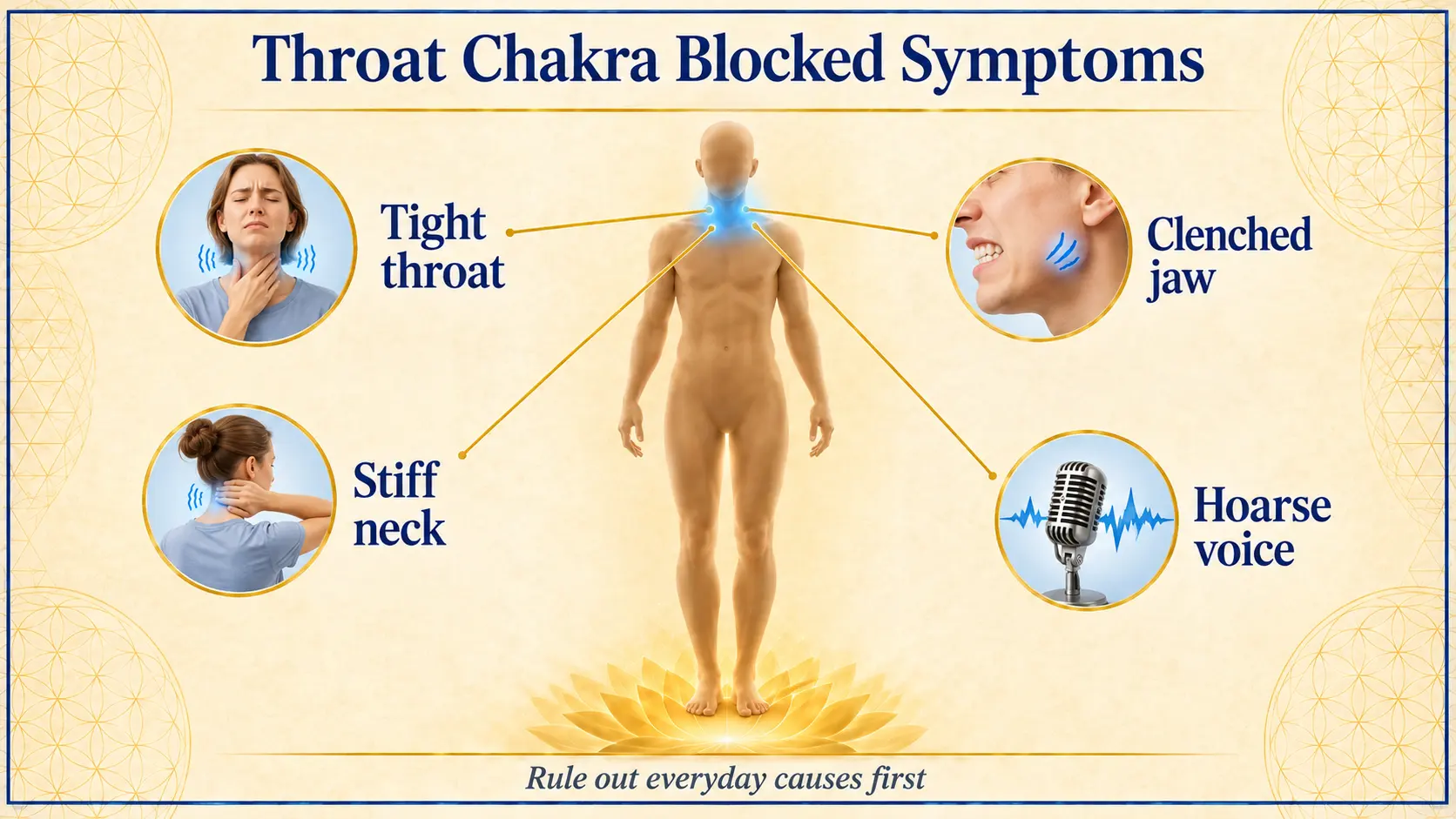
All of these symptoms can be caused by non-chakra related reasons in day-to-day life including illness, acid reflux, allergies, vocal overuse, poor posture at a desk, dry air or stress. Some sources list issues with the thyroid, ear infection and gum disease as throat chakra symptoms. However, as these are medical issues, it is important to see a doctor about them. In chakra teachings, physical symptoms are only assessed alongside emotional and behavioral symptoms.
The table below puts each sign next to the everyday causes worth ruling out first.
| Physical symptom | Traditional chakra association | Other possible causes |
|---|---|---|
| Tight throat when holding back tears | Held-back expression | Anxiety, crying, acid reflux, a throat infection |
| Clenched jaw or teeth grinding | Unspoken anger | Stress, poor sleep, temporomandibular disorder, a dental bite problem |
| Stiff neck and upper shoulders | Tension around the throat | Posture, screen work, muscle strain |
| Hoarse or shaky voice under stress | A voice that is held back | Laryngitis, colds, overusing the voice, reflux, smoking |
| Frequent throat clearing | Something left unsaid | Postnasal drip, allergies, reflux, dry air |
| Lump-in-the-throat feeling | Emotion stuck in the throat | Anxiety, reflux; a lump you can feel in the neck needs a doctor |
Note: the middle column comes from chakra teaching, not from medicine. Check the everyday causes first, and see a doctor if a symptom is strong, new or getting worse.
Emotional and Mental Signs
Internally, a blocked throat chakra can create a great deal of pressure. Common emotional and mental symptoms include:
- Worrying about being judged: too worried about how you sound, you don't speak.
- Feeling your opinion does not matter: in workplace or home environments.
- Emotions bottled up: feeling angry or sad for weeks and suddenly a burst of emotion.
- Lack of belief in your ideas: dismissing your ideas before anyone else.
- Social anxiety: anxiety about making phone calls, presenting, or talking in groups.
- Uncertainty in your opinion: so used to agreeing with others that it is unclear what you really think.
Some of these symptoms could be caused by social anxiety and low mood. If you have been experiencing any of these symptoms for over 2 weeks, or if you are finding it difficult in work, school or relationships, it would be best to talk to a doctor or therapist. Chakra work can be done alongside this support, but should not replace it.
Behavioral Signs of Throat Chakra Imbalance: Voice, Truth and Listening
Many people may first identify a problem with their throat chakra through their behavior. Common behavioral patterns in people with a blocked throat chakra include:
- Silencing yourself in arguments, and replaying the argument in your head afterwards.
- Saying 'yes' but meaning 'no'.
- Telling small lies to avoid conflict or to avoid explaining yourself.
- Hinting at what you need, but not asking for it.
- Apologizing for an idea before sharing it ("this is probably stupid, but...").

Generally, it feels unsafe to be truthful in these situations. As a result, safety is prioritized over truth. In chakra terms, small truthful moments, for example saying 'no thank you' once this week, or completing sentences that you normally leave unfinished, help the throat chakra begin to open.
Overactive vs Underactive Throat Chakra
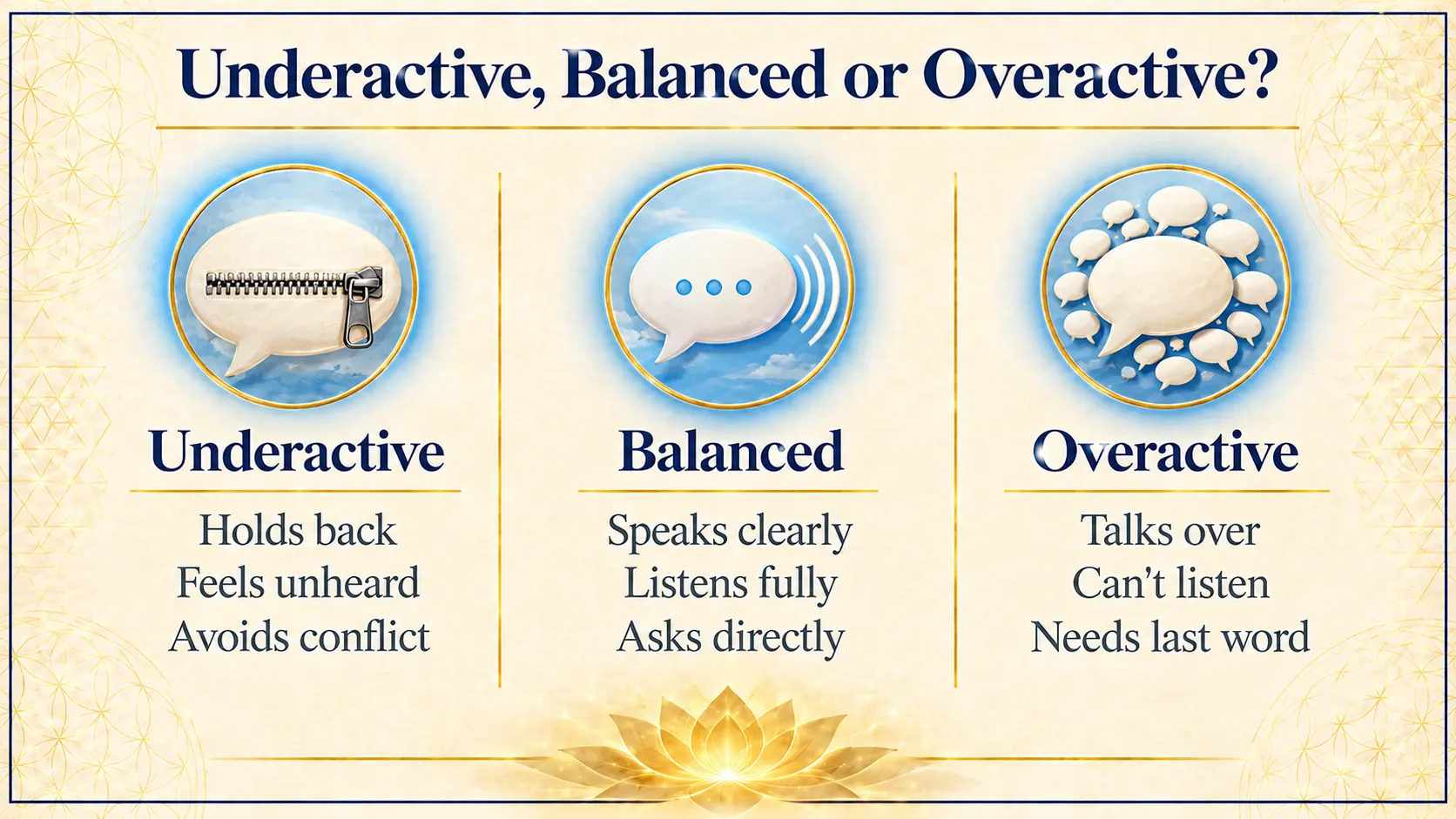
There are two different imbalances within the throat chakra. An underactive throat chakra means less is being said (most people refer to this as a 'blocked' throat chakra). An overactive throat chakra means too much is being said, and therefore listening is compromised. Anodea Judith, in Eastern Body, Western Mind (1996), uses the terms deficient and excessive for these imbalances.
Underactive throat chakra signs
Reluctance to speak, quiet or weak voice, reluctance to give opinions, shyness, difficulty expressing emotions, and a tendency to agree with others. Individuals with this imbalance are often good at listening to others, but rarely get listened to themselves. Most of this page relates to this imbalance.
Overactive throat chakra signs
Fast, high volume speech; interrupting; discomfort in silence; gossiping; loud or harsh speech; poor active listening. Main symptoms of an overactive throat chakra are excessive speech and poor active listening. While this may appear confident, teachers believe this is simply an outward version of the same imbalance. Even though so much is being said, much may remain unspoken.
These are illustrative patterns from modern chakra teaching, not psychological categories. The table compares the three states side by side.
| Characteristic | Underactive | Balanced | Overactive |
|---|---|---|---|
| Speaking | Holds back, quiet voice | Clear and kind | Talks a lot, interrupts |
| Listening | Listens, but is rarely heard | Listens fully | Finds it hard to listen |
| Honesty | Small lies to keep the peace | Honest and tactful | Blunt to the point of hurting |
| Needs | Hints instead of asking | Asks directly | Demands |
| Conflict | Goes silent | Disagrees calmly | Argues, needs the last word |
| Silence | Hides in it | Comfortable with it | Can't stand it |
Signs of a balanced throat chakra
You express yourself kindly and clearly. You can be comfortable in silence and listening. You can disagree with people without conflict. You can ask directly for what you need, and can say 'no' without extensive reasoning. Generally, your words and actions match. Balance in the throat chakra is something you can return to regularly (particularly after a difficult conversation), rather than a permanent state.
What Blocks the Throat Chakra? Causes of a Throat Chakra Blockage
For most teachers, a blocked throat chakra occurs as a result of learning that it is unsafe or unproductive to be vocal. Common causes are:
- Silenced as a child: "children should be seen and not heard", or punishment for challenging.
- Being criticized or made fun of for an idea, accent or stammer.
- Secretive family environment: certain topics were never discussed.
- In relationships, being silenced to avoid anger.
- In workplaces, having no say in decisions. Questions or complaints not encouraged.
- People pleasing: prioritizing others' comfort over your own.

Sometimes trauma can be a more serious cause of a blocked throat chakra. This chakra can be affected by trauma in which expressing yourself was punished, or not believed, including abuse, bullying, or forced secrecy. If this is part of your story, our page on throat chakra trauma explains careful steps and why a trauma-informed therapist comes first.
Anodea Judith links this chakra to ages around 7-12, during which children learn to tell stories, share ideas and find their place within a group. Depending on whether interest or impatience was shown in the child's speech in this period, it can influence the development of the throat chakra in later life.
Blocked vs Open Throat Chakra
Usually, people begin to open their throat chakra gradually. People may begin to express themselves in easy situations, such as a message to a friend, and progress to more difficult situations such as in work, or past family arguments.
Sometimes, people may struggle with this new expression. For example, you may be overly direct in what you say, become tearful whilst speaking, or feel vulnerable after speaking honestly. This is common when changing a long-standing pattern. If you are unsure whether you have a blocked throat chakra, or are beginning to open it, compare your symptoms to our page on throat chakra opening symptoms.
Next Step: How to Unblock Your Throat Chakra
Once you are aware of these symptoms, you can begin working on them. Modern chakra teachers suggest using vocal techniques, and relaxing the neck and jaw.
- Neck and shoulder stretches: Fish pose, Supported Shoulder Stand, and Cat/Cow (see throat chakra yoga poses).
- A short throat chakra meditation, for example a few minutes of chanting HAM
- Long humming exhalation: see throat chakra breathing.
- 10 minutes of free writing: write down anything you didn't say today.
- Singing: many teachers recommend singing in the car or shower if you struggle to speak loudly.
All of these techniques, and a quick start and 7-day plan, can be found in our throat chakra healing page. Therefore, they are not repeated here. Try doing one technique for a week, and see if it becomes easier to speak up.
When Symptoms Need a Doctor
Whilst chakra work can be a great way to relax and become more in tune with your body, it cannot treat illness. Many symptoms listed on this page may be caused by medical issues.
Please consult a doctor if you have had a sore throat for over a week or recurring sore throats, your voice has been hoarse for 3 weeks or more (commonly caused by laryngitis, but should be checked), or you have a lump in your neck. Seek urgent medical attention if you are having difficulties swallowing or breathing. If you are experiencing tiredness, weight changes, and always feeling cold, it could indicate an underactive thyroid. Pain and clicking in the jaw could indicate a temporomandibular disorder.
A strong fear of speaking or social situations may indicate an anxiety disorder. These are common and treatable. If you ever have suicidal thoughts, immediately contact emergency services or a crisis line.
Sources
- Arthur Avalon (Sir John Woodroffe), The Serpent Power, 1919 - translation of the Sat-Chakra-Nirupana (verses 28-29): Vishuddha as a smoky purple lotus with sixteen crimson vowels on its petals, the circular ether region white like the full moon, and HAM.
- Anodea Judith, Eastern Body, Western Mind, 1996 - deficient and excessive patterns of each chakra and their stages of life.
- NHS - Sore throat, Laryngitis, Swallowing problems (dysphagia), Underactive thyroid, Temporomandibular disorder (TMD).
- National Institute of Mental Health - Anxiety disorders.
Frequently Asked Questions About a Blocked Throat Chakra
What does a blocked throat chakra feel like?
People describe it as words getting stuck: you know what you want to say, but it doesn't come out, or it comes out much softer than you meant. Some also notice a tight throat, a clenched jaw or a voice that goes quiet under pressure. These are descriptions from chakra practice, not medical signs.
How do you know if your throat chakra is blocked?
Chakra teachers look for several signs together that last for weeks: holding back your opinion, feeling unheard, saying yes when you mean no, and tension in the throat or jaw when you are upset. One sign alone means little. Our 14-question throat chakra test helps you see your own pattern.
Can a blocked throat chakra cause a sore throat?
There is no medical evidence that a chakra causes a sore throat. Sore throats usually come from infections, reflux, allergies or dry air, and one that lasts more than a week, or a voice that stays hoarse for three weeks, should be checked by a doctor. Chakra teachers only read throat tension together with emotional signs.
What emotions block the throat chakra?
Teachers most often name fear of judgment, shame about speaking up, anger that was never expressed and the habit of keeping the peace at any cost. Many trace these feelings back to a childhood where talking back was punished or where some topics were never discussed at home.
Why does my throat feel tight when I want to cry?
When you hold back tears, the muscles around the throat and voice box tense up, which many people feel as a lump or tightness. It is a normal body reaction to stress. Chakra teachers see it as a picture of held-back expression; a lump you can feel in your neck should always be checked by a doctor.
Can anxiety block the throat chakra?
Chakra teachers often link anxiety, especially social anxiety and fear of speaking, with an underactive throat chakra, because both make it hard to use your voice. In medicine, anxiety is a common and treatable condition of its own. If worry stops you from speaking at work or with friends, talk to a doctor or therapist.
How long does it take to unblock the throat chakra?
There is no fixed time. Teachers usually suggest a few weeks of regular practice, such as chanting HAM, humming breath, neck stretches and small honest conversations, before you judge any change. Old habits of keeping quiet can take longer. Our throat chakra healing guide has a 7-day plan to start with.
Blockage symptoms of the other chakras:
-
Blocked root chakra signs
- safety, the body and money
-
Blocked sacral chakra signs
- emotions, creativity and pleasure
-
Signs of a blocked solar plexus chakra
- confidence and digestion
-
Signs of a blocked heart chakra
- love, grief and trust
-
Third eye chakra blockage symptoms
- intuition and mental clarity
-
Crown chakra blockage symptoms
- spiritual connection and meaning