
Why Taller People May Experience Different Posture Energy Alignment in Yoga?
Discover how tall people experience unique posture challenges in yoga. Learn about structural leverage, energy alignment, and practical strategies for optimal practice.
Table Of Contents
The intersection of physical stature and mindfulness practices reveals that human anatomy directly dictates the flow of internal energy. Taller individuals frequently find that standard instruction fails to accommodate the unique mechanical demands of a longer skeletal frame. When long limbs alter the spatial distribution of mass, the kinetic feedback loop changes shape entirely.
Understanding these adjustments transforms how spatial orientation impacts subtle energy networks, shifting the focus from standard flexibility to proportional stabilization. Consequently, true alignment emerges not from forcing a uniform posture, but from calibrating the breath and core to anchor an expanded physical presence.
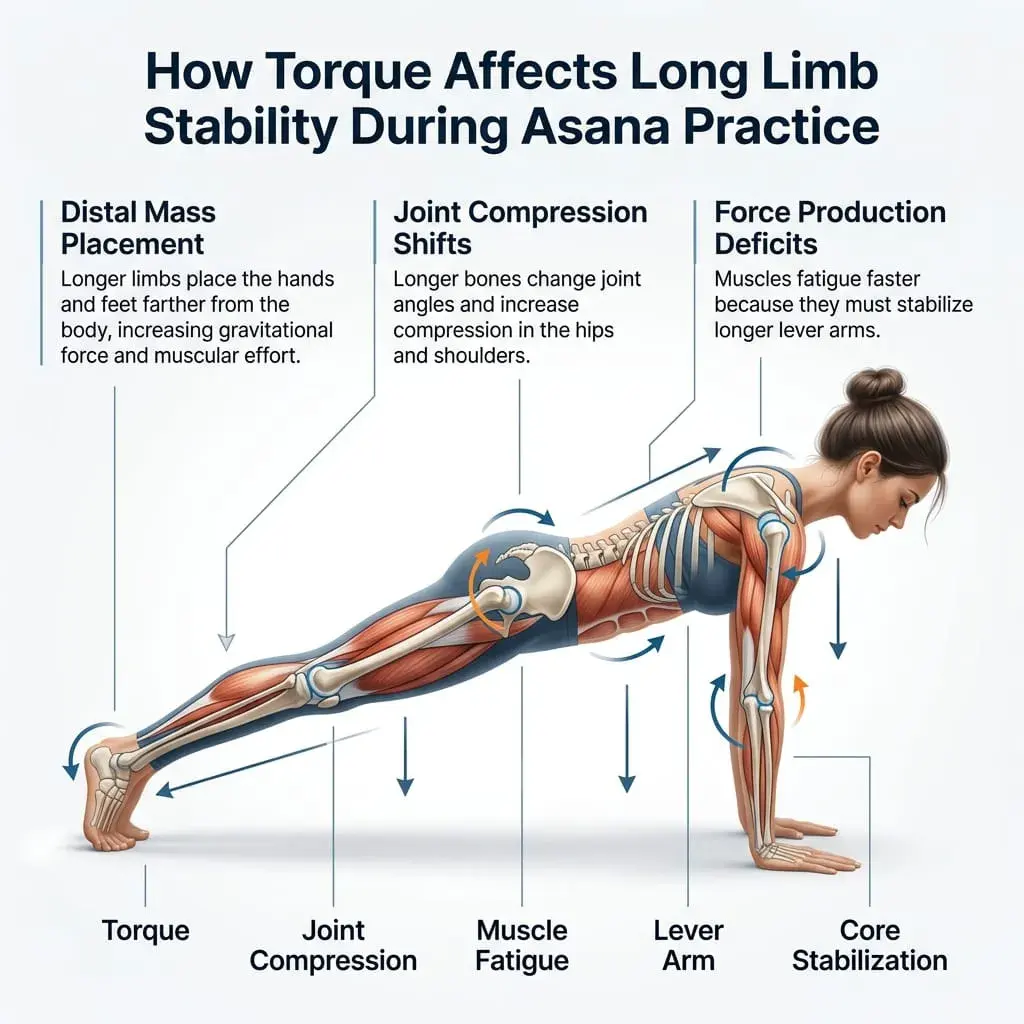
How Torque Affects Long Limb Stability during Asana Practice?
Longer bones act as extended lever arms, meaning muscles must exert significantly more force to move or stabilize the same relative weight across a joint. This mechanical reality shifts the energetic demands of static holding shapes, turning simple postures into intense challenges for strength.
Distal Mass Placement
Longer limbs place the weight of the hands and feet further from the trunk of the body. This increased distance multiplies the downward gravitational pull, requiring intense muscular contraction to maintain basic structural integrity.
Joint Compression Shifts
Extended bone lengths alter the angle of muscular insertion around major joints like the hips and shoulders. This variation increases the compressive forces within the joint capsule, demanding precise rotational adjustments to prevent long-term stress.
Force Production Deficits
Because muscles must contract over a longer physical distance to stabilize long levers, fatigue sets in much faster. Practitioners often mistake this rapid muscular fatigue for a lack of endurance or improper breath control.
Why Structural Leverage Alters Center of Gravity Mechanics?
Does a longer torso change the foundational security of a classical yoga foundation? Physics confirms that vertical height shifts the physical center of mass upward. Mechanically, the human center of gravity resides slightly above the midpoint between the navel and the pit of the stomach, rather than at a fixed low percentage for every frame. This heightened equilibrium point creates greater rotational force when tilting away from the central vertical axis.
An individual using a digital height comparison tool like https://easyheightcomparison.com/ to look at biological scaling alongside shorter practitioners quickly observes that identical angular deviations produce much larger balance disruptions in an elongated frame. The continuous muscular activation required to counteract this top-heavy torque often manifests as hidden tension in the deep core musculature.
What Misconceptions Surround Flexion and Long Hamstrings?
A persistent misunderstanding in somatic practices suggests that taller individuals lack flexibility simply because they cannot easily touch their toes in a seated forward fold. This false narrative completely ignores the basic proportions of the human skeleton.
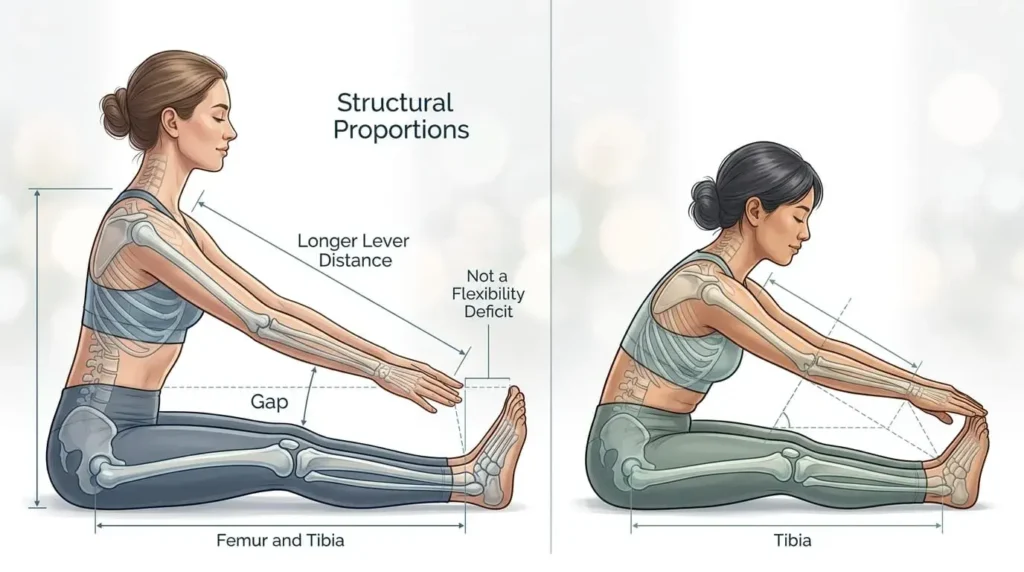
When the length of the femur and tibia greatly exceeds the proportional length of the arms, the torso remains physically separated from the legs by a wider gap. The resistance experienced is not a lack of elasticity in the muscle tissue, but rather a structural boundary created by the relationship between the extremities and the trunk.
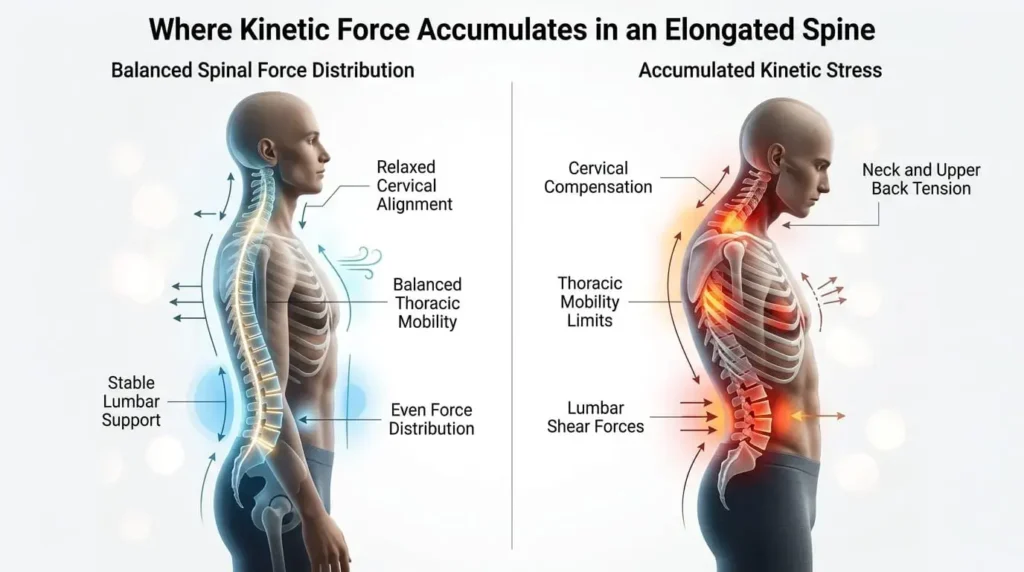
Where Kinetic Force Accumulates in an Elongated Spine?
The vertebral column bears the brunt of gravitational force, acting as a primary channel for nervous system transmission. In an elongated spine, force distribution follows a distinct pattern that requires specific structural awareness.
Lumbar Shear Forces
Longer torsos create a larger lever that can place excessive strain on the lower back during deep backbends. Without active abdominal support, gravitational pull can cause the lower vertebrae to compress uncomfortably.
Thoracic Mobility Limits
Taller rib cages often experience structural rigidity, which restricts natural rotation through the upper and middle parts of the back. This stiffness can limit lung expansion and disrupt the smooth flow of deep breathing.
Cervical Counterbalancing Needs
When the lower sections of the spine lose their natural curves, the neck must work extra hard to keep the head aligned over the shoulders. This compensation often leads to chronic tension in the upper back.
When Does Proprioception Need Mechanical Adjustment?
Proprioception, the subconscious perception of movement and spatial orientation, requires more processing time when signals travel through longer neural pathways. This subtle delay can make quick transitions feel clumsy or uncoordinated.
Slowing down the transition between poses allows the nervous system to accurately track the position of distant extremities. This deliberate pacing helps prevent the body from overshooting its safe range of motion, creating a stable foundation for steady energy flow.
How to Apply Practical Strategies for Proportionate Balance?
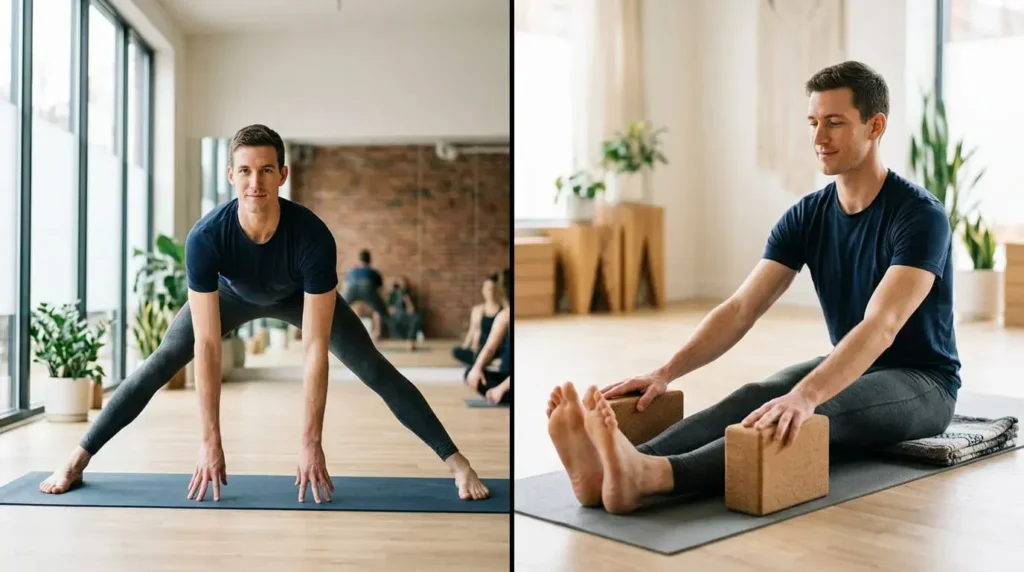
Adapting a yoga practice for a taller frame requires shifting focus from standard aesthetics to individual body proportions. Using props and adjusting stance width can help level the playing field, making challenging poses much more accessible.
Wider Foot Foundations
Widening the stance in standing poses instantly lowers the center of gravity and broadens the base of support. This simple shift reduces wobble and helps conserve energy during longer holds.
Intelligent Block Elevation
Placing hands on elevated blocks during forward folds brings the floor closer to the torso. This adjustment compensates for shorter arm-to-leg proportions, taking unnecessary strain off the hamstrings and lower back.
Frequently Asked Questions About Tall People and Posture Alignment
How do long femurs affect squatting depth?
Longer thigh bones push the hips further back during a squat, requiring a deeper forward lean of the torso to keep the center of mass balanced over the feet.
Why does the downward dog feel strained for tall people?
The standard distance between hands and feet often compresses a long spine, but stepping the feet further back relieves shoulder pressure and creates space for the back to lengthen.
Can a long torso cause neck strain in backbends?
Yes, a longer upper body generates more leverage, which can lead to overbending in the neck if the mid-back lacks the mobility to distribute the curve evenly.
Do taller people need different yoga modifications than average-height practitioners?
Yes, taller practitioners benefit from specific adjustments including wider stance foundations, elevated props, and slower transitions between poses to accommodate their longer limbs and altered center of gravity.
How can tall people improve their flexibility despite longer limbs?
Understanding that proportional structure—not muscle elasticity—creates resistance is key. Using blocks, straps, and props, along with consistent practice tailored to individual proportions, helps tall practitioners develop genuine flexibility appropriate to their body.
Why do tall people experience faster muscle fatigue in yoga poses?
Longer bones function as extended lever arms, requiring muscles to work much harder over greater distances. This increased mechanical demand causes fatigue faster than in shorter-limbed practitioners, which is a structural reality rather than an endurance issue.
What is the best approach to energy alignment for taller individuals in yoga?
Rather than forcing uniform postures, calibrate your breath and core engagement to anchor an expanded physical presence. Focusing on proportional stabilization and individual body mechanics creates true alignment that respects your unique structure.
Blog Categories:
About the Author: