Blocked Heart Chakra: Symptoms, Causes, Overactive vs Underactive
Heart chakra blocked symptoms: emotional, physical and everyday signs, what blocks it, underactive vs overactive, grief, and when to see a doctor.
Table Of Contents
The heart chakra blocked symptoms described most often in modern chakra books are keeping people at a distance, trouble trusting or forgiving, holding on to old hurt, loneliness, harsh self-criticism, and a tight chest or shallow breathing when you are upset. They are signs to reflect on, not a diagnosis, and chest pain or a racing heart always needs a doctor first.
Heart Chakra · Key Facts
- Sanskrit name:Anahata ("unstruck")
- Location:Center of the chest, at the level of the heart
- Color and element:Green, air
- Mantra and frequency:YAM, 639 Hz (modern Solfeggio association)
- Main themes:
- Take the test →Quick check:The free 14-question heart chakra test
The heart chakra is the fourth of the seven main chakras and sits in the middle of the system, which is why teachers often call it the bridge between the body-based lower chakras and the upper ones. When it is described as blocked, people usually mean that giving and receiving love has become hard or guarded. Like other chakra imbalance symptoms, these signs point to a pattern, not a diagnosis. Below is information on symptoms, causes of blockages, overactive heart chakras and a link to a quick heart chakra quiz.
Heart Chakra Blocked Symptoms at a Glance
Common symptoms of a blocked or unbalanced heart chakra (sometimes searched as blocked chest chakra) include:
- difficulty connecting with others (even people you like)
- difficulty trusting a romantic partner or friend due to a past disappointment
- ruminating on arguments or the breakdown of a relationship
- feeling lonely in a crowd
- being much more self-critical than you would ever be of a friend
- dismissing praise, support and affection
- a tight chest, shortness of breath and hunched shoulders when feeling sad or tense
It is common to experience some of these symptoms after a difficult time or loss. However, if multiple symptoms occur and persist for a lengthy period of time, teachers suggest there may be a blockage. Each group is explained in more detail below, and the heart chakra test takes 5-10 minutes if you want to see your own pattern.
Blocked Heart Chakra Meaning: What the Signs Point To
When the heart chakra is blocked, it means that it is difficult to give and receive love. As it relates to the element of air, a blocked heart chakra is often described as being emotionally out of breath, meaning that very little is being taken in, and even less given out.
The Sanskrit name Anahata means 'unstruck'. In an ancient Tantric text translated by Arthur Avalon, the heart chakra is described as having 12 petals and being a deep red color like the Bandhuka flower. At the center of it is a hexagonal region of air, which is smoke gray. This is formed by two intersecting triangles. Today, people commonly associate green with this chakra, although more recent authors also include pink.
As with all chakras, this cannot be scientifically tested. Whilst the chakra system is symbolic, many people find it a good way to articulate how they are feeling. In this case, people can feel that they have closed off their hearts slightly.
Physical Symptoms of a Blocked Heart Chakra
In chakra books, the heart chakra relates to the chest, heart, lungs, upper back, shoulders, arms, hands and often the thymus gland. Therefore, physical symptoms associated with a blocked heart chakra according to chakra teachers include:
- tightness or heaviness in the chest
- shallow breathing or holding of breath
- hunched shoulders and a slightly collapsed chest
- tension between the shoulder blades and in the upper back
- frequent sighing, or the sensation of a lump in the throat when sad
- cold hands (depending on the teacher)
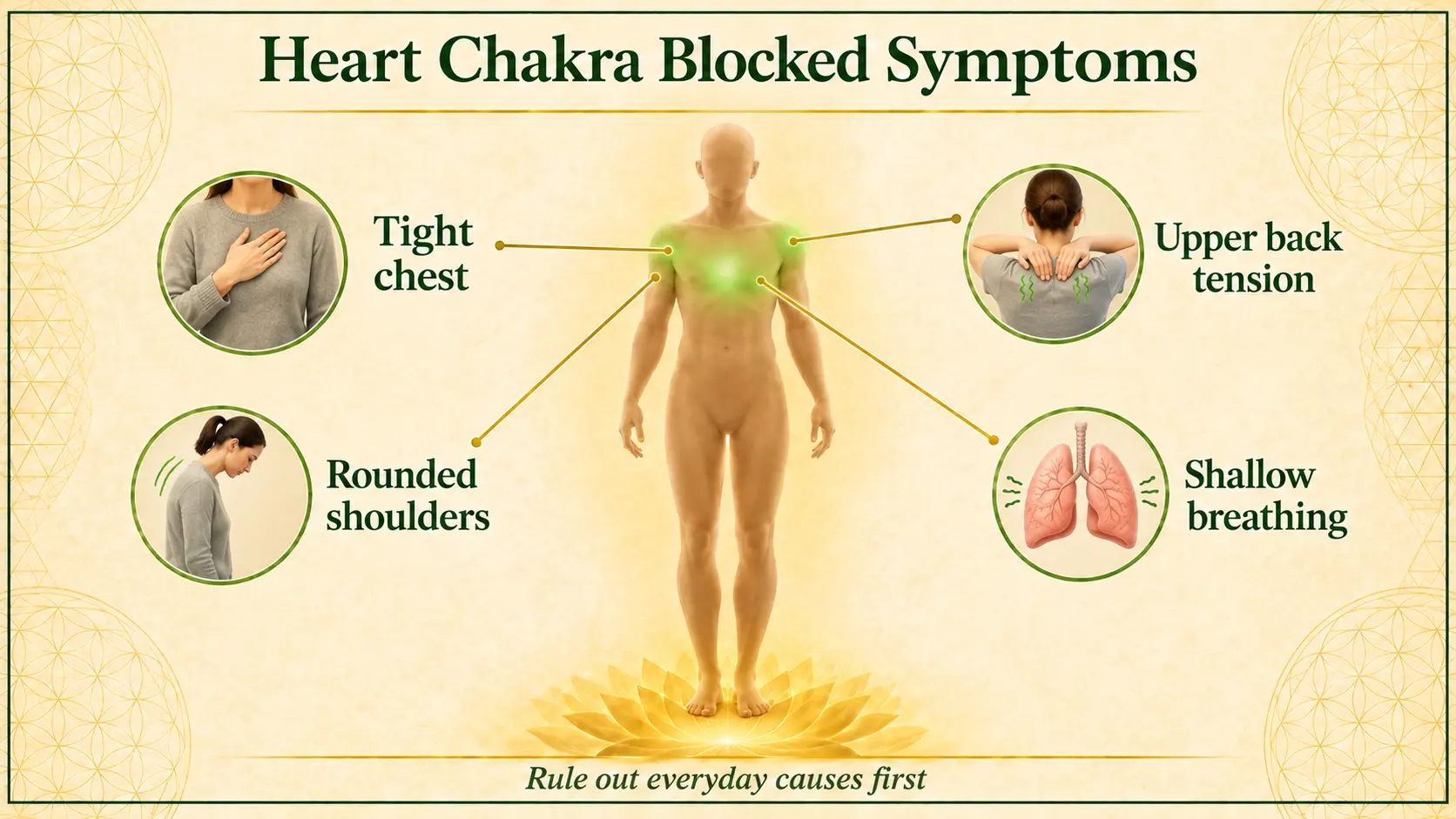
However, these symptoms can be caused by many common, non-chakra related problems. Stress, anxiety, poor sitting posture, asthma, chest infections, and heart or circulation issues can cause all of these symptoms. Teachers consider the emotional symptoms as well. Tightness in the chest that comes and goes with a stressful time is different from chest pain. If you are searching for heart chakra pain, note that chest pain should be checked by a doctor first (see the doctor section below).
The table below puts each sign next to the everyday causes worth ruling out before you think about chakras.
| Physical symptom | Traditional chakra association | Other possible causes |
|---|---|---|
| Tight or heavy chest when upset | Held-back grief and feeling | Anxiety, stress, reflux, heart or lung problems; chest pain always needs a medical check |
| Shallow breathing or holding the breath | A closed air element | Anxiety, asthma, posture, a chest infection |
| Rounded shoulders, collapsed chest | Protecting the heart | Desk posture, weak upper back muscles, tiredness |
| Tension between the shoulder blades | The back of the fourth chakra | Posture, muscle strain, long hours at a screen |
| Frequent sighing or a lump in the throat | Sadness that is not expressed | Tiredness, anxiety, low mood, grief |
| Cold hands | Feeling held back (some teachers) | Cold weather, poor circulation, Raynaud's, an underactive thyroid |
Note: the middle column comes from chakra teaching, not from medicine. Check the everyday causes first, and see a doctor if a symptom is strong, new or getting worse.
Emotional and Mental Signs
Most people will relate to the emotional symptoms of a blocked heart chakra. As this chakra connects us to others and ourselves, blockages will affect the people in close relationships with us:
- Lack of trust: expecting to be let down, so it is difficult to fully trust people
- Holding grudges: feeling resentful about a past hurt, even years later
- Feelings of isolation: even in groups of people, you rarely feel connected
- Fear of rejection: due to a fear of being told no, you avoid asking for what you need
- Self-criticism: being very critical of how you look, what you achieve and your mistakes
- Emotional numbness: after a loss, feeling flat and almost 'switched off'
Some of these symptoms may be related to feeling sad, anxious or depressed. If they are lasting longer than 2 weeks, or are affecting work, sleep or relationships, it would be a good idea to speak to a doctor or therapist. Chakra work can be used to support this, but should not be used instead of professional help.
Behavioral Signs of Heart Chakra Imbalance: Love, Trust and Forgiveness
Imbalances in the heart chakra can also be seen in behavior, which often makes them easier to identify. Common behaviors include:
- ending a relationship or friendship because the person got too close
- keeping score in relationships
- always taking the role of carer, and refusing to allow people to care for you
- avoiding difficult conversations and becoming quiet
- checking a partner's phone or messages because you cannot relax

Behind most of these behaviors, a protective habit is at work. To begin to re-open a closed heart chakra, small risks of connection are needed, such as accepting help from others, or expressing your true feelings to one trusted person.
Overactive vs Underactive Heart Chakra
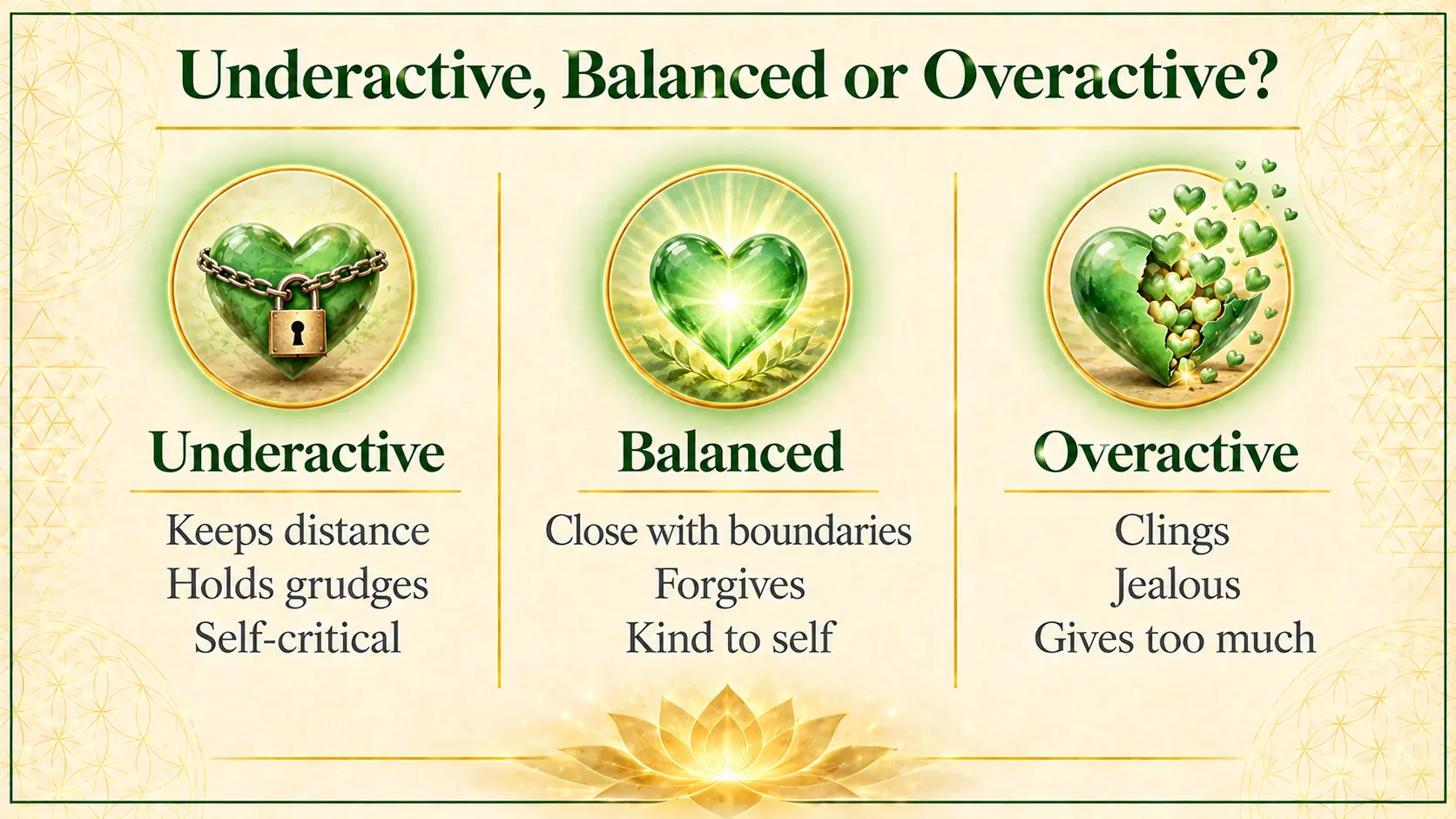
Two imbalances can occur in the heart chakra. If it is underactive, not enough love is being given or received (commonly referred to as a blocked heart chakra). If it is overactive, too much love is being given, causing dependency. As described by Anodea Judith in Eastern Body, Western Mind (1996), an underactive 4th chakra can be referred to as 'deficient', and an overactive 4th chakra as 'excessive'.
Underactive heart chakra signs
Avoiding people, coldness, criticism, feelings of isolation, difficulty empathizing and fear of intimacy. People with an underactive heart chakra often appear very independent, and may say that they just prefer to be alone. This pattern is covered in most detail on this page.
Overactive heart chakra signs
Being very attached, jealousy, difficulty with boundaries, saying yes to everything, giving too much of yourself, and constantly needing reassurance of being loved. Codependency can fall into this category also. Although it appears very open, teachers consider this an imbalance, as giving in this way often comes from a fear of being abandoned.
These are illustrative patterns from modern chakra teaching, not psychological categories. The table compares the three states side by side.
| Characteristic | Underactive | Balanced | Overactive |
|---|---|---|---|
| Closeness | Withdraws, keeps people away | Close, with boundaries | Clings, can't be alone |
| Trust | Suspicious, expects to be let down | Trusts and checks | Trusts blindly, then jealous |
| Giving | Holds back | Gives and receives | Gives until exhausted |
| Forgiveness | Holds grudges | Forgives without forgetting | Excuses everything |
| Self-love | Harsh self-critic | Kind to yourself | Needs constant reassurance |
| Grief | Frozen, numb | Moves through it over time | Overwhelmed by it |
Signs of a balanced heart chakra
Being able to allow people close while maintaining personal boundaries, being able to forgive without ignoring the initial hurt, receiving support and praise from others, and treating yourself as kindly as you would treat others. Feeling sad will still be painful, however it can flow through you over time, rather than creating a barrier. Balance in this chakra is something to aim for, rather than something reached.
What Blocks the Heart Chakra? Causes of a Heart Chakra Blockage
Most teachers agree that a blocked heart chakra occurs as a result of unprocessed painful experiences within relationships. Causes include:
- Breakups and betrayals: ending a relationship, an affair, or a friend cutting ties
- Loss and unresolved sadness: losing a loved one, a miscarriage, or the end of a family as you knew it
- Conditional love: growing up feeling that in order to receive love, you must be 'good' or useful
- Feeling rejected or abandoned (often in early life)
- Prolonged feelings of isolation, such as after moving house or a long illness
- Constant self-criticism and feeling unlovable as you are

As described by Anodea Judith, between the ages of 4 and 7, children begin to understand how they fit into relationships, their roles within their families, and how they are viewed by others. The amount of warmth and acceptance received during this time can influence how open the heart chakra is in adulthood.
Heart Chakra Trauma: Heartbreak, Grief and Betrayal
Deeper traumas within the heart chakra can occur as a result of betrayal within a relationship, sudden loss, emotional neglect in childhood, or love mixed with control or fear within a relationship. This can cause a prolonged closing of the heart chakra.
Symptoms are often similar to those above, but more severe. People can feel as if they are preparing for the next loss, become distant from people getting close to them, or have ongoing sadness with no movement. Some people also report tightness in their chests when remembering the experience.
Practices to encourage calmness, such as breathing and meditation, can be helpful. However, it is best to use them as a supporting tool. If a loss or betrayal is affecting daily life, seeking support from a grief counselor or trauma-informed therapist is the appropriate first step. Chakra work can be added to this at your own pace.
Blocked vs Open Heart Chakra
Usually, moving from a blocked to an open heart chakra does not happen suddenly. People often experience it as softening. This may begin with small feelings of warmth and ease in conversation, and after this, previously held feelings can resurface.
This can be confusing. Increased tearfulness, resurfaced past sadness, or increased sensitivity to the emotions of others may make it seem as though you are regressing. If you are unsure whether you have a blocked chakra or are beginning to open, compare your symptoms to those on our heart chakra opening symptoms page.
Next Step: How to Unblock Your Heart Chakra
Once you know which symptoms you relate to, you can begin to unblock your heart chakra. Modern teachers recommend the following activities to begin opening this chakra:
- Chest-opening poses: Cobra, Camel and supported Fish from our heart chakra yoga poses
- A short heart chakra meditation, for example a few minutes of loving-kindness
- Wide, slow breathing into the ribs (see heart chakra breathing)
- saying one truthful sentence to a trusted person
- spending time in nature surrounded by trees and plants (many teachers associate this chakra with green)
Every method, with a quick start and a 7-day plan, is in our guide how to open heart chakra, so we don't repeat it here. Pick one activity to do over the next week and note how you feel in close relationships.
When Symptoms Need a Doctor
Whilst chakra work can help you feel relaxed and aware of your feelings, it cannot treat illness. Many symptoms on this page could be caused by medical issues.
If you experience chest pain or pressure radiating to your arm, jaw, neck or back, or accompanied by sweating, nausea or shortness of breath, seek immediate medical attention from emergency services, as this may indicate a heart attack. If you are experiencing persistent heart palpitations, dizziness, or difficulty breathing that is new or getting worse, please see a doctor.
After a loss it is normal to feel sad. However, if intense feelings of sadness last for a long period of time, the NHS page on grief after a loss can help you know where to get support. If you are feeling numb, isolated and low for long periods of time, this may be a sign of depression, which is common and treatable. If you ever have suicidal thoughts, please seek immediate help from emergency services or a crisis line.
Sources
- Arthur Avalon (Sir John Woodroffe), The Serpent Power, 1919 - translation of the Sat-Chakra-Nirupana: Anahata as a lotus the color of the Bandhuka flower with twelve letters (Ka to Tha) on its petals, the smoke-colored six-cornered region of air and YAM (verses 22-23).
- Anodea Judith, Eastern Body, Western Mind, 1996 - deficient and excessive patterns of each chakra and their stages of life.
- NHS - Chest pain, Heart attack, Heart palpitations, Shortness of breath, Grief after bereavement or loss.
- National Institute of Mental Health - Depression.
Frequently Asked Questions About a Blocked Heart Chakra
What does it mean when your heart chakra is blocked?
In chakra teaching, a blocked heart chakra means that giving and receiving love has become hard: you keep people at a distance, find it difficult to trust or forgive, and may feel lonely even with others around. It is a symbolic description, not a medical condition. Our 14-question heart chakra test helps you check your pattern.
Why does my heart chakra hurt?
Pain in the chest is a medical question first: it can come from the heart, the lungs, reflux, muscle strain or anxiety, and chest pain that spreads to the arm, jaw or back needs emergency help. Chakra teachers read a tight or heavy chest during grief or stress as held-back feeling, but only after a doctor has ruled out other causes.
What emotions block the heart chakra?
Teachers most often name unprocessed grief, resentment and grudges, fear of rejection, jealousy and harsh self-judgment. Shame about needing others is also mentioned. These feelings are a normal part of life; teachers only speak of a blockage when they stay for a long time and keep you from feeling close to anyone.
Can grief block the heart chakra?
Many chakra teachers see unfinished grief as one of the main reasons the heart chakra closes, especially after a sudden loss or a death that could not be talked about. Grief itself is not a blockage; it is the natural response to loss. If it stays very intense for months, a grief counselor can help.
What is a closed heart chakra?
A closed heart chakra is another name for a blocked or underactive heart chakra. Teachers use it for a guarded pattern: little openness, distrust, holding back affection and difficulty accepting care. The opposite imbalance, an overactive heart chakra, shows as clinging, jealousy and giving until you are exhausted.
How long does it take to open the heart chakra?
There is no fixed time. Teachers usually suggest a few weeks of regular practice, such as chest-opening yoga, loving-kindness meditation and slow breathing, before you judge any change. Old heartbreak or grief can take much longer and may need support. Our guide on opening the heart chakra has a 7-day plan to start with.
Blockage symptoms of the other chakras:
-
Root chakra blockage symptoms
- safety, the body and money
-
Sacral chakra blockage symptoms
- emotions, creativity and pleasure
-
Blocked solar plexus chakra symptoms
- confidence and digestion
-
Signs of a blocked throat chakra
- speaking up and self-expression
-
Signs of a blocked third eye chakra
- intuition and mental clarity
-
Signs of a blocked crown chakra
- spiritual connection and meaning