

How to Prepare for a Spiritual Reading: A Chakra-by-Chakra Check-In
Get more from a spiritual reading by checking in with each of your seven chakras first, with reflective questions, grounding tips and what to do afterward.
Table Of Contents
Sometimes people may not do much preparation for a spiritual reading. As a result, the question asked may not be exactly what was intended, and the issue may be noticed after the reading (or after closing the chat).
To avoid this, try spending a few minutes preparing. By going through each of the 7 chakras and asking one honest question for each, you can get into the right place. No specific equipment is required – just a chair, and a few slow breaths. It may be useful to have paper and pen to hand.
Why Prepare?
By preparing, you can avoid asking the reading a question that is purely based on your fears or hopes. You can also be clearer on exactly what you want to find out.

This system using chakras is useful as each chakra relates to a different aspect of life. The idea of chakras appears in texts of tantric Hinduism and Buddhism from around the 8th century. The 7 chakra system commonly known today in western culture was popularized by Arthur Avalon in his translation of a Sanskrit text in 1919, which was originally written in 1577. A summary of the history of the chakra system can be found here. However, the colors of the spectrum used in relation to chakras are much more modern additions. In older texts, the chakras are described very differently.
There is no scientific proof for chakras. However, this preparation method still has value. Whether you personally believe chakras to be true energy points, or as a useful representation, this is a useful structure to ask yourself questions in.
Deciding the Format of Your Reading
It can be helpful to decide what format you would like to do your reading in before considering your question. Some people prefer to have a face-to-face reading with a tarot reader, whereas others may be more comfortable with receiving a written reading so they can refer back to it in a few weeks. If typing feels more natural, a live spiritual reading by chat lets you ask follow-up questions as the conversation goes along, and some of these services are open around the clock. Be sure to read carefully, as some live readings may clearly state that they are AI-generated, so you know what format of reading you are getting.

There is no right choice to make here. Choose the option that allows you to be relaxed and honest. Whichever method you choose, look for an intuitive reader who is clear about what they can and cannot see in a reading. They should not lead you towards any particular conclusion, nor require you to pay for a second reading.
Going Through the Chakras
Find a place where you will not be disturbed. Sit with both feet on the ground, take a few slow breaths into your stomach, and have paper to hand. Work your way through each chakra, pausing to consider the question for one to two minutes. You can then write down your answer.
Root Chakra and Sacral Chakra
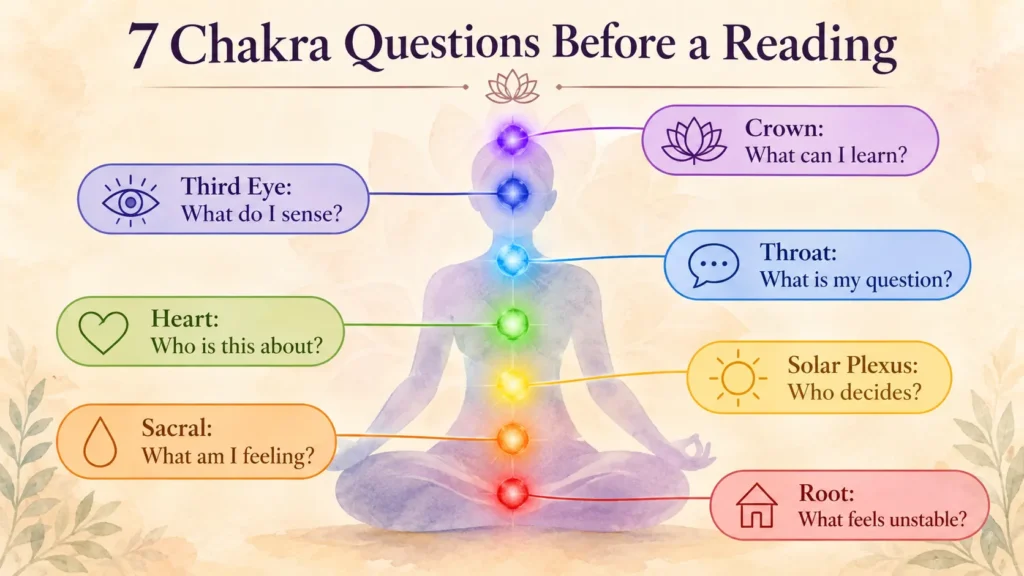
The root chakra is located at the base of the spine and is often depicted in red. It is associated with safety and feeling a sense of belonging. So, what in your life currently feels unstable? This could be related to where you are living, feeling less secure in a job, or an unstable relationship. Often it will turn out that this is the real issue in your reading.
Above this, just below the belly button, is the sacral chakra. This is orange and associated with emotions and pleasure. It is also said to be common to store unwanted emotions in this chakra. Think about which emotion is coming up for you in relation to your question. It could be sadness, guilt, or something similar. You don’t need to do anything with this information right now, just acknowledge it. If you would like, you could simply write a keyword relating to the emotion.
Solar Plexus Chakra
Sometimes the question for this chakra may feel uncomfortable. The solar plexus chakra (Manipura) is located in the upper stomach, is yellow, and associated with confidence and determination. In relation to this chakra, consider if you are hoping the reader will make a decision for you.
It can be very common to feel this way, but in order to get the most out of a reading, it is best to treat the information given as an insight, and ultimately make the decision for yourself. For some people, it can be helpful to write “whatever comes up, the next step is mine” at the top of the page.
Heart Chakra
Many people ask questions in readings such as “What is he thinking?” or “Does she still care?” but often this reflects more on what the person asking needs to know. The heart chakra (Anahata) is in the center of the chest and associated with all forms of love, including self-love.
Consider if the question is about someone else, or about yourself. Both are fine to begin with. Knowing this also means it will be easier to be open to answers you may not have expected.
Throat Chakra
The throat chakra (Vishuddha) is blue and associated with communication and truth. Here you should write down your question. Make sure to ask an open question, as if you ask a question expecting a ‘yes’ or ‘no’ response, the reader may not have much to work with. Consider changing the questions into open ones:
- Instead of “Will this relationship work out?” Try: “What do I need to understand about this relationship right now?”
- Instead of “Should I take the job?” Try: “What should I keep in mind while I decide about this job?”
- Instead of “Am I blocked?” Try: “What is holding me back from selling the house?”
If you have three or four questions, try prioritizing them. Often time can be an issue with these.
Read the question aloud. If it doesn’t sound natural, try rephrasing.
Third Eye Chakra
Located between your eyebrows, the third eye chakra (Ajna) is associated with intuition, and is often depicted in indigo. Close your eyes and consider what you think the answer to your question may be. Write down anything that comes to mind, even if it seems silly! Once you get your reading, you can compare this to what you thought. Sometimes it will match, and sometimes it won’t, but it is useful to have something to compare anyway.
Crown Chakra
The crown chakra (Sahasrara) is at the top of the head, and is usually depicted in purple. It is associated with purpose and spirituality. Think about what in general you would like to gain from this reading. It could be more patience, more trust in yourself, or letting go of something that has been an issue for years. This means that, even if the specific information from the reading differs from your expectations, you will be able to gain something from it.
Chakra Check-In at a Glance
If you’d like something next to you during the check-in, here are the same questions in one place, one row for each chakra, so you can work down the list with your notebook open.
| Chakra | Question to Ask | What It Can Show |
|---|---|---|
| Root Chakra | What in my life feels unstable right now? | The worry that often sits behind the reading |
| Sacral Chakra | Which emotion keeps coming up about my question? | Feelings you may have been avoiding |
| Solar Plexus Chakra | Am I hoping the reader will decide for me? | Whether you are handing over your own choice |
| Heart Chakra | Is my question about someone else, or about me? | What you need, beyond what the other person thinks |
| Throat Chakra | How can I ask this as an open question? | A clear question the reader can work with |
| Third Eye Chakra | What do I think the answer is? | A first guess to compare with the reading |
| Crown Chakra | What do I want to learn from this overall? | Something to take away, whatever the details |
Common Issues
Some issues may occur more commonly than expected.
- Asking several readers the same question in one evening. Often this leads to confusing information and increased worry.
- Booking a reading during a difficult time, immediately after an argument or a bad day. If possible, give it a day.
- Having several questions to ask, but not knowing which is the most important.
- Telling the reader too much, so you are unsure whether the reader has given real insight, or giving so little information that the reader has very little to work with. Usually it is fine to give a little context.
After a Spiritual Reading
Even a gentle reading can be a bit of an upheaval. Before going straight back to emails or running children around, take a moment to ground yourself.

- Return to your root chakra. Feel your feet on the floor and take several slow breaths into your stomach.
- Write some notes. Consider what felt right, what didn’t, and any surprises. Compare with your initial guess from the third eye chakra.
- Complete a small action to match what you heard. It is often more insightful to complete actions based on what you’ve learned. Even a quick phone call can count!
- Be patient. Sometimes the information makes immediate sense, but other times it may take weeks. It is worth coming back to your notes in a month.
Health services suggest writing things down. The University of Rochester Medical Center has some information on journaling to improve emotional wellbeing. It suggests journaling may help with managing stress, anxiety, and low mood.
Spiritual readings should not replace professional advice in medical, psychological and financial issues. If you are experiencing a difficult time, persistent low mood, financial issues, or have worrying symptoms in relation to your health, please speak to a doctor, therapist or qualified advisor. If you are feeling unsafe or have thoughts of self-harm, please contact emergency services in the US (911) or in your local area immediately.
In a Rush?
If you don’t have much time, don’t worry! In this case, I would suggest skipping most of this guide. Simply do the root chakra (3 slow breaths with feet on the floor) and write your open question. Even with just these steps, you will have covered more than you may think, and can do the full preparation next time.
Frequently Asked Questions About Preparing for a Spiritual Reading
How long before a spiritual reading should I prepare?
Anywhere from a few minutes to the day before can work. Many people do the chakra check-in 15 to 30 minutes before the reading, so the question is still fresh and they are not rushing. If your question is a big one, like a career change or the end of a relationship, it can help to jot down some thoughts a day or two earlier and then do a shorter check-in just before. Even three slow breaths and one written question are better than nothing.
Should I meditate before a spiritual reading?
You don’t have to, but a short meditation can help you arrive calmer and more open. Five minutes of slow breathing with your eyes closed is enough for most people. If sitting still isn’t your thing, a short walk, a cup of tea in silence or the root chakra step from the check-in (feet on the floor, breathing into your belly) does a similar job. The aim is to slow down enough to listen properly instead of reacting.
How many questions should I bring to a spiritual reading?
For a short reading of 15 to 30 minutes, one to three questions is usually plenty. Longer sessions leave room for a few more, but it’s still worth ranking them, because the first question often opens up things that take time to explore. Write them down in order of importance and keep them open instead of yes-or-no. If the reader covers your main question well, the others can wait for another time.
Is a chat reading as good as a face-to-face reading?
That depends more on you than on the format. Some people find it easier to be honest when they type, and they like having a written record to look back on. Others feel more connected when they can see and hear the reader. Before you book any chat service, check who or what is answering, since some services say openly that their readings are AI-generated. Choose the format where you feel relaxed enough to ask what you want to know.
What if my spiritual reading doesn’t feel accurate?
Write down what didn’t fit and give it a little time, because some messages make more sense after a few weeks. If it still doesn’t fit, that is useful to know as well. A reading is one perspective, and you are free to set aside anything that doesn’t feel right for you. If a reader pressures you to pay for extra sessions to fix a problem, such as removing a curse, treat that as a warning sign and walk away.
How often should I get a spiritual reading?
There is no fixed rule, but leaving at least a few weeks between readings on the same question is a sensible habit. Asking the same thing again and again tends to bring mixed messages and more anxiety. A good rhythm is to get a reading, act on one small step and come back when something has actually changed. If you feel you need a reading every day to make decisions, it may help to talk that through with a counselor.
Can a spiritual reading help with anxiety or depression?
A reading can feel comforting and give you a fresh way to look at a situation, but it is not a treatment for anxiety, depression or any other health condition. If low mood, worry or sleep problems have lasted more than two weeks, or they are getting in the way of daily life, speak to a doctor or therapist. If you ever have thoughts of harming yourself, call 911 in the US or your local emergency number straight away.
Blog Categories:
About the Author: