
Root Chakra Trauma: Signs, Causes and How to Heal It
Root chakra trauma explained: which experiences teachers link with it, childhood trauma, signs, and gentle grounding to use alongside trauma therapy.
Table Of Contents
Root chakra trauma is not a medical or psychological diagnosis. It is the name chakra teachers give to experiences that threatened your safety, survival or sense of belonging, such as neglect, an unstable home, poverty, violence, a serious accident or illness, or losing your home. In this view it shows up as feeling unsafe, on edge or unable to settle. Gentle grounding practices can help you feel steadier, and trauma itself is best treated with a trauma-informed therapist.
- Chakra: Muladhara (root), base of the spine
- Core need: safety, stability and belonging
- Linked experiences: neglect, unstable home, money or food insecurity, violence, accidents, illness, displacement
- Common signs: constant alertness, trouble resting, fear about money, feeling disconnected from the body
- Gentle practices: eyes-open grounding, slow walking, calm breathing, routine
- Best support: a trauma-informed therapist
- Status: a spiritual framework, not a diagnosis
The root chakra is the first chakra, and relates to feeling safe within ourselves and the world. If you have experienced trauma, symptoms will often be similar to root chakra blocked symptoms, but will generally be deeper and require a more gentle approach.
What Is Root Chakra Trauma?
Within chakra theory, the root chakra relates to basic needs in life. You should be able to put food on the table, have a body that makes you feel safe, and be part of a group of people. As described by Anodea Judith in her widely read book Eastern Body, Western Mind, the root chakra relates to your 'right to be here' and 'right to have'. Root chakra trauma relates to anything which has made you feel as though these rights were not guaranteed.
Within psychology, overwhelming situations can cause us to activate our fight, flight or freeze response. After experiencing serious trauma, we may be highly sensitive and on high alert for a long period of time. This can lead to us becoming easily startled, tense and struggling to relax. In chakra theory, this increased sensitivity is seen as the root chakra contracting in order to protect you. These viewpoints can coexist, however it cannot be proven that one causes the other.
It is important to note that there is no scientific proof that chakras exist or that trauma can be stored in chakras. Chakra theory is a way of understanding experiences, and many people still find it to be a useful tool to understand bodily feelings. To learn about trauma in relation to the other chakras, please refer to our guide to chakra trauma.
Root Chakra Trauma Symptoms and Signs
Generally, symptoms of root chakra trauma relate to feeling unsafe. However, it is important to know that none of these symptoms in isolation mean that you have experienced trauma.
- Being constantly on edge, startled by sudden noises, or always sitting where you can easily see the door
- Struggling to relax, sleep or switch off
- Panic or embarrassment regarding money, food or shelter that doesn't match the reality of the situation
- Feelings of disconnection, numbness, or feeling 'out of body', particularly when stressed
- Difficulty trusting people, or becoming overly attached to someone or somewhere to gain a sense of security
- Tension in the hips, legs and lower back, and holding your breath
Tension in the body can be caused by many everyday factors, such as sitting for long periods of time and poor sleep, so it can't show whether trauma is behind it. If you have persistent pain, digestive issues or difficulties sleeping, please see a doctor.
What Trauma Is Stored in the Root Chakra?
Generally, root chakra trauma refers to a threat to safety. Some teachers, including Anodea Judith, say that trauma relating to the root chakra may include birth trauma, abandonment, physical neglect, poor attachment to a parent, difficulty with feeding, serious illness or surgery, physical abuse, and growing up in a violent environment. More recent authors on chakra trauma also include trauma in adulthood. Within chakra theory, it is said that these traumas are 'stored', meaning that people feel these traumas in this chakra. It has not been measured.
The table sums up the experiences chakra teachers link with the root chakra and how they can show up in adult life.
| Experience | Examples | How it can show up later |
|---|---|---|
| Neglect or unstable care | A parent who came and went, unpredictable moods at home, not enough food | Trouble relaxing, always on guard, fear that things will fall apart |
| Not having enough | Hunger, eviction, parents panicking about bills | Worry about money or food that doesn't match your situation now |
| Sudden events | Car crash, fall, fire or flood, a frightening diagnosis | Startle easily, tense body, avoiding reminders |
| Violence or abuse | Physical abuse, growing up in a violent home | Feeling unsafe in your body, trouble trusting people |
| Displacement | Moving country as a refugee, moving house often, losing a family home | No sense of belonging, never settling anywhere for long |
| Family history | Parents or grandparents who lived through war, famine or persecution | Fear and watchfulness learned at home |
Note: these links come from chakra teaching, not from a diagnosis. Many people have one or more of these experiences and feel fine; if the reactions in the right column are strong or don't go away, talk to a therapist.
Issues with a lack of resources (food, money) can cause long-lasting issues. For example, if you have had to deal with a lack of money in your home, or your parents have been extremely stressed due to bills, you may be left with issues concerning money and food, even if your current situation is better. Similarly, sudden traumatic events (such as car accidents, falls, fires and floods, or scary diagnoses) can cause root chakra trauma. For more information about recovering after traumatic physical incidents, see our article on physical trauma recovery.
Displacement counts too. Moving countries as a refugee, moving frequently as a child, or losing the family home can leave you without a sense of belonging.
Some teachers include intergenerational trauma in relation to the root chakra. Research has been carried out on intergenerational trauma in the children of Holocaust survivors and others. Much of this appears to be passed down within families. For example, a parent may pass down their fear, hypervigilance and parenting style. It has been shown in animal studies that trauma effects may also be passed down biologically, via epigenetic changes. However, this has not yet been shown in humans (Yehuda and Lehrner, 2018).
Many chakra teachers associate sexual trauma with the sacral chakra. However, not all traditions categorise trauma in this way. Many people feel sexual trauma in both the root and sacral chakras, as it affects the sense of safety in the body.
Root Chakra Childhood Trauma
Within chakra teachings, childhood is very important in relation to root chakra trauma. It is said that the root chakra develops from before birth to around age 1-2 years. In psychology, this period matches the first stage of development described by the psychologist Erik Erikson, referred to as trust vs mistrust. If basic needs are met in the first stages of life, babies will learn to feel that the world is generally safe. If needs are met inconsistently, babies may become hypervigilant.
Root chakra trauma in childhood does not always happen as a big event. It may be caused by a parent suddenly leaving, an unpredictable mood in the home, not having enough food in the cupboards, or frequently moving between family members. It can also happen within a loving family, when the family itself was in survival mode (due to illness, poverty, or long stays in hospital).
As an adult, this may present as struggling to relax (even on holiday), feeling that at any moment everything could go wrong, or holding on very tightly to money or possessions. Alternatively, it may mean that you never stay in the same place for long. This does not mean that everything is the fault of your parents, and many people with difficult childhoods have very stable lives as adults.
Root Chakra Trauma vs. Root Chakra Blockage
Within chakra teachings, a blockage or imbalance in the root chakra may mean that you are feeling unfocused, stressed about money or low in energy in the short term. This may be caused by stressful or difficult times. Trauma, in contrast, is deeper, and follows an event or a period of real unsafety. The reaction is bigger, and may be triggered by reminders.
To heal imbalanced root chakra energy, the exercises in our guide on how to unblock root chakra energy can be used at your own pace. To heal trauma, the same exercises should be done for a shorter time, with open eyes, and with appropriate support. For a full list of the signs of imbalanced root chakra energy, please see our page on root chakra blocked symptoms.
ADVERTISEMENT: CONSCIOUS CRYSTALS - 7 CHAKRA COLORS SPECIAL DEALS

Buy Real Chakra Stones and Crystal Jewelry
Explore Full Collection

How to Heal Root Chakra Trauma Gently
It is important to prioritise feeling safe in the present when healing root chakra trauma. Exercises that relax most people, such as closing your eyes and focusing inward, may cause you to feel panicky if you have root chakra trauma. Therefore, all of the following exercises are short, slow and done with open eyes.
Therapists often refer to the 'window of tolerance': the range of feeling you can handle without becoming overwhelmed or shutting down. Try to stay within your window of tolerance. If you begin to feel:
- a racing heart, shaking, or rapid breathing that does not calm
- memories or images that are too intense
- numbness, or dissociation
Then pause the exercise. Name a few things you can see in the room. This is not a failure, you are practising a very important skill!
Orienting and the 5-4-3-2-1 Exercise
Try grounding yourself by slowly looking around the room. This will help many people to feel safe in the present, although it may not be the same for everyone. The 5-4-3-2-1 grounding exercise builds on this. Complete this exercise for 1-2 minutes.
- Name 5 things you can see.
- Name 4 things you can feel (for example, your feet in your shoes, or the chair beneath you).
- Name 3 things you can hear.
- Name 2 things you can smell.
- Name 1 thing you can taste.
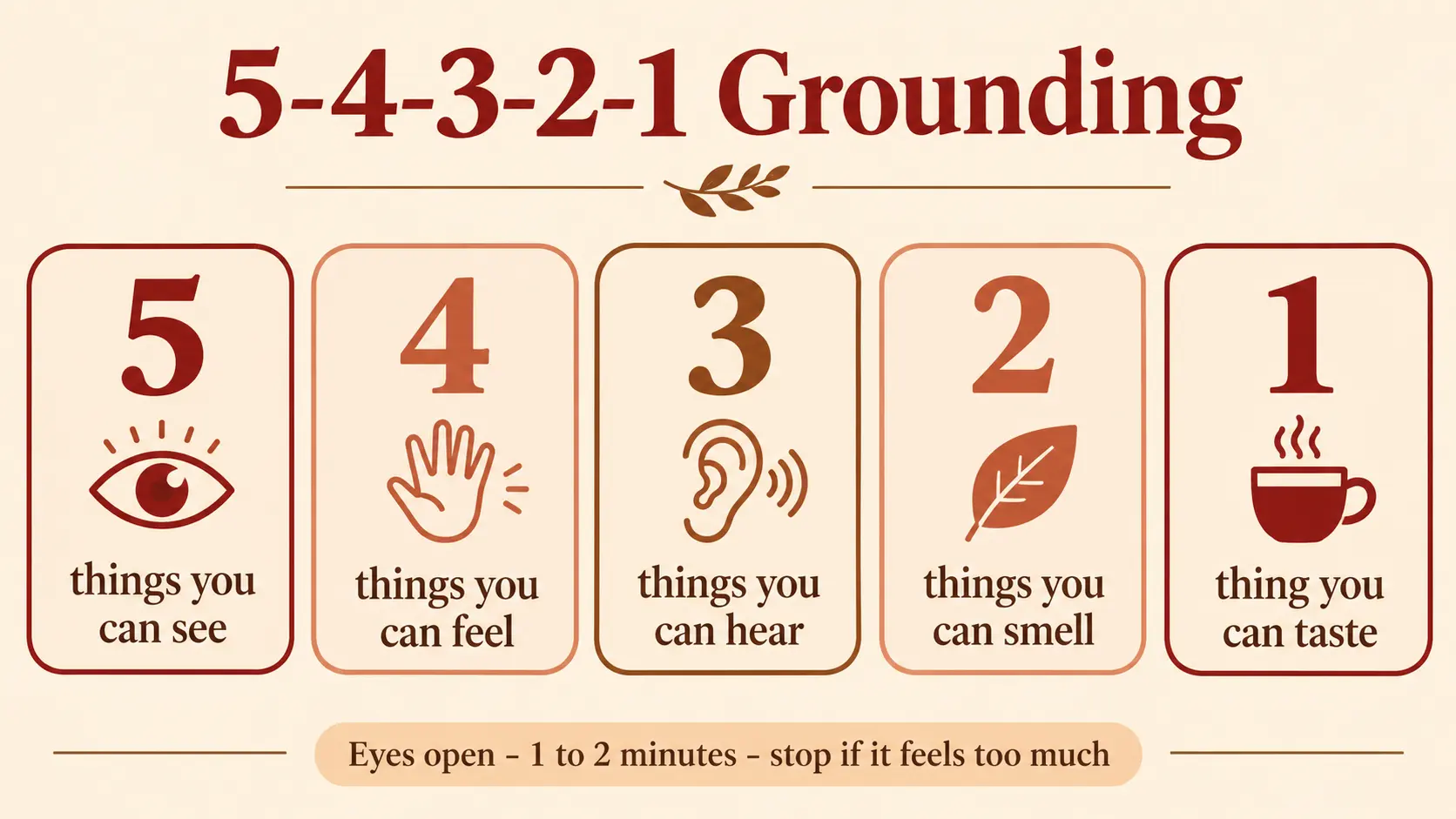
This can be done anywhere (on public transport, in meetings), and can be repeated as often as you like.
Feet, Legs and Slow Movement
Feeling your feet on the floor is the most basic root chakra exercise. The following can be done for 3-5 minutes.
- Sitting or standing, press your feet firmly into the ground and take 5 slow breaths.
- Press your hands into a wall for a few breaths, allowing your legs to bear the weight.
- Walk slowly for 2-3 minutes. Notice how you are placing each foot down. If possible, walk barefoot on grass.
For more grounding techniques, please see the guide on how to unblock the root chakra. Most of the exercises can be done here at a slower pace.

Breath That Calms Rather Than Stirs
Fast breathing or holding your breath for a long time may cause old feelings to resurface. Try making your exhalations longer than your inhalations: breathe in for 4 counts and out for 6 counts, for 2-3 minutes. For gentle breathing exercises, please see our page on root chakra breathing, and use them for only a few minutes.
Meditation and Affirmations, With Care
Once you are comfortable with the above exercises, you may wish to try a short root chakra meditation. To stay within your window of tolerance, start with about 5 minutes and keep your eyes half open. If the images or memories become too intense, stop. Affirmations work best if they feel authentic. Saying "I am completely safe" may not feel true to you. Instead, "I'm okay in this room right now" is something you can check. Try different affirmations from our list of root chakra affirmations, choosing ones that do not create tension in you.
Making Daily Life Feel Safer
Many aspects of everyday life relate to the root chakra. Eating regularly, going to bed at a regular time most nights, having a small tidy area of your own, having a simple budget plan, and having a few people you can call can all be seen as root chakra work. These may be more important than doing specific exercises.
| Practice | Trauma-sensitive way to do it | Stop or change if… |
|---|---|---|
| 5-4-3-2-1 grounding | Eyes open, 1-2 minutes, anywhere | You feel more anxious - just look around the room instead |
| Feet and legs | Press the feet down for 5 breaths, push against a wall, walk slowly for 2-3 minutes | You feel dizzy or unsteady - sit down |
| Calm breathing | In for 4, out for 6, for 2-3 minutes; no fast breathing or long holds | You feel short of breath - go back to normal breathing |
| Meditation | About 5 minutes, eyes half open | Memories or images become too strong - open your eyes and name what you see |
| Affirmations | Pick lines you can check, such as "Right now, in this room, I'm okay" | A line makes you tense up - choose a different one |
Root Chakra Trauma Release: What Does It Mean?
You may notice the term "trauma release" in many places within chakra and bodywork. Generally, it refers to releasing tension in the body. Tension may be released through a deep breath, a yawn, shaking in the legs, tears, warmth or sudden feelings. Within chakra theory, this would be seen as the root chakra releasing what it held.
However, a more precise way to think about this is that your nervous system is calming, or held-back feelings are surfacing. There is no evidence that anything is leaving the chakra. While this can be a positive sign, it is not the aim of the practice. Trying to encourage this release may push you out of your window of tolerance. Allow the feelings to come and go, keep your eyes open, and if it gets too intense, stop. If intense reactions occur regularly, it would be best to work through this with a therapist.
Chakra Work and Trauma Therapy Together
While chakra practices may help you to feel calmer in between sessions, they are not a treatment for trauma. Therapies with strong evidence for treating PTSD include cognitive processing therapy, prolonged exposure and trauma-focused CBT. EMDR is also widely recommended (American Psychological Association). Some people also benefit from body-based therapy, such as somatic experiencing. However, research in this area is still in its early stages and less established (Kuhfuß et al., 2021). For a clear explanation of PTSD and its treatment, please refer to the National Institute of Mental Health.
The two can work very well together. A good trauma therapist will likely teach many grounding techniques very similar to those above. The idea that trauma affects not only mental health but also the body became widespread thanks to Bessel van der Kolk's book The Body Keeps the Score. However, not all claims in this book have been confirmed. If you use chakra practices, let your therapist know so that they can support you in incorporating them safely.
ADVERTISEMENT: CONSCIOUS CRYSTALS - 7 CHAKRA COLORS SPECIAL DEALS
Buy Real Chakra Stones and Crystal Jewelry
Explore Full Collection
When to See a Therapist
If any of the following apply to you, please consider seeking help from a therapist or doctor:
- frequent unwanted memories or flashbacks
- avoiding people, places or activities because they remind you of the event
- not sleeping well for weeks, or feeling numb most of the time
- coping through drinking, eating or other habits
- thoughts of hurting yourself
If you are in crisis in the USA, please call or text 988 to reach the 988 Suicide and Crisis Lifeline. If you are elsewhere, please contact your local emergency services, or find a free helpline in your country using Find A Helpline.
Sources
- Anodea Judith, Eastern Body, Western Mind (1996, revised 2004): chakra one, rights, traumas and abuses.
- Erik H. Erikson, Childhood and Society (1950): trust versus mistrust.
- Yehuda R, Lehrner A. Intergenerational transmission of trauma effects: putative role of epigenetic mechanisms. World Psychiatry. 2018;17(3):243-257.
- American Psychological Association, Clinical Practice Guideline for the Treatment of PTSD (2017, updated 2025).
- Kuhfuß M, Maldei T, Hetmanek A, Baumann N. Somatic experiencing - effectiveness and key factors of a body-oriented trauma therapy: a scoping literature review. Eur J Psychotraumatol. 2021;12(1):1929023.
- Bessel van der Kolk, The Body Keeps the Score (2014).
- National Institute of Mental Health, "Post-Traumatic Stress Disorder".
Frequently Asked Questions About Root Chakra Trauma
What are the symptoms of root chakra trauma?
Chakra teachers describe signs linked with safety: being on guard all the time, trouble resting or sleeping, panic about money, food or housing, feeling numb or "not in your body", and trouble trusting people. None of these on its own means you have trauma, and many have everyday causes too.
Can childhood trauma affect the root chakra?
In chakra teaching, yes: the root chakra is said to develop first, so early neglect, instability or not having enough is linked with it most often. Psychology describes something similar in its own terms, as the early stage where a child learns whether the world is safe. Many people with a hard start still build steady lives.
Can root chakra trauma cause anxiety?
Trauma can leave the nervous system on alert, which often feels like anxiety, and chakra teachers describe this as the root chakra tightening to protect you. If anxiety is strong, frequent or getting in the way of daily life, talk to a doctor or therapist; grounding practices can help alongside treatment, not instead of it.
Can root chakra meditation make trauma symptoms worse?
It can. Long meditation with closed eyes sometimes brings up panic or strong memories in people with trauma. Keep it to about five minutes, keep your eyes half open, and stop if it becomes too much. If this happens often, work with a trauma-informed therapist.
How long does it take to heal root chakra trauma?
There is no set timeline, and it is different for everyone. Small steps, such as a minute of grounding each day, regular meals and sleep, and support from a therapist, tend to help more than trying to move quickly.
What does root chakra trauma release mean?
Practitioners use it for moments when the body lets go of tension during a practice, such as sighing, yawning, trembling or tears. A careful way to see it is the nervous system settling or held-back feelings coming up. It isn't the goal, so don't chase it, and stop if it feels too strong.
What is the difference between root chakra trauma and a blockage?
In chakra language, a blockage is a general imbalance, such as feeling scattered or worried about money for a while. Trauma follows a real threat to your safety, runs deeper and can be triggered by reminders, so the same practices are done shorter, with eyes open, and next to proper support.
Begin simply: next time you sit down, press your feet into the floor, look around the room and take a few breaths. Once this feels easy, good next steps are:
-
Root chakra healing
- grounding methods and a 7-day plan
-
Root chakra healing meditation
- a guided script, eyes open if you prefer
-
Root chakra healing affirmations
- short lines that feel believable