
Root Chakra Frequency: 396 Hz, LAM Mantra and Healing Sounds
Root chakra frequency: 396 Hz and 256 Hz, the LAM mantra, the note, healing music and how to use sound to ground and balance Muladhara.
Table Of Contents
The root chakra frequency most often used is 396 Hz, the first tone of the modern Solfeggio scale. Other systems give the root chakra 256 Hz (the note C), 256.87 Hz for singing bowls or 216 Hz on a Pythagorean scale. Its seed mantra is LAM. Most people listen to a low tone or chant LAM for 10-15 minutes while sitting or lying still.
- Solfeggio frequency: 396 Hz
- Musical note: C (256 Hz)
- Pythagorean scale: 216 Hz
- Singing bowl: 256.87 Hz
- Seed mantra (bija): LAM
- Element: earth
- Colour: red
- Location: base of the spine
- Session length: 10-15 minutes
Sound is one of the oldest ways people work with the root chakra, the energy centre teachers place at the base of the spine. It works best next to the other grounding habits in the guide on how to unblock root chakra energy, such as walking barefoot and slow breathing.
ROOT CHAKRA · MULADHARA
396
Hz
Solfeggio frequency
Volume15%
Duration00:00
What Is the Root Chakra Frequency?
While there is no universally agreed frequency, within most playlists and resources, the frequency given is 396 Hz. However, depending on the tuning system followed by the teacher or instrument maker, there are at least four different commonly used frequencies.
Within a Solfeggio tuning system, this chakra is given a frequency of 396 Hz. Within note tuning systems however, this chakra is given a note of C. This note is commonly given a frequency of 256 Hz (used by many tuning fork makers). However, singing bowls made for chakra work are often given a frequency of 256.87 Hz, tuning into the C note using 432 Hz as a tuning reference. Alternatively, within the Pythagorean tuning system on our chakra frequencies page, this chakra is given a starting frequency of 216 Hz (an octave below 432 Hz).
However, on tuning forks, you may also find a frequency of 194.18 Hz. This figure was calculated by Hans Cousto, a Swiss mathematician, in his book The Cosmic Octave. He turned the length of the Earth's rotation into a sound many octaves higher, resulting in this "Earth day" frequency. The chakra tuning fork sets built on Cousto's numbers use it as the root chakra fork, because of its connection with Earth.
Which root chakra frequency in Hz should I choose? If using pre-recorded music, 396 Hz is the easiest to access. If purchasing an instrument, a low C singing bowl or a 256 Hz tuning fork will most likely be a root chakra instrument.
The table puts the six root chakra frequencies you will come across side by side.
| System | Root chakra frequency | Where the number comes from |
|---|---|---|
| Modern Solfeggio | 396 Hz | Joseph Puleo's six tones (1970s), made popular in 1999; 396 Hz is "UT" |
| Note C, scientific pitch | 256 Hz | Every C is a power of two; used by many tuning fork makers |
| Note C, A = 432 Hz | 256.87 Hz | Singing bowls tuned to the 432 Hz standard |
| Note C, A = 440 Hz | 261.63 Hz | Middle C on a modern piano |
| Pythagorean scale (432 Hz heart) | 216 Hz | Half of 432 Hz, one octave below the heart tone |
| The Cosmic Octave (Hans Cousto) | 194.18 Hz | The Earth day tone: one solar day raised 24 octaves |
These are tuning conventions and modern associations, not measured frequencies of the chakra. 396 Hz is not a C either: on a piano tuned to A = 440 Hz it sits close to G (392 Hz), and Cousto's 194.18 Hz is a G an octave lower.
Root Chakra Mantra: How to Chant LAM
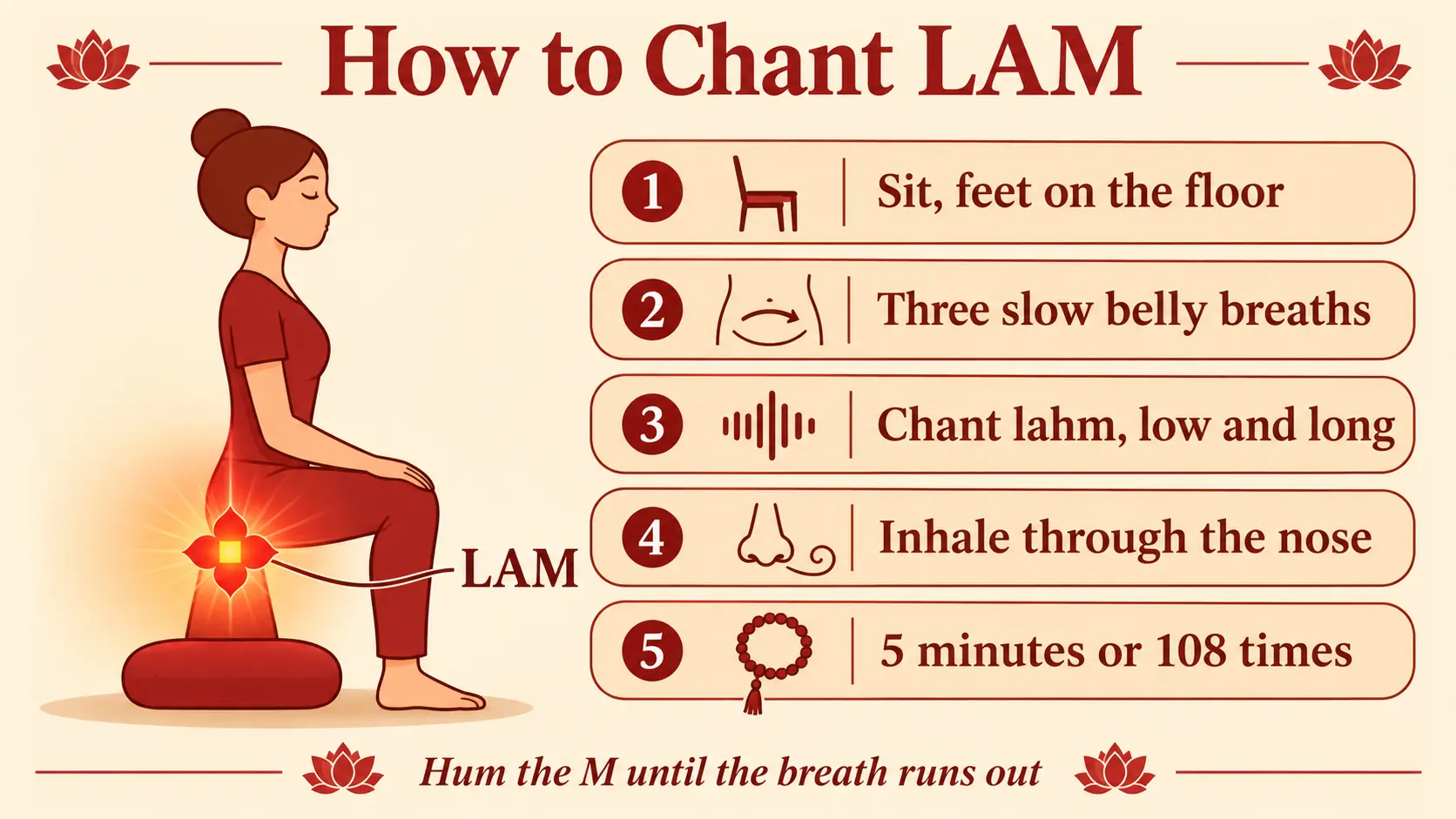
The root chakra mantra is LAM. In The Serpent Power, Arthur Avalon's translation of the 16th-century Sanskrit text Sat-cakra-nirupana, the word LAM is found in the centre of the four-petalled Muladhara lotus. It is in a square representing the earth. It is pronounced more like "lahm", with a prolonged humming "m" at the end.
No instrument is required here, so this is a good place to begin.
- Sit on a cushion or chair with both feet flat on the ground and with a straight but relaxed back.
- Breathe in deeply to your belly three times.
- Exhale and chant "lahm". Make sure to prolong the "m" as much as possible. Try to make this sound as low as is comfortable.
- Inhale through your nose. Repeat this process. Try to focus on the bottom of your spine and the contact point between your body and the seat.
- Repeat for around 5 minutes, or 108 times on a mala.
Some people may wish to chant loudly, whisper or simply visualise saying the word. All of these methods are commonly used. If your voice is straining or cracking, or if this pitch is difficult to produce, try a slightly higher pitch. This should vibrate in your body, not cause pain to your throat.
Root Chakra Music and Sound Tools
Using pre-recorded root chakra music is an easy option. However, using physical tools may be a more physical experience. Three tools commonly used to support the root chakra are given below, from easiest to most physical.
Singing Bowls
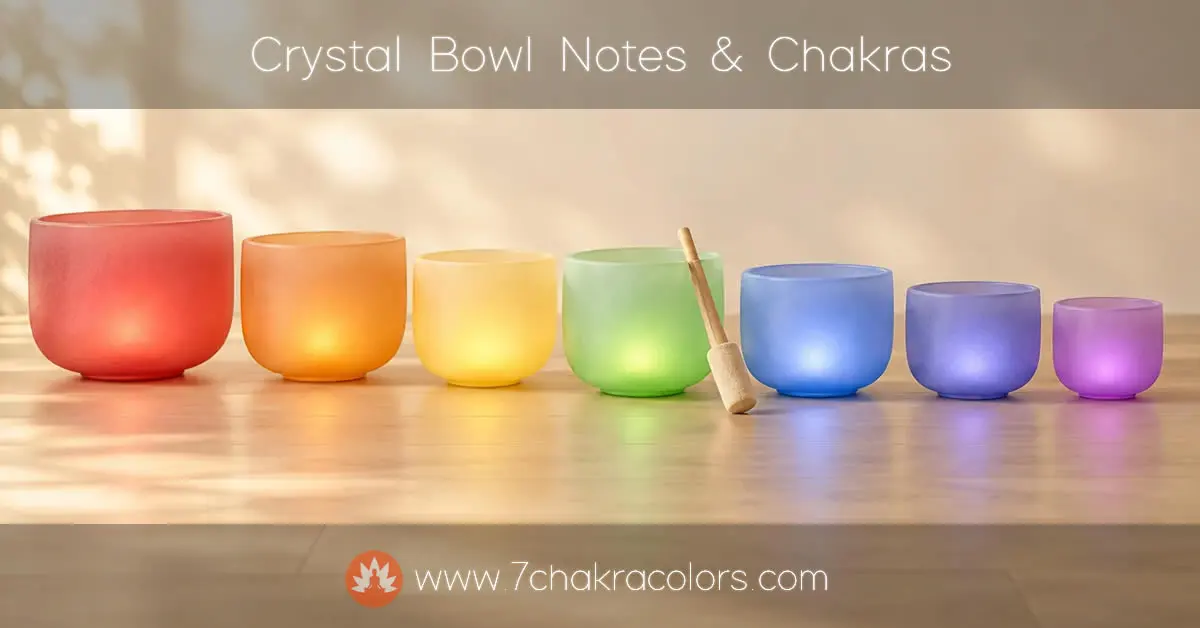
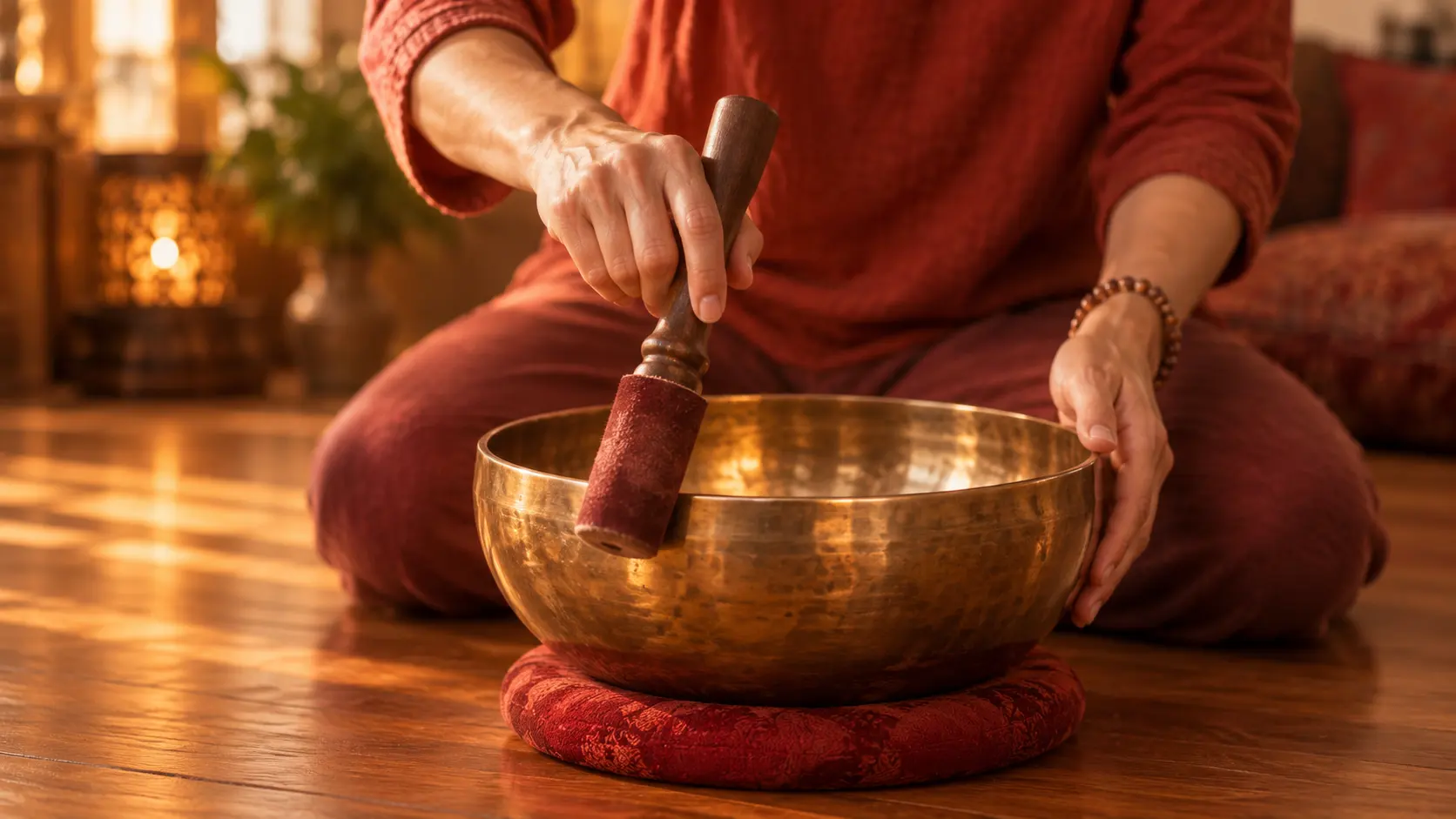
A singing bowl used for the root chakra is generally one of the larger bowls in a collection. It should be tuned to a C. Using a crystal bowl will create a pure tone, whereas a metal bowl will create a richer sound with more overtones. To make this sound, gently strike with the mallet or slowly rub the mallet across the edge. Place it on a cushion on the floor in front of you so you can feel the vibrations.
Tuning Forks
Heavy tuning forks (with small discs at each end) are intended to be felt, rather than heard. Tap the fork onto your knee or a rubber disc and hold it against your body. In relation to the root chakra, a 256 Hz or 194.18 Hz tuning fork is often placed at the top of the foot, the knee or the sacrum. Light or non-weighted forks can be held near the ear. Do not place forks on new injuries or painful bones.

Drums and Low Music
Long before chakras were mapped out, many cultures used drumming to ground. Using a frame drum, or a rhythm on a surface (around the same tempo as a slow heartbeat), can perform a similar grounding function to a singing bowl. Search for 396 Hz songs, or root chakra songs with no sudden changes. If possible, play through speakers so you can physically feel the lower notes in the floor.
ADVERTISEMENT: CONSCIOUS CRYSTALS - 7 CHAKRA COLORS SPECIAL DEALS

Buy Real Chakra Stones and Crystal Jewelry
Explore Full Collection

How to Use Root Chakra Healing Frequency: A 15-Minute Session
The easiest way to practise this root chakra healing frequency is to combine listening and chanting. Doing this for 15 minutes once per day is sufficient.
Begin with 2 minutes of slow belly breathing. The page on root chakra breathing has a few easy ones. Next, sit or lie down with both feet flat on the floor and play the 396 Hz frequency for around 6 minutes. You can use the player at the top of this page. Next, chant LAM for 5 minutes. Finally, sit in silence for 2 minutes, becoming aware of the sensations in your feet, legs and the weight of your body.
| Minutes | What you do | Sound |
|---|---|---|
| 0-2 min | Slow belly breathing, feet flat on the floor | Silence |
| 2-8 min | Sit or lie down and listen | 396 Hz in the player above, or a C bowl |
| 8-13 min | Chant LAM on each out-breath | Your own voice |
| 13-15 min | Sit still and feel your feet, legs and the weight of your body | Silence |
If you would like guidance on this practice including a body scan and visualisation, try the root chakra meditation. Play the frequency at a low volume in the background.
Some people find it better to do this in the morning, some in the evening. More importantly, try to do it at a similar time every day for a few weeks, and notice how you feel after, rather than during.
Why 396 Hz? Where the Solfeggio Numbers Come From
While most websites suggest that these frequencies are ancient, in reality this is a more recent development.
The origin of the names relates to a hymn praising John the Baptist, called Ut queant laxis. Around 1025, a monk called Guido d'Arezzo used the first syllable of each line of this hymn to teach singers about a scale (ut, re, mi, fa, sol, la), hence "do-re-mi". However, no frequencies were associated with these notes in the hymn itself. Pitch was not measured in hertz until the 19th century.
Numbers were assigned much later. In the 1970s, an American man named Joseph Puleo claimed to have discovered six frequencies using numerology on verses of Numbers in the Bible. These were popularised by Leonard Horowitz and Joseph Puleo in 1999, in the book Healing Codes for the Biological Apocalypse. In this list, we get the frequency of 396 Hz, referred to as "UT". This frequency is meant to release fear and guilt, and as such, sound healers began to associate it with the root chakra, related to safety and survival.
Although, this doesn't mean that using 396 Hz is not useful. Many people find it calming and pleasurable to relax to. However, it is important to know that the connection between the root chakra and 396 Hz is a modern teaching, not an ancient one. Also, there is no scientific evidence to suggest that any specific frequency in this approximate range will be more effective than another.
Root Chakra Note: C and 256 Hz
With Western tuning systems, each chakra is related to a note in the C major scale, with the root chakra being the first (C).
However, you may be confused. If you are using a modern piano (tuned to A = 440 Hz), middle C will be 261.63 Hz, not 256 Hz. However, this figure relates back to an older scientific tuning, where every C note is a power of 2 (128, 256, 512). Many tuning forks are still made to this tuning, as it gives clean numbers. If tuning to A = 432 Hz, you get around 256.87 Hz. All of these frequencies relate to the note C, however in slightly different places within the scale. They are close in pitch, but you may hear a slight difference if you play them one after another.
Sometimes you may find a note much lower than middle C (one or two octaves below), however this is fine. As the root chakra is connected to the earth element, a deep sound (felt in the chest and abdomen), rather than a bright sound, is more appropriate for this chakra, regardless of the exact frequency.
Does Root Chakra Sound Healing Work?
There is some evidence that meditating to sound can help people relax, however there is no evidence to support that a specific frequency helps a specific chakra. This should be noted as many pages state otherwise.
One small study took place in California in 2017. Sixty-two adults completed mood questionnaires before and after a singing bowl meditation. Participants reported feeling less tense, angry, tired and in a bad mood. Those who had never done this practice before felt the most benefit (Goldsby et al., 2017). However, as there was no control group in this experiment, we cannot determine how much change in feelings was caused by the singing bowls, and how much was due to resting in a calm environment.
Overall therefore, consider 396 Hz a pleasant way to slow down and become aware of your body, as intended with root chakra practices. If it makes you feel calmer and grounded, then it's a good reason to do it.
ADVERTISEMENT: CONSCIOUS CRYSTALS - 7 CHAKRA COLORS SPECIAL DEALS
Buy Real Chakra Stones and Crystal Jewelry
Explore Full Collection
Safety: Volume, Hearing and When to Get Help
Although this is a gentle practice, care should be taken with your hearing. Keep the volume low (especially when using headphones) and take frequent breaks. Both of these recommendations are advised by the World Health Organization.
- If a sound causes ringing in the ears, a headache, dizziness or anxiety, stop using it.
- If you suffer from tinnitus or sound sensitivity, begin with very quiet sessions or try chanting instead.
- Do not place heavy tuning forks on injured areas, swollen joints or the stomach in pregnancy.
- Do not drive vehicles or operate machinery while listening to relaxing music.
Whilst frequencies and mantras can be a beneficial self-care tool, they should not be used in place of medical or mental health support. If you are feeling anxious, unsafe or low for more than a couple of weeks, speak to a doctor or therapist.
Sources
- Arthur Avalon (Sir John Woodroffe), The Serpent Power (1919), translation of the Sat-cakra-nirupana: Muladhara, the four petals, the square of earth, the bija LAM.
- Hans Cousto, The Cosmic Octave: the Earth day tone, 194.18 Hz, used as the root chakra fork in planetary tuning fork sets.
- Leonard G. Horowitz and Joseph S. Puleo, Healing Codes for the Biological Apocalypse (1999): the six Solfeggio frequencies.
- Goldsby TL, Goldsby ME, McWalters M, Mills PJ. Effects of Singing Bowl Sound Meditation on Mood, Tension, and Well-being: An Observational Study. J Evid Based Complementary Altern Med. 2017;22(3):401-406.
- de Witte M, Spruit A, van Hooren S, Moonen X, Stams GJ. Effects of music interventions on stress-related outcomes: a systematic review and two meta-analyses. Health Psychol Rev. 2020;14(2):294-324.
- World Health Organization, "Deafness and hearing loss: safe listening" (questions and answers).
Frequently Asked Questions About Root Chakra Frequency
What frequency is the root chakra?
The root chakra frequency quoted most often is 396 Hz, the first tone of the modern Solfeggio set. Systems based on musical notes give the root chakra the note C instead, which is 256 Hz in scientific pitch, about 256.87 Hz on bowls tuned to A = 432 Hz and 261.63 Hz on a modern piano. The Pythagorean scale on our chakra frequencies page uses 216 Hz. None of these numbers has been measured in the body; they come from different tuning traditions.
Is the root chakra frequency 256 Hz or 396 Hz?
Both are used, by different systems. 396 Hz comes from the modern Solfeggio list, while 256 Hz is the note C in scientific pitch, the note that chakra-and-music charts give the root. They are not the same pitch: 396 Hz is close to a G. If you listen to recordings, 396 Hz is the easiest to find. If you buy an instrument, a bowl or fork tuned to C is what shops usually sell as a root chakra tool.
Is 432 Hz a root chakra frequency?
Not directly. 432 Hz is a tuning standard, an alternative to the usual A = 440 Hz, and the Pythagorean scale on our chakra frequencies page uses it as the heart chakra tone. The root chakra values that come from it are 216 Hz, one octave below, and 256.87 Hz, the note C when an instrument is tuned to A = 432 Hz. That is why many root chakra singing bowls are sold at 256.87 Hz.
What are the benefits of listening to the root chakra frequency?
Teachers say a low, steady tone helps you feel grounded, calm and more aware of your body. The research is about music and relaxation in general, not about chakras or one exact frequency: a 2020 review of 104 controlled trials (de Witte and colleagues, Health Psychology Review) found that music lowered both physical and felt stress. So 396 Hz can be a useful focus for a calming routine, but there is no evidence that it unblocks or heals the root chakra itself.
How long should I listen to 396 Hz?
Five to 15 minutes once a day is plenty. Start with five minutes at a low volume, using the timer in the player on this page, and build up to the full 15-minute session if you like it. Longer is not better: a pure tone can start to feel tiring or irritating, and if it gives you a headache, ringing in the ears or dizziness, stop and try chanting LAM instead.
Do I need headphones for root chakra frequencies?
No. Speakers work well and are often better for low tones, because you feel them through the floor and in your body as well as hear them. Small phone speakers play 194 to 256 Hz quite quietly, so use a better speaker or headphones if the sound is faint. With headphones, keep the volume below about 60 percent of the maximum, as the World Health Organization advises for safe listening, and take breaks.
Can I listen to the root chakra frequency while sleeping?
You can play it quietly as you fall asleep, but set a timer, for example 15 or 30 minutes, rather than leaving a tone on all night. Use a speaker rather than headphones in bed, keep the volume low and stop if the sound keeps you awake. It is a relaxation aid, not a sleep treatment, so if poor sleep goes on for weeks, talk to a doctor.
Try chanting LAM for 5 minutes before bed tonight. If you enjoy it, combine it with the 396 Hz track to complete the practice. For further suggestions, try:
-
Root chakra healing meditation
- a guided meditation to do alongside
-
Root chakra healing
- the full method
-
Root chakra affirmations
- quick affirmations to do after chanting