

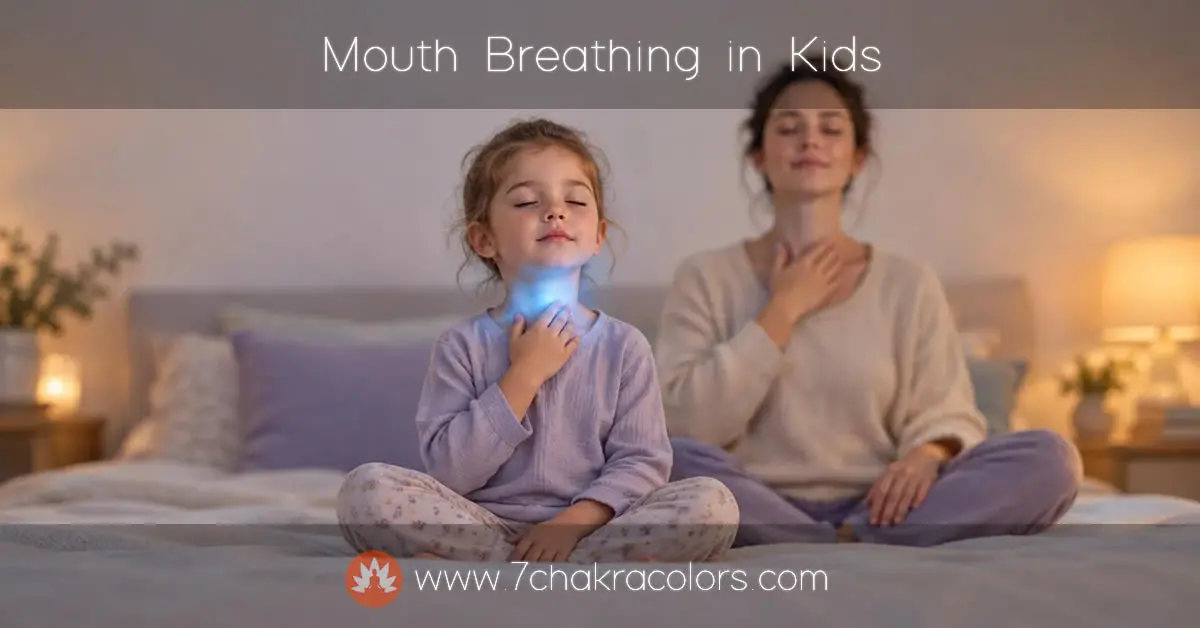
Why Is My Child Mouth Breathing? A Throat Chakra and Breath Perspective
Why is your child mouth breathing? See when enlarged adenoids are the cause, what treatment involves, and gentle throat chakra breathing games for kids.
Table Of Contents
Most parents notice it at night first. You put your head round the door before bed and your kid is flat out with their mouth hanging open, making that small snoring noise, and in the morning there’s a wet spot on the pillow. Is child mouth breathing a problem, or just one of the odd things kids do? Fair question, and the honest answer is that it depends on what’s behind it.
Sometimes it really is nothing. A cold, a stuffy week in pollen season, or an hour of running around the garden will leave any mouth hanging open for a while, and it closes again on its own.
When it doesn’t close, it deserves a proper look. I come at this from the energy side, through the throat chakra and the old yogic idea that breath belongs in the nose. Honestly, though, the first question is a physical one.
Could It Be Enlarged Adenoids? Check the Body First
So, adenoids. They’re a lump of soft tissue tucked up behind the nose, at the spot where the nose bends down into the throat, and no amount of torch-shining into an open mouth will show you them. I suspect that’s half the reason they get missed. They’re immune tissue – related to the tonsils and doing a similar job – and they tend to be at their biggest somewhere between about three and seven years old. After that they usually start shrinking, and by the teenage years there’s often very little left.
Trouble starts when they swell and stay swollen. That can happen after one cold too many, with allergies, or simply because some children are born with large ones. The back of the nose gets partly plugged, and air has to come in the only other way available.
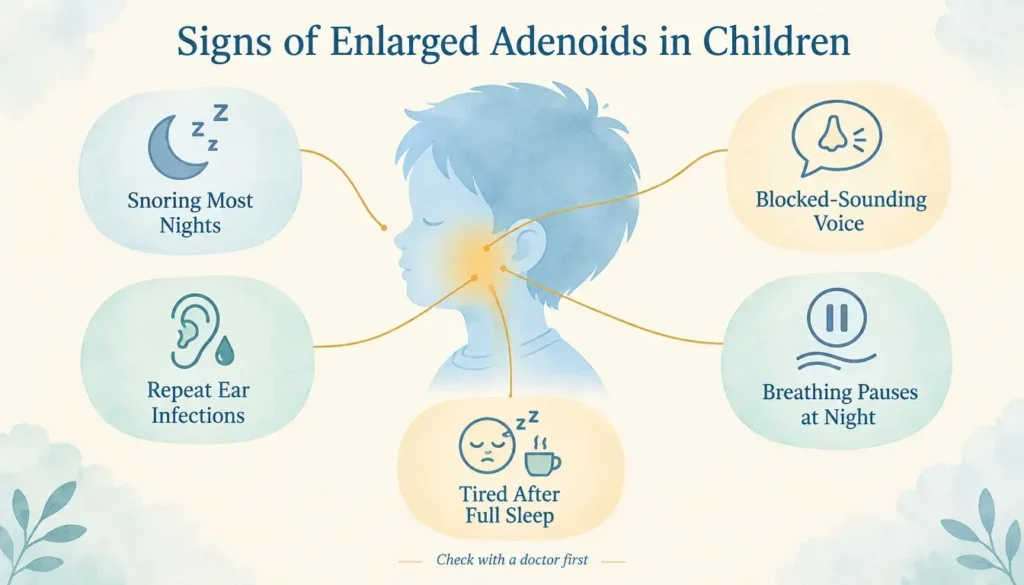
Signs parents often pick up on:
- Snoring most nights, not just when there’s a cold going round
- A voice that sounds blocked even though the nose isn’t running
- Ear infections that keep coming back, or a child who says “what?” far more than they used to
- Little pauses in breathing at night, sometimes ending in a gasp or a restless flip onto the other side
- A full night’s sleep on paper, and still a grumpy, droopy kid at breakfast
What Is an Adenoidectomy Like for a Child?
If an ENT doctor takes a look and decides the adenoids really are in the way, they’ll usually suggest an adenoidectomy. Big word, simple idea – the adenoids come out. It’s one of the most routine operations in children’s ENT. Your child sleeps through it under general anaesthetic, it’s all done through the mouth so there’s nothing to see on the face afterwards, and most kids are home by evening. After that, figure on about a week off, living on ice cream and yoghurt and probably more TV than you’d normally allow.
Will losing them weaken the immune system? Parents ask this all the time, and ENT doctors are pretty consistent about it – no, children do perfectly well without them.
How Much Does Adenoid Removal Cost?
That depends hugely on where you live and how you’re insured, so there isn’t one number to give you. Singapore is a handy example because clinics there publish their ranges openly. A standard adenoidectomy at a subsidised restructured hospital runs about S$2,000 to S$3,000, private hospitals sit nearer S$5,000 to S$8,000, and Medisave can cover up to S$950 of it. If you want to see how the bill splits between surgeon, anaesthetist, theatre time and follow-ups, this adenoidectomy price guide in Singapore goes through each piece.
Prices elsewhere will look different, but I’d still ask for a written estimate before anything gets booked. The surgeon’s fee is rarely the whole bill.
What If the Nose Is Clear and the Mouth Still Stays Open?
Funnily enough, adenoids aren’t always the answer. A child can get the all-clear from the doctor, or have the adenoids out already, and still sit there with their mouth open the minute they stop concentrating.

Usually that’s habit. A long winter of colds teaches the body that the mouth is the easy route, and the body keeps using it long after the nose has cleared. Watch your child in front of a screen or bent over a drawing and you’ll often catch it then – lips parted, jaw hanging, no idea they’re doing it.
Habits can be retrained, though, and kids tend to pick up a new one faster than we do.
Is It Enlarged Adenoids or Just Habit? How to Tell
Only a doctor can say for sure, but the clues usually lean one way or the other. If you’re trying to get a feel for it before an appointment, watch your child for a week or so and see which column sounds more like them.
| What You Notice | Points Toward Enlarged Adenoids | Points Toward Habit |
|---|---|---|
| Mouth during the day | Open most of the time, even when calm and resting | Open mainly when absorbed in a screen or drawing, closes when reminded |
| Breathing with lips closed | Gets uncomfortable or short of air within a minute | Can breathe through the nose easily when asked |
| Sleep | Loud snoring most nights, sometimes pauses or gasps | Fairly quiet sleep, mouth maybe a little open |
| Ears and voice | Repeat ear infections or a blocked-sounding voice | No real pattern of ear trouble, voice sounds normal |
| Cold mirror test | Faint clouds, or hardly any, when breathing out through the nose | Two clear clouds on the glass |
| Best next step | Book a pediatrician or ENT appointment | Nose-breathing games and gentle reminders, with a check-up if unsure |
What Does the Throat Chakra Have to Do With Breathing?
Vishuddha, the throat chakra, mostly gets talked about as the chakra of the voice. Being heard, saying what you mean, that sort of thing. What tends to get skipped is how much of the body the tradition hands to it: the throat and neck, the jaw and mouth, and the ears as well. It’s the fifth of the seven, usually pictured as a sky-blue lotus at the base of the neck – and its element is space, or akasha, the emptiness that lets sound travel.

I find that map interesting with a mouth-breathing child in mind. The hanging jaw and the snoring throat sit squarely in Vishuddha’s patch, and so do those ears that keep filling up with fluid. I’m not saying the chakra causes any of it. What I’d say is that if you work with energy at all, this is the center that asks for attention here.
The name itself is a nice clue. Shuddhi means purification, and Vishuddha is often translated as something like “especially pure.” In the yogic view, this is where what comes in gets cleaned up before it goes any deeper – air included.
The Yogic Case for Breathing Through the Nose
Yoga has always treated the nose as the proper doorway for prana. Two of the main energy channels, ida and pingala, are said to end at the left and right nostrils, ida cooling and moon-like, pingala warming and sun-like, and a lot of pranayama is really about balancing the two.
Here’s a fact I love. Your nostrils actually take turns. Try it now, actually – one side probably feels a bit freer than the other. Give it a few hours and they’ll most likely have swapped. Doctors call it the nasal cycle – and the old swara yoga texts were describing the same thing centuries before anyone measured it.
The modern explanation for why the nose matters lines up surprisingly well. It warms the air, moistens it and filters out a fair bit of dust before anything reaches the lungs. The sinuses also release nitric oxide, a gas the body uses in the airways, and in a small study of adults at the Karolinska Hospital in Stockholm, humming raised the nitric oxide levels in the nose about fifteen times compared with breathing out quietly.
Nose-Breathing Games That Actually Work for Kids
Telling a six-year-old to “close your mouth” works for about eleven seconds. Games last longer. None of these will open a nose that’s physically blocked, so they’re for the habit side of things, after a doctor has had a look.
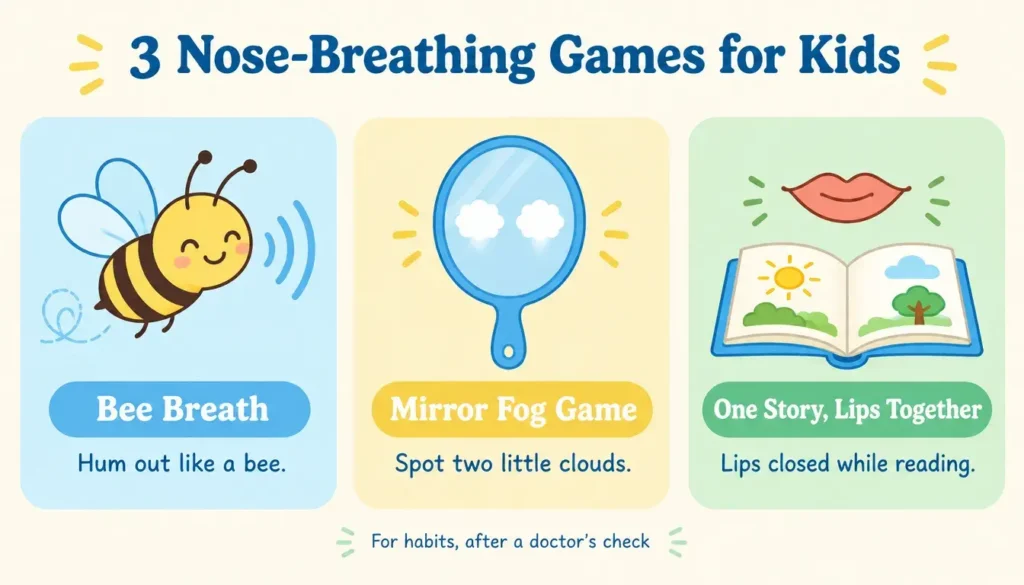
Bee Breath (Bhramari)
If yoga ties one practice to the throat chakra above the rest, it’s this one, and Yoga International has a short piece on bhramari as a throat chakra practice if you’d like the grown-up version. With kids I’d keep it loose. You sit across from each other with your mouths shut, take a breath in through the nose, and hum it out slowly and as low as you can go, which to a child sounds exactly like a bee stuck in the room. Thumbs in the ears makes the buzz louder inside the head. Most kids discover that by accident and then won’t do it any other way. Five or six bees is plenty. If they giggle halfway through, let them – it still counts.
The Mirror Fog Game
- Pop a small hand mirror in the fridge for ten minutes so it’s nice and cold.
- Have your child hold it just under their nose, lips closed, and breathe out slowly.
- Two little clouds should appear on the glass, one for each nostril.
- Ask which cloud is bigger today. That’s the nasal cycle showing up right there, and it turns into a small daily experiment.
One Story, Lips Together
Pick a short bedtime story and make one rule: lips stay together while you read. A few things that help it stick:
- A tiny sticker on the back of their hand as a reminder
- Letting them catch you if your mouth drops open (they’ll love that)
- Stretching to two stories once one feels easy
A Short Bedtime Routine for Your Child’s Throat Chakra
This one’s quieter than the games, and it slots in somewhere between brushing teeth and lights out.
- Turn the big light off. A blue nightlight is a nice nod to Vishuddha’s color, but honestly any soft lamp is fine.
- Get comfy on the bed together and have your child lay a hand on the front of their neck, just resting there.
- In through the nose for a slow four, out as a hum. Do the bee three or four times – their fingers will feel the throat buzzing, and kids tend to find that fascinating.
- Have them picture a small blue light in their throat getting a little brighter with each hum.
- Finish by saying one thing each about the day, out loud. It doesn’t have to be deep. “The soup was too hot” counts.
Crystals are a lovely addition if your family likes them. Blue lace agate is the one I’d go for with children – soft-colored and gentle – and sodalite works well too. One rule, though: the stone lives on a shelf or the windowsill, not under the pillow. Little tumbled crystals are just the right size to end up in a small child’s mouth.
When to See a Doctor About Mouth Breathing in Children
I love this kind of work, but I’m not going to pretend humming fixes an airway. Mouth breathing in children that goes on for months or years can change how the jaw and face grow and how the teeth meet, and it often comes with poor sleep. A tired child doesn’t always look sleepy, either. Sometimes they just look restless and snappy and can’t sit still, which is easy to read as a behavior problem. A pediatrician or ENT can check the airway fairly quickly, and some of the checks are almost as low-tech as the mirror game – a mirror under the nose, or a sip of water held in the mouth while the child breathes.
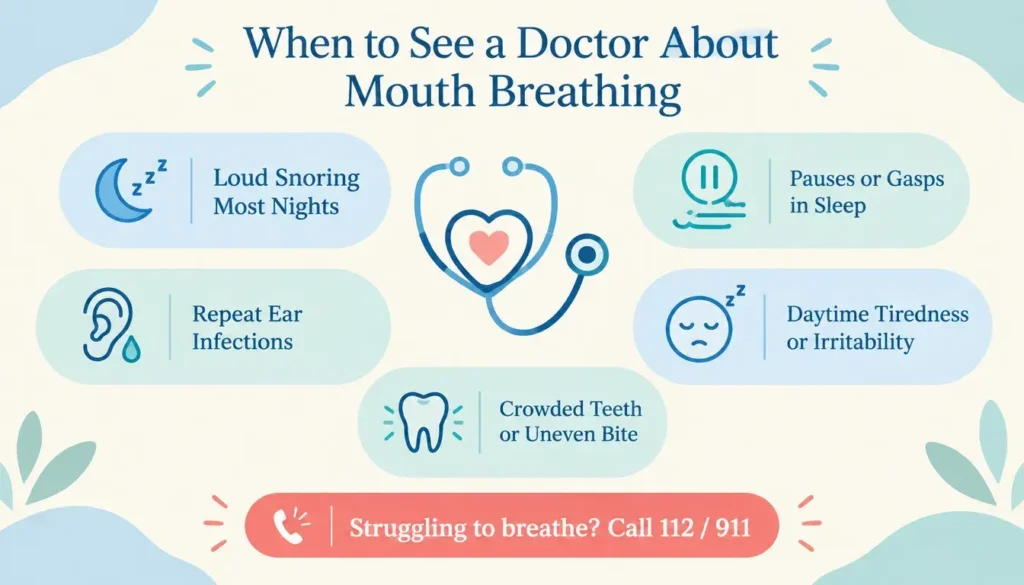
It’s worth booking a visit if you’re seeing things like:
- Snoring loud enough to hear from the hallway, most nights of the week
- Pauses in breathing or gasping during sleep
- Repeated ear infections, or hearing that seems to have dropped off
- A child who’s dozy or short-tempered during the day and struggles to settle at school
- New teeth coming in crowded, or top and bottom teeth that don’t quite meet
Don’t wait for an appointment if your child is fighting for breath, their lips or face turn bluish, or you can see the skin pulling in between their ribs as they breathe. Call emergency services straight away – 112 in Europe, 911 in the US.
Back to That Open-Mouthed Sleeper
Most of the time, a child who breathes through their mouth has either a nose that’s partly blocked or a habit that stuck around after one too many colds. Getting the first one checked is the kind thing to do. The habit takes longer to shift, and mostly it’s patience plus a fair amount of buzzing like a bee.
If you want somewhere to start, put a mirror in the fridge tonight. Tomorrow you can both see which nostril is doing more of the work.
Frequently Asked Questions About Child Mouth Breathing
Is it normal for a child to breathe through their mouth sometimes?
Yes, now and then it’s completely normal. Kids breathe through their mouths when they’ve got a cold, when hay fever blocks things up, or after a good run around outside. What’s worth noticing is mouth breathing that carries on when the nose is clear, especially at night with snoring, breathing pauses or restless sleep. If that’s been going on for more than a few weeks, it’s sensible to ask a pediatrician or ENT to take a look at the airway.
Can mouth breathing in children correct itself?
Sometimes it does. Adenoids usually start shrinking from around age seven, so some children grow into easier nose breathing on their own, and a habit left over from a run of colds can fade with a bit of gentle practice. Waiting isn’t always the right call, though. If your child snores most nights, has pauses in their breathing during sleep or keeps getting ear infections, get them checked rather than hoping it passes, since months of poor sleep can affect mood, growth and concentration.
Do adenoids grow back after an adenoidectomy?
Occasionally, yes. A small amount of adenoid tissue can be left behind, and in some children it grows back enough to cause blocked breathing or snoring again. When that happens, a second operation called a revision adenoidectomy is sometimes needed. Most kids, though, have the surgery once and simply breathe and sleep better afterwards. If snoring or mouth breathing creeps back months later, it’s worth mentioning to the ENT surgeon who did the operation so they can have another look.
Is mouth taping safe for children?
Mouth taping has become popular with adults, but I wouldn’t use it on a child, and pediatric sleep and ENT specialists generally advise against it. A child who mouth breathes at night often does it because their nose genuinely can’t take in enough air, and tape doesn’t fix that. It just removes the backup route. Young children also can’t always pull tape off quickly if they need to. Daytime games like bee breath are a far gentler way to build the habit, after a doctor has checked the airway.
Which crystals are good for a child’s throat chakra?
Blue lace agate is the gentlest choice for children. It’s a soft, pale blue stone traditionally linked to calm communication and the throat chakra. Sodalite and blue calcite are popular too, and aquamarine works nicely if you already have one. With kids, though, where the stone sits matters more than which one you pick. Keep it on a shelf, a windowsill or a high bedside table, never in the bed or within reach of a toddler, because small tumbled crystals are a real choking hazard.
How often should children practice bee breath?
A few rounds a day is plenty. Five or six slow hums at bedtime, or a couple of minutes after school, is enough for most kids, and it works best when it feels like a game rather than an exercise. Children usually enjoy it more when you do it with them and let them cover their ears to feel the buzz. If your child feels dizzy, has a blocked nose or just isn’t in the mood that day, skip it and try again tomorrow.
Can a blocked throat chakra affect a child’s speech or confidence?
In chakra tradition, Vishuddha governs expression, so a child who goes very quiet, mumbles or struggles to speak up is often described as having a throat chakra that needs some support. Humming, singing together and giving them room to be heard all fit that idea well. Real speech difficulties are a different matter, though. Delayed speech, unclear sounds or hearing problems should be checked by a pediatrician or a speech and language therapist, since ears blocked by enlarged adenoids can affect speech too.
Blog Categories:
About the Author: