

Energetic Roots of Leg Problems: Reading Your Legs Through the Root Chakra
Explore the energetic roots of leg problems – what your feet, knees and calves say about support and the root chakra, and when leg pain needs a doctor.
Table Of Contents
Stand at any bus stop on a frosty morning and just watch the legs for a while. One rocks from heel to toe. Another locks both knees and leans into a single hip, as if the pavement can’t quite be trusted to hold them. Legs give a lot away.
I keep coming back to that picture whenever I think about the energetic roots of leg problems. My hunch, and it’s a fairly old one in energy work, is that legs keep score of how held up you feel. Aching, stiff or buckling knees can say quite a bit about support, and about whether some part of you is dragging its feet. Get a diagnosis first, obviously. Then the energetic angle can fill in what the X-ray leaves blank, and hand you a few things to try at home.
What Do Legs Symbolize in Energy Healing?
Everyday speech gave this away long before anyone drew a chakra chart. Grandmothers have been telling people to stand on their own two feet for generations, nervous grooms get cold feet, and the uncle who won’t budge on where the Christmas tree goes is digging his heels in. Energy traditions simply take those sayings seriously.

Legs pull double duty. They hold you up, and they carry you somewhere. Energy healers read the first job as support – whether that’s money coming in or friends who’d show up with soup – and the second as forward movement, meaning how willing you are to step out before you can see where the path goes.
And when either one goes shaky, my guess is your legs will know before you do. You’d be surprised how often a pair of tight calves turns out to be riding along with a deadline that’s been hanging around all week. Or there’s a pending move abroad, a job you keep meaning to quit, and the knees begin to grumble every time you take the stairs. I don’t think of it as the body punishing anyone. If anything, it’s taking notes – quietly, and in a dialect much older than language.
Some of that is symbolism, sure. The rest is plain biology. Stressed muscles brace, and a hard month has a way of settling into the lower back like a lodger who won’t leave.
And Where’s the Root Chakra in All This?
Its Sanskrit name is Muladhara, though most of us just say root chakra, and it sits right down at the bottom of the spine by the tailbone. Mula is root, adhara is roughly a base to stand on. Not exactly a mystery what it does, then. This is where your sense of safety lives, along with that quiet, rarely spoken permission to exist and belong somewhere.
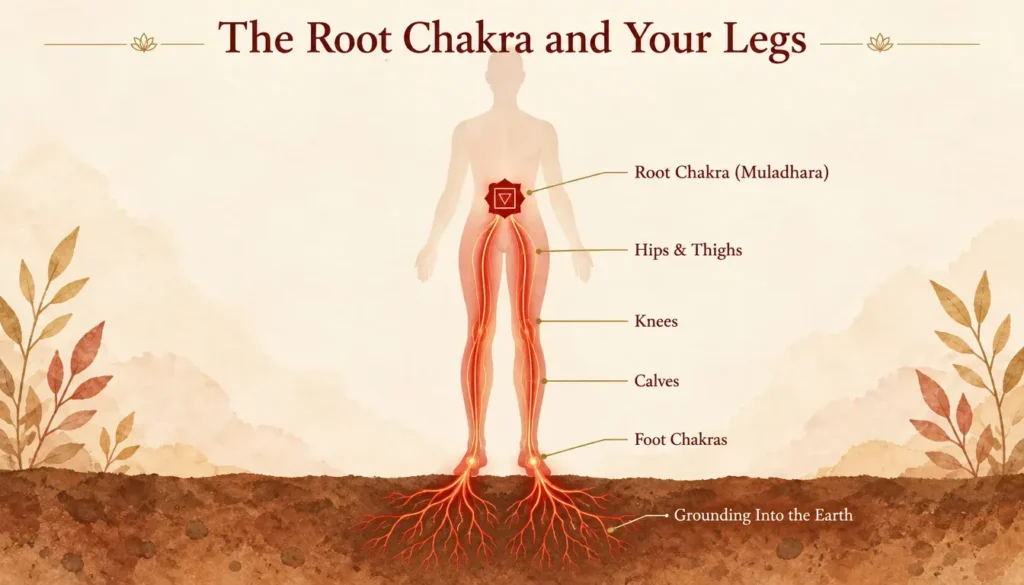
Its influence doesn’t stop at the pelvis, though. Energetically it runs down through the hips and thighs, past the knees and calves, into the feet and from there into the earth. I like to picture it as the root system of a tree – the part nobody admires, the part that decides whether the whole thing survives a storm. A number of energy systems go a step further and place tiny minor chakras in the soles of your feet, which is roughly where the plugging-in to the earth is supposed to happen.
So when the root gets knocked out of balance, I’d look downstairs first. Wet-sand legs, legs that feel weak for no reason or won’t stop twitching, an ache that hops from knee to ankle to hip like it can’t pick a seat. Read through a chakra lens, that’s a pointer toward wherever life currently feels unsafe or a bit unsupported. Red is the root’s color, and you’ll meet it again in the practice further down.
What Are Different Leg Problems Trying to Tell You?
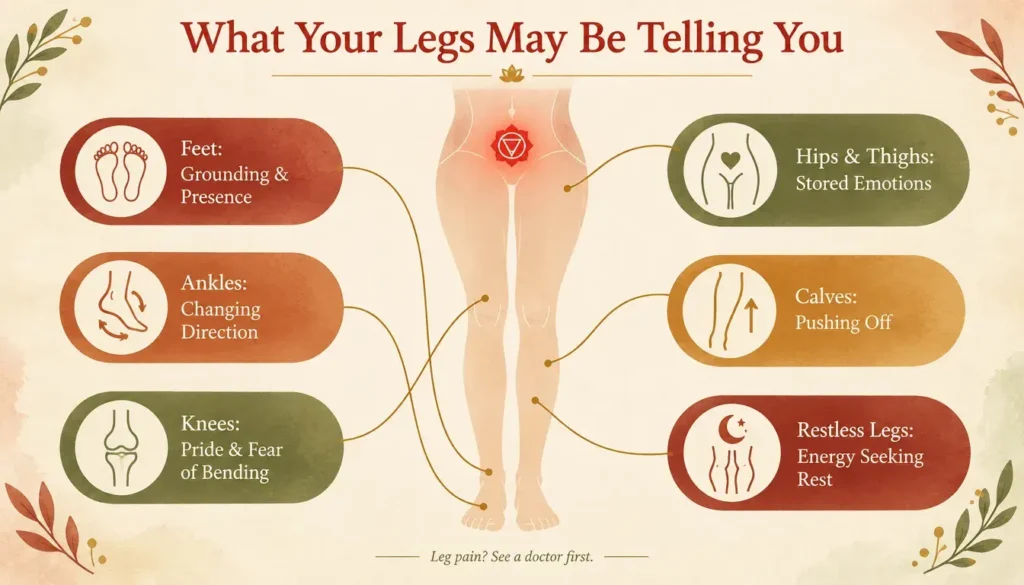
Each part of the leg tends to carry its own theme. Use these as starting points for reflection, not fixed rules (bodies are rarely that tidy).
Feet: Where You Meet the Ground
Feet are the most literal grounding point you have. Each one holds 26 bones and 33 joints, all built to read the surface beneath you and adjust in tiny ways with every step. Energetically, foot trouble often shows up when you’ve lost contact with the here and now and you’re living in your head, or in next month’s worries.
Cold feet are the classic sign. So are recurring foot cramps and that odd sensation of not quite feeling the floor, which plenty of us notice most during long stretches of overthinking.
Ankles: Changing Direction
Ankles let you pivot. They’re the joint of flexibility and course correction, which is why ankle problems seem to cluster around turning points – a new job, a relationship ending, a decision you keep postponing. Funny how often an ankle goes over in the very week you’re meant to sign a lease or hand in your notice.
Knees and the Trouble With Bending
Knees are about bending, literally and otherwise. Metaphysical writers have tied them to pride for a long time, to stubbornness too, and to a kind of dread about what’s around the corner. You’ll often see stiff, locked knees on people whose whole stance in life is a bit locked as well – the person who has to be right, or the one who’s been hauling everybody else’s expectations around for years without once setting them down.
Then again, knees are hard-working hinges, and hinges get worn. Osteoarthritis takes its time about it. Early on there might be a few softened patches of cartilage and nothing you’d notice, then come the stiff first steps out of bed and the protest on the stairs, and in the late stage bone grinds against bone. If only one part of the knee is worn out and the ligaments are holding up fine, a surgeon might swap just that part rather than the whole joint. I’d point anyone heading that way to this overview of knee osteoarthritis partial knee replacement, which goes stage by stage, starting with exercise and losing a bit of weight and ending at surgery for when nothing gentler works. Energy work can sit right next to that kind of treatment. It shouldn’t stand in for it.
Hips and Thighs: Where Old Stuff Gets Stored
Few places in the body hold on to tension as stubbornly as the thighs, probably because they’re so big and so strong. They also sit right on the border between the root and sacral chakras, so a tight upper leg can be holding two things at once – an old sense of insecurity, and feelings you never let yourself have at the time. Yoga teachers know hip openers for exactly this, and people come out of them teary without knowing why. If it happens to you in pigeon pose, don’t fight it.
Calves and Shins: Pushing Off
Your calves are sometimes called your “second heart”. Each time they tighten, they squeeze the veins tucked deep inside them and shove blood uphill toward your chest, which is a long climb when you think about it. In energy terms the calves are about the push-off, that split second where you actually commit and go. Calves that cramp or stay tight tend to show up in people who are all set to move and still hold back, a bit like sitting at a green light with the handbrake on.
Heavy, Restless, or Numb Legs
Some sensations don’t belong to one spot. With restless legs syndrome – doctors also call it Willis-Ekbom disease – there’s an itch to move the legs that tends to get worse once evening comes. Energetically it looks to me like root energy pacing the room, a nervous system that won’t quite trust that it’s safe to lie down and rest. On the medical side there are well-known links with low iron, with pregnancy and with certain medicines, so get it checked rather than just meditating on it.
Sciatica is another one. Your sciatic nerve is the body’s longest and thickest, starting in the lower back and running all the way down the back of each leg, so when it gets pinched or inflamed the pain can shoot along a surprising distance. Energetically it’s often tied to worry about money and long-term security – root chakra territory again.
Leg Problems and Their Energetic Meaning at a Glance
If you skimmed the last few sections (fair enough), here’s the whole leg mapped out in one place.
| Body Area | Energetic Theme | Common Signs |
|---|---|---|
| Feet | Grounding and presence in the here and now | Cold feet, foot cramps, not quite feeling the floor |
| Ankles | Flexibility and changing direction | Rolled ankles and sprains around big decisions |
| Knees | Pride, stubbornness and fear of what’s next | Stiff, locked knees and pain on the stairs |
| Hips and Thighs | Stored insecurity and held-back feelings | Tight upper legs, tears during hip openers |
| Calves and Shins | The push-off, committing to move | Cramps and tightness when you hold back |
| Whole Leg | Safety and long-term security | Restless, heavy or numb legs, sciatica |
Is Your Root Chakra Underactive or Overactive? Watch Your Legs
A lot of chakra writing treats the root as either “open” or “blocked” and leaves it there. I find it more useful to think of it leaning one of two ways, since the legs act quite differently depending on which.
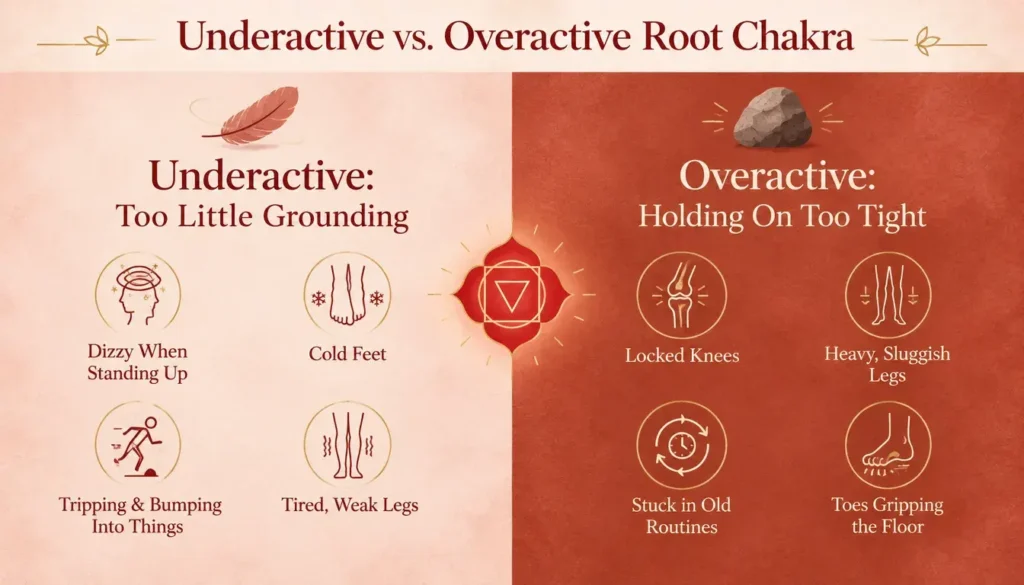
When the root chakra is underactive and you’re not grounded enough, you might notice:
- Going slightly dizzy as you get up from the desk after a tense afternoon
- Feet that stay cold even with the heating on
- Tripping over nothing, catching your hip on the corner of the table, missing the last step
- Tired, weak legs that don’t match how much you’ve actually walked that day
An overactive root chakra, where you’re holding on too tightly, tends to feel more like this:
- Knees locking and calves going rigid the moment you stand still in a queue
- Legs so heavy that leaving the sofa turns into a small debate with yourself
- Keeping the same route to work and the same five-year plan long after either makes sense
- Curling your toes inside your shoes during an awkward phone call
Most of us bounce between the two depending on the year we’re having, which doesn’t make it any easier to spot. The fix, handily, is about the same: more time with bare feet on actual ground, and a straight look at what’s scaring you.
Leg Symptoms You Shouldn’t Try to Meditate Away
I love this work, but I’m not going to pretend it treats a blood clot. Leg symptoms that are new, keep getting worse or just don’t add up need a doctor first. A few of them need one tonight. Mayo Clinic has a no-nonsense page on when leg pain needs a doctor that’s worth saving to your phone, and these are the warning signs I’d never sit on.

Call 112 (Europe) or 911 (US) straight away for:
- A single calf gone sore, swollen, red or hot, especially after a long flight or a long drive – it can be a clot
- Leg swelling plus chest pain, struggling for breath, fainting or coughing up blood
- A fall or knock after which the leg won’t take your weight, or you heard something pop or grind
- A leg that goes pale and cold out of nowhere
For pain that starts when you walk, swelling in both legs, or something a few days of resting and elevating hasn’t shifted, a normal appointment is the right call. Once you know what’s going on physically, the energetic side has something solid to stand on. Which, in a way, is the whole point.
A 10-Minute Grounding Practice for Tired Legs
This is the routine I’d start with. It’s simple enough to do in your socks on the kitchen floor before breakfast.

- Find a spot on the floor and stand with your feet about as wide as your hips, knees soft rather than locked. Before changing a thing, check where your weight has settled – in the heels, the toes, maybe more on one leg than the other.
- Spread your toes like you’re trying to grip wet sand. Then let the weight sink into the ball of the big toe and the little toe, plus both sides of the heel, so each foot rests on four corners.
- Breathe in slowly through your nose and let it travel down past the belly, into the thighs and calves. On the out-breath I like to imagine thick red roots pushing out of the soles, heavy as wet clay.
- Sway a little, front to back and then side to side, smaller each time, like a pendulum running out of push, until you’re still in the middle. Two minutes or so is plenty.
- Bend the knees a few centimeters, then straighten. Ten of those, in rhythm with your breath, whichever way round suits you. Clicking or complaining? Make the bend smaller.
- Sit down, rest your palms on your thighs and say quietly, “I’m supported. I can move forward.” Feeling a bit silly is fine (most of us do at first).
Give it a week of mornings. Your walk will probably tell you first, and now and then your sleep does too.
Grounding Habits for the Other 23 Hours
Ten minutes on the kitchen floor is a start. The bigger shifts usually come from what you do with the rest of the day.
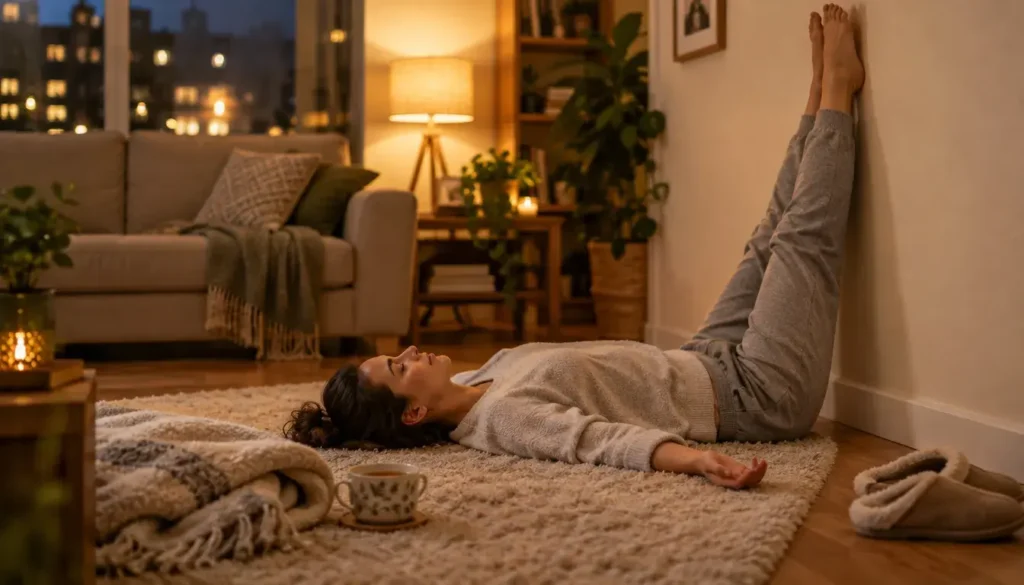
Walk barefoot when you can – grass in summer, sand at the beach, even a wooden floor at home. There are thousands of nerve endings in your soles, and they come back to life fast once they’re out of thick, padded trainers. Brushing your teeth on one leg looks daft and works surprisingly well for wobbly ankles. When your head’s all over the place, eat something warm and stodgy, say roasted beetroot or a bean stew that’s been on the hob all of a rainy Sunday. Then before bed, lie down with your legs resting up the wall for five minutes, which is bliss after a day spent standing.
Look honestly at where your support comes from, too. A bit of savings for a rough month, and someone who’d actually answer the phone at 2 a.m. (a home that feels like yours counts as well). Strengthening those is root work every bit as much as any meditation.
Learning to Stand on Your Own Feet Again
Your legs have carried you through every day of your life so far, including the ones you’d rather forget. They deserve some attention before they start shouting for it.
Get anything worrying checked first. After that, pick one practice from this article and give it a week – your feet will tell you whether it’s working.
Frequently Asked Questions About the Energetic Roots of Leg Problems
What does leg pain mean spiritually?
In energy work, leg pain is usually read as a message about support and movement. Your legs hold you up and carry you forward, so trouble there can point to feeling unsupported, or to some part of you that’s reluctant to take the next step. I’d treat that as a question to sit with rather than a diagnosis. Pain that’s new, worsening or unexplained should be checked by a doctor first, and the energetic reading can then sit alongside proper medical care.
Which chakra is connected to the legs?
The root chakra, or Muladhara, is the one most closely tied to the legs. It sits at the base of the spine, but energetically its influence runs down through the hips and knees, past the calves and into the feet. Some traditions also describe small minor chakras in the soles, which is where grounding into the earth is said to happen. The hips and upper thighs overlap with the sacral chakra too, so emotional tension likes to collect there as well.
Can stress or emotions cause leg pain?
Stress has very real physical effects on the legs. Tense muscles brace, posture slowly shifts, and plenty of people notice tight calves or a stiff lower back during a hard stretch at work. Anxiety can also make restless, jittery legs feel worse at night. That said, leg pain has lots of medical causes, anything from arthritis to a blood clot, so don’t assume it’s emotional. Get it checked first, then work on the stress side as well.
What does knee pain mean emotionally?
Metaphysical writers link the knees to pride and stubbornness, and to fear about what’s coming next. Knees are the joints that bend, so stiffness there is often read as trouble yielding or letting go of other people’s expectations. Knees also wear out mechanically, though, and osteoarthritis is extremely common as we get older. If your knee hurts on the stairs, swells or feels stiff every morning, an orthopaedic assessment comes first. The emotional side is something to explore in parallel.
How do I know if my root chakra is blocked?
The signs often show up in the legs and in everyday life at the same time. An underactive root can look like cold feet, clumsiness, light-headedness when you stand up and a general sense of being unsettled. An overactive root tends to feel heavy and rigid instead, with locked knees, sluggish legs and a hard time letting go of old routines. Most people swing between the two. Regular grounding, like barefoot walking and slow breathing into the legs, helps either way.
How long does it take to balance the root chakra?
There’s no fixed timeline, and I’d be wary of anyone who promises one. Plenty of people feel a little steadier after a single grounding session, especially if they’ve been living in their head for weeks. Deeper shifts, the kind that change how you stand and how safe you feel day to day, usually take a month or more of regular practice. A good test is ten minutes every morning for a week, then noticing how your walk and your sleep compare.
When is leg pain an emergency?
Call 112 in Europe or 911 in the US if one calf suddenly becomes swollen, red, warm or painful, especially after a long flight or drive, because it can be a blood clot. The same goes for leg swelling with chest pain, breathlessness, fainting or coughing up blood, and for an injury that leaves you unable to bear weight. A leg that suddenly turns pale and cold also needs urgent care. Grounding practices are for afterwards, never instead.
Blog Categories:
About the Author: