

Physical Manifestations of Root Chakra Blockages: What Your Body Is Trying to Tell You
Lower back pain, constipation, cold feet, pelvic tension – learn the physical signs of root chakra blockages and how to ground your energy safely.
Table Of Contents
Your body usually knows something’s off long before your mind admits it.
A lower back that won’t loosen no matter how much you stretch. Constipation that shows up every time money gets tight. Cold feet – literally cold feet – whenever life feels uncertain. These are some of the most common physical manifestations of root chakra blockages, and they’re easy to brush off as random bad luck.
Usually they’re not random. The root chakra – Muladhara in Sanskrit – sits at the base of your spine and handles your sense of safety, stability, and belonging. When that energy gets stuck, the body tends to speak first. Sometimes pretty loudly.
This guide walks through what those signals look like, why they show up where they do, and what you can do about them. Plus where energy work ends and medical care has to begin. That line matters more than most chakra articles admit.
What the Root Chakra Actually Governs
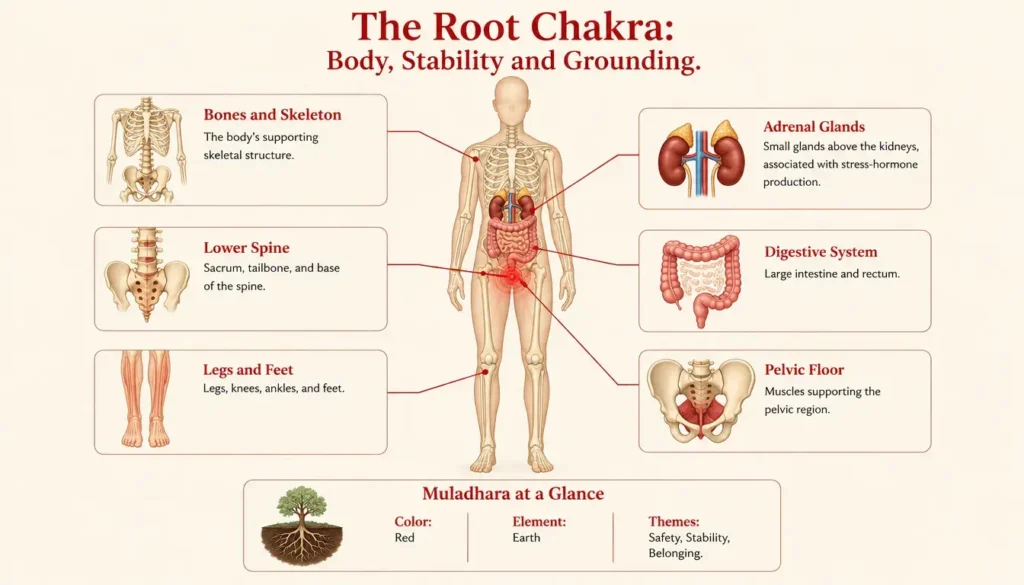
Muladhara is the first of the seven chakras, anchored at the perineum and tailbone. Its color is red. Its element is earth. Everything about it points down – toward the ground, toward roots, toward the physical basics of staying alive.
On the body level, the root chakra is connected to:
- The base of the spine, the sacrum, and the tailbone
- Legs, knees, ankles, and feet
- The large intestine, rectum, and anus
- The pelvic floor muscles
- The adrenal glands, which manage your stress hormones
- Bones and the overall skeletal structure
Emotionally, it’s survival stuff. Money, home, food, work, family ties. Whether you feel you’re allowed to take up space on this planet at all.
So when you hear that a blocked root chakra shows up in your legs, your gut, or your lower spine, it’s not a stretch. Those are exactly the parts of you this center rules.
Why Energy Blockages Turn Into Physical Symptoms
The simplest way to see it – a blocked chakra is energy that’s stopped moving. And stuck energy in the body tends to look like tension, contraction, and sluggishness.
Think about what fear does to you. Your glutes clench. Your pelvic floor pulls up and in. Your stomach knots, and digestion more or less switches off. That’s your survival system doing its job, and survival is root chakra territory through and through.
Western medicine describes a very similar loop in its own language. Harvard Health has a clear breakdown of how the stress response affects the body, covering stress hormones, the HPA axis, and why staying stuck in fight-or-flight for months wears you down physically. Different vocabulary. Same pattern.

When you live in low-grade survival mode for a long stretch – job insecurity, a move, a breakup, debt, or a shaky childhood that never quite left your nervous system – the root chakra stays contracted. The body parts it governs start carrying the load. Quietly at first, then not so quietly.
The Most Common Physical Signs of a Blocked Root Chakra
You won’t necessarily get all of these. Most people notice two or three that keep coming back, often flaring during stressful seasons and easing off when life calms down. That pattern itself is a clue.
Lower Back, Hip, and Tailbone Pain
This is the classic one. Chronic tightness across the lower back, sciatica-style aches running down one leg, a tailbone that’s sore after sitting, hips that feel locked in place no matter how many stretching videos you follow.
Energetically, the lower spine is your support column. When you don’t feel supported – by people, by your finances, by life in general – this area braces. And keeps bracing. You can massage it, heat it, foam roll it, and it’ll still creep back if the underlying sense of instability doesn’t change.
Heavy, Restless, or Cold Legs and Feet
Your legs are how you stand on the earth and move forward through life. A root chakra imbalance often shows up as legs that feel heavy and tired, or the opposite – restless legs at night that won’t settle.

Cold feet are surprisingly common too. So are knee problems, weak ankles, and a sort of clumsy, ungrounded feeling where you trip over things more than usual. People describe it as not quite being in their body. Floating a few inches above it.
Digestive Trouble and Constipation
The large intestine belongs to the root chakra, and it’s extremely sensitive to how safe you feel. Constipation is the textbook root chakra symptom – holding on, not letting go, gripping tightly to whatever you’ve got.
But it swings the other way as well. Some people get loose stools or urgent trips to the bathroom when anxiety spikes. Bloating, cramping, and IBS-type flare-ups that track closely with stress all fit the picture. Your gut is basically reporting on your nervous system in real time.
Anal Tract, Rectum, and Pelvic Floor Problems
This one people rarely talk about. Which is part of the problem.
The anus and rectum sit right at the root chakra’s physical anchor point. Hemorrhoids, fissures, a chronically clenched pelvic floor, and aching around the tailbone and perineum are often read in energy work as the body holding tension exactly where your survival energy lives. A lot of people walk around with their pelvic floor tensed all day without ever noticing – until it starts to hurt.
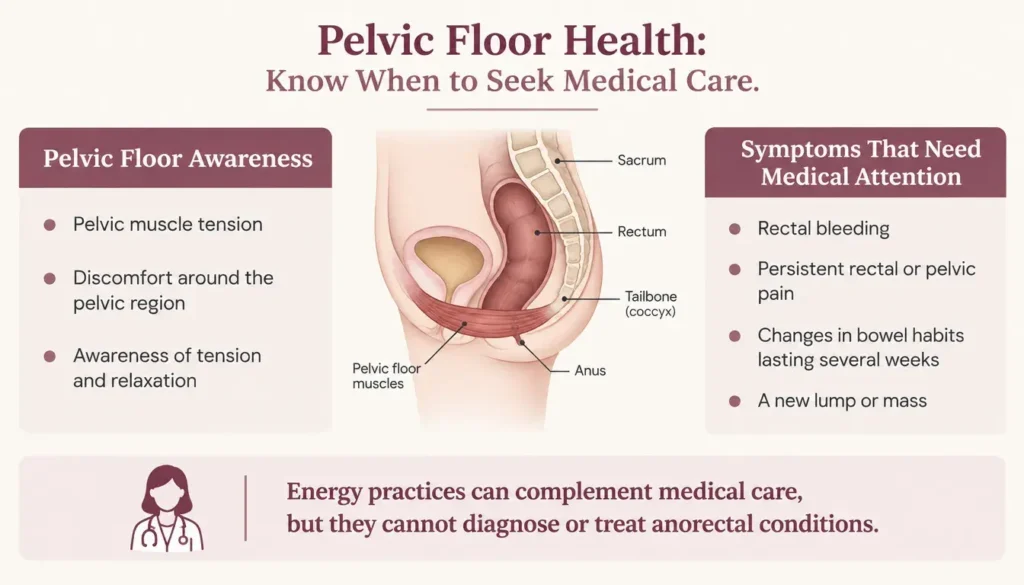
Here’s what matters, though. This is the one area where you really can’t lean on energy work alone. Rectal bleeding, changes in bowel habits that last more than a few weeks, persistent pain, or a lump you can feel all need a doctor’s attention. Not a crystal. Not a meditation. A doctor. Polyps and rectal tumors are often caught early precisely because someone took those symptoms seriously, and today’s treatments can be far less invasive than people expect.
If you’re already going through treatment or surgery in this area, grounding practices can be a gentle companion to your medical care – never a replacement for it. Healing here is physical, sure, but it also stirs up fear, vulnerability, and a loss of control, which are all root chakra themes. Reading up on what to expect from transanal surgery recovery helps you prepare practically, and slow breathing into the belly and pelvis (once your surgeon says it’s fine) can help your body feel safe enough to rest and repair.
Shame keeps this area blocked, too. Talking about it openly – with your doctor, with someone you trust – is part of the clearing. Honestly, maybe the biggest part.
Chronic Fatigue and Adrenal Burnout
The adrenal glands pump out your stress hormones, and they’re closely tied to root energy. Living in survival mode for months means they’re working overtime, and eventually you crash.
This kind of tired is different. You sleep eight hours and wake up drained. Coffee stops working. Or you’re wired at night and exhausted all day, which is that stress cycle running backwards. Your body’s been on high alert for so long it forgot how to switch off.
Weight Changes, Low Immunity, and Bone Issues
Some people gain weight around the hips and belly when the root is out of balance – the body holding on, building a protective buffer. Others lose weight without trying and can’t seem to keep it on, as if there’s nothing anchoring them.

Catching every cold going around is another sign people mention. So are aching joints, brittle nails, and general bone discomfort. None of these prove a chakra blockage by themselves. Together, alongside the emotional signs below, they start to tell a story.
Root Chakra Blockage Symptoms at a Glance
Here’s a quick reference that pulls the main body areas together, with one grounding practice for each that tends to help.
| Body Area | Common Physical Sign | Grounding Practice That Helps |
|---|---|---|
| Lower back, hips, tailbone | Chronic tightness, sciatica-style aches, sore tailbone | Child’s pose and slow breathing into the base of the spine |
| Legs and feet | Heavy or restless legs, cold feet, weak knees and ankles | Walking barefoot on grass, sand, or soil |
| Digestion and colon | Constipation, bloating, stress-linked IBS flare-ups | Warm, cooked root vegetables and regular mealtimes |
| Anal tract and pelvic floor | Clenched pelvic floor, hemorrhoids, perineal tension | Medical check first, then gentle pelvic breathing |
| Energy levels | Chronic fatigue, wired-but-tired, unrefreshing sleep | A consistent bedtime and LAM chanting before sleep |
| Immunity and bones | Frequent colds, aching joints, weight swings | Red jasper or hematite carried as a daily grounding cue |
Underactive vs. Overactive: Two Ways the Root Gets Stuck
“Blocked” doesn’t always mean the same thing. A root chakra can be underactive – not enough energy flowing – or overactive, where it’s gripping too hard. The physical signs differ a bit.
An underactive root chakra tends to look like:
- Low energy and constant tiredness
- Weak, heavy, or cold legs and feet
- Unexplained weight loss or trouble keeping weight on
- Feeling spacey, dizzy, or disconnected from your body
- Getting sick often
An overactive root chakra tends to look like:
- Stiffness and rigidity, especially in the hips and lower back
- Constipation and a clenched pelvic floor
- Weight gain around the lower body
- Sluggishness – feeling stuck, like you can’t get moving
- Tension that shows up as jaw clenching or teeth grinding
Most people are a mix. That’s fine. You don’t need a perfect diagnosis to start working with it.
Emotional Signs That Usually Travel With the Physical Ones
The body symptoms rarely show up alone. Look for these alongside them:
- Constant worry about money, even when things are technically okay
- Feeling like you don’t belong anywhere
- Trouble trusting people or life in general
- Restlessness – an urge to keep moving, changing, escaping
- Or the opposite: fear of change, clinging to routines and possessions
- A low hum of anxiety you can’t pin on anything specific
If you’re nodding along to both lists, the connection’s probably real.
When to See a Doctor First
Energy work is powerful. It’s also not a diagnosis. Any of these deserve a proper medical check before you treat them as purely energetic:
- Blood in your stool or rectal bleeding of any kind
- Bowel changes lasting longer than three weeks
- Weight loss you can’t explain
- Numbness, tingling, or weakness in your legs
- Back pain that wakes you at night or keeps getting worse
- Exhaustion that doesn’t lift with rest
Get checked. Then do the root chakra work alongside whatever your doctor recommends. The two don’t compete – they just work on different layers of the same problem.
How to Unblock Your Root Chakra and Ease Physical Symptoms
The good news – the root responds fast to physical practices. It’s the most body-based chakra, so the fixes are pretty body-based too.
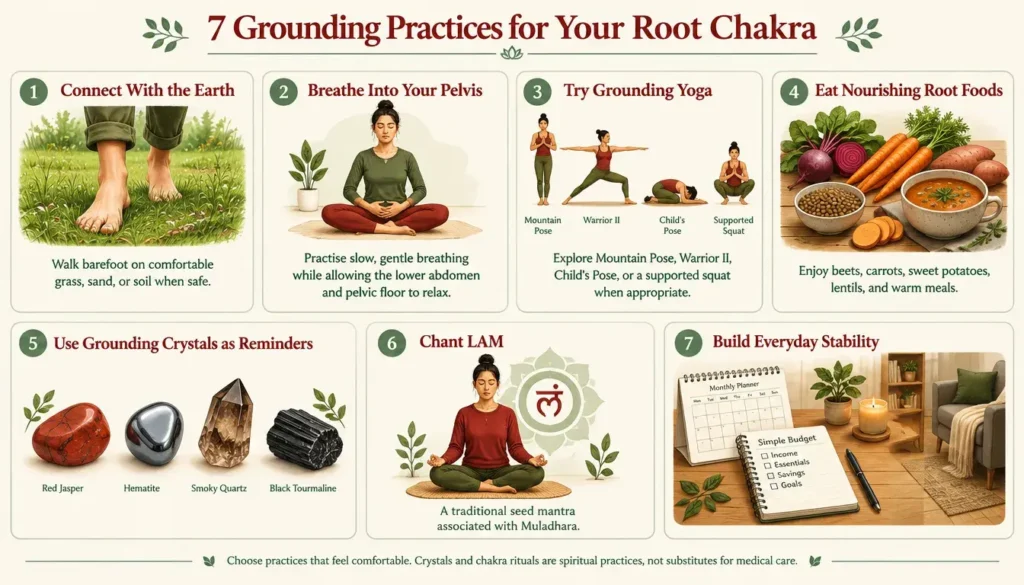
- Get your bare feet on the ground. Grass, sand, soil, a forest trail. Ten minutes outside barefoot does more than an hour of reading about grounding.
- Breathe into your pelvis. Most people breathe high and shallow, up in the chest. Let your inhale drop all the way down until you feel your pelvic floor gently soften. Exhale slowly.
- Use grounding yoga poses. Mountain pose, Warrior II, Child’s pose, and a supported low squat all bring attention down into your legs and hips. Skip deep squats if you’re recovering from pelvic or rectal surgery, and ask your doctor before restarting.
- Eat root foods. Beets, carrots, sweet potatoes, lentils, and warm, cooked meals. Red foods traditionally support Muladhara, and warm food is just easier on a stressed gut anyway.
- Work with grounding crystals. Red jasper, hematite, smoky quartz, and black tourmaline are the go-to root chakra stones. Keep one in your pocket as a physical cue to slow down.
- Chant LAM. It’s the seed sound of the root chakra. Hum it low and feel the vibration at the base of your spine. Many people also listen to 396 Hz tones during meditation for this center.
- Handle the practical stuff. A budget. A consistent bedtime. A clean, safe corner of your home. The root chakra loves real-world stability, and no meditation replaces actually paying that overdue bill.
A 5-Minute Root Reset You Can Try Today
No candles needed. Your bedroom floor works. So does your parked car.
- Sit with both feet flat on the floor and press them down gently.
- Close your eyes. Notice where your body touches the chair or ground.
- Breathe in for four counts, sending the breath down to the base of your spine. Picture a deep red color there.
- Hold for two counts. Then exhale for six, letting your pelvic floor and glutes release.
- Repeat ten times. On each exhale, imagine whatever you’re gripping – worry, fear, tension – dropping down through your feet into the earth.
- Finish by saying quietly: “I’m safe. I’m supported. I’m here.”
Do it every morning for a week. Watch your lower back. Watch your digestion. Small shifts count.
Listening Instead of Fighting
Physical symptoms of a blocked root chakra aren’t your body betraying you. They’re your body asking, pretty directly, for a sense of safety it hasn’t had in a while.
Take the medical signs seriously. Take the energetic ones seriously too. Then give your body what it’s been asking for – ground under your feet, breath in your belly, and a life that feels a little more stable each week.
That’s where healing starts. From the bottom up.
Frequently Asked Questions About Root Chakra Blockages and the Body
What are the physical symptoms of a blocked root chakra?
The most common ones show up in the body parts the root chakra governs – lower back and tailbone pain, stiff hips, heavy or cold legs and feet, constipation and other digestive trouble, a tense pelvic floor, and ongoing fatigue. Many people also notice frequent colds or weight changes. You usually won’t have all of them. Two or three that keep returning during stressful periods is the typical pattern.
Can a blocked root chakra cause lower back pain?
In energy work, lower back pain is one of the clearest signs of root chakra imbalance. The lower spine is your support column, and when you don’t feel supported in life – financially, emotionally, physically – that area tends to brace and stay tight. That said, back pain has plenty of physical causes too. If it’s severe, getting worse, or comes with numbness in your legs, see a doctor before treating it as purely energetic.
Is constipation linked to the root chakra?
Yes, it’s one of the textbook root chakra symptoms. The large intestine belongs to Muladhara, and it reacts strongly to how safe you feel. Constipation is often read as holding on – gripping tightly to what you have out of fear of losing it. Some people swing the other way and get urgent, loose stools when anxious. Either way, your gut tends to mirror your nervous system.
Can root chakra blockage cause problems in the anal area or pelvic floor?
The anus, rectum, and pelvic floor sit right at the root chakra’s anchor point, so tension and discomfort here are often linked to blocked root energy. A pelvic floor that’s clenched all day is very common in people living with chronic stress. But this is an area where medical care always comes first. Rectal bleeding, lasting changes in bowel habits, or persistent pain need a doctor, and grounding work should only ever support that care.
How long does it take to heal a blocked root chakra?
Small shifts often show up within one to two weeks of daily practice – you sleep a bit better, your lower back softens, digestion settles. Deeper changes usually take a few months, especially if the blockage comes from long-term instability like money stress or an unsettled childhood. Consistency matters more than intensity. Five minutes of grounding every morning does more than an hour once a week.
Can root chakra work replace medical treatment?
No. Chakra work is a supportive practice, not a medical treatment. Physical symptoms – especially bleeding, unexplained weight loss, numbness, or pain that won’t go away – need a proper diagnosis from a doctor. What grounding practices can do is help your nervous system feel safer, which supports rest, recovery, and healing alongside whatever your doctor recommends.
What’s the fastest way to ground root chakra energy?
Get your bare feet on the ground and breathe low. Ten minutes standing or walking barefoot on grass, sand, or soil, while letting each breath drop down into your pelvis, works quickly for most people. If you can’t get outside, sit with both feet pressed flat into the floor and do ten slow breaths, picturing tension draining down through your legs into the earth.
Blog Categories:
About the Author: