


Understanding Depression and Its Impact on Everyday Life
Learn how depression affects mood, emotions and the body, when to seek professional help, and how meditation can ease symptoms day to day.
Table Of Contents
“Depression” is one of those words everyone uses and very few people could properly explain. Ask around and most will tell you it means being sad for a while. That’s part of it, sure. But only a small part.
We all go through stretches of feeling low, lonely or stressed out – after a breakup, say, or a winter that drags on a month too long. That alone isn’t depression. Those moods tend to pass on their own once life shifts a little.
Depression is different. It seeps into work, sleep, relationships, the way you talk to yourself, and it rarely packs up and leaves just because you’d like it to. In fact, it may continue even when you do not have “objective” reasons to feel that way.
People living with it are often misunderstood, so let’s look at what depression actually is, how it shows up in everyday life, and what can help – from professional treatment to daily practices like meditation.
What Depression Really Is – Let’s Define It First
Depression is a recognized mental health condition that changes how you feel, think and act – your mood, your motivation, the way you get through an ordinary Tuesday. And there’s no single version of it. Sometimes it’s a heavy, grey sadness you can’t quite describe to anyone, not even yourself.
Just as often, sadness hardly comes into it. You might mostly notice a tiredness sleep won’t touch, or that the guitar in the corner hasn’t been picked up in months. One friend stops replying to group chats and says they’re “just busy.” Someone else keeps showing up at work, hits every deadline and looks perfectly fine from the outside, while privately struggling just to keep going. That second pattern is often called high-functioning depression, and it’s remarkably easy to miss.
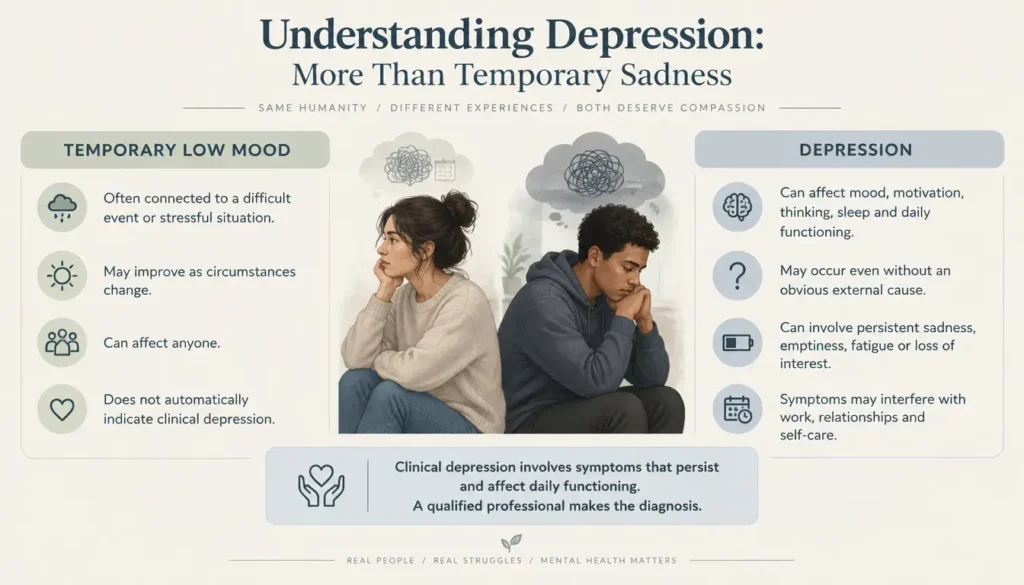
Nor is it simply a bad mood that overstayed its welcome. A rotten afternoon after an argument or a rejection email is part of being human – you sleep on it, and by the weekend it’s mostly gone. Depression lingers. When symptoms last most of the day, nearly every day, for two weeks or longer – and start getting in the way of work, relationships or basic self-care – that’s when doctors begin to look at it as clinical depression.
When Professional Help Is Needed
Because depression shows up so differently from person to person, the help that works varies a lot too. For a milder case, change can come from fairly ordinary places. A steadier sleep routine. Getting outside more. People around you who notice when you’ve gone quiet.
Then there’s the heavier end of the spectrum. If things are sliding – slowly, maybe, but sliding – and you’re letting self-care go, falling behind at work or dropping responsibilities you used to handle without thinking, that’s your cue to bring in a professional. Watch for these in particular:
- Low mood that hasn’t lifted in two weeks or more
- Showering, eating properly, work or family duties starting to fall by the wayside
- Pulling away from nearly everyone around you
- Leaning on alcohol or other substances to get through the day
- Thoughts of self-harm or that life isn’t worth living – in that case, contact a crisis line or emergency services right away
And no, do not think for a single second that this means that you’re “crazy”, or something like that. Bear in mind that lots of people go to a mental health treatment center because they know that out there, they’ll be provided with the right support. Depending on the severity level of your depression, you’ll potentially be provided with medications, psychotherapy, and many other excellent tools.

So make the call, or send the email. Therapists and doctors have heard it all before, and judging you isn’t part of the job.
The Link Between Emotions and Depression
Your emotional life is where depression tends to do its loudest damage – it’s among the clearest signs of depression, really. There can be a constant low hum of sadness, or emptiness, or a quiet conviction that nothing’s going to improve. Sometimes it’s just numbness, which is oddly harder to explain than sadness.
Things that once brought a bit of joy stop landing. Your Sunday bike ride slowly turns into one more thing on the to-do list, and you catch yourself dreading it.
It doesn’t always look like sadness, either. Plenty of people with depression come across as grumpy rather than down. Dishes left in the sink become a fight.

Another common experience is emotional blunting – the sense that positive feelings are locked away somewhere out of reach. A friend tells you she’s pregnant, or you finally get the promotion, and you say all the right things while feeling… not much. There’s a clinical term for that muted capacity for pleasure – anhedonia – and it sits right at the heart of how depression is diagnosed.
It’s a lonely place to be. More so when you can’t even name what caused it.
You Can Help Yourself, As Well
Professional care and the people who love you come first. Still, there’s a lot you can do on your own between appointments.
Yoga and meditation are two of the easiest ways in. They’re popular for reducing symptoms of depression for fairly down-to-earth reasons: they settle a nervous system that’s been stuck on high alert, and over time they help the brain chemistry that keeps mood steady.
You’ll find a lot of psychiatrists and psychologists nudging patients toward them – alongside therapy or medication, never instead of it. And you don’t need any prior experience to begin. There are plenty of good beginner tutorials on platforms such as YouTube that explain everything step by step.
Meditation as Help for Depression
Of all these tools, meditation for depression deserves a closer look, because it goes straight at the patterns that keep depression going.
The biggest one is rumination – replaying the same painful thoughts over and over. Why did I say that. What’s wrong with me? It’s always going to be like this. Meditation doesn’t try to out-argue that voice. Instead, you practice spotting the thought as it shows up, labelling it (“there’s that one again”), and letting it drift past like a car going by outside the window. Yet that little bit of distance – between thinking something and swallowing it whole – tends to grow the more you practice.

Your body gets a say in this as well. Long, unhurried exhales switch on the parasympathetic nervous system, the part that handles “rest and digest”, and the stress response – which in depression often sits stuck at a steady simmer – starts to cool off. There’s even a structured program built around this, mindfulness-based cognitive therapy (MBCT), designed for people who’ve been through depression more than once and want to keep it from coming back.
Types of Meditation That Can Help
There’s no one correct way to meditate. What works on a restless Monday might be useless on a heavy Thursday, so try a few:
A Simple 10-Minute Practice to Start With
- Find a spot where you won’t be bothered – the couch works fine – and set a timer for ten minutes.
- Let your eyes close, or rest them on a point on the floor a meter or so ahead.
- Breathe in through your nose while you count to four. Let it out slowly, over six.
- Your mind will wander off – to emails, to lunch. That’s fine. Notice where it went and come back to the breath, as many times as it takes.
- For the last minute, check in with your body – shoulders, jaw, hands. No fixing, only noticing.
Doing a little every day matters more than doing a lot occasionally. Some days, sitting quietly with your own head will feel like too much – and that’s okay. Put on a guided recording instead, or try a slow walking meditation. If meditation ever brings up distress you can’t manage, stop and talk it through with your therapist or doctor.
| Meditation Type | How It Helps | Best For |
|---|---|---|
| Mindful Breathing | Anchors attention in the breath and breaks the loop of rumination | Beginners and anxious, racing-thought days |
| Body Scan | Moves attention slowly through the body, releasing held tension and reconnecting you with physical sensations | Numbness, restless sleep and evenings |
| Loving-Kindness (Metta) | Builds warmth toward yourself and others, softening harsh self-criticism | Guilt, shame and harsh inner talk |
| Guided Meditation | A voice leads you through each step, so you don’t have to sit alone with your thoughts | Low-energy days and anyone who finds silence hard |
| Walking Meditation | Combines gentle movement with mindful attention to each step | Fatigue, low motivation and people who can’t sit still |
| Sound and Chakra Meditation | Uses tones, frequencies or chakra visualization to give the mind a calm focus point | Heavy, stuck feelings and heart-centered practice |
How Depression Affects Your Body
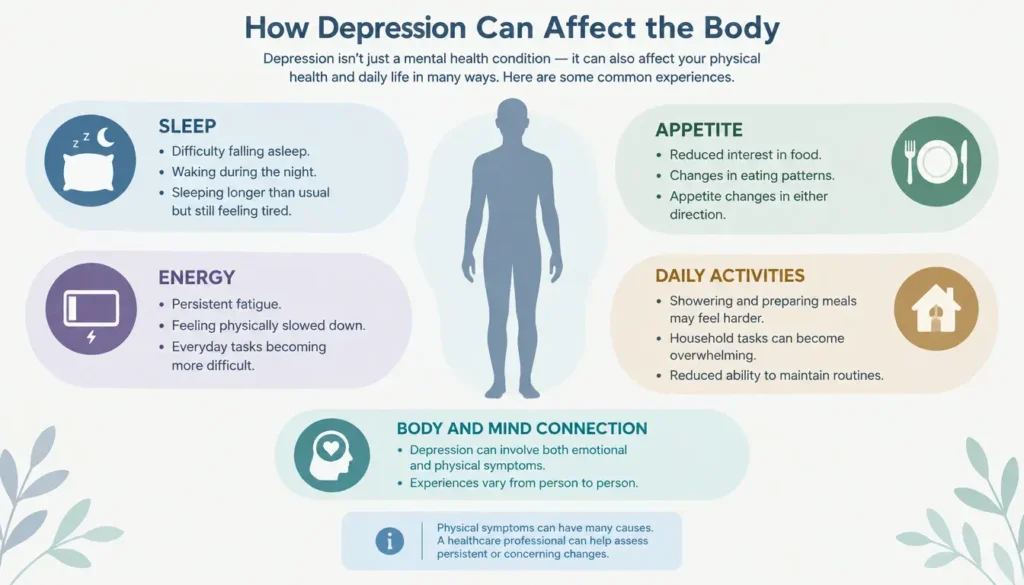
Depression isn’t just a storm in your head; it leaves a massive, highly noticeable fingerprint on your physical body, too. Sleep is often one of the first things to go. You might stare at the ceiling until 2 a.m., or wake at four with your mind already racing. Or it flips – twelve hours in bed, and you still drag yourself up feeling like you never slept.
Appetite gets thrown off too, in either direction. Lunch gets skipped, then dinner, and food just stops being interesting. For other people it’s the late-night fridge visits and the bag of chips that’s somehow empty before the episode ends. Both show up, eventually, on the scale and in your energy levels.
And the tiredness. Not the good kind you get after a long hike – heavy, bone-deep, and a nap doesn’t fix it. When it’s bad, a shower feels like a project. So does heating up leftovers, or carrying a basket of laundry to the next room.
There Is a Way Forward
It’s completely understandable if you feel hopeless or lost because of depression right now – and it doesn’t mean things will stay this way. As you can see, there are a lot of fantastic options at your disposal that you can resort to, to successfully navigate this situation.
You don’t have to fix everything this week. Text one person. Book the appointment you’ve been putting off. Or just sit down for five minutes tonight, before bed, and breathe.
Frequently Asked Questions About Depression and Meditation
What is the difference between sadness and depression?
Sadness is a normal reaction to something painful – a loss, a disappointment, a hard week – and it usually eases within hours or days. Depression is a mental health condition that lingers. It shows up most of the day, nearly every day, often without a clear cause, and it affects sleep, energy, appetite, concentration and the ability to enjoy things. The key difference is how long it lasts and how much it gets in the way of everyday life.
How long do symptoms have to last before it’s considered depression?
Doctors generally look for symptoms that have been present most of the day, nearly every day, for at least two weeks. That includes low mood or loss of interest, along with changes in sleep, appetite, energy or concentration. If you’ve felt this way for two weeks or more and it’s affecting your work, relationships or self-care, it’s a good time to speak with a doctor or mental health professional.
Can meditation cure depression?
No, meditation isn’t a cure, and it shouldn’t replace therapy or medication when those are needed. What it can do is ease symptoms, reduce stress and help you step out of the cycle of negative, repetitive thinking that keeps depression going. Mindfulness-based cognitive therapy, which builds on meditation, is used specifically to help people lower the risk of depression coming back. It works best as part of a wider treatment plan.
What type of meditation is best for depression?
There isn’t one best type – it depends on how you feel on a given day. Mindful breathing is a good starting point for most beginners. Guided meditation helps when sitting alone with your thoughts feels too heavy. Loving-kindness meditation softens harsh self-criticism, a body scan helps with numbness and tension, and walking meditation suits low-energy days. Try a few and keep the one you’ll actually come back to.
How long should I meditate each day to help with depression?
Start with five to ten minutes a day. Consistency matters far more than length, so a short daily practice at roughly the same time will do more than a long session once a week. As it gets easier, you can extend it to fifteen or twenty minutes. On harder days, even two or three minutes of slow breathing counts.
What is high-functioning depression?
High-functioning depression describes people who keep up with work, family and daily responsibilities while struggling with depression on the inside. From the outside, they often look fine or even highly productive, which makes it easy for others – and for themselves – to overlook what’s going on. It’s not an official diagnosis, but the symptoms are real and deserve the same attention and care.
When should I seek professional help for depression?
Reach out to a doctor or mental health professional if your symptoms last longer than two weeks, keep getting worse, or make it hard to handle work, relationships or basic self-care. If you’re having thoughts of self-harm or feel that life isn’t worth living, don’t wait – contact a crisis line or emergency services right away. Asking for help is a sign of strength, not weakness.
Blog Categories:
About the Author: