


Sprained Ankle From Yoga? What to Do Now, and How to Keep Practicing While It Heals
Sprained your ankle doing yoga? What to do in the first 48 hours, which poses to swap, gentle practice while it heals, and how to return to balance safely.
Table Of Contents
My wife sprained her ankle during yoga not long ago, and I’ll admit my first reaction was a slightly confused “in yoga?” Somehow I’d always filed it under the safe stuff, next to walking and gardening, the things you do to feel more stable rather than less. It got me wondering how common this actually is, and what you’re supposed to do with your practice while it heals.
So I did the obvious thing and read everything I could find, from orthopaedic guides to physio advice and a couple of research papers I probably didn’t need to finish. What follows is basically my notes, tidied up a bit, for anybody sitting on a sofa right now with a swollen ankle and a yoga mat rolled up in the corner looking at them.
How Do You Sprain an Ankle Doing Yoga, Anyway?
Turns out it happens more than you’d guess. Researchers who went through a study of US emergency room records from 2001 to 2014 estimated close to 30,000 yoga injuries treated in ERs over that stretch, and sprains and strains made up about 45% of the ones with a diagnosis. The part that surprised me most was the over-65 group, where the injury rate went up roughly eight times in ten years. I suspect a lot of that is simply more older people starting yoga, which is great, without anyone telling them that holding on to a wall is allowed.

Most ankle sprains are what doctors call inversion sprains. Your foot rolls over to the outside with the sole tipping inward, and the little ligaments on the outer ankle get yanked past where they’re happy to go. The usual victim is the anterior talofibular ligament, which I had to read three times before I could say it. On a yoga mat, the moments where that tends to happen look something like this:
- Wobbling out of tree pose or warrior III and catching yourself on the side of your foot
- Stepping back into a lunge without looking, and landing half on the mat, half on the edge of it
- Jumping forward from downward dog and landing with your weight on the outside of one foot
- Standing up after a long seated meditation while one foot is still completely asleep (this one catches out more people than you’d think)
- Sliding on a sweaty mat in a hot class when your grip goes all at once
Tiredness plays a part in most of these. Tree pose ten minutes into a class and tree pose near the end, when your thighs are trembling and you’re half thinking about what’s in the fridge, are honestly not the same pose.
Just Sprained It? What to Do in the First Couple of Days
The early care is where I’d leave most of the explaining to the people who treat ankles for a living. This sprain ankle treatment guide from an orthopaedic clinic walks through it properly, from the different grades of sprain to physiotherapy and prevention. The short version is the well-known RICE approach:
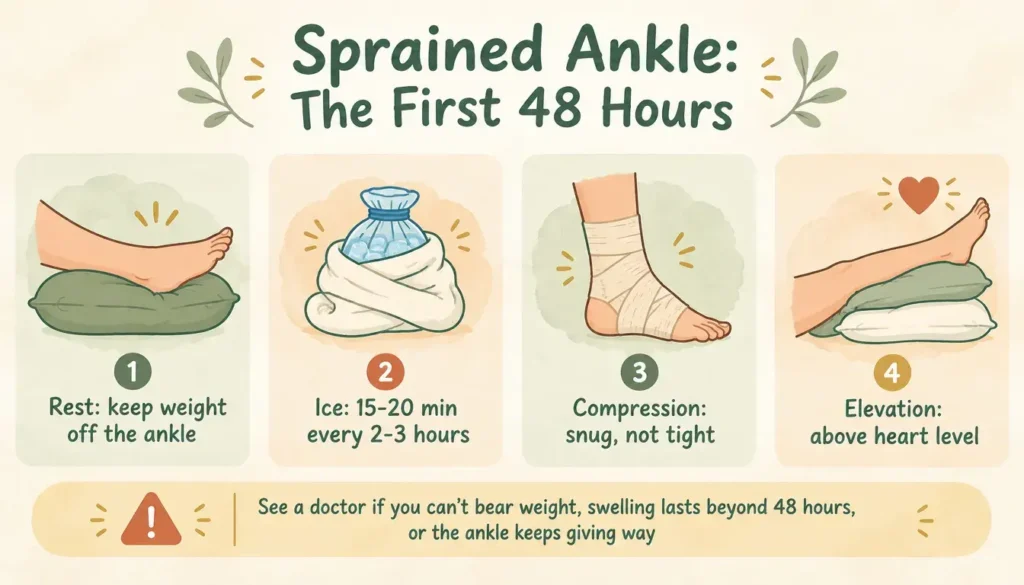
- Rest – keep weight off the ankle for now, and yes, that includes “just checking” whether it’s fine to walk on.
- Ice – 15 to 20 minutes, then a break of two or three hours, and repeat through the first 48 hours. Put a thin towel between the ice and your skin. A bag of frozen peas does the job and moulds around the ankle better than ice cubes do.
- Compression – wrap it with an elastic bandage. Firm is good, but if your toes start going pale, cold or tingly, it’s on too tight.
- Elevation – get the ankle higher than your heart, so lying down with the foot on a couple of pillows rather than sitting with it on a footstool.
How long will it take? That mostly comes down to the grade. Mild grade 1 sprains tend to calm down in one to three weeks, while grade 2 is usually more like three to six. A grade 3 means a ligament is badly torn, and then you’re looking at months, not weeks.
If you can’t stand on the foot at all, get it looked at. Same if it’s no better after two days, or if the ankle keeps buckling under you. I didn’t know before all this that a sprain and a small fracture can look almost identical from the outside – a doctor’s exam, and often an X-ray, is the only real way to tell.
Is It OK to Do Yoga With a Sprained Ankle?
In most cases, yes, once the first few days are behind you and your doctor or physio is happy for you to move. You just have to stop thinking of yoga as something that happens on your feet. It’s surprising how much of a practice is left once you take standing poses off the table.
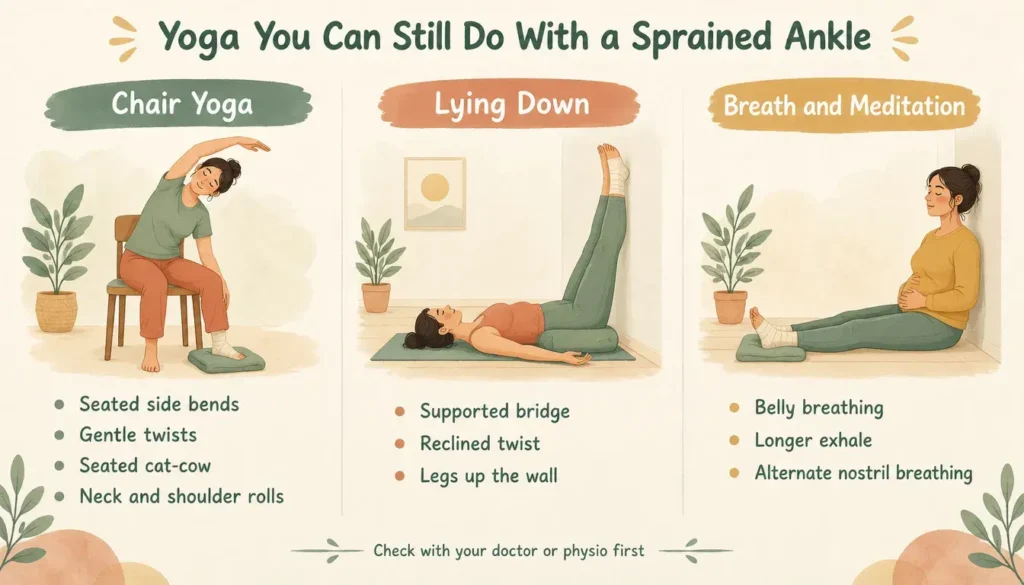
Chair Yoga for the Upper Body
Chair yoga has a bit of a retirement-home image, which I think is unfair, because it’s one of the most useful tools you’ve got when a foot is out of action. Seated side bends, gentle twists, cat-cow with your hands on your knees, and slow shoulder and neck rolls can all be done with the injured foot resting flat or propped on a cushion. Your back will thank you for it, especially when you’re spending more hours than usual on the sofa.
Poses You Can Do Lying Down
Lying on your back opens up a surprising amount. Supported bridge with a block under the sacrum, a gentle reclined twist and legs up the wall all keep weight off the ankle completely. Legs up the wall is a lovely one here because it doubles as elevation, so you get the yoga and the RICE in one go. Keep the injured foot relaxed and don’t point or flex it hard until it’s ready.
Breathwork and Longer Meditation
This is the part I’d push hardest. Plenty of us treat meditation and pranayama as the bit at the end of class we skip when we’re busy. An injury hands you the time back. Twenty minutes goes quicker than you’d think if you mix slow breathing into the belly with some alternate nostril breathing, or simply make each out-breath a bit longer than the in-breath. When you’re sore and grumpy, that calming effect is worth a lot. Sit on a chair or against the wall with the leg out straight, though, because folding a swollen ankle into cross-legged is asking for trouble.
Which Yoga Poses Should You Swap While Your Ankle Heals?
Some of the most familiar poses ask a lot of the ankle, and you won’t always notice until you’re halfway into one. I put the usual suspects in one place, with a gentler option for each, so you can keep going without leaning on the sore joint.
| Pose | Why It’s Hard on a Sprained Ankle | Gentler Swap While It Heals |
|---|---|---|
| Tree Pose | All your weight sits on one ankle, and a wobble rolls it straight to the outside | Reclined tree pose on your back, with the knee dropped open onto a block |
| Warrior III | You balance on one leg while tipping forward, so the standing ankle works overtime | Bird dog on hands and knees, with a folded blanket under the shins |
| Downward Dog | Pressing the heels toward the floor stretches and loads the ankles under your body weight | Puppy pose with the knees down and the tops of the feet resting on the mat |
| Chair Pose | A deep ankle bend while your thighs hold you up puts steady pressure on a sore joint | Seated chair pose on a real chair, arms reaching up |
| Garland Pose | A deep squat folds the ankle about as far as it goes | Happy baby lying on your back, holding the feet or the backs of the thighs |
| Hero Pose | Kneeling back on your heels presses the tops of the feet and points the ankles hard | Easy seat on a cushion with the injured leg stretched out in front |
| Jump-Throughs | Every landing sends a jolt through the ankle, often onto the outer edge of the foot | Step the feet forward one at a time, or sit down and walk the legs through |
Which Types of Yoga Are Easiest on a Sprained Ankle?
Some classes are much harder on feet than others. In a quick vinyasa or Ashtanga class you’re stepping forward, stepping back and hopping between poses dozens of times, and every one of those landings goes through the ankle. Hot yoga I’d avoid for a good while too – once the mat gets slick with sweat, you’re basically balancing on a wet bathroom floor. I’d put those on hold until you’re properly back on your feet, and then ease in at the back of the room, where nobody minds if you skip the jump-throughs.
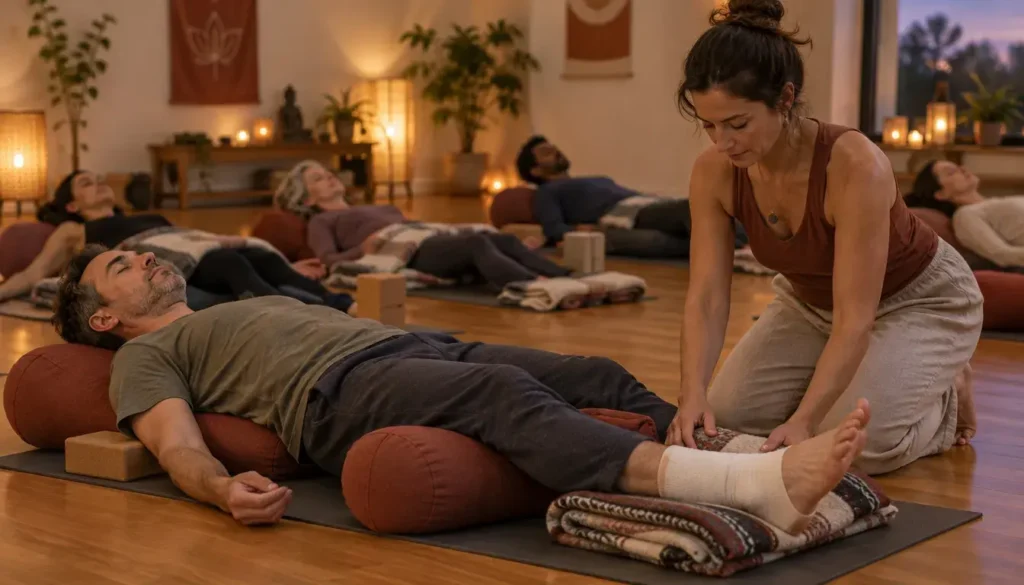
Yin yoga and restorative classes are a different story. You spend most of a yin or restorative class on the floor, staying in each pose for a few minutes while bolsters and blankets hold you up. Do mention the ankle to the teacher before you start, even if it feels like making a fuss. A good teacher would much rather know, and the Iyengar crowd especially seem to enjoy working out a fix with a chair, a strap and a couple of blocks.
How Do You Cope With Being Stuck on the Sofa?
The mental side of a sprain gets very little attention. A sprain doesn’t only take away your practice, it takes away the dog walk, the trip to the shop and the ability to carry a cup of tea from one room to another without help. For anyone who hates being looked after (and plenty of us do), the frustration can easily end up louder than the pain.

A short body scan, done lying down once or twice a day, is the simplest thing I found for this. You can try it right now if you like:
- Lie on your back with the injured ankle propped on a pillow and let your arms fall wherever they like.
- Begin at the crown of your head and let your attention drift slowly downward. Your forehead, then your jaw (most of us clench it without noticing), then shoulders, chest and belly. You’re just checking in, not fixing anything.
- Don’t jump over the ankle when you reach it. It might throb, or feel hot and tight. Stay with that for a breath or two, then let your attention spread out into the rest of the leg and the floor under you.
- Wrap up with five slow breaths, and make each breath out a little longer than the breath in.
Will your ligament heal any faster? Sadly not. But the fidgety, cooped-up feeling usually eases off a bit, and on day four of watching the same ceiling that counts for something.
When Can You Do Balance Poses Again?
Not as soon as it stops hurting, which is the mistake almost everyone makes. A sprained ankle tends to lose some of its sense of position – that quiet, automatic awareness of where your foot is in space that the medical people call proprioception. That’s a big part of why ankles that have been sprained once tend to get sprained again.
The good news is that balance training seems to help rebuild it. In a randomised trial published in the BMJ, 522 athletes who’d recently sprained an ankle were split into two groups. Half did an eight-week home balance programme alongside their usual care. Over the following year, 22% of that group sprained the same ankle again, compared with 33% of the group who didn’t train, which works out to about a third lower risk.
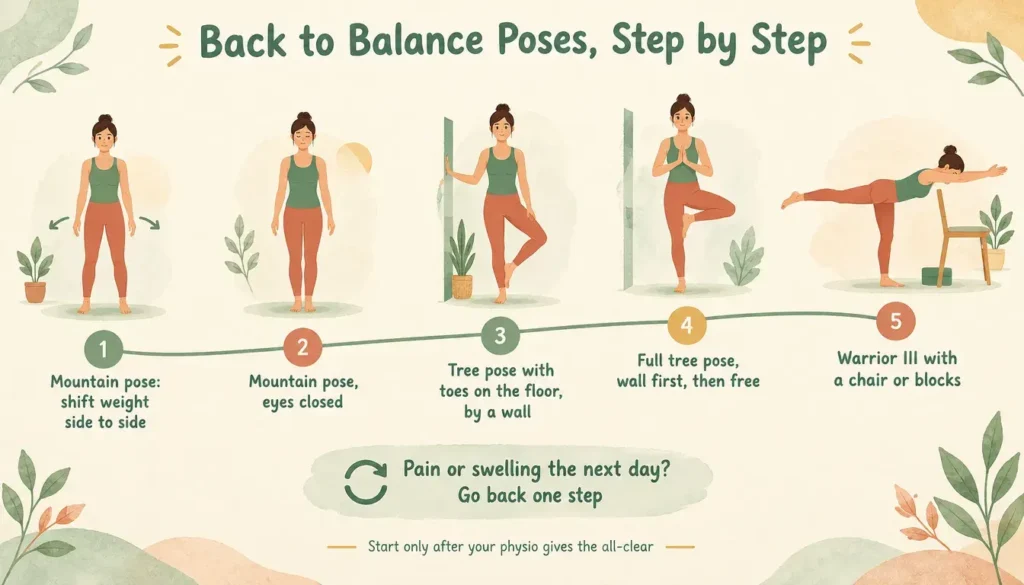
If you think about it, a yoga class already has a fair bit of balance training built in. When your physio says you’re ready, build back up slowly, something along these lines:
- Stand in mountain pose with your feet hip-width apart and rock your weight gently from one foot to the other, slowly, like you’re testing ice on a pond.
- Do the same with your eyes shut for a few breaths. Without your eyes to help, the ankle has to do all the work, and you’ll notice it straight away.
- Tree pose with the toes of the lifted foot resting on the floor, kickstand-style, standing close enough to a wall to touch it.
- Full tree pose by the wall, then away from it, then on the injured side for a little longer than the good side.
- Warrior III and the other more demanding balances last of all, with a chair or blocks under your hands at first.
Woke up the next morning with the ankle sore or puffy again? Then drop back a step for a week or so. I know it’s tempting to skip ahead, but this is exactly the stage where people re-sprain it.
How Can You Avoid Rolling an Ankle on the Mat?
A handful of small habits make a real difference here:

- Put tree, eagle and warrior III near the start of your practice when your legs still have plenty in them, not at the end of an hour-long flow
- Look down when you step back into a lunge. Most slips happen in the in-between moments, not in the pose you’re concentrating on
- Practise new balances next to a wall, and touch it whenever you need to – nobody’s grading you
- Retire the old mat once it gets shiny and slippery, and in hot classes throw a grippy towel over it
- Before getting up from a long sit, circle your ankles and wiggle your toes for a minute, in case a foot has gone to sleep
The most useful habit is probably the least visible one – listening when a pose feels off, and coming out of it without making a big deal about it.
A Few Things I’d Tell Anyone Who’s Just Rolled an Ankle on the Mat
Don’t brush off the first few days, and if something seems wrong, have a doctor check it. Meanwhile there’s still plenty of yoga you can do from a chair or the floor, and all that extra time for breathing and sitting still is a good thing, even though in the first week it’ll probably feel like a punishment. Then come back to standing slowly, one wobbly tree pose at a time. If nothing else, it’s made me a little more respectful of tree pose, and a lot fonder of the wall.
Frequently Asked Questions About Yoga and Sprained Ankles
Can yoga help a sprained ankle heal faster?
Not directly. The ligament heals on its own timetable, and no pose speeds that up. What gentle yoga can do is keep the rest of your body moving, help with stiffness once the swelling has gone down, and later rebuild the balance and ankle awareness a sprain tends to knock out. That last part matters, because it’s linked to fewer repeat sprains. Wait until the first few days have passed and your doctor or physio is happy for you to move before you start.
Should I wear an ankle brace or tape for yoga after a sprain?
For the first few weeks back on the mat, a soft brace or some supportive taping can make standing poses feel a lot less nerve-racking. Many physios suggest using support during activity for a while after a sprain, especially if the ankle still feels unsure of itself. A brace shouldn’t replace balance work, though. The goal is an ankle that steadies itself, so think of the brace as training wheels and ask your physio when to start leaving it off.
Is ice or heat better for a sprained ankle?
Ice is the usual choice for the first 48 hours or so, while the ankle is swollen and warm. Use it for 15 to 20 minutes at a time, with a cloth between the ice and your skin. Heat tends to increase swelling early on, so most guidance says to hold off. Once the swelling has settled, a warm compress or a warm bath can ease stiffness before gentle movement. If you’re not sure which stage you’re at, ask whoever is treating the ankle.
Can I do downward dog with a sprained ankle?
Usually not in the early weeks. Downward dog pushes your heels toward the floor and puts a fair amount of body weight through the ankles, which a fresh sprain won’t enjoy. Puppy pose is a good stand-in, since your knees stay on the mat and the tops of the feet rest flat. When the ankle feels stronger, try down dog again with your heels lifted well off the floor and bend your knees generously. Back off if it aches the next day.
How can I tell if my ankle is sprained or broken?
You often can’t tell by looking, because a sprain and a small fracture can swell and bruise in much the same way. Doctors commonly use a checklist called the Ottawa ankle rules to decide who needs an X-ray. It looks at things like whether you can take four steps on the foot, and whether pressing on certain bony spots around the ankle hurts. If you can’t put weight on the foot, or the pain is severe, get it checked rather than guessing.
Is barefoot yoga bad for weak ankles?
Not in itself. Practising barefoot is how yoga is normally done, and feeling the mat under your feet is part of what trains balance. The trouble comes from slippery surfaces, tired legs and rushed transitions, not from bare feet. A grippy mat, a wall nearby for new balances and slower, more careful stepping make the biggest difference. If your physio has given you a brace for the early weeks back, it’s fine to wear it until they say otherwise.
How long should I wait before going back to a yoga class?
It depends on how bad the sprain was. After a mild one, many people can join a gentle class within a couple of weeks, sitting out the standing balances. A moderate sprain usually needs several weeks, and a severe one can take months. Restorative or yin classes are often a good first step back. Let the teacher know about the ankle before class, and get the go-ahead from your doctor or physio before you return to faster flows.
Blog Categories:
About the Author: