
Chakras Along the Spine: How Kundalini Rises From Root to Crown
Discover the chakras along the spine, how kundalini rises from root to crown, what it feels like, and when tingling or pressure needs a doctor’s check.
Table Of Contents
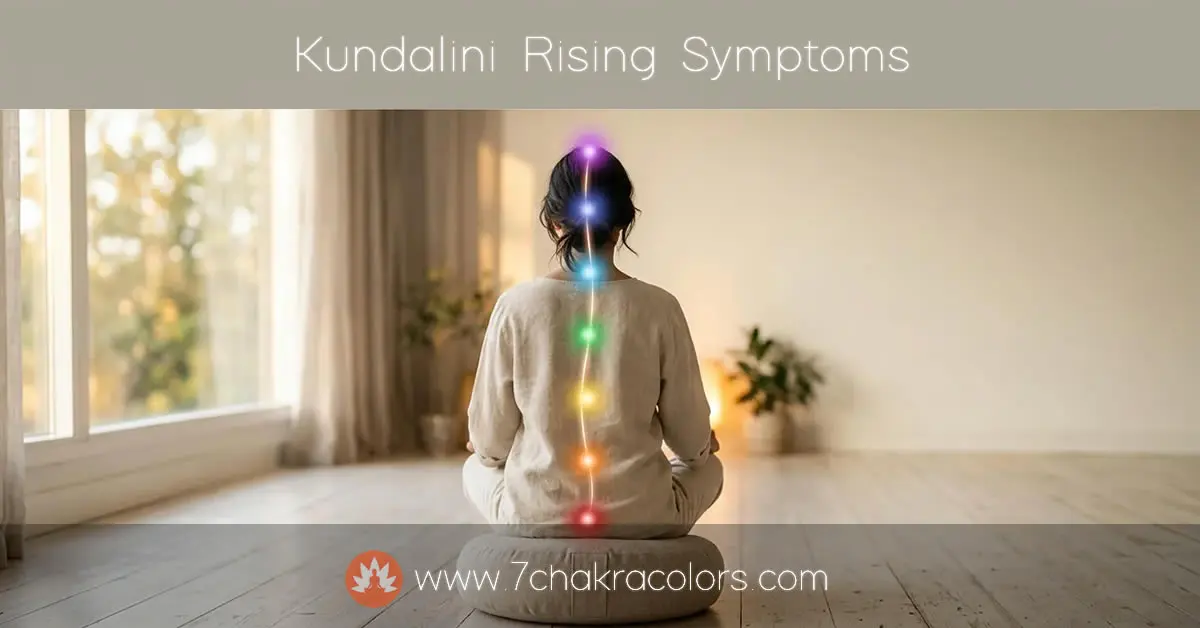
Spend an afternoon hunched over a laptop and your back keeps a diary of the whole thing. Lower back goes first, usually. By five o’clock your shoulders are somewhere near your ears and your neck feels like a coat hook with too many coats on it. Yoga would say you’re feeling more than posture. All seven chakras along the spine sit on that one column of bone, and kundalini – the energy said to lie coiled at its base – is meant to climb the whole length of it.
I find that a useful way to picture it. A ladder, more or less, where each rung has its own personality and its own bad habits.
Why the Spine, of All Places?
The old Tantric maps run a channel straight down the middle of you and call it sushumna nadi. I think of it as the main road, going from the tailbone all the way to the top of the head. Ida and pingala are the two side roads, winding around it and swapping sides every time they hit a chakra. They look a lot like the two-snake staff you see on some pharmacy signs (people love pointing that out, and it’s probably a coincidence, but a pleasing one).
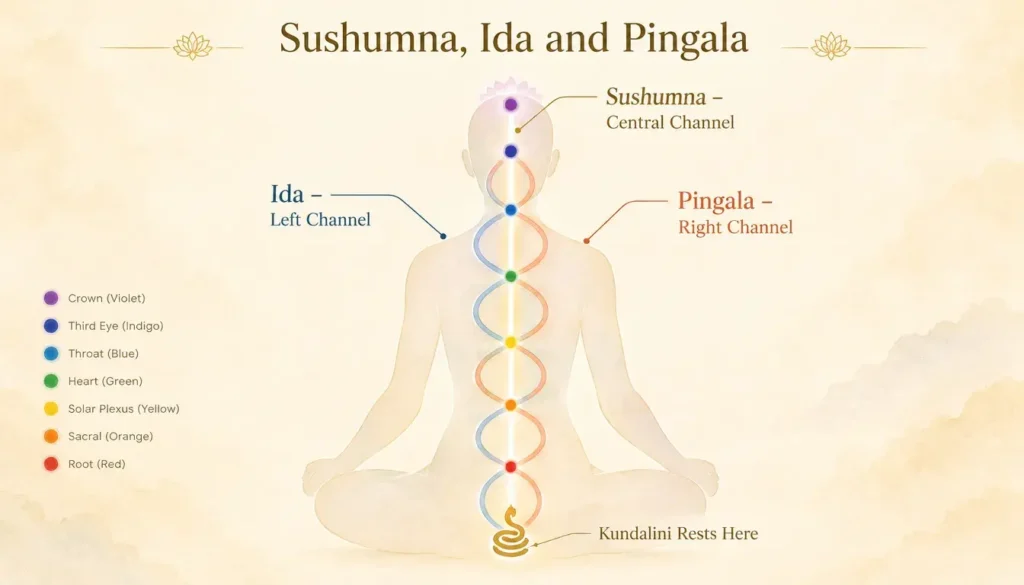
There’s a detail most chakra articles skip. In some schools each chakra has two addresses. The real one, the controlling point, is tucked inside the spine, while the one you actually meditate on sits round the front – your navel, the middle of your chest, that spot between the eyebrows. I like this. It means that when you breathe into your breastbone for the heart chakra, you’re ringing the front doorbell of a house whose kitchen is out the back, which would explain why heart work has a habit of loosening the upper back too.
And kundalini? Picture a snake asleep at the base of the spine, wrapped round three and a half times, which is an oddly precise number for a metaphor. It first shows up in Tantric Shaiva scriptures somewhere between the 6th and 8th centuries, so the idea has had a while to settle in. Wake it up and, so the story goes, it climbs sushumna chakra by chakra until it gets to the crown.
Kundalini Symptoms, According to the People Feeling Them
Ask ten people and you’ll get ten descriptions, which is half the trouble. For some it’s a mild warmth drifting up the back during meditation, gone a minute later. Others get something closer to a power surge.
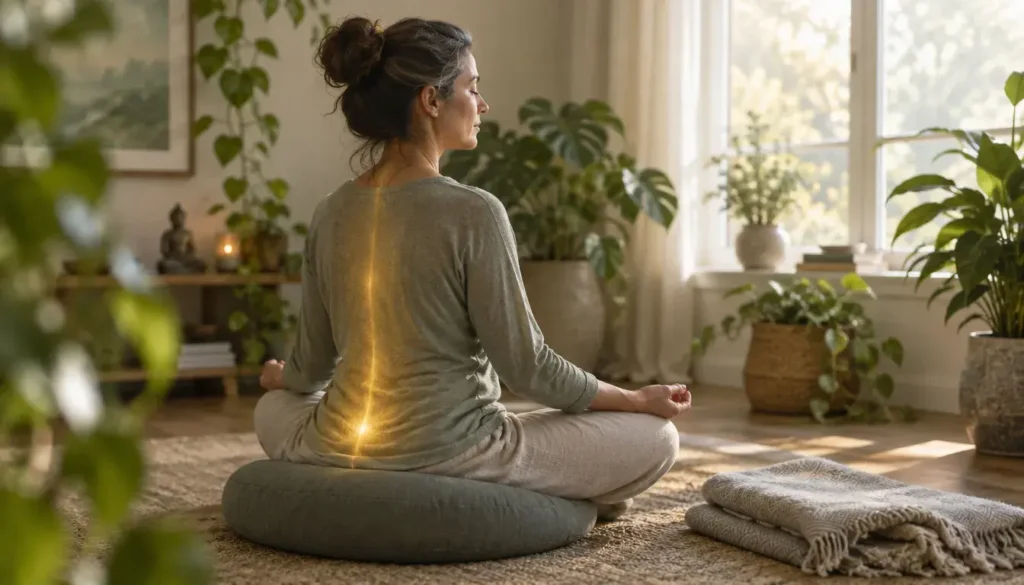
The research I keep coming back to is a 2022 Frontiers in Psychology study of 80 seasoned meditators from one Tantric yoga school. The researchers were careful never to say kundalini in their questions, which I think was smart, and the spine still turned up as the place people felt things most. Vibration and tingling were the words they reached for most, and roughly one in five described sensations rising up the spine or back. Mood shifts were even more common, and almost all of them were pleasant ones.
Put that research next to the traditional accounts and the classic kundalini symptoms look something like this:
- A low hum in the back that crawls upward, usually right when you’ve finally gone still
- Warmth pooling at the bottom of the spine like a heated car seat nobody switched on, sometimes spreading through the whole body until the meditation ends
- Little twitches, or your spine suddenly straightening itself as if a puppeteer got bored
- Pressure between the eyebrows, or a fizzy crown that’s still going while you’re putting the kettle on
- Breathing that speeds up or slows right down without you deciding it should
- Inner sounds, and oddly enough the study’s participants most often heard something like crickets
Most of the time this is the body responding to deep attention. Researchers have shown that simply focusing on one part of the body can make it tingle or feel warm. Still, I wouldn’t wave every sensation through as “just energy.”
Tingling, Pressure, Jolts: When It Might Not Be Kundalini
I’m a big believer in this practice, but some of the sensations above overlap with neurological problems, and from the inside they can feel almost identical.

A tingle that never quite leaves your hand might be a nerve getting squeezed somewhere in your neck, and the lower back can do the same thing to your legs. Headaches that come with vomiting or weakness are a whole different animal from third eye pressure, and I’d never lump them together. Twitches that turn up when you’re nowhere near a meditation cushion deserve a proper look, a first seizure as an adult most of all. And back or neck pain that shrugs off rest and stretching can mean a disc problem or a spinal canal that’s narrowing.
For the medical side, there’s a straightforward guide on when a Singapore neurosurgeon consultation is worth booking, and it covers the warning signs better than I could. One thing in it I found reassuring: a visit is mostly an examination, a scan or two and a diagnosis. Surgery only comes into it when the gentler options haven’t done the job.
A few signs shouldn’t wait for any appointment at all. If one side of your face or body suddenly goes weak or numb, your speech slurs, you get the worst headache you’ve ever had, or you’ve taken a knock to the head or spine, call 112 in Europe or 911 in the US. The meditation can wait until a doctor’s had a look.
From Tailbone to Skull: Where Each Chakra Lives
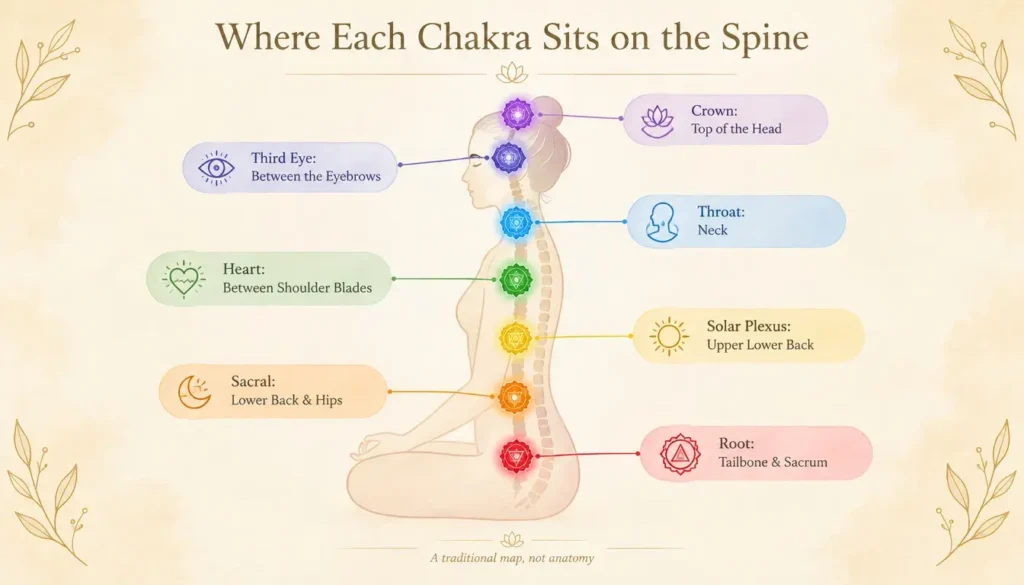
Every chakra has its own patch of spine. Not in the X-ray sense (nobody’s spotted one on an MRI yet), and different schools quibble over the borders, but as a map for catching where you hold things, it does the job.
Root Chakra, Down by the Tailbone
Muladhara, the root chakra, is the bottom rung, parked by the tailbone where kundalini is meant to be napping. When it’s out of sorts the lower back and legs usually complain first – that dull ache after a bad week, or the way you can’t stop shifting around in your chair during a long meeting. Energy here is slow and heavy by nature. That’s fine. What you don’t want is kundalini setting off from a wobbly base.
Sacral Chakra and the Hips That Remember Everything
Svadhisthana lives a hand’s width higher, roughly where the sacrum meets the curve of your lower back. Emotion and creativity are its territory, and dancers in particular will tell you hips hang on to old feelings the way a kitchen drawer hangs on to takeaway menus. Tight hip flexors tugging on the lower back are the physical version of the same story.
Solar Plexus Chakra, Just Under the Ribs
Manipura translates as something like “city of jewels,” which is a lovely name for the spot you clench before bad news. On the spine it lines up with the upper lumbar vertebrae, about level with your navel. Kundalini passing through here often feels like heat, which suits a chakra whose element is fire.
Heart Chakra – Between the Shoulder Blades
Anahata sits in the middle of the chest at the front, and in the thoracic spine at the back, right about where you can never quite reach to scratch. It’s also where a lot of people carry a stubborn knot that no amount of massage seems to shift. The front of the heart chakra gets all the attention for love and grief. The back of it, I think, is about whether you feel supported.
The old texts also place the second of three energetic knots, called granthis, here. The first one sits low, down near the root, and the last is lodged between the eyebrows. My favorite description comes from the Yoga-Shikha Upanishad, which likens kundalini getting through them to shoving a red-hot iron rod through the joints of a bamboo cane. Vivid, and honestly a little alarming.
Throat Chakra – The Neck
Vishuddha matches the cervical spine, the seven small vertebrae that hold your head up all day. Hours of looking down at a phone load them heavily, and energy workers would add that unspoken words tend to pile up in the same place. When kundalini reaches the throat it sometimes shows up as an urge to clear your throat or let out a sound – grunts and the odd hum were among the involuntary noises meditators in that 2022 study reported.
Third Eye and Crown – Where the Channel Reaches the Head
Ajna, the third eye, sits between the eyebrows, the point where sushumna is said to turn up into the head. Sahasrara, the crown, isn’t on the spine at all. It sits above it, at the very top of the skull, which is why it’s described as the place kundalini finally arrives. When the meditators in that study saw inner light, it was mostly somewhere in the head and mostly white, which is less psychedelic than people tend to expect.
All Seven Chakras and Their Spot on the Spine
If you’d like the whole climb on one screen (handy to glance at before you sit down to practice), here it is, starting at the bottom of the spine and working up.
| Chakra | Spine Area | What People Often Feel There |
|---|---|---|
| Root | Tailbone and sacrum | Heaviness or warmth at the very base of the spine |
| Sacral | Lower back and hips | Warmth around the hips, old emotions stirring |
| Solar Plexus | Upper lumbar spine, about navel height | Heat, or a clenched, fluttery stomach |
| Heart | Upper back, between the shoulder blades | Pressure or softening in the chest, upper back letting go |
| Throat | Neck (cervical spine) | An urge to clear the throat, hum or make a sound |
| Third Eye | Between the eyebrows | Pressure in the forehead, flashes of inner light |
| Crown | Top of the head, above the spine | Tingling at the crown, a sense of space opening up |
Why Kundalini Gets Stuck (or Rises Too Fast)
Traditional teachers warn about two opposite problems. The familiar one is energy that barely moves. You feel flat and heavy, and practice seems to go nowhere. Usually a chakra somewhere along the way is tight, with the lower ones being the usual suspects.

The second gets far less attention. Treat kundalini like a sprint, with hours of hard breathwork, back-to-back retreats and hardly any grounding, and you can end up wide awake at 3 a.m., hot for no reason and anxious in a way that won’t switch off. Gopi Krishna, a Kashmiri writer, wrote a whole memoir about a rough ride like that, and the term kundalini syndrome now crops up in clinical papers. Funny enough, the meditators in the 2022 study barely reported anything negative, and the authors put that down to slow, steady practice with a good teacher. The tortoise wins this one.
If your sleep goes to pieces or your mood takes a dive after intense practice, stop for a while and see a doctor or a mental health professional. Nobody gives out medals for pushing through.
A 10-Minute Spine Breath You Can Do in a Chair
I keep this one soft deliberately. You’re only getting to know your spine from the inside, and whatever else happens can take its time.

- Perch on the front edge of a chair, feet flat. Your spine knows how tall it wants to be, so let it decide.
- Breathe in through your nose and imagine the air sliding up your back from tailbone to crown, slow as honey off a spoon. Ten or twelve of those.
- Breathe out down the front of you, into the belly. Up the back and down the front, a lazy loop.
- Somewhere will probably feel thick, or oddly empty. Hang out there for a few breaths without trying to sort it out.
- Spend the last two minutes breathing down into the soles of your feet. I’d argue this bit matters more than anything fancy you felt in the middle.
Warmth or tingling during this is fine. If it gets intense, open your eyes, press your feet into the floor and stop for the day. It’ll keep.
What Helps When the Energy Runs Too Hot?
- Ten minutes walking barefoot on grass or sand, phone left at home
- A warm, heavier meal – root vegetables, a thick soup, something you actually have to chew
- Dropping breath retention and fast breathing techniques for a few weeks
- Giving big backbends a rest and spending more time folded forward or curled up in child’s pose
- A boringly regular bedtime, even on nights your brain swears it’s wide awake
What Your Back Might Be Trying to Say
The next time your lower back grumbles after a rough week, or something warm creeps between your shoulder blades mid-meditation, treat it like a note somebody left you. Sometimes it’s kundalini on its slow climb. Sometimes it’s a stiff disc or an irritated nerve that wants a doctor’s opinion. Learning to tell the two apart is part of the practice too, if you ask me.
Frequently Asked Questions About Kundalini and the Spine Chakras
Can kundalini awaken on its own, without any practice?
It can, according to plenty of first-hand accounts. People describe spontaneous awakenings after a big life upheaval, a stretch of grief, an illness or even out of nowhere on an ordinary afternoon. Most reports still come from people who meditate or do breathwork, though. If sensations arrive unasked and feel frightening, or start affecting your sleep and mood, talk to a doctor first to rule out a medical cause, and look for an experienced teacher rather than trying to push the process along yourself.
How long does a kundalini awakening last?
There’s no fixed timeline, and anyone promising you one is guessing. The physical sensations during practice often last seconds or minutes and then fade. The wider shift people describe, in how they feel and see things, is usually talked about in months or years rather than days. What matters more than duration is how you’re coping. Symptoms that drag on, keep getting stronger or turn up outside meditation deserve a medical opinion, not just more patience.
Is kundalini energy dangerous?
For most people who practice steadily, it isn’t. In research on trained meditators, the experiences reported were overwhelmingly pleasant, and negative effects were rare. Trouble tends to show up when kundalini is forced with long, intense breathwork and very little grounding, or in people who already have a mental health vulnerability. Going slowly, working with a good teacher and stopping when things feel too strong are the sensible safeguards. Sudden severe symptoms always need urgent medical care first.
Why does my spine tingle when I meditate?
A few things can be going on at once. Simply paying close attention to one area of the body can make it tingle or feel warm, and sitting upright for a while changes how your back feels too. In yoga, a gentle buzz moving up the spine is read as kundalini starting to stir. If the tingling only happens during practice and fades afterwards, it’s usually nothing to worry about. Numbness or tingling that hangs around the rest of the day is worth getting checked.
Which chakra should I work on first?
Start at the bottom with the root chakra. It’s the foundation the others rest on, and the old texts are fairly consistent that kundalini rising from a shaky base is where problems begin. Root work is also the easiest to fit into normal life: walking barefoot, eating warm, filling meals, keeping a regular routine and spending time in nature. Once you feel steadier, moving your attention up through the sacral and solar plexus chakras tends to feel more natural.
Can chakra work help with back pain?
It can help some people relax, breathe better and notice where they hold tension, and that alone sometimes eases a stiff back. Gentle stretching and breath practices along the spine are a pleasant addition to everyday care. That said, chakra work is a complement to medical treatment, not a replacement for it. Back or neck pain that lasts for weeks, keeps getting worse, or comes with numbness, weakness or trouble with bladder or bowels needs to be seen by a doctor.
Should I stop meditating if I feel kundalini symptoms?
Not necessarily. Mild warmth, tingling or a sense of energy moving are common and usually settle on their own. Keep sessions gentle, finish with a few minutes of grounding and skip intense breath retention for a while. If the sensations become overwhelming, or you start losing sleep, feeling anxious or not quite like yourself, take a break and speak to a doctor or mental health professional. Coming back to practice later, more slowly, is always an option.
Blog Categories:
About the Author: