

Energy Work and Supplements to Calm Your Dog Before Travel
Help your dog stay calm before travel with energy work, calm touch and supplements like CBD, plus how to read stress signals and settle in after the trip.
Table Of Contents
Nobody knows exactly when it started. Fifteen thousand years ago, maybe a lot more – the estimate shifts every time someone digs up another old jawbone. The likeliest story goes something like this: a few wolves that were a bit less scared of people than the rest started hanging around camps, picking at whatever got thrown away. Humans didn’t chase them off. And that’s more or less how the longest friendship our species has ever had got going.
Both sides got something out of it, which is probably why it lasted. People got an early-warning system with fur on it – ears and noses far better than ours, a bark when something moved out there in the dark, and later a hunting partner fast enough to catch what we couldn’t. Dogs got leftovers. A warm spot near the fire. Safety in numbers. Simple trade.

Except it didn’t stay simple. Over thousands of generations dogs learned to read our faces – they’re one of the very few animals that follow a pointing finger without being trained to. And we changed too. Look at your dog for a while and there’s a decent chance your oxytocin goes up – and theirs as well, as a 2015 study in the journal Science found when it measured owners and dogs gazing at each other. Same hormone that bonds parents and babies. Which explains a lot about who wins the begging contest at dinner.
Today the hunting part has mostly gone. Your dog probably isn’t guarding the herd. They’re guarding the sofa. What’s left is the emotional half of the deal, and it’s bigger than ever – dogs come on holidays, sleep in our bedrooms, move house with us. Which is lovely. And also where things get tricky, because those trips weren’t their idea. If you’re getting ready for one, a mix of calm handling, simple energy work and supplements like cbd to calm dogs can make the whole thing a lot easier on both of you.
Why Travel Is So Hard on Some Dogs
Dogs have personalities. Anyone who’s lived with two at once knows that. One sleeps through a thunderstorm, the other spends it wedged behind the toilet.
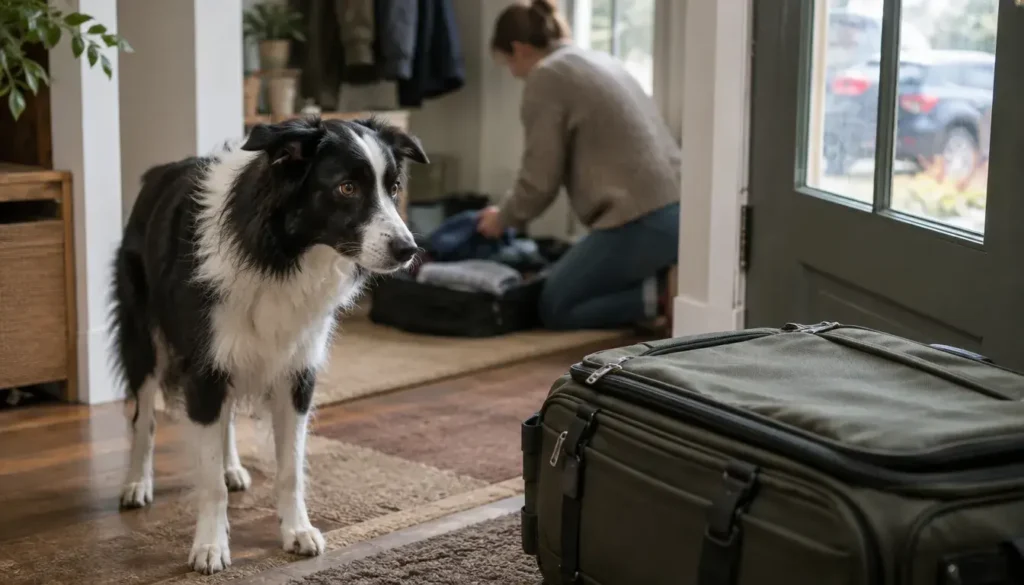
And they pick up on things early. Way earlier than we’d like. The suitcase comes down from the wardrobe and your dog is already pacing, two days before you leave. They’re not psychic, they’re just watching you very closely – your routine shifts, your voice gets a bit tighter, you start doing strange things like folding clothes into a box. To a dog who loves predictability, that’s a warning sign.
Then the trip itself piles on the stress:
- Motion and noise. The engine drones on and on, the car brakes, leans into curves. Plenty of dogs get carsick, and after a couple of bad rides it’s not the motion they’re afraid of anymore – it’s the car. Just seeing it parked in the driveway is enough.
- Loss of control. Stuck in a crate or clipped into a harness, they can’t walk away from whatever’s bugging them. For a nervous dog that’s half the problem.
- Strange smells everywhere. For an animal that maps the world through its nose, a new place is a lot of information all at once.
- Broken routine. Meals late, walks skipped, sleeping in an unfamiliar room.
- Your stress. This one gets overlooked. If you’re stressed, your dog notices.
Dogs who travel all the time often shrug this off. A dog whose biggest trip so far has been the vet? Different story.
How to Prepare Your Dog Before the Trip
Talk to Them – Really
It might feel silly, but tell your dog what’s coming. Obviously “we’re driving to Grandma’s on Saturday” means nothing to them. Your tone does, though. So do a handful of words they already know – “car,” “walk,” the jingle of the leash coming off the hook – and the general sense that you’re relaxed about all of it.
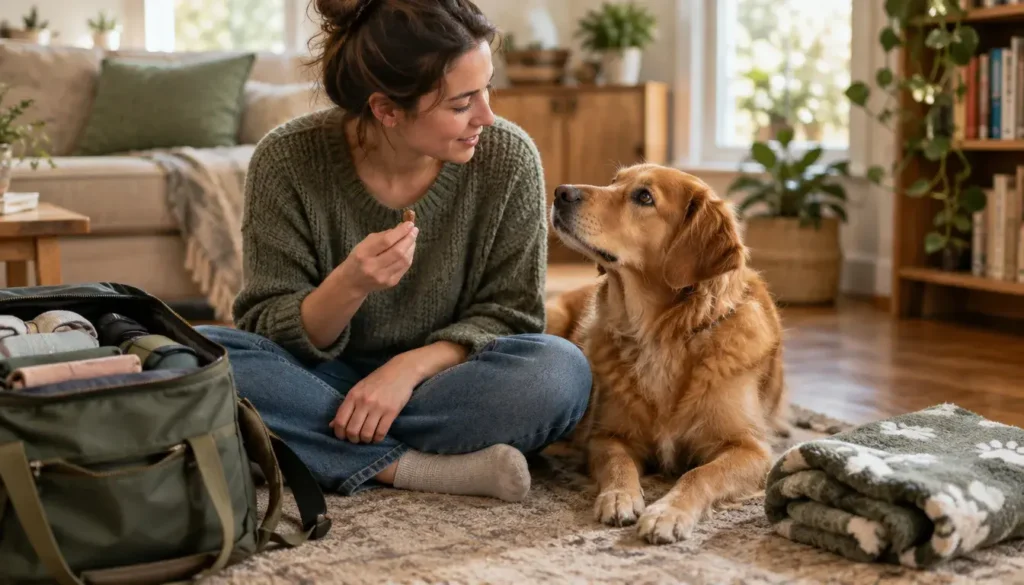
Pick two or three words and stick with them. Then sit down next to the packed bag with your dog, say “trip” like it’s the most boring word in the world, hand over a treat and get on with your day. A few days of that and the word loses its edge. It’s just a thing that happens before a biscuit.
Practice With Short Drives
Start tiny. A ten-minute drive to the park and back home again. Then twenty minutes. Bring the bed or blanket they’ll travel with so it already smells like them – and like a good time. Skip big meals right before, especially if they get queasy.
Energy Work and Calm Touch
This is where a lot of owners notice the biggest shift. Energy work with dogs doesn’t need to be complicated. It’s mostly slow, deliberate touch with your full attention on it.
Sit on the floor next to your dog while they’re already fairly relaxed. Place one flat hand on their chest and the other at the base of the spine – in chakra terms, the heart and root areas, linked with connection and with feeling safe. Let your own breathing slow right down, loud enough that your dog can hear it. A lot of dogs pick up the rhythm within a minute or two. You’ll feel it under your palm when it happens – the ribcage moves slower, the muscles give a little.
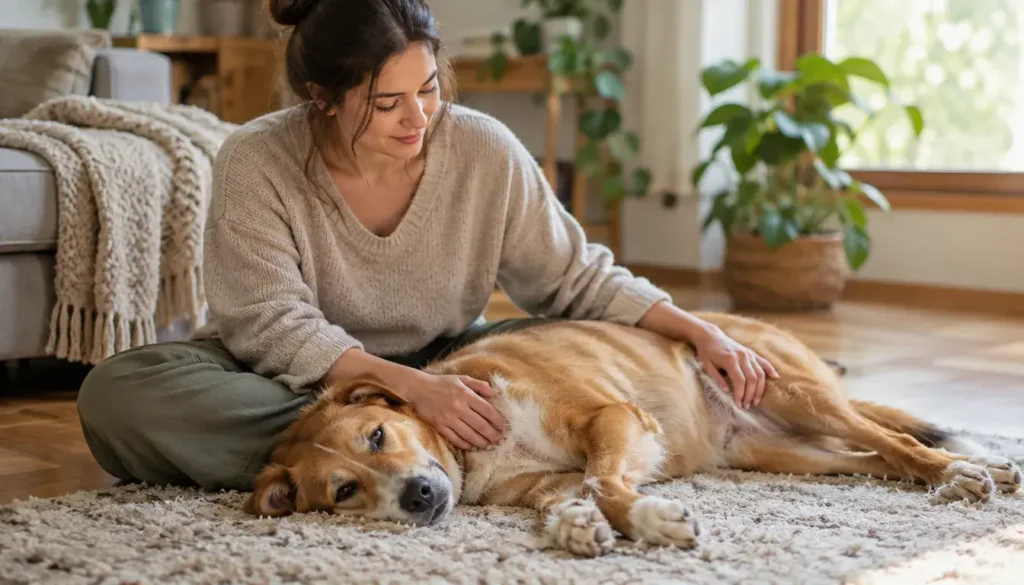
After that, run your hand from the head all the way back to the tail, nice and slow. Some spots will tighten up as you pass. Don’t rush past them. Wait there for a breath or two, then carry on. Do this for five or ten minutes a day in the week before you leave and you’ve got a little ritual you can take with you – into the back seat, to a rest stop, onto the floor of a rented apartment. Reiki-style hand holds work the same way if that’s your thing. Your dog doesn’t care what you call it.
Supplements: Where CBD Fits In
Calm handling goes a long way. For some dogs, though, it’s not quite enough on its own, and that’s where supplements come in. Did you know CBD is one of the most common options owners turn to for travel stress? Some dogs respond really well – they’re still alert and themselves, just less wound up.
A few practical points if you’re thinking of trying it:
- Get something made specifically for dogs. You want the amount of CBD per dose printed clearly on the label, and zero THC – THC is toxic to dogs.
- Try it at home first. A quiet Sunday is perfect. Much better to find out how your dog reacts on your living room floor than halfway down the motorway.
- Timing matters. Give it well before you set off, not once your dog’s already panting in the back. How much and how early is something the label and your vet should tell you.
- Other options exist too – L-theanine, chamomile-based chews, pheromone collars. Try one thing at a time so you know what’s working.
Reading Your Dog’s Body Language on the Road
Your dog is telling you how the trip is going all the time. Most of it is pretty easy to read once you know what you’re looking at.
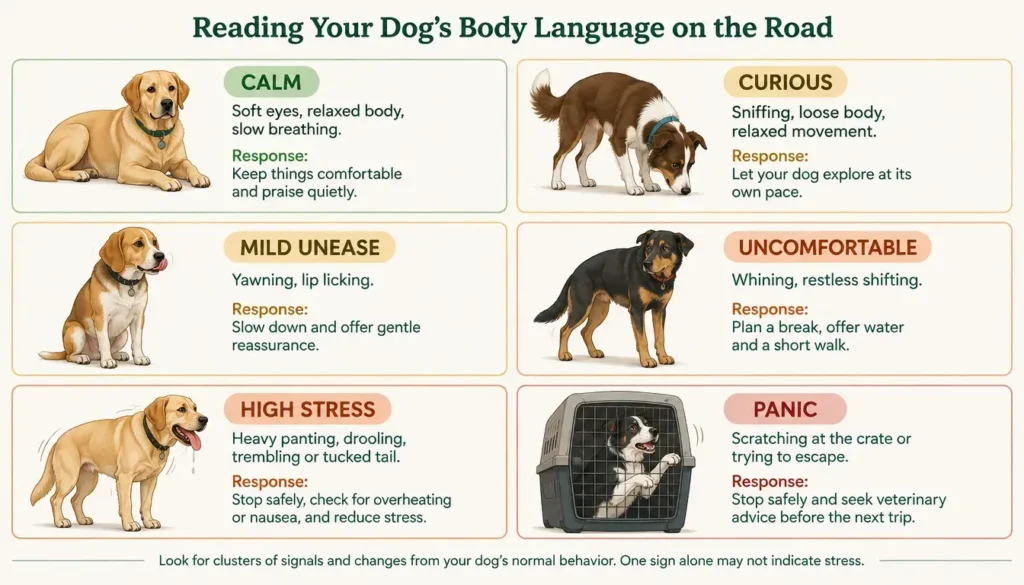
These are the signals you’ll see most often:
| What Your Dog Does | Stress Level | What It Usually Means | What You Can Do |
|---|---|---|---|
| Lying down, soft eyes, slow breathing | Calm | Your dog feels safe and is coping well | Keep things as they are and praise quietly |
| Curious sniffing, loose body | Calm | Interested in the new place, not worried by it | Give time to explore at their own pace |
| Yawning, lip licking | Mild | Mild unease – your dog is trying to calm itself | Slow down, talk softly, offer a hand on the chest |
| Whining, restless shifting | Mild | Uncomfortable, bored or needing a toilet break | Plan a stop, offer water and a short walk |
| Ears back, tail low | Mild | Unsure about what’s happening around them | Reduce noise, add a familiar blanket or toy |
| Heavy panting, drooling | High | Strong stress or motion sickness (or overheating) | Stop, cool the car, fresh air, check for nausea |
| Trembling, tail tucked, hiding | High | Fear – your dog feels unsafe | Pause the trip if you can and use the calming routine |
| Scratching at the crate, trying to escape | High | Panic – risk of injury | Stop safely and talk to your vet before the next trip |
One signal alone doesn’t mean much – a yawn might just be a yawn. But a yawn plus lip licking plus a tail tucked under? That’s a dog asking for help.
Helping Your Dog Settle After You Arrive
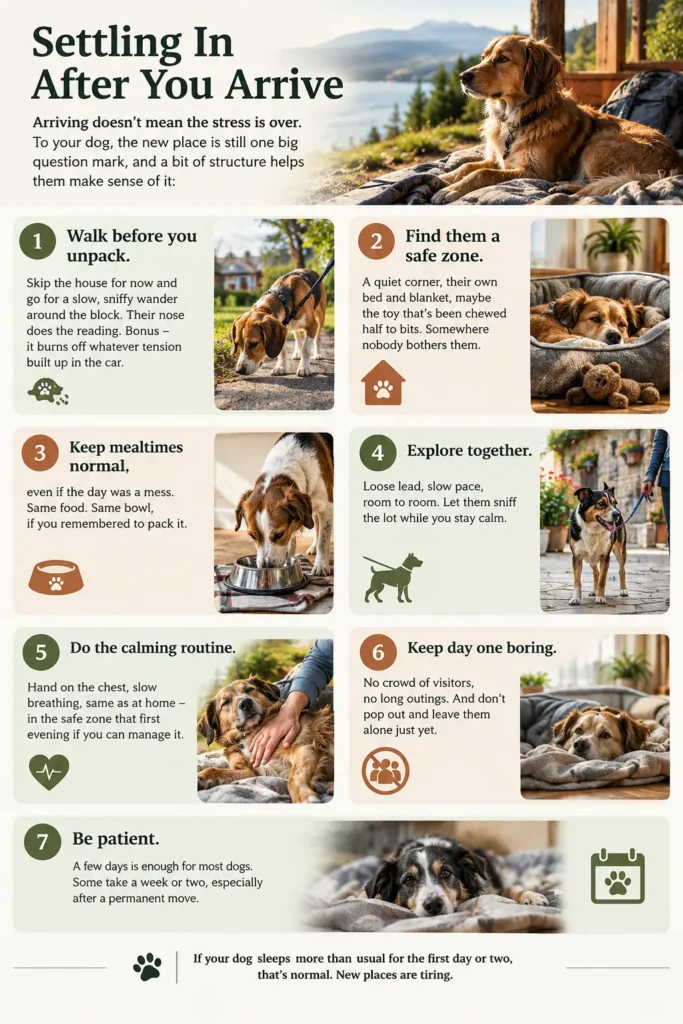
Arriving doesn’t mean the stress is over. To your dog, the new place is still one big question mark, and a bit of structure helps them make sense of it:
- Walk before you unpack. Skip the house for now and go for a slow, sniffy wander around the block. Their nose does the reading. Bonus – it burns off whatever tension built up in the car.
- Find them a safe zone. A quiet corner, their own bed and blanket, maybe the toy that’s been chewed half to bits. Somewhere nobody bothers them.
- Keep mealtimes normal, even if the day was a mess. Same food. Same bowl, if you remembered to pack it.
- Explore together. Loose lead, slow pace, room to room. Let them sniff the lot while you stay calm.
- Do the calming routine. Hand on the chest, slow breathing, same as at home – in the safe zone that first evening if you can manage it.
- Keep day one boring. No crowd of visitors, no long outings. And don’t pop out and leave them alone just yet.
- Be patient. A few days is enough for most dogs. Some take a week or two, especially after a permanent move.
If your dog sleeps more than usual for the first day or two, that’s normal. New places are tiring.
A Word of Caution About Supplements
The honest picture on CBD for dogs is that the science is young. A few small studies have looked at stress during car rides and time alone. In a 2023 trial from the Waltham Petcare Science Institute, dogs given a single dose of THC-free CBD had lower cortisol after a car ride than dogs on a placebo. Others – one on fear of loud noises, for example – didn’t find much of a difference at all. Nobody’s sure yet what long-term use looks like, or how the right amount changes from a chihuahua to a Great Dane.
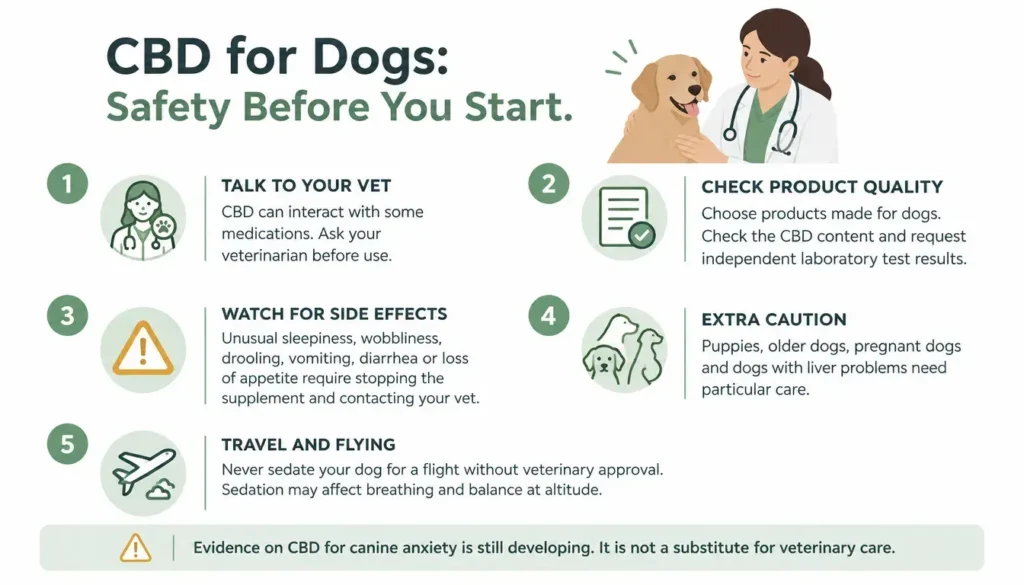
So I’d think of it as one tool among several. Before you start, a few things to know:
- Check with your vet, particularly if your dog’s on any other medication. CBD can interact with some drugs.
- Keep an eye out for side effects – a dog who’s suddenly very sleepy or wobbly on its feet, drooling, vomiting, diarrhea, not eating. See any of those and you stop, then call the vet.
- Puppies, older dogs, pregnant dogs and dogs with liver trouble need extra caution.
- Flying? Don’t sedate without your vet’s okay. Lots of airlines and vets are against it, because sedation can mess with breathing and balance up at altitude.
- Ask for third-party lab results. If a brand can’t show you what’s in the bottle, move on.
Then there’s the serious end of things. A dog who hurts itself, stops eating or still can’t settle after several days isn’t dealing with a bit of travel nerves. That needs a vet or a certified behaviorist, and no supplement is going to cover it.
For most dogs, though, it doesn’t take much. A couple of practice drives. The blanket that smells like home. Your hands, your voice, a bit of patience. If a supplement helps your particular dog, add it. Just keep watching them – you’ll know whether something’s working long before you’ve finished the bottle.
Frequently Asked Questions About Calming Your Dog Before Travel
How do I know if my dog is anxious about traveling?
Watch for the early signs – pacing when the suitcase comes out, hiding, lip licking, yawning and a low tail. In the car, heavy panting, drooling, whining or trembling usually mean real stress. One signal on its own doesn’t tell you much. Several together do. If your dog also refuses food or tries to escape the crate, take it seriously and talk to your vet before the next trip.
Does energy work really help calm dogs?
Many owners find it does, though there’s little formal research on it. What happens in practice is simple: slow, focused touch and calm breathing help your dog relax, and many dogs start to match their owner’s breathing. Whether you see it as chakra work, reiki or just mindful petting, the routine gives your dog something familiar and soothing to hold on to when everything else is new.
Is CBD safe for dogs before a trip?
Pet-specific CBD products without THC are generally well tolerated by many dogs, but research is still limited and every dog is different. Talk to your vet first, especially if your dog takes other medication, since CBD can interact with some drugs. Try it at home on a quiet day before the trip, and watch for side effects like heavy sleepiness, wobbliness, vomiting or diarrhea.
How long before travel should I start preparing my dog?
A week or two is ideal for a dog who isn’t used to traveling. That gives you time for a few short practice drives, a daily calming routine and a test run with any supplement you’re planning to use. Even a few days of preparation helps, though. Start with short car rides that end somewhere fun, like the park, so the car stops meaning only the vet.
Should I feed my dog before a long car ride?
Give a light meal a few hours before you leave rather than a big one right before. A full stomach makes motion sickness more likely. Bring water and offer small sips at rest stops, and plan a break every couple of hours for a short walk and a toilet stop. Once you arrive, go back to your dog’s normal feeding times as soon as you can.
How long does it take a dog to settle in a new place?
Most dogs settle within a few days on a short trip. After a permanent move, it can take one to three weeks before your dog feels fully at home. You can speed things up by setting up a quiet safe zone with their own bed, keeping meals and walks on schedule, and repeating the calming routine you used at home. Extra sleep in the first couple of days is normal.
Can I sedate my dog for air travel?
Not without your vet’s approval. Many vets and airlines advise against sedating dogs for flights, because sedation can affect breathing, balance and body temperature at altitude. If your dog is very anxious about flying, ask your vet about safer options and start crate training well before the trip, so the travel crate already feels like a familiar, safe place.
Blog Categories:
About the Author: