Crown Chakra Symbol – Meaning, Tattoos and Downloads
Crown Chakra symbol meaning, tattoos, and downloads. Learn Sahasrara symbol and spiritual significance.

The crown chakra (Sahasrara) explained: meaning, location, violet color, symbol, mantra, function, benefits, balanced vs blocked signs and practices.
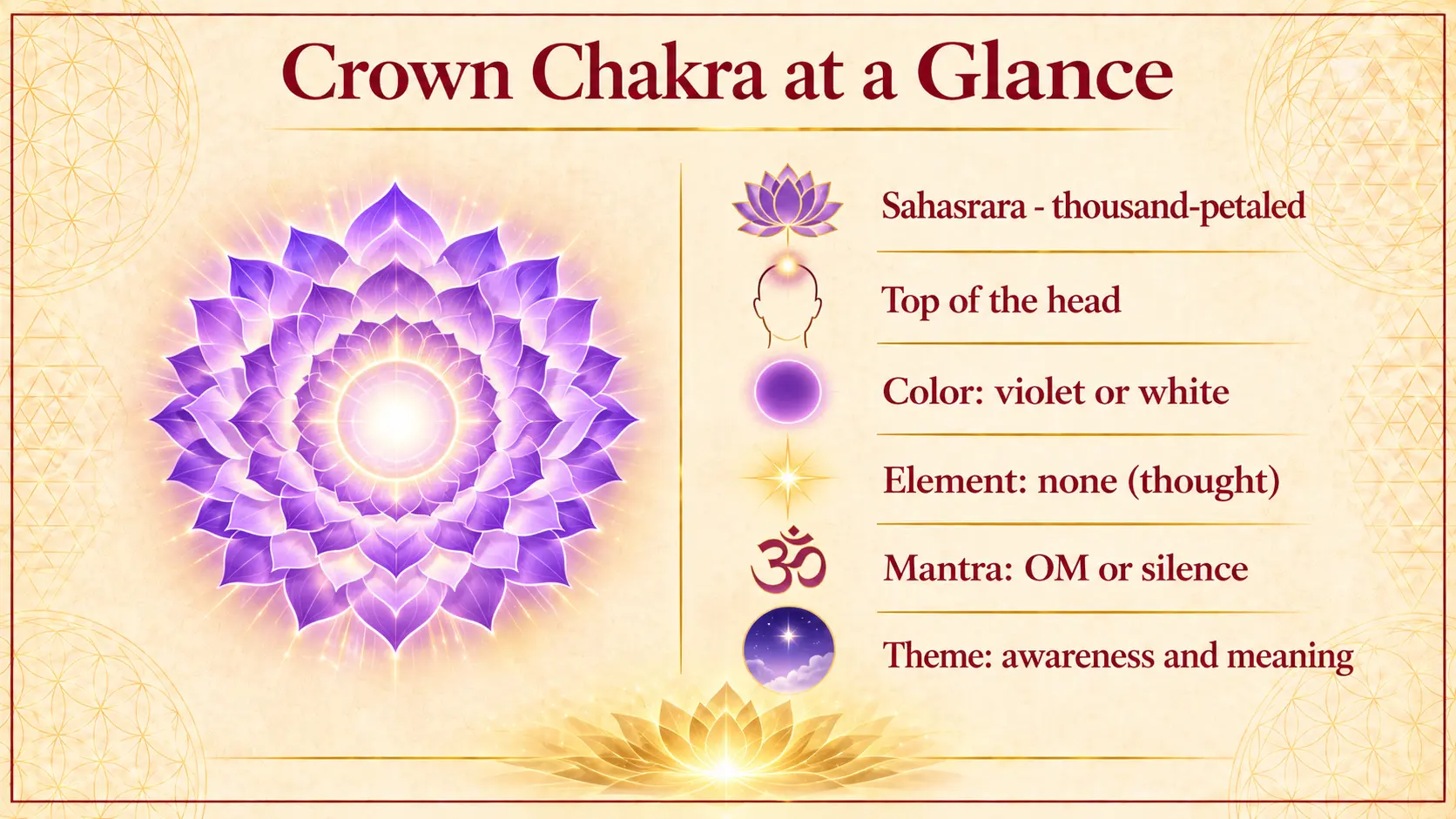
The crown chakra, or Sahasrara ("thousand-petaled"), is the seventh and highest of the seven main chakras. In chakra tradition it sits at the top of the head, or just above it. Its color is violet (or white), and modern chakra teachings link it with awareness, meaning and connection to something larger than yourself.
Crown Chakra at a Glance
Sahasrara · the seventh chakra
The crown chakra is the seventh of the seven chakras and the last in the series. Its Sanskrit name is Sahasrara, and in English it is also called the seventh chakra, the 7th chakra or the head chakra. It sits at the very top of the system (see the chakra map), above the third eye, and teachers describe it as the point where the individual meets the whole.
In chakra teachings it is the center of awareness. It is linked with spirituality, meaning, wisdom, faith, inner peace and the feeling of being connected with life, nature or the divine, depending on what you believe. When people say their crown chakra is open, they usually mean that they feel part of something larger and have a sense of purpose, without losing touch with everyday life.
Chakras are not physical organs, and there is no scientific evidence that they exist as structures in the body. They come from yoga and Tantra, and many people use them as a map for awareness and meaning. This page explains what the crown chakra means in the traditional texts and in modern chakra books, and links to a detailed page for each part of crown chakra practice.
Sahasrara is a Sanskrit word made of sahasra, "thousand", and ara, "spoke" or "petal". It means "thousand-petaled", after the lotus with a thousand petals that stands for this chakra. A thousand here is not an exact count. In Indian thought it means "countless", so the name also suggests something without limits. It is pronounced roughly "sah-hahs-RAH-rah".
Unlike the other six, the crown chakra is often not counted as a chakra at all in the old texts. It is the place beyond the chakras, where the journey of Kundalini ends. Shiva, pure consciousness, is said to live here, and when Kundalini, Shakti, rises from the root and unites with him, the yogi is described as reaching liberation.
The crown chakra represents your connection with something beyond the personal self. In modern teaching it stands for spirituality, awareness, wisdom, meaning, trust in life and the experience of unity, the feeling that everything is connected. For some people that is God, for others nature, the universe or simply a deep sense of peace. These meanings come mainly from modern chakra psychology. The traditional texts describe the crown as the seat of Shiva and of pure consciousness.
In modern chakra books, the crown chakra is responsible for awareness and meaning. When it is balanced, teachers say you can step back from your thoughts, feel calm in the face of what you cannot control, find meaning even in hard times, and stay open to ideas and beliefs that differ from yours. When it is out of balance, you either feel cut off, cynical and without purpose, or you float in spiritual ideas, lose touch with the body and neglect daily life.
Some teachers also link the crown chakra with the brain, the nervous system, the skull and sleep. These links come from chakra books, not from medicine. Headaches, dizziness, sleep problems, low mood and any neurological symptoms need a doctor.
In verses 40-49 of the Sat-Chakra-Nirupana, a 16th-century Tantric text translated by Arthur Avalon in The Serpent Power (1919), Sahasrara is placed above the head, above all the other lotuses. It describes a lotus with a thousand petals, lustrous white, hanging with its head turned down. The fifty letters of the Sanskrit alphabet are written on the petals, repeated twenty times. In its center is the full moon, a shining triangle and, within it, the void, the great emptiness where Paramashiva lives.
The text calls this the place of liberation: here Kundalini unites with Shiva, and the mind and the senses come to rest. Modern teachers rarely use this picture literally. They keep the light, the thousand petals and the idea of union, and read them as awareness, meaning and inner peace.
The crown chakra is located at the top of the head, at the highest point of the skull. Many teachers place it at the brahmarandhra, the "opening of Brahman", which lines up with the soft spot (fontanelle) of a newborn baby's skull. In the subtle body of yoga it sits at the upper end of the central channel, the sushumna nadi.
Many people feel this area in meditation as tingling, warmth, lightness or a gentle pressure on the top of the head. That is why crown chakra practices are usually quiet: sitting still, lying in Savasana or resting the attention on the crown of the head.
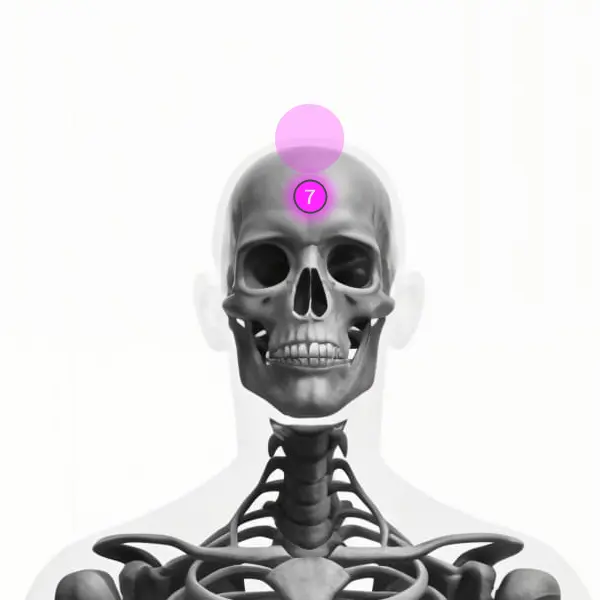
Diagram is showing where crown chakra is located at the top of your head (violet dot 7) and where the energy of the crown chakra can be felt when you concentrate on it (transparent violet circle)
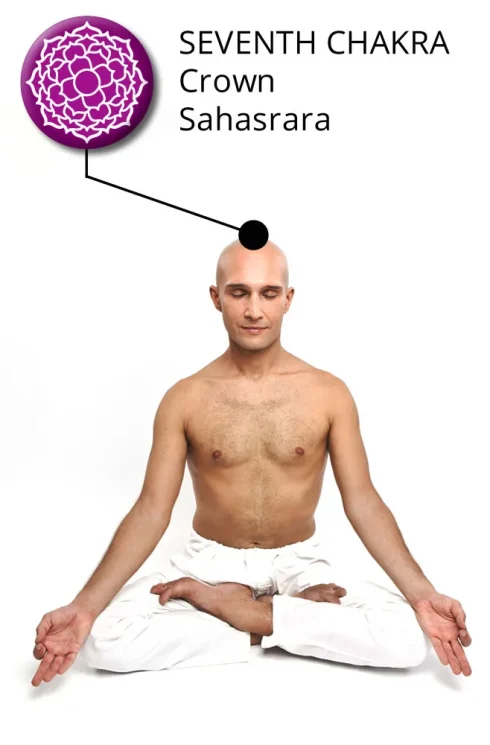
Both answers are given. Most modern chakra books place it on the top of the head. The old texts describe it just above the head, outside the body, because it stands for what goes beyond the body. In practice the difference is small: you can rest your attention on the crown of the head or a few centimeters above it, whichever feels more natural.
Chakra books connect the crown chakra with the brain, the nervous system, the skull and the skin, and with sleep and states of awareness. It has no sense, because it is described as beyond the five senses. The gland most often named is the pineal gland, which helps regulate sleep, though some teachers name the pituitary gland instead. Gland links are a modern addition and are not medically proven.
Anodea Judith connects each chakra with a stage of life. In her model the crown chakra is not linked with childhood: it develops from early adulthood onward and throughout life, as we look for meaning, values and wisdom of our own.
These links are a way of thinking about the body, not a diagnosis. Neurological, sleep and mood problems belong with a doctor.
The crown chakra color is violet in the modern rainbow system, which gives the seven chakras the colors of the spectrum from red at the root to violet at the crown. Violet is the last and highest color of the visible spectrum, so it became the color of the highest chakra in 20th-century chakra books.

The traditional texts paint it differently. In the Sat-Chakra-Nirupana the thousand petals are lustrous white, brighter than the full moon, and some versions describe them as containing all colors. So white is the old color and violet the modern one. That is the violet chakra meaning in modern books: violet has stuck because it is linked with spirituality, royalty and mystery in many cultures.
Many people use violet or white as a reminder in their practice, for example a purple or white cloth on a meditation corner, an amethyst, flowers like lavender, or visualizing violet or white light at the top of the head. There is no proof that color changes the chakra, but it is an easy way to bring your attention to it.
All three are used. Violet is the main color in the rainbow system. White is the traditional color and the one many meditations use, because white light contains all colors. Gold is a third option some teachers use for the "light" of awakening. None is wrong; choose the one that feels right for you.
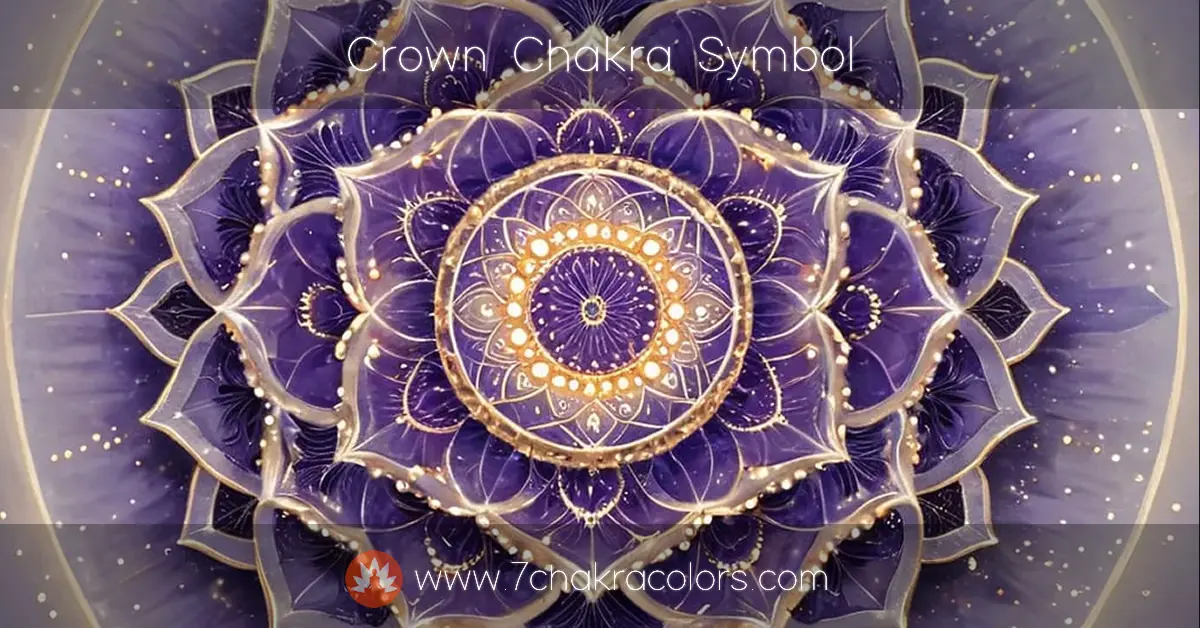
The crown chakra symbol is a lotus with a thousand petals, often drawn in layers around a central circle. In the traditional picture the fifty letters of the Sanskrit alphabet are written on the petals twenty times over, which means the crown contains every sound, and so every word and every idea. In the center is the full moon or a point of light.
Because it is so simple and so full of meaning, the symbol is a popular tattoo. The meaning of each part, color versions and free downloads are on our crown chakra symbol page.
In sound healing, the crown chakra is most often given 963 Hz, the highest tone of the modern Solfeggio frequencies. Chakra tuning forks based on musical notes give it the note B instead, usually 480 Hz. Both are modern conventions: the old texts name no frequency, and for the crown not even a mantra. The page linked in the facts box compares the systems and lets you listen to each tone.
The characteristics of a balanced crown chakra, as modern chakra teachings describe them (not diagnostic criteria), start with feeling calm and open. When crown chakra energy is steady, you have a sense of meaning, you can accept what you cannot change, you are curious about big questions, and your spiritual life, whatever form it takes, goes together with a normal, grounded daily life.
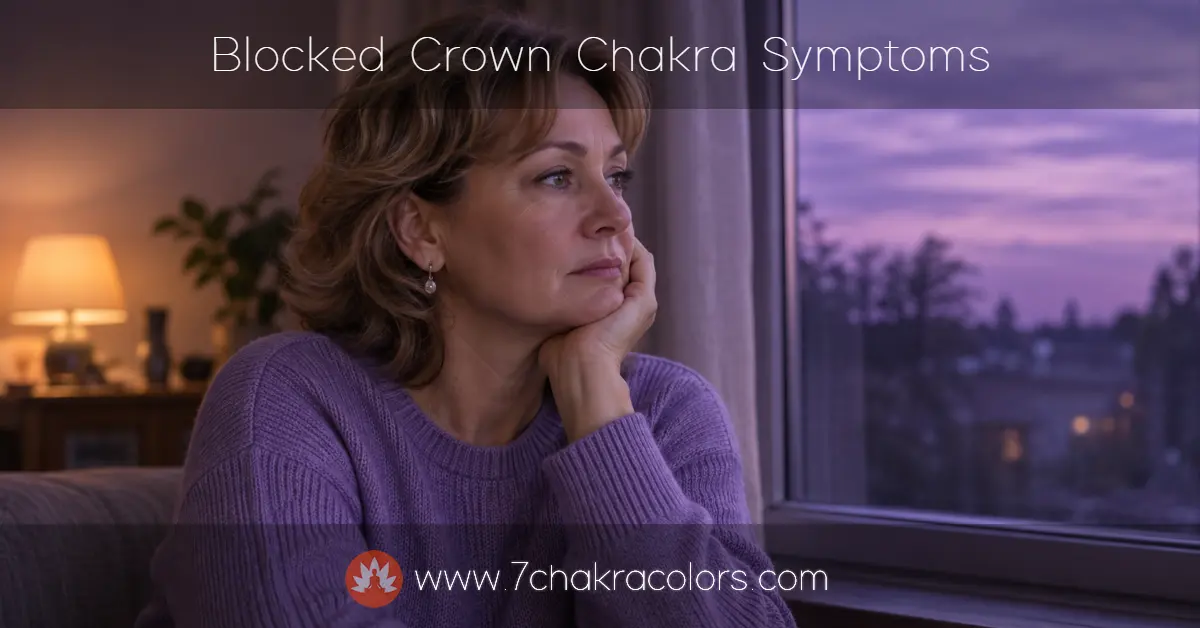
When the crown chakra is blocked or underactive, teachers describe feeling cut off or empty, cynicism, a lack of purpose, rigid beliefs and trouble trusting anything you cannot see. An overactive crown chakra is the opposite picture: living in your head, spiritual escape from real problems, feeling spaced out or detached from the body, and neglecting food, sleep and people. The full lists and the causes are on our page about crown chakra blocked symptoms.
Our free crown chakra test asks a set of short questions about meaning, trust in life, spiritual practice, openness and how grounded you stay. Your answers show whether your crown chakra looks balanced, underactive or overactive, and which areas need the most attention.
It takes a few minutes. Answer from your everyday life, not from your best moments in meditation. The result is a starting point, not a diagnosis, and the healing and practice pages explain how to work with it.

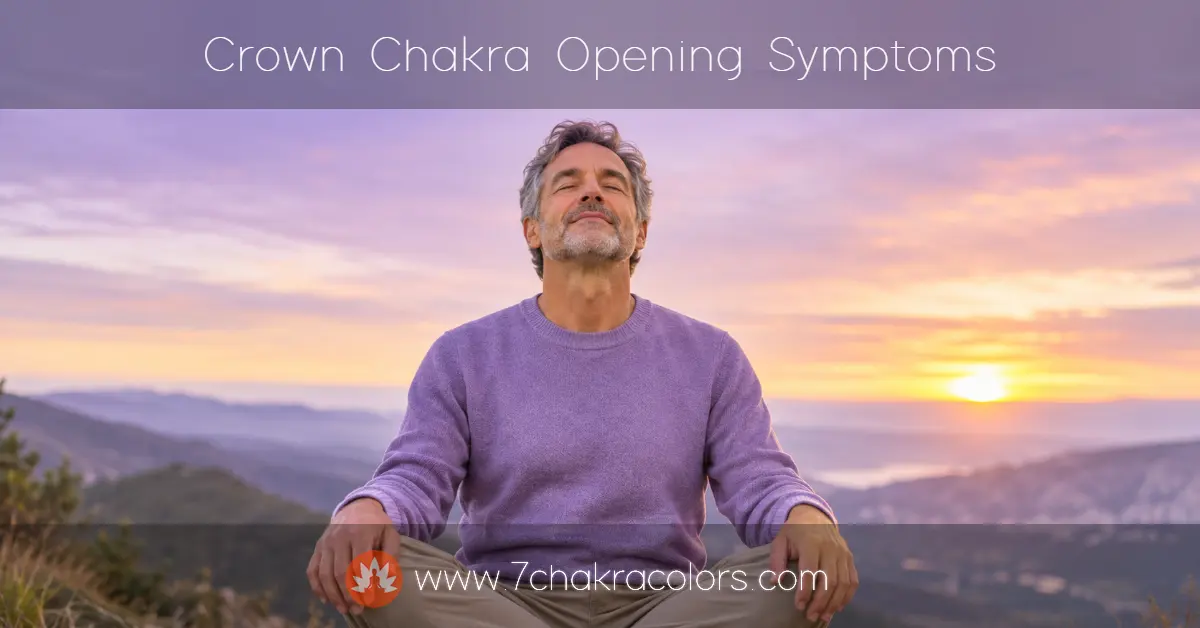
When the crown chakra starts to open, people often describe tingling or warmth on the top of the head, moments of deep calm, a feeling of unity with everything, more meaningful coincidences, and changes in sleep. What these changes mean, how long they last and when to see a doctor is explained on our page about crown chakra opening symptoms.
Many teachers suggest that the crown chakra responds best to stillness: silent meditation, a few minutes of quiet each day, prayer or gratitude, time under an open sky, and rest. Because the crown can make people feel spacey, grounding practices for the root chakra are usually recommended alongside.
Our guide to crown chakra healing puts a five-step start, a seven-day plan and every method in one place, with notes on how to unblock, open and balance the chakra safely. If you want to check where you stand first, start with the test mentioned above.

Each practice has its own page with full instructions. Here is a short summary of each, so you can choose where to start.
Yoga for the crown chakra is quiet and upright. Typical poses are Upward Salute, Half Moon, Seated Mountain and Lotus or Half Lotus, with a supported Headstand as an option for experienced students only, and a long Savasana with the attention on the crown. Our crown chakra yoga poses page explains each pose step by step, with a warm-up for the neck and scalp, a 15-minute sequence and safety notes.

A crown chakra meditation usually rests the attention on the top of the head and uses the image of white or violet light, or of a thousand-petaled lotus opening, and often ends in open, silent awareness. Even five minutes of real silence counts. A full guided script is on our crown chakra meditation page.

Crown chakra breathing is gentle: slow, natural breaths, noticing the short pause after each exhale, and sometimes alternate nostril breathing to settle the mind before meditation. Strong or forced breathing is not recommended for this chakra. Instructions and timings are on our crown chakra breathing page.
Crown chakra affirmations are about trust, peace and connection, for example "I am part of something larger" or "I trust the path I am on". Say them slowly and let a moment of silence follow each one. We have grouped crown chakra affirmations by need, with a free printable list.
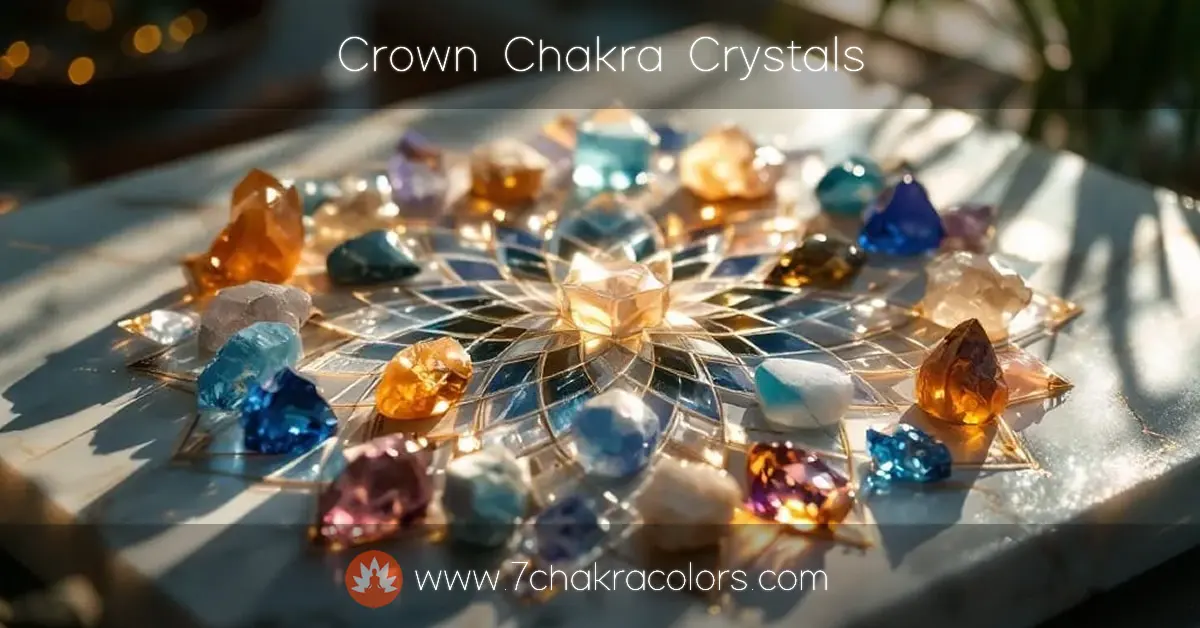
Clear, white and violet stones are linked with the crown chakra. The best known are clear quartz, amethyst, selenite, howlite and lepidolite. People hold them during meditation, place one just above the head while lying down, or keep one in a quiet corner of the home. There is no scientific evidence that crystals change energy, but many people find them a useful focus. What each stone is used for and how to cleanse it is in our crown chakra crystals guide.
Chanting OM, listening to a 963 Hz tone, singing bowls tuned to B and, above all, silence are the usual ways to work with the crown through sound. Many sessions end with a minute of quiet after the last tone fades. You can play the tones, compare the tuning systems and practice the crown chakra mantra on our frequency page.

Teachers name a few benefits again and again when they describe a balanced or "strong" crown chakra. The first is inner peace: a calm that does not depend on everything going well. The second is meaning, the sense that your life has a direction and a place in a bigger picture. The third is openness, being able to hold your own beliefs while respecting other people's.
People also describe more presence, less fear of change and loss, and a lighter relationship with their own thoughts. These are the same changes that many people report from regular meditation, whether or not they use the chakra model. None of them means withdrawing from the world; a strong crown chakra is described as wisdom that shows up in ordinary life.
The crown chakra is often linked with spiritual awakening, and that brings a warning most teachers give: go slowly. Long hours of meditation, fasting or intense practices aimed at "opening" the crown can leave people feeling unreal, anxious, unable to sleep or cut off from others. In the chakra model, this is the crown working without the support of the lower chakras.
The remedy is simple and physical: eat regular meals, walk barefoot, sleep, spend time with people, and practice for the root chakra as much as for the crown. If you feel detached from reality, hear or see things others don't, or cannot sleep for days, stop the practice and see a doctor straight away.
The table below sums up the traditional and modern properties of the crown chakra. Traditional properties come from the Tantric texts, the others from modern chakra books, and modern associations vary from teacher to teacher.
| Property | Traditional (Tantric texts) | Modern association |
|---|---|---|
| Sanskrit name | Sahasrara | Sahasrara, crown chakra, seventh chakra |
| Translation | Thousand-petaled (sahasra + ara) | Also read as "countless" or "limitless" |
| Chakra number | Beyond the six chakras | Seventh |
| Location | Above the head | Top of the head, at the crown (brahmarandhra) |
| Color | Lustrous white petals | Violet, also white or gold |
| Element | None (beyond the elements) | Thought or consciousness (Anodea Judith) |
| Sense | None | Beyond the five senses |
| Seed mantra | None named | OM, AH or silence |
| Lotus petals | A thousand, with the fifty letters repeated twenty times | Thousand-petaled violet or white lotus |
| Shape | Full moon, a shining triangle and the void | Circle or point of light |
| Animal | None | None |
| Deities | Paramashiva; Shiva and Shakti united | Varies by system |
| Frequency | Not named | 963 Hz (Solfeggio), 480 Hz (note B) |
| Gland | Not named | Pineal gland (some teachers: pituitary) |
| Stage of life | Not named | Early adulthood onward, throughout life (Anodea Judith) |
| Themes | Not named | Awareness, spirituality, meaning, wisdom, inner peace |
| Crystals | Not named | Clear quartz, amethyst, selenite, howlite, lepidolite |
| Yoga poses | Not named | Quiet, upright poses: Upward Salute, Half Moon, Seated Mountain, Lotus, Savasana |
| Mudra | Not named | See chakra mudras |
The crown chakra is the seventh and last chakra in the series. Below it, between the eyebrows, is the third eye chakra (indigo, light), the center of insight that leads up to the crown. At the other end of the column is the root chakra (red, earth). Teachers often describe the two as partners: the root holds you on the earth, the crown opens you to the sky, and a healthy life needs both.
Yes. Sahasrara is the Sanskrit name and crown chakra is the usual English one. Seventh chakra, 7th chakra and head chakra mean the same thing. The Sanskrit name means "thousand-petaled", after the lotus that stands for it.
In modern chakra teaching it is linked with awareness, meaning, spirituality, wisdom and inner peace. The old Tantric texts describe it as the seat of pure consciousness rather than by what it controls. It is a way of thinking about meaning and awareness, not an organ that runs the body.
Teachers use the phrase for a balanced crown chakra: a calm sense of meaning, openness to other views, trust in life and a spiritual practice that fits into ordinary days. It does not mean intense experiences. A strong crown is described as steady and grounded, not dramatic.
Many teachers warn that it is possible to push too hard. Long hours of meditation, fasting or intense techniques can leave people feeling unreal, anxious or unable to sleep. Short, regular practice together with grounding is the usual advice, and lasting symptoms should be checked by a doctor.
The third eye chakra, between the eyebrows, is about insight, intuition and clear seeing. The crown chakra, at the top of the head, is about awareness itself, meaning and the sense of being connected with something larger. Teachers describe the third eye as seeing clearly and the crown as simply being aware.
In the chakra model, yes: every person is described as having all seven chakras, whatever they believe. You do not need to be religious to work with it. Many people use the crown chakra simply as a way to think about meaning, calm and awareness.
No. There is no scientific evidence that chakras exist as physical structures. The crown chakra is a concept from yoga and Tantra that many people use to think about awareness and meaning. Headaches, dizziness, sleep problems or low mood should be checked by a doctor.