
How to See Your Aura? 👋 5 Easy Exercises with Illustrations
Learn to See Your Aura – Follow these simple steps with illustrated instructions and see your aura in 5 minutes.
Table Of Contents
Aura Seeing: The Beginner’s Guide
Aura seeing is a learnable skill – not a mysterious gift reserved for psychics. You can spot energy fields in just days with steady practice – all you need are your eyes and a slightly different way of seeing.
What You’ll Learn in This Guide
- Why peripheral vision is the key to seeing auras
- 5 progressive exercises to train your aura sight from scratch
- How to see the energy around your own hands and body
- What to expect as a beginner – and what the experience actually feels like
Work through these exercises in order. Each one builds on the last. By exercise five, you’ll be reading the aura of another person in real time.
Why Most People Can’t See Auras (And Why You Actually Can)
To be able to see the aura, you need to practice a bit different way of looking.
Staring straight on, your eyes and brain just ditch these energies without thinking – that’s why you’ve gotta yank your attention toward the periphery instead.
Kids naturally catch auras and energies, but somewhere along the way, we lose it – mostly because nobody encourages that side of perception. This type of attention is erased from our central vision as our minds put no relevance to such information.
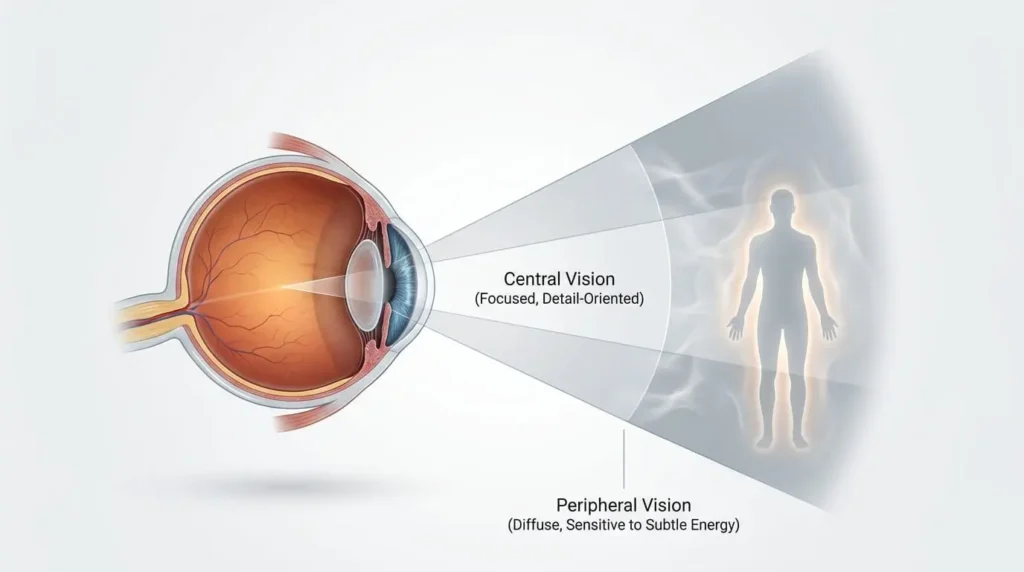
So the easiest way to see auras is to trick your mind by using peripheral vision.
Getting your peripheral vision to catch auras isn’t rocket science. Here are some straightforward exercises that’ll get you there.
The 5 Aura Seeing Exercises for Beginners
These exercises are progressive. Don’t skip ahead. Exercise one trains the mechanics. Exercise five puts everything together on a live person. Give each one at least a few sessions before moving on.
1. Exercise One: Training Your Peripheral Vision

It is best to practice this on a desktop monitor. Mobile screens are usually too small.
- Keep your head at a normal viewing distance from the computer screen.
- Focus your central vision on the black dot between the two (red and blue) circles.
- Relax and empty your mind. Do not forcefully try to see something.
- You will soon start seeing a moving halo around the blue and the red circles.
- The halo around the red circle will be blueish, and the halo around the blue circle will be redish.
- Once you see it, do not move your eyes from the dot in the middle. Just use your peripheral vision to watch the moving halo.
- Train this for a while until you feel comfortable sustaining the peripheral vision and maintaining your focus on the task.
It is important to state that with this exercise, you do not actually see the energy of the circles. You are simply seeing the contrasting colors around them, which is a natural occurrence when watching different colors with peripheral vision. However, this exercise will help you train your peripheral sight and maintain focus, so once you see the energy of living subjects, you will be able to maintain your concentration. The technique is the same.
2. Exercise Two: Watching the Energy Around Your Hands
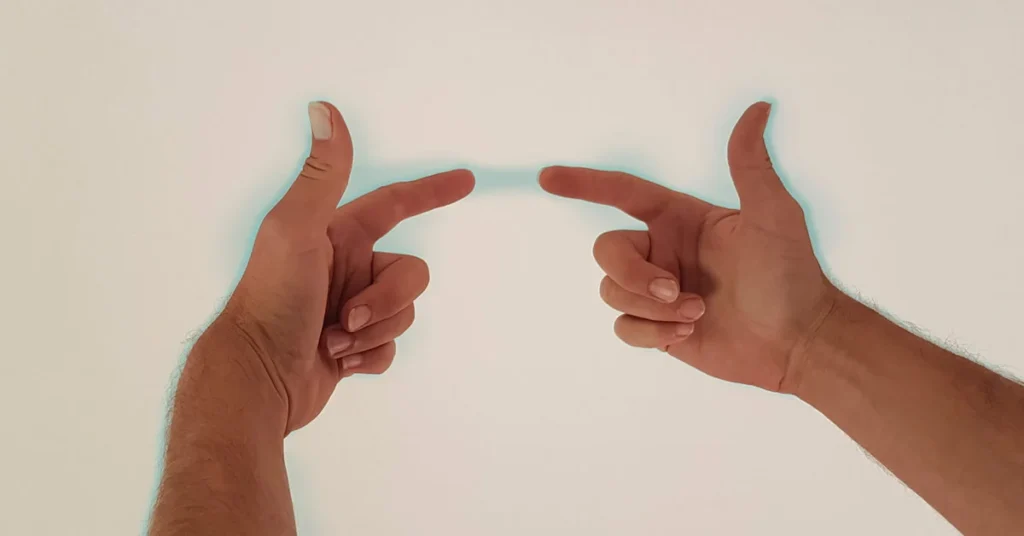
- Make sure you are in a place with sufficient light, but not too bright. Skip intense light and direct sun – and don’t try it in complete darkness either. Eventually, you’ll catch energy no matter the lighting.
- Practice in front of a neutral background. A white wall or a not-too-bright sky is ideal.
- Sit down, relax, and stretch your arms so that your palms are at around 40 centimeters distance in front of your eyes.
- Stretch and touch your index fingers together. Focus your sight on the point of the touch.
- Move your index fingers around 5 centimeters apart while still maintaining the focus on the central point of the touch.
- Now, try to focus your sight on a neutral point in the distance, as if you are looking at something in the distance.
- Again, use your peripheral vision, and you will see the light blue energy around your fingers and palms.
- Hold that gaze still and play with it. Bring your fingers back together, then spread them out. You might notice the glow bouncing between them, or catch a thin band of light stretching across the gap.
- Once you’ve nailed this and can keep your focus locked in, take it into pitch darkness. You’ll still catch the glow.
3. Exercise Three: Watching the Pranic (Chi) Energy in the Sky
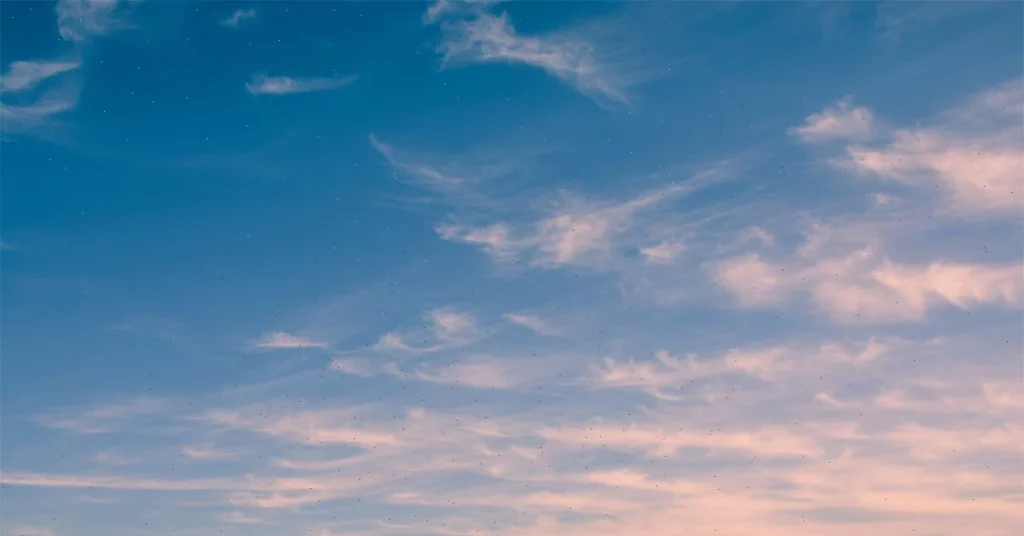
There is an ongoing debate about whether the occurrence of this phenomenon is based on actually seeing the prana/chi energy or if it is just a side effect of seeing the reflection of light on particles in your eyes.
That’s called the blue field entoptic phenomenon – basically, those specks you’re seeing? They’re white blood cells drifting through your eye’s capillaries. Nevertheless, this technique is also beneficial in developing your peripheral vision and concentration.
- You have to practice this outside. Sunny or cloudy works fine – just keep the sky from being too harsh. Late afternoon’s your sweet spot.
- Lie down or sit comfortably and relax.
- Look into the sky, but do not focus your sight on any particular point. Just gaze into the distance.
- Concentrate on your peripheral vision.
- You will see tiny white and black dots swirling around in the sky.
- Do not focus on a single dot with your central vision, but only use your peripheral vision to track one single dot. Each dot has a separate movement, so you can track every single dot moving around the sky.
4. Exercise Four: Seeing Your Own Aura
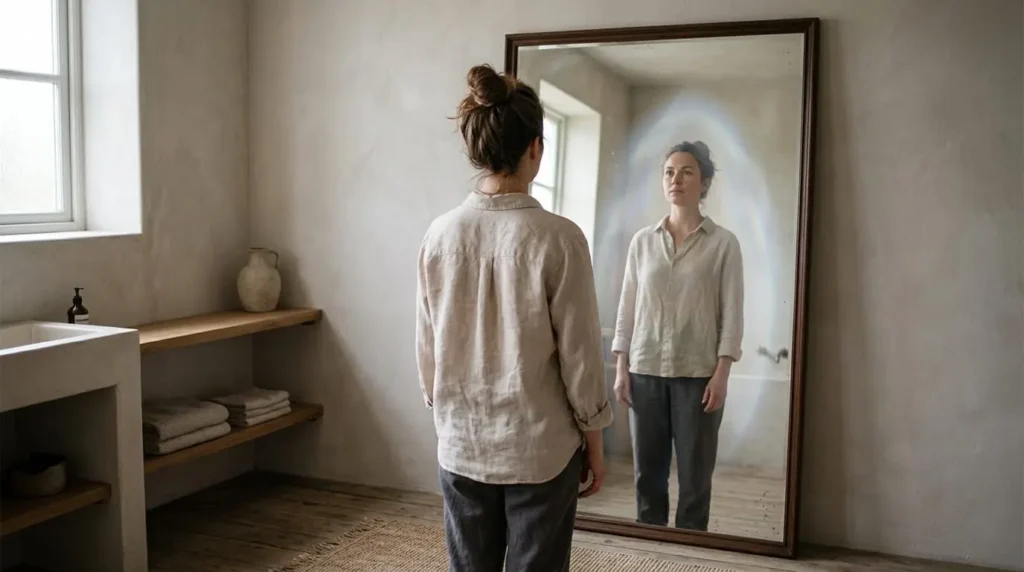
- Stand in front of the large mirror in a room with a neutral background. Usually, a larger bathroom mirror would do.
- It is best to be naked or wear clothes of neutral colors, such as white, beige, or light grey.
- Use peripheral vision and look at your reflection somewhere at the point around 10 centimeters above your right shoulder. That should be your central vision focus point.
- You will see your aura/etheric energy around your head.
- Do not move your eyes from the focus point. Only watch the energy with your peripheral vision.
5. Exercise Five: Seeing Another Person’s Aura
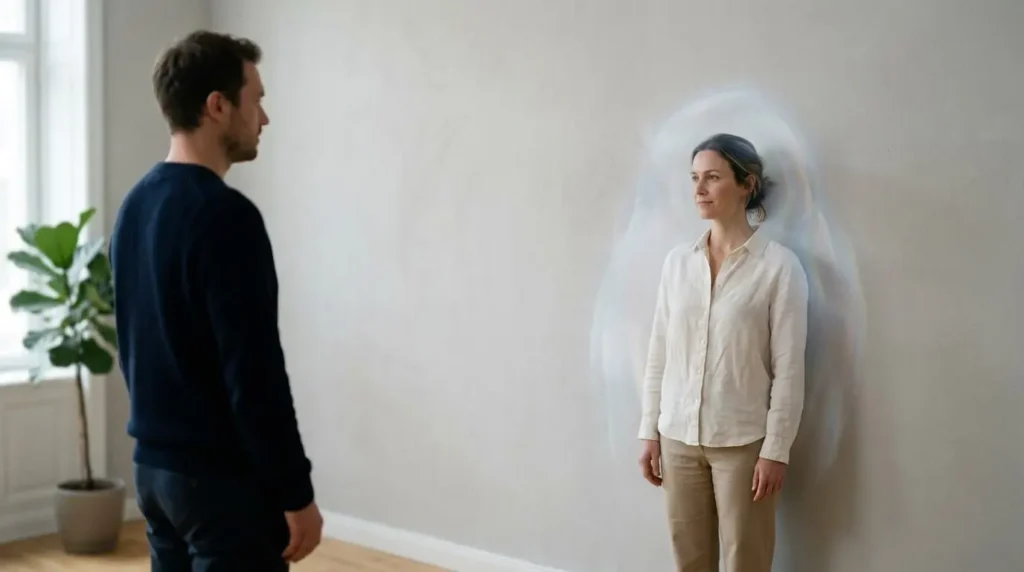
This is where everything clicks. Your own reflection is forgiving – it stays still, it’s always available, and you can practice without pressure. Another person is different. Their energy field is bigger, more active, and once you see it for the first time, you won’t forget it.
Ask someone to help. A friend, a partner, whoever’s willing to stand still for a few minutes. They don’t need to do anything special – just be relaxed and comfortable. Nervous energy creates visual noise, so if they’re tense, it’ll be harder to read clearly.
- Have them stand against a plain, neutral wall. White or light grey works best. No busy patterns, no windows behind them letting in direct light.
- They should wear plain, neutral-colored clothing if possible – or at minimum avoid anything with loud patterns or bright colors that might interfere.
- Stand about two to three meters away. Close enough to see clearly, far enough to take in their whole head and shoulders.
- Fix your central vision on a point just above one of their shoulders – same focal point technique as the mirror exercise. Don’t look at their face.
- Soften your gaze. Let your eyes go slightly unfocused, like you’re staring past them rather than at them.
- Use your peripheral vision to observe the space around their head and shoulders. Don’t hunt. Just wait.
- You’ll start to see a band of lighter energy outlining their form. Hold that soft gaze. Let it develop.
- Once you can hold the etheric layer steady, notice if any color starts appearing further out – half a meter or more from the body. That’s the emotional or mental aura layer beginning to show.
Some people find another person’s aura easier to see than their own. The energy field tends to be more pronounced, more expressive. Others find it harder at first because there’s a self-consciousness to watching someone – and that tension tightens your gaze. If you feel yourself straining, drop your eyes, take a breath, and start again from the soft-focus point.
Don’t report what you see in real time. Stay quiet and observe. Compare notes after. You’ll be surprised how often what you perceived matches how they were actually feeling.
If you want to take this further, working through how to open your third eye will sharpen the same inner focus that makes aura work possible.
What to Expect When You First Start Seeing Auras
Most beginners see a faint, colorless shimmer at first – almost like heat rising off pavement. No worries – you’re on the right track. You’ve snagged the first layer, the etheric body, which hugs your physical form and shows up as a pale white or blueish shimmer.
Color comes with practice. As your peripheral vision strengthens and your focus deepens, you’ll start picking up warmer tones – yellows, greens, blues. They track with the chakras and show what someone’s really feeling. A bright yellow sitting around the head usually signals they’re tangled in their own thoughts, spinning circles. A deep blue suggests calm and strong intuition.
Don’t chase the color. Stay relaxed. The moment you shift into active looking – straining, hunting – you’ll lose it.
Common Mistakes Beginners Make
The biggest mistake is trying too hard. Aura seeing requires a soft, unfocused gaze – the opposite of how we normally look at things. Squinting, straining, or trying to “lock on” to the energy will close it off every time.
A few other things that slow progress:
- Practicing in harsh lighting. Bright overhead lights flatten everything. Soft natural light or indirect light works best.
- Busy backgrounds. Patterned walls, cluttered rooms – these compete with what you’re trying to see. Neutral backgrounds are essential early on.
- Skipping the early exercises. Exercise one feels like a parlor trick, but it’s actually building the exact visual skill you need. Don’t skip it.
- Expecting vivid color immediately. The etheric layer comes first. Give it time.
How Aura Colors Connect to the Chakras
Once you’re consistently seeing auras, understanding what the colors mean adds a whole new layer to the practice. Each major aura color maps roughly to one of the seven chakras.
- Red – connects to the root chakra; signals vitality, passion, or sometimes stress
- Orange – sacral chakra energy; creativity, emotional openness, warmth
- Yellow – solar plexus; confidence, mental clarity, personal power
- Green – heart chakra; healing, compassion, balance
- Blue – throat chakra; communication, calm, truth
- Indigo – third eye; intuition, deep perception, spiritual sensitivity
- Violet/White – crown chakra; higher consciousness, spiritual connection
These aren’t rigid rules. They won’t sit still – mood swings, health changes, whatever’s churning underneath all shift them around. One person can look totally different color-wise from one day to the next. Think of it as a snapshot, not a permanent label.
Aura Reading: Morality Guidelines
If you reach this level with dedicated practice, you will possibly be able to interact with other people’s energies and preferably channel the universal energy to help them heal their energy bodies.
Energy shapes the body, emotions, and spirit in people, plants, animals – everything. So this skill opens you up to healing work in pretty much any direction you want to take it. It takes real time and practice, and your intuition builds as you go.
You’ll need to learn some energy protection and cleansing techniques as well – especially when you’re poking around in someone else’s energy field. I’ll cover some of these in another post. And always get permission before working with someone’s energy. Definitely, such gifts and powers can be misused, and it is advised not to do so.
Frequently Asked Questions
Can anyone learn to see auras, or do you need a special gift?
Anyone can. Seriously. It comes down to peripheral vision – something your eyes already do. Kids pick it up without trying because nobody’s told them it isn’t real yet. Adults have to go back and dust off that perception. That’s really all these exercises do – not wire in something foreign, just wake up what got switched off.
How long does it take to start seeing auras?
First signs tend to come quicker than people think. Sometimes session one, sometimes session two. A shimmer. A faint glow at the fingertips. Nothing that’ll knock you over – but it’s real. Weeks for some. Months for others. Honestly it’s less about time and more about whether you can get out of your own way during practice.
What does an aura actually look like to a beginner?
First thing you’ll likely see is a pale, almost grey-white outline – thin, right up against the skin, like the body has a faint border. That’s the etheric layer. Closest one to the physical. Colors live further out, and they only start showing up once your eye stops reaching for them.
Why do I lose the aura the moment I try to look directly at it?
That’s literally what kills it. The second you look directly, central vision takes over – and central vision is blind to this stuff. It only works when you’re not hunting. Fix your gaze on a nearby point and let the aura sit at the edge of your attention. Not the middle. The edge.
What do the different aura colors mean?
Rough guide: red is root, green is heart, blue is throat, violet or white sits up at the crown. They move around constantly – mood, health, whatever’s going on underneath. Someone can read completely different on a bad week versus a calm one. What you’re seeing is a snapshot of right now, not a fixed trait.
Is it safe to read other people’s auras?
Reading is fine. You’re just observing. Where it gets more serious is when you start interacting with or trying to heal someone else’s energy field – that requires care, practice, and honestly some protection work first. Always ask permission before going that far. And don’t skip the energy cleansing side of things, especially if you’re working with a lot of people.
Can I practice aura seeing on myself?
Yes – and it’s actually a good place to start. Your own hands give you an easy target that’s always available. Exercise two in this guide walks you through exactly that. Once you’re comfortable there, the mirror exercise lets you see the energy field around your own head. You don’t need another person to develop this skill. Just a neutral background and some patience.
Does it matter what time of day I practice?
It does, a little. Harsh midday light – especially direct sun – tends to wash things out. Late afternoon is generally better, softer. Indoors, avoid bright overhead lighting. Diffused natural light coming through a window is ideal. Not because the energy changes with the time of day, but because the lighting conditions make it either easier or harder for your eyes to catch what’s there.
Blog Categories:
About the Author: