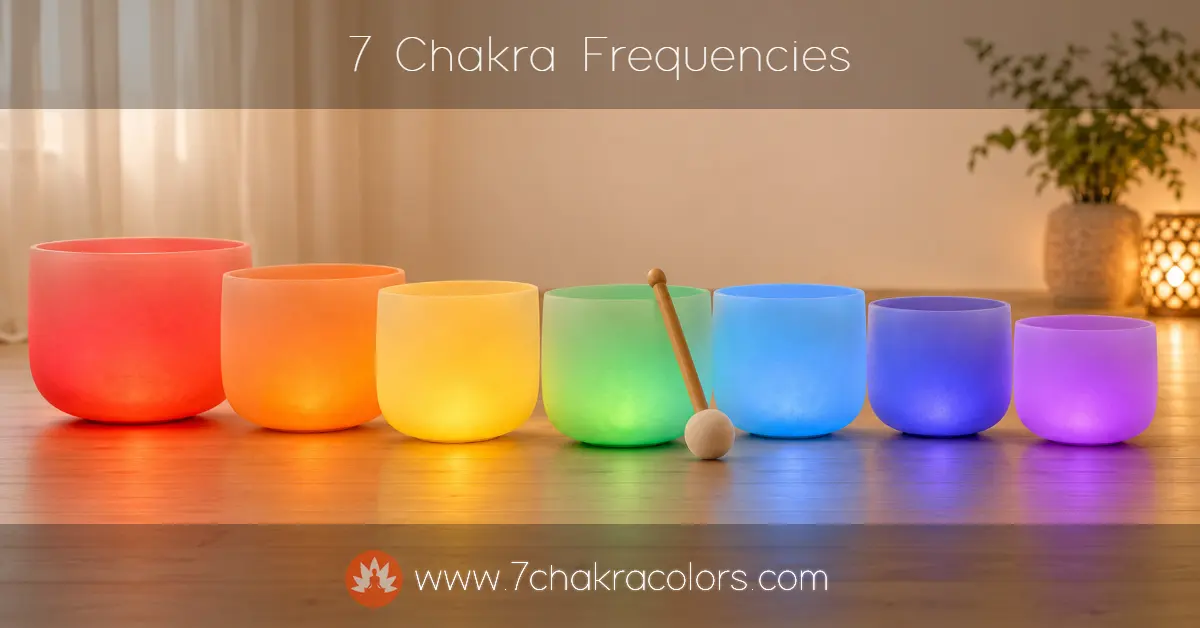
7 Chakra Frequencies: Hz Chart, Sound Player and Free Downloads
Chakra frequencies for all 7 chakras: the Solfeggio chart from 396 to 963 Hz, notes, tuning fork and bowl Hz. Play every tone online or download it free.
Table Of Contents
Chakra frequencies are sound tones, measured in hertz (Hz), that sound healers pair with the seven chakras. The best-known set is the modern Solfeggio scale: 396 Hz for the root, 417 Hz sacral, 528 Hz solar plexus, 639 Hz heart, 741 Hz throat, 852 Hz third eye and 963 Hz crown. Note-based systems use the notes C to B instead (256-480 Hz on tuning forks). You can play and download every tone on this page.
Chakra Frequencies · Key Facts
- Best-known system:Solfeggio, 396-963 Hz
- Note system:C, D, E, F, G, A, B (root to crown)
- Other systems on this page:Singing bowls (often A = 432 Hz), Cousto planetary forks and our own Pythagorean chart (432 Hz heart)
- Free downloads:Every tone in the chart, WAV, 1-5 minutes
- Session length:10-20 minutes, at low volume
- Evidence:Sound can help people relax; no study shows a frequency acting on a chakra
- Chakra frequency chart
- Play the chakra frequencies
- Download all chakra frequencies
- Compare the frequency systems
- What the research says
Chakra Frequency Chart: All 7 Chakras in Hz
Below is a summary of the frequencies of all 7 chakras across all the different frequency systems on this page. The Solfeggio frequencies are the most commonly used in playlists. The fork and singing bowl frequencies are the notes C to B, meaning that if you wish to buy instruments then look at the numbers in these columns.
| Chakra | Solfeggio | Tuning fork (note) | Singing bowl (A = 432 Hz) | Pythagorean (our chart) | Cousto planetary fork |
|---|---|---|---|---|---|
| Root | 396 Hz | 256 Hz (C) | 256.87 Hz | 216 Hz | 194.18 Hz |
| Sacral | 417 Hz | 288 Hz (D) | 288.33 Hz | 288 Hz | 210.42 Hz |
| Solar plexus | 528 Hz | 320 Hz (E) | 323.63 Hz | 324 Hz | 126.22 Hz |
| Heart | 639 Hz | 341.3 Hz (F) | 342.88 Hz | 432 Hz | 136.10 Hz |
| Throat | 741 Hz | 384 Hz (G) | 384.87 Hz | 486 Hz | 141.27 Hz |
| Third eye | 852 Hz | 426.7 Hz (A) | 432 Hz | 648 Hz | 221.23 Hz |
| Crown | 963 Hz | 480 Hz (B) | 484.90 Hz | 864 Hz | 172.06 Hz |
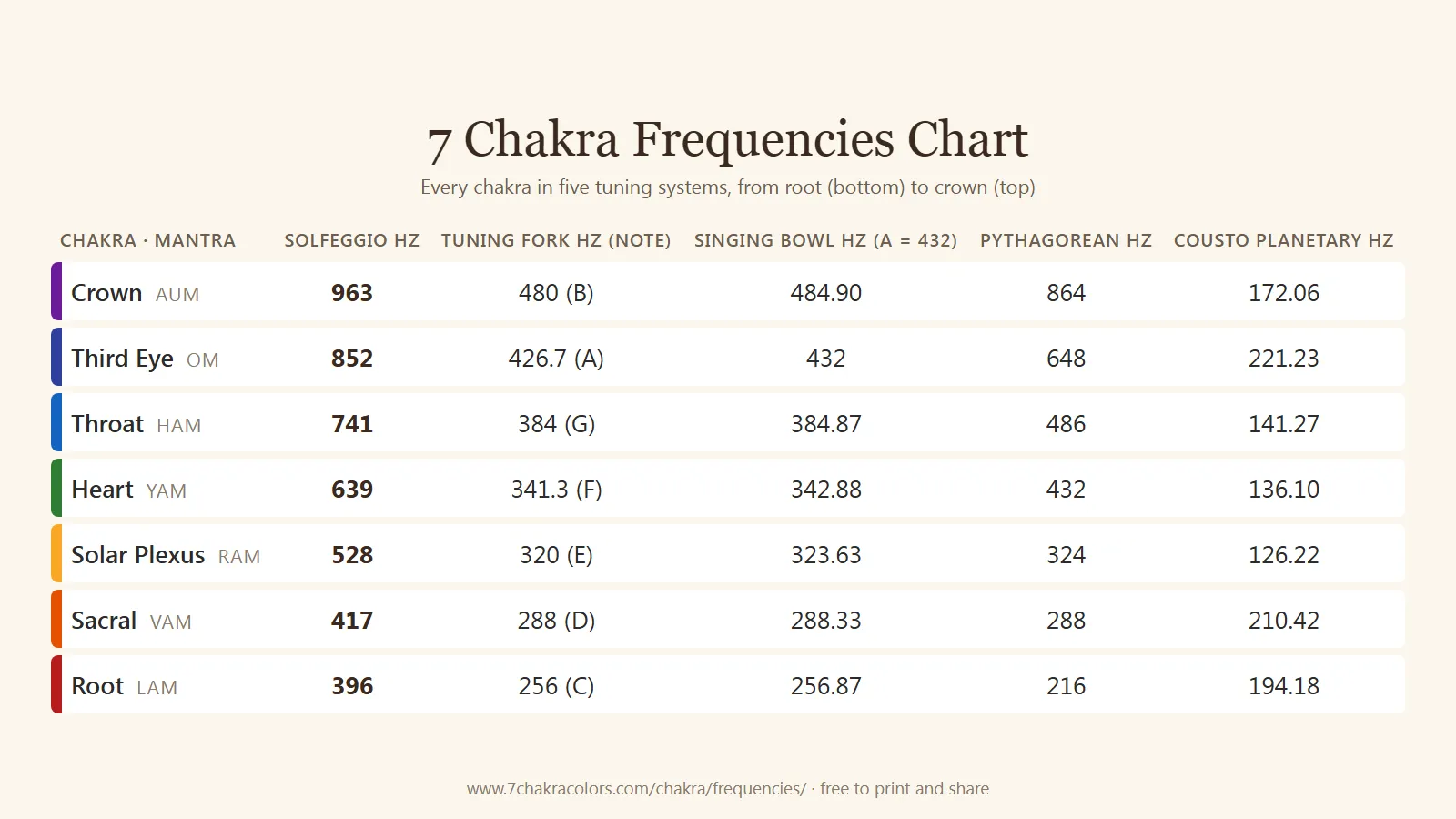
Free printable version: download the 7 chakra frequencies chart (PDF).
The values increase from the bottom to the top of the body in 4 frequency systems. This correlates with the belief that chakras lower down the body vibrate more slowly and heavily than chakras higher up. The Solfeggio frequencies are arbitrary. The fork and singing bowl frequencies are real musical intervals, meaning that if played in sequence, they create a scale. The planetary tones, however, based on cycles of the Earth, Moon and planets, do not simply increase.
Chakra Frequency Player
Below is the chakra frequency player. Choose a crystal or a Tibetan bowl and one of the five frequency systems from the chart, and the seven bowls take those frequencies, from the root to the crown. Tap a bowl to strike it, or start a timed session and the player plays the bowls on its own until the timer ends.
How to Use the Chakra Frequency Player
- Lower the volume. Start quieter than you think you need, especially on headphones.
- Choose a bowl and a frequency system. Crystal bowls give a clear, long tone; Tibetan metal bowls a warmer sound with more overtones. The system sets the Hz of all 7 bowls.
- Tap a bowl to strike it. It rings out on its own. Tap it again to strike it again.
- Pick a session intensity. LOW plays soft single strikes, MID adds bowls that ring for longer, and HIGH plays more often and adds rim slides.
- Choose a timer and press Start session. A session lasts 5 to 60 minutes and fades out at the end. Press Stop session to end it early.
Chakra Meditation Music Download: All Frequencies Free
Every frequency in the chart can be downloaded as a WAV file. Choose the frequency system and the chakra, pick a length from 1 to 5 minutes and press Download WAV. Once downloaded, the file can be looped on any music player or used for your own meditation or yoga.
The file is made on your own device, in the browser, as a pure sine wave at the exact frequency shown. There is no music or other sound in it. The tones are free to use for any purpose, whether for your own meditation, a yoga class, a video or commercially.
If listening to the frequencies on a mobile device, you may find it easier to use the free singing bowls meditation app. This contains recordings of singing bowls for each chakra.
What Are Chakra Frequencies?
A chakra frequency is a single steady tone that a teacher, a music producer or an instrument maker links to one of the 7 chakras. When listening to a frequency, or chanting with it, or playing it on a singing bowl or tuning fork, you should place your focus on the corresponding part of your body. The number indicates how many times the wave vibrates per second. 396 Hz vibrates 396 times per second.
There is no official list of chakra frequencies. The concept of chakras comes from yoga in India and Tantra. In classical Sanskrit texts relating to chakras (such as the 16th-century Sat-cakra-nirupana), each chakra is assigned a seed syllable (bija mantra, for example LAM and YAM), a colour, an element and a number of lotus petals. However, no pitch is ever assigned. All sets of frequencies in Hz for chakras are modern, created in the last 50 years or so. Therefore, depending on the website, the root chakra may be 396 Hz or 256 Hz or 194.18 Hz. None of these are wrong within their own system.
On this page there are 5 chakra frequency systems. 4 of these are commonly used, and 1 is unique to this page:
- Solfeggio frequencies (396-963 Hz) - most commonly used in playlists and on YouTube.
- Notes in the key of C major - as most tuning forks for chakras are in C major.
- Singing bowls - often tuned to A = 432 Hz.
- Pythagorean - created for this page from a base frequency of 432 Hz.
- Planetary tones by Hans Cousto (for some tuning forks).
The 7 Chakra Frequencies, One by One
Each chakra has its own page with mantras, instruments and a short meditation. Below is a brief summary of each in order.
Root Chakra: 396 Hz, the Note C and LAM
In the Solfeggio system, the root chakra frequency of 396 Hz is related to removing fear and guilt, hence being associated with safety. Tuning forks tune to 256 Hz (C), and singing bowls tuned to A = 432 Hz give a frequency of 256.87 Hz. The root chakra fork in Hans Cousto's system is 194.18 Hz (the Earth day). The seed mantra is LAM. Low frequencies are best for this chakra. Using drums, a deep bowl or a low humming tone will be felt more in your legs and stomach than in your head.
Sacral Chakra: 417 Hz, D and VAM
The sacral chakra (below the navel) is associated with 417 Hz. In Puleo's list, this sacral chakra frequency represents undoing situations and creating change. As change and fluidity are associated with this chakra, sound healers connect it with the water element. On the fork, it is the note D (288 Hz), and in the Pythagorean system it is also 288 Hz. The mantra for this chakra is VAM. Many people associate water sounds (rain, slow waves etc.) with this chakra.
Solar Plexus Chakra: 528 Hz, E and RAM
528 Hz is the most popular frequency in this list. It is often referred to as the love frequency, or miracle tone. It is often said to repair DNA, however this was stated in books by Leonard Horowitz and has never been proved in studies. In the chakra system, 528 Hz is associated with the solar plexus (in the upper stomach) and represents willpower and confidence. The mantra is RAM. Its note is E (320 Hz on forks). On the solar plexus chakra frequency page, information on the one small study into 528 Hz music is given.
Heart Chakra: 639 Hz, F and YAM
This chakra, in the middle of the chest, is associated with 639 Hz. Within Solfeggio books, this frequency is associated with connection. It is the note F on forks (341.3 Hz) and 342.88 Hz on 432 Hz bowls. Its seed mantra is YAM (air). In the Pythagorean system, it is the central chakra (432 Hz) and all other frequencies are calculated from this. On the heart chakra frequency guide, information on the singing bowl for the heart chakra and a lying meditation is given.
Throat Chakra: 741 Hz, G and HAM
741 Hz is associated with the throat chakra. Its note is G (384 Hz). It is often said that 741 Hz detoxifies the body, however there is no evidence for this. As this is the chakra where your own voice is most important, chanting the mantra HAM out loud will have a greater effect on the throat than just listening to it. On the throat chakra frequency page, advice on how to chant, and how to decide between using a bowl or a fork, is given.
Third Eye Chakra: 852 Hz, A and OM
852 Hz is the frequency of the third eye. This is often searched for, as it is said to open the third eye. Its note is A. If forks are in the key of C, it will be 426.7 Hz. If the bowl is tuned to 432 Hz, it will be exactly 432 Hz. The mantra for this chakra is OM and should be whispered or said mentally. For more information, see the third eye frequency page.
Crown Chakra: 963 Hz, B and AUM
963 Hz is the frequency for the crown chakra (on top of the head). This is the highest frequency in the extended Solfeggio system, and was added later. Its note is B (480 Hz on forks, 484.90 Hz on bowls). In many traditions, this chakra does not have a seed mantra, and is associated with silence. The way most commonly practised by teachers is to slowly chant AUM and leave a long pause. For the full meditation on this chakra, see the crown chakra frequency page.
Benefits of Chakra Frequency Meditation
Overall, the benefits of chakra frequencies are similar to any calming sound meditation. The particular frequency chosen does not make too much difference. Having a constant note to focus on makes it easier to sit in meditation for 10 minutes than complete silence. Most people use chakra frequencies in order to:
- relax after work, or before exams or hard conversations
- have a focus for meditation
- notice tension within the body (as taught by chakra teachers)
- relax in the evening in preparation for sleep - play at a low volume and on a timer
However, contrary to what is often stated in online tracks, chakra frequencies cannot cure illnesses, alter DNA or detoxify the body. See the research section below for more information.
What Are the 7 Healing Frequencies?
Almost always, if someone refers to the 7 healing frequencies, they mean the Solfeggio frequencies in order for the chakras. These are 396, 417, 528, 639, 741, 852 and 963 Hz. The first 6 were taken from one book in 1999. The 963 Hz frequency was added in later years so that each chakra would have a frequency.
| Chakra | Solfeggio frequency | What the Solfeggio books claim |
|---|---|---|
| Root | 396 Hz (UT) | Liberating guilt and fear |
| Sacral | 417 Hz (RE) | Undoing situations and facilitating change |
| Solar plexus | 528 Hz (MI) | Transformation and "miracles" (the DNA claim is unproven) |
| Heart | 639 Hz (FA) | Connecting relationships |
| Throat | 741 Hz (SOL) | Expression and solutions |
| Third eye | 852 Hz (LA) | Returning to spiritual order |
| Crown | 963 Hz | Awakening and oneness (a later addition) |
The right-hand column shows what the frequencies mean according to Solfeggio books. This can be a good focus for meditation, for example if you want to improve a relationship while listening to 639 Hz.
What Chakra Is 174 Hz? And 285 Hz?
Neither of these frequencies is attributed to a chakra in most frequency charts. However, within later lists, they have been added below 396 Hz, making 9 notes in total. Generally, these two frequencies are seen to relate to the body and pain, rather than to one energy centre. Some teachers, however, associate 174 Hz with the root chakra as a "base" frequency. Within a few apps, 285 Hz is associated with the sacral chakra, however this is a choice made by the creator of the app. If there are 9 frequencies in total for 7 chakras on a chart, these are the extra frequencies.
Where Do the Solfeggio Frequencies Come From?
Often it is stated that Solfeggio frequencies are ancient frequencies from Gregorian chants that have recently been rediscovered. However, they are actually a relatively recent development, and this is useful to know.
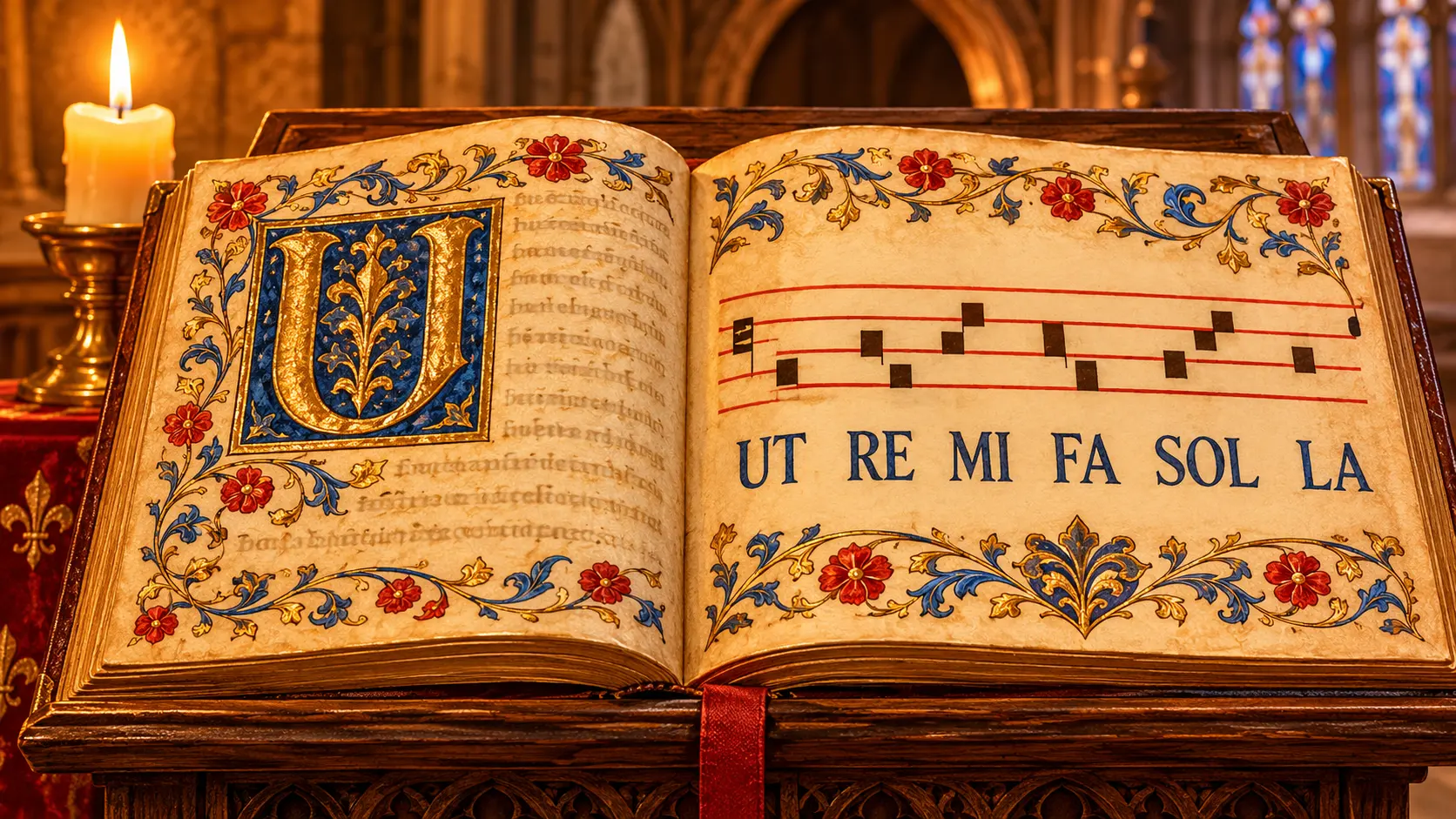
"Solfeggio" comes from the sung syllables sol and fa. In the early 11th century, a monk named Guido of Arezzo taught singers to sing using the scale ut, re, mi, fa, sol and la. He based these syllables on the first word of each line of a hymn to John the Baptist (Ut queant laxis). Ut was later changed to do, and si (later ti) was added to create the scale we know today as do-re-mi. The syllables were names for the steps in the scale. They did not have specific pitches, and in the 11th century it would not have been possible to measure how many vibrations a sound makes per second. This wasn't possible until centuries later.
The numbers came from Joseph Puleo, an American naturopath. In the 1970s he claimed to discover 6 frequencies by performing a form of numerology with the numbers of verses in chapter 7 of the Book of Numbers in the Bible. He matched these with the 6 old syllables, giving UT 396 Hz, RE 417 Hz, MI 528 Hz, FA 639 Hz, SOL 741 Hz and LA 852 Hz. Interestingly, the digits of each frequency add up to either 3, 6 or 9 (3 + 9 + 6 = 18, 1 + 8 = 9). These frequencies became very well known in 1999 with the book Healing Codes for the Biological Apocalypse, written by Leonard Horowitz and Joseph Puleo. It is Horowitz who also claims that 528 Hz can repair DNA.
From here, music producers and sound healers have continued to build upon the frequencies. The 963 Hz frequency (and then 174 Hz and 285 Hz) were added. Frequencies were matched with chakras based on the theme (the root chakra is connected with fear and safety, and the heart chakra with relationships). Today there are thousands of hours of Solfeggio music available online. While this does not make the frequencies any less pleasant to listen to, it is important to know that the association of 396 Hz with the root chakra is a modern teaching, and not an ancient one.
Pythagorean Chakra Frequencies (432 Hz Base)
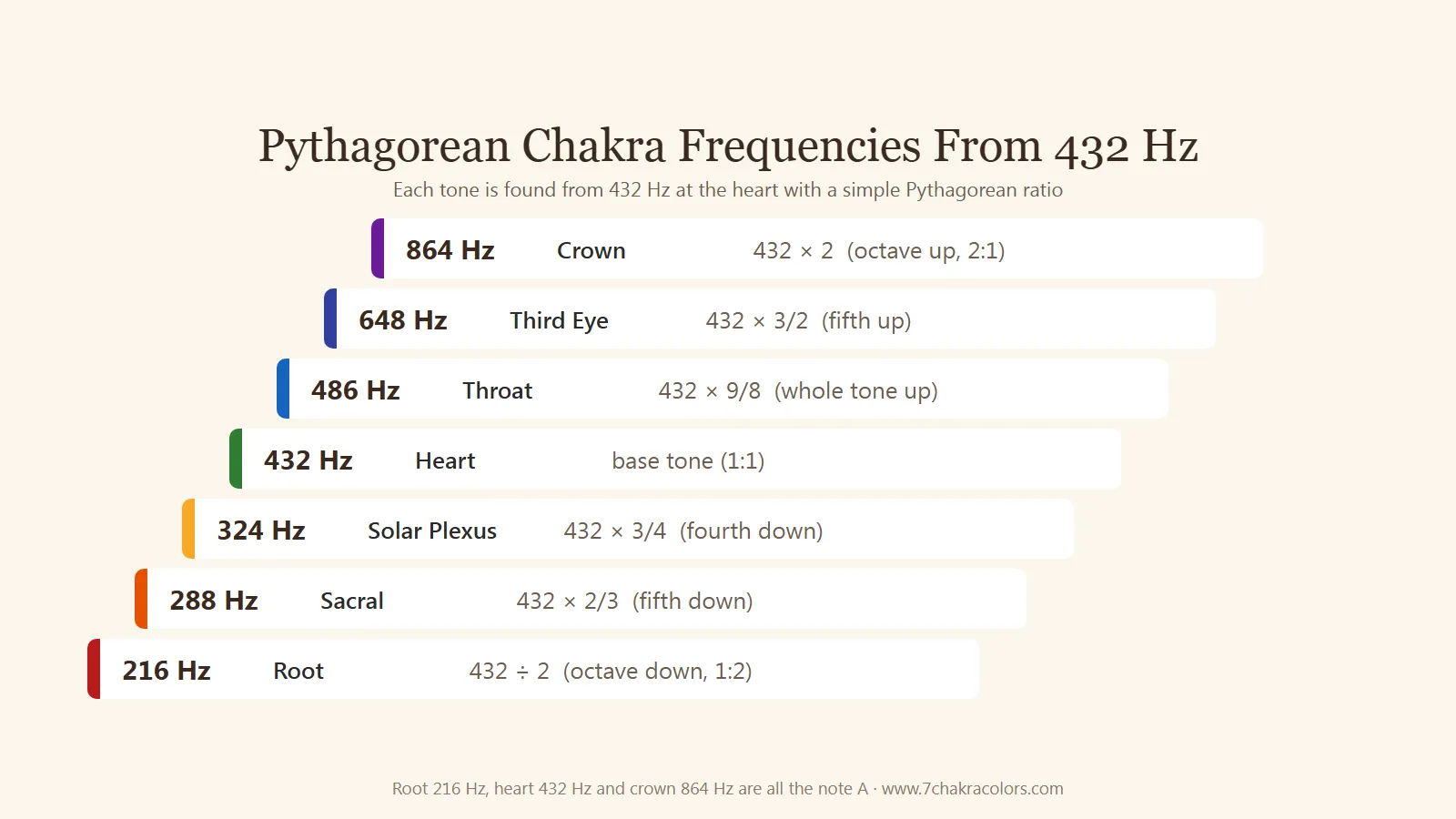
Using Pythagorean ratios, we have created this unique chakra frequency scale for the player on this page; it is our own mapping, not a historical chakra scale. To calculate the remaining 6 frequencies, we took the heart chakra frequency (432 Hz) and multiplied or divided it by the following ratios, which were used by Pythagoras and his followers to describe musical harmony around 500 BCE. We began with the heart chakra as it is the middle of the 7 chakras, and 432 Hz is preferred by many sound healers over the standard 440 Hz.
Ratios:
- Octave (2:1)
- Perfect fifth (3:2)
- Perfect fourth (4:3)
- Whole tone (9:8)
From this we have calculated:
- Root chakra: 432 / 2 = 216 Hz
- Sacral chakra: 432 x 2/3 = 288 Hz
- Solar plexus: 432 x 3/4 = 324 Hz
- Throat chakra: 432 x 9/8 = 486 Hz
- Third eye: 432 x 3/2 = 648 Hz
- Crown chakra: 432 x 2 = 864 Hz
| Chakra | Frequency | How it is found from 432 Hz |
|---|---|---|
| Root | 216 Hz | Octave down (1:2) |
| Sacral | 288 Hz | Perfect fifth down (2:3) |
| Solar plexus | 324 Hz | Perfect fourth down (3:4) |
| Heart | 432 Hz | Base tone (1:1) |
| Throat | 486 Hz | Whole tone up (9:8) |
| Third eye | 648 Hz | Perfect fifth up (3:2) |
| Crown | 864 Hz | Octave up (2:1) |
The root and crown chakras are each one octave below or above the heart chakra. Therefore, all three chakras are on the note A.
As shown, 216 Hz and 864 Hz are the frequencies of the root and crown chakras in this scale. As they are calm frequencies, they may help you focus and relax during meditation. However, neither frequency has been studied specifically.
Chakra Notes and Frequencies: Tuning Forks (C to B)
In most chakra tuning fork sets, each chakra will have a note from the C major scale. Root chakra: C; sacral: D; solar plexus: E; heart: F; throat: G; third eye: A; crown: B. Often, an additional tuning fork will be included, which is the C note one octave higher (512 Hz). The typical frequencies in the set are 256 Hz, 288 Hz, 320 Hz, 341.3 Hz, 384 Hz, 426.7 Hz, 480 Hz and 512 Hz.
Compared to piano notes, these seem unusual. On modern pianos, middle C is tuned to 261.63 Hz (assuming A = 440 Hz). However, the C at 256 Hz is based on work by the French scientist Joseph Sauveur. He suggested around 1700 that all Cs in the scale should be powers of two: 128 Hz, 256 Hz and 512 Hz. This is sometimes referred to as scientific or philosophical pitch. Tuning forks with these frequencies are popular to make, as the numbers are round and easy to tune.
Other notes in the scale are calculated by taking pure ratios (just intonation) from the 256 Hz C: D = 9/8 of C (288 Hz), E = 5/4 (320 Hz), F = 4/3 (341.3 Hz), G = 3/2 (384 Hz), A = 5/3 (426.7 Hz), B = 15/8 (480 Hz). If this scale was calculated using Pythagorean ratios, however, the E would be 324 Hz and the B would be 486 Hz, exactly matching the solar plexus and throat chakra frequencies of the Pythagorean scale above. Therefore slight differences occur between the two scales due to different tuning methods from long ago.
| Chakra | Note (ratio from C) | Tuning fork frequency |
|---|---|---|
| Root | C (1:1) | 256 Hz |
| Sacral | D (9:8) | 288 Hz |
| Solar plexus | E (5:4) | 320 Hz |
| Heart | F (4:3) | 341.3 Hz |
| Throat | G (3:2) | 384 Hz |
| Third eye | A (5:3) | 426.7 Hz |
| Crown | B (15:8) | 480 Hz |
Note: many sets add an eighth fork, the high C at 512 Hz (2:1).
384 Hz is the G note, for the throat chakra. 512 Hz is a high C note. 512 Hz tuning forks are commonly used for hearing checks by doctors.
Use a fork by tapping it gently on a rubber pad or your knee. Never tap it on a hard surface! Hold the tuning fork just a few cm from your ear, or place the stem on your body (if weighted). Forks produce a pure note which will fade within 20-30 seconds, so tap the fork a few times during your session.
Singing Bowl Chakra Frequencies
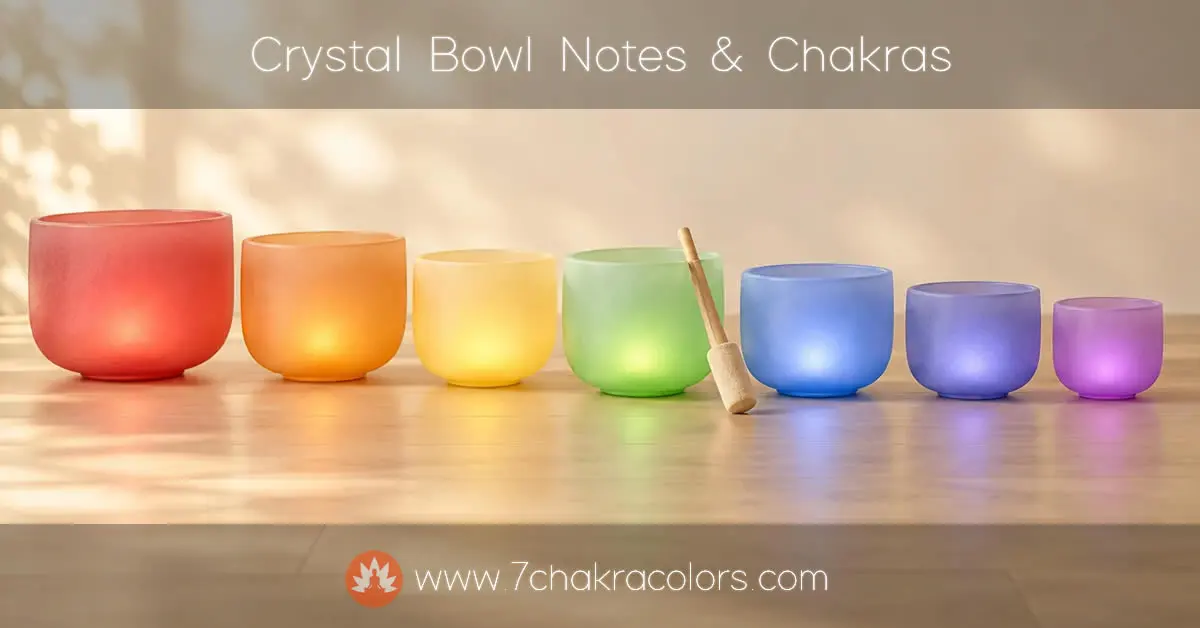
Singing bowls use a scale from C to B. Many singing bowls are available with A = 432 Hz (equal temperament, like a modern piano), whilst others use the standard A = 440 Hz. Be sure to check the label. If A = 432 Hz, the frequencies are as follows: root (C) 256.87 Hz, sacral (D) 288.33 Hz, solar plexus (E) 323.63 Hz, heart (F) 342.88 Hz, throat (G) 384.87 Hz, third eye (A) 432 Hz, crown (B) 484.90 Hz.
| Chakra | Note and frequency (A = 432 Hz) | Typical crystal bowl size |
|---|---|---|
| Root | C, 256.87 Hz | 12 inches |
| Sacral | D, 288.33 Hz | 11 inches |
| Solar plexus | E, 323.63 Hz | 10 inches |
| Heart | F, 342.88 Hz | 9 inches |
| Throat | G, 384.87 Hz | 8 inches |
| Third eye | A, 432 Hz | 7 inches |
| Crown | B, 484.90 Hz | 6 inches |
Note: bowl sizes are typical for frosted quartz sets; the real note depends on the maker and the wall thickness.
Variations may occur in real singing bowls. The note depends on the size and thickness of the walls, and the material (quartz or metal). Most singing bowls produce multiple overtones when played. Although a singing bowl may be labelled as playing at 432 Hz, due to this variation in tone, it may actually be a few Hz out but still sound correct. Quartz crystal bowls produce a very clear sustained note. Metal singing bowls (from Nepal or India) are hammered by hand from a bronze alloy. They produce a rougher sound with many overtones. Usually, they will not be sold as specific chakra frequencies, though some shops may match them to a note.
Singing Bowls vs Tuning Forks
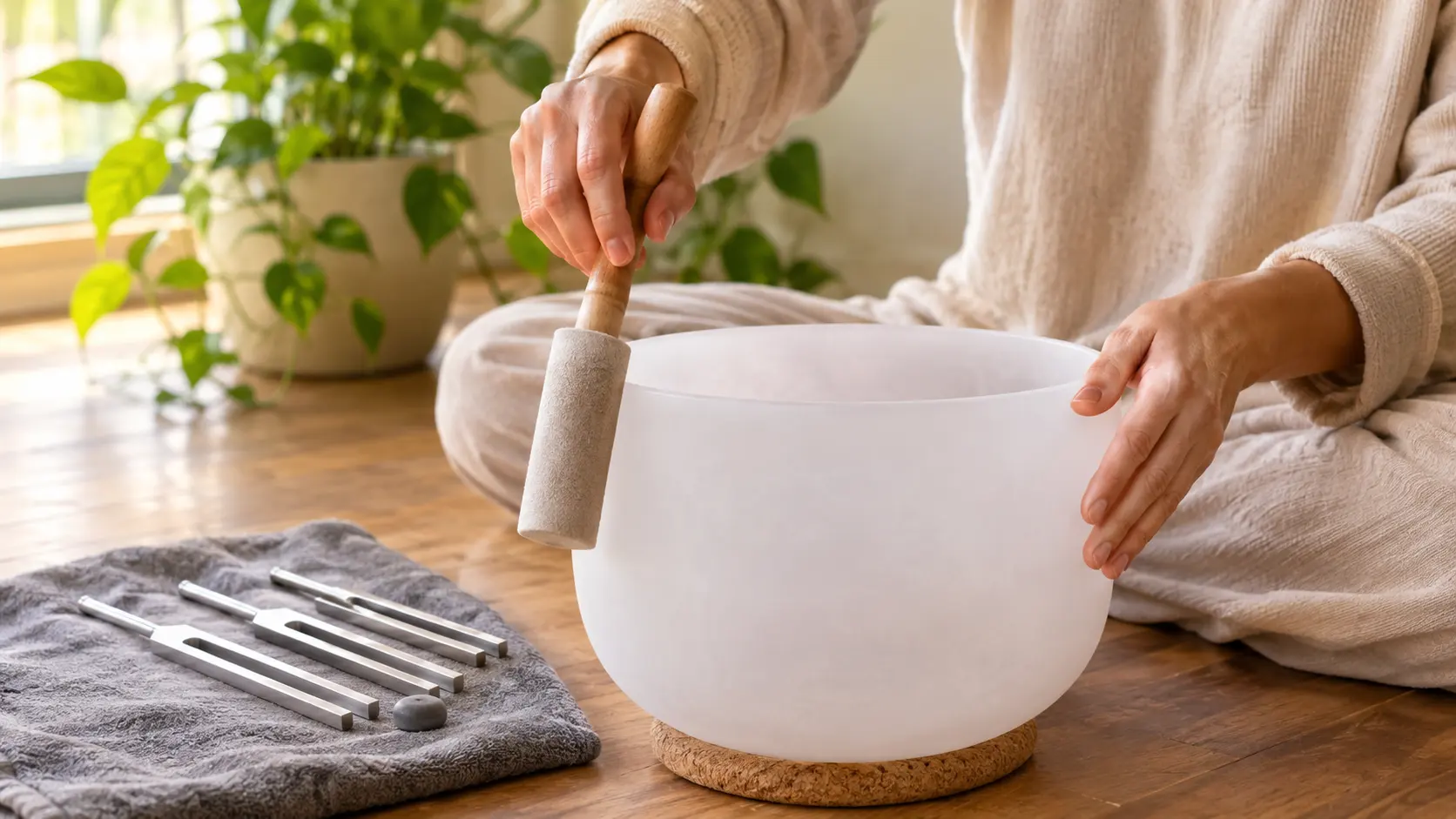
Singing bowls create a rich sound that can be heard throughout the room, making them great for group sessions. They are great to use during savasana at the end of yoga or just to sit with a sound. Tuning forks provide a pure note close to the ears or body and are great for focusing on one chakra for a short period of time. They also tend to be much cheaper. Often, a full set of chakra tuning forks may be cheaper than one quartz singing bowl. Tuning forks can be easily put in a bag.
Planetary Tuning Forks: Hans Cousto's Cosmic Octave
The 5th tuning method comes from Hans Cousto, a Swiss mathematician and music researcher. In his book The Cosmic Octave (originally published in German in the 1980s), Cousto took the cycles of the Earth, Moon, Sun and planets, and doubled them many times (many octaves), until they were in a range which humans can hear. Of these frequencies, some have been matched to chakras by tuning fork manufacturers.
| Chakra | Cousto frequency | Cycle it comes from |
|---|---|---|
| Root | 194.18 Hz | Earth day |
| Sacral | 210.42 Hz | Synodic Moon (new moon to new moon) |
| Solar plexus | 126.22 Hz | Sun |
| Heart | 136.10 Hz | Earth year (the "OM" tone) |
| Throat | 141.27 Hz | Mercury |
| Third eye | 221.23 Hz | Venus |
| Crown | 172.06 Hz | Platonic year |
Although many frequencies exist, the most famous is 136.10 Hz (the cycle of the Earth in one year). Hans Cousto refers to it as the OM frequency. It is typically used for the heart chakra in planetary frequency sets, and many OM chanting tracks are tuned to this frequency. For more information on this frequency, see our article on the cosmic OM frequency. Unlike other tuning systems, in planetary frequencies the solar plexus frequency is the lowest and the third eye frequency is the highest. However, as each tuning fork is used individually, this does not matter.
Which Chakra Frequency System Should You Use?
The most straightforward place to begin is with Solfeggio frequencies, as these are the ones used in almost all meditation tracks and apps. If playing an instrument, it is best to use note frequencies, as forks and bowls are sold in relation to specific notes.
| System | Range (root to crown) | Best for |
|---|---|---|
| Solfeggio | 396-963 Hz | Recorded music, playlists and apps |
| Notes and tuning forks | 256-480 Hz | Tuning fork sets and singing along |
| Singing bowls | 256.87-484.90 Hz | Bowl sessions, sound baths and yoga |
| Pythagorean (our chart) | 216-864 Hz | A mathematically related set, in our player |
| Cousto planetary | 126.22-221.23 Hz | Planetary fork sets and the OM tone (136.10 Hz) |
It is fine to combine frequency types in a session. 396 Hz may be played at the same time as a 256 Hz tuning fork close to your ear. Some people enjoy this combination and some do not. More important than the type of frequency used is repeating a short meditation with similar frequencies on most days.
How to Use Chakra Frequencies for Meditation: A 20-Minute Session for All 7 Chakras
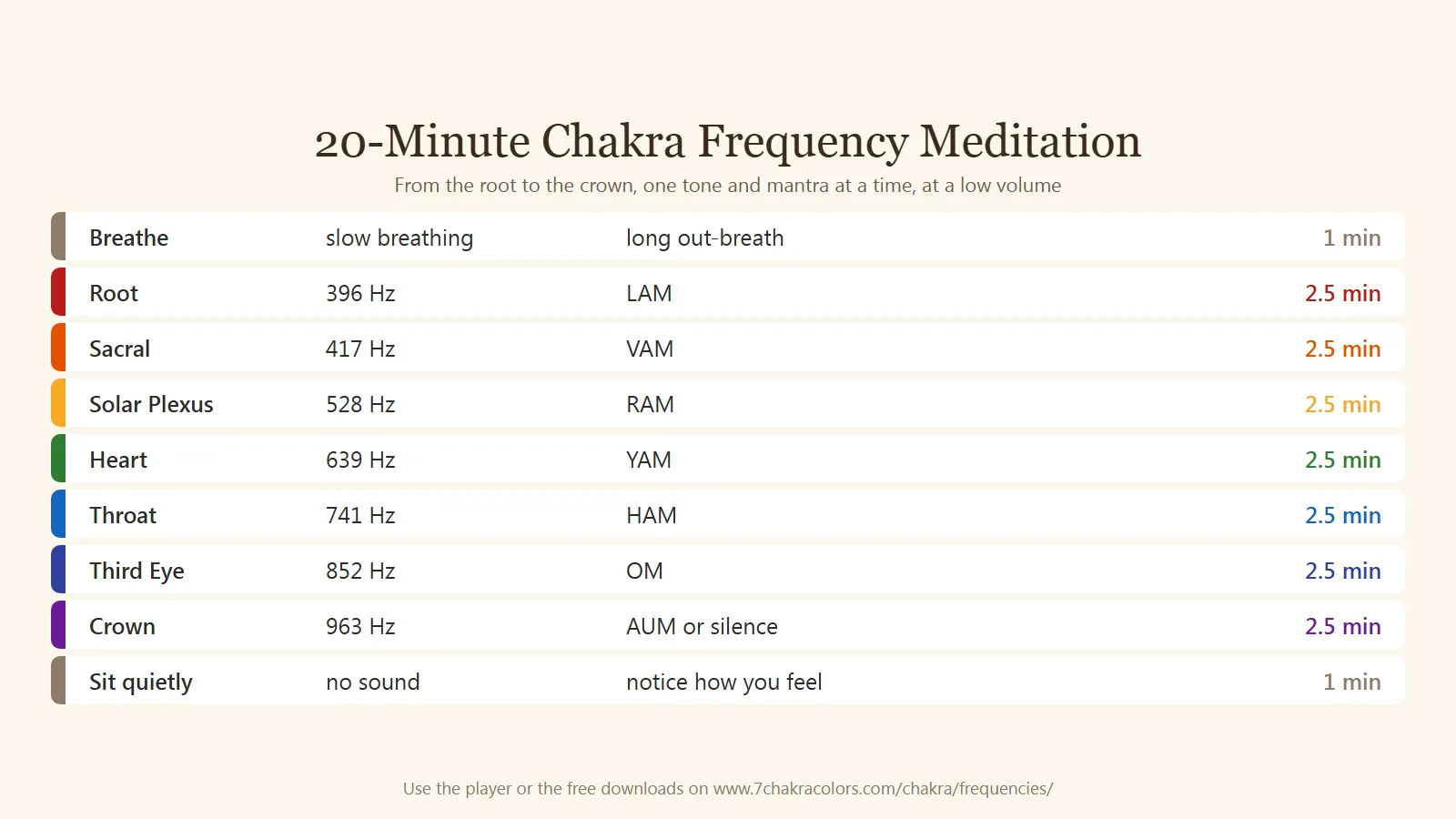
Play all 7 notes, one after another (approx. 2.5 minutes per chakra). Use the player above, the downloads, or any Solfeggio playlist.
- Volume: play at a low volume. Play much softer than you think you will need, especially through headphones. If you struggle to hear the sound, increase it slightly.
- Sit or lie in a comfortable position. Whether in a chair with your feet on the floor or on a mat is fine. Close your eyes or rest them on the floor.
- Breathing: breathe slowly for 1 minute. Exhale for longer than you inhale.
- Root chakra (396 Hz): focus on the bottom of the spine. Optionally, quietly chant or sing LAM on the exhalation.
- Work through each chakra in turn, moving to the matching tone and mantra: sacral chakra (417 Hz) - VAM (below the navel); solar plexus (528 Hz) - RAM (upper stomach); heart (639 Hz) - YAM (chest); throat (741 Hz) - HAM; third eye (852 Hz) - OM.
- Crown chakra (963 Hz) or 1 minute of silence (preferred by many teachers).
- Sit in silence for a further minute. Be aware of how you feel now.
If focusing on one chakra, play that chakra frequency for the majority of the meditation, and use the other frequencies as a short warm-up. 15-minute meditations for individual chakras can be found on the Frequency page for each chakra. One of the chakra breathing exercises may work well as a warm-up.
Do Chakra Frequencies Work? What the Research Says
There is good evidence that listening to sound and music can help people to relax. However, there is no evidence that any particular frequencies affect chakras, or that any healing effects occur in the body from listening to a specific frequency such as 528 Hz.
The best evidence is for music in general. A meta-analysis in 2020 combined over one hundred studies, and found that listening to music reduced levels of stress hormones, heart rate and self-reported stress (de Witte et al., 2020). This was found with all types of music, not chakra frequencies.
Fewer studies have been done on sound meditation. In 2017, 62 adults completed mood questionnaires before and after a singing bowl meditation in California. Their levels of tension, anger, tiredness and negative mood all decreased. This was most pronounced in people who had never tried it before (Goldsby et al., 2017). However, there was no control group, meaning it may simply be due to being still in a quiet room.
Very few studies have been conducted on a single frequency. In Japan, 9 healthy individuals listened to the same piece of music, once tuned to 528 Hz and once to the usual 440 Hz. After listening to the 528 Hz version, participants had lower levels of the stress hormone cortisol in their saliva, and reported feeling less tense (Akimoto et al., 2018). However, this study involved only 9 people and has not been repeated. Furthermore, the authors state that other claims regarding the healing properties of Solfeggio frequencies lack scientific backing. No reliable evidence links specific frequencies to specific chakras.
Therefore, chakra frequencies should be seen as a simple, relaxing meditation method. If listening to 396 Hz makes it easier for you to sit still and feel your body, then it is a good idea to continue using it. If binaural beats are added to some tracks, this is a different technique. See chakra frequencies and binaural beats for more information.
Is It Safe to Listen to Healing Frequencies?
Listening to quiet frequencies is safe for almost everyone. However, care needs to be taken with volume. Pure frequencies can be tiring for your ears, and listening to long sessions with headphones on could cause issues. The World Health Organization recommends listening at volumes below 80 decibels for no more than 40 hours a week. Keep volumes low with headphones, and take regular breaks (WHO, safe listening).
Stop listening if you experience any of the following:
- ringing in the ears (tinnitus)
- headaches
- dizziness
- feeling anxious
If you suffer with tinnitus or sensitivity to noise, start at a very low volume. It may be better to play through speakers, or to chant.
Do not listen to relaxing tracks while driving or doing something which requires your full attention.
Avoid placing weighted tuning forks on injured, inflamed or painful areas. If you are pregnant, or have an implanted device (such as a pacemaker), talk to your doctor first.
If you suffer with epilepsy, check with your doctor to make sure it is safe to listen to tracks with flashing lights or strong beats.
Chakra frequencies are self-care and should not replace medical or psychological treatment. If you have been feeling anxious, down or having trouble sleeping for more than a couple of weeks, speak to a doctor or therapist.
Sources
- Arthur Avalon (Sir John Woodroffe), The Serpent Power (1919), translation of the Sat-cakra-nirupana: the bija mantras of the chakras.
- Guido of Arezzo, Epistola de ignoto cantu (about 1030): the syllables ut, re, mi, fa, sol, la from the hymn Ut queant laxis.
- Leonard G. Horowitz and Joseph S. Puleo, Healing Codes for the Biological Apocalypse (1999): the six Solfeggio frequencies.
- Hans Cousto, The Cosmic Octave: Origin of Harmony (English edition 1988): the planetary tones.
- de Witte M, Spruit A, van Hooren S, Moonen X, Stams GJ. Effects of music interventions on stress-related outcomes: a systematic review and two meta-analyses. Health Psychol Rev. 2020;14(2):294-324.
- Goldsby TL, Goldsby ME, McWalters M, Mills PJ. Effects of Singing Bowl Sound Meditation on Mood, Tension, and Well-being: An Observational Study. J Evid Based Complementary Altern Med. 2017;22(3):401-406.
- Akimoto K, Hu A, Yamaguchi T, Kobayashi H. Effect of 528 Hz Music on the Endocrine System and Autonomic Nervous System. Health. 2018;10(9):1159-1170.
- World Health Organization, "Deafness and hearing loss: Safe listening" (questions and answers).
Frequently Asked Questions About Chakra Frequencies
What is the difference between chakra frequencies and Solfeggio frequencies?
Solfeggio frequencies are one set of tones, 396 to 963 Hz, that come from a 1999 book and were later matched to the chakras. Chakra frequencies is the wider term for any tone linked to a chakra, so it also covers the notes C to B on tuning forks, singing bowl tunings and planetary tones. The Solfeggio set is simply the best-known one.
Which chakra frequency should I listen to first?
Many teachers start at the root with 396 Hz or a low C, because the lower chakras are said to give the upper ones a stable base. If one area of your life feels most out of balance, you can also begin with that chakra. Either way, a few quiet minutes a day matter more than the order.
Can you listen to all seven chakra frequencies together?
Playing all seven tones at the same time makes a dense, clashing sound that most people find tiring. The usual way is to play them one after another, from the root to the crown, as in the 20-minute session on this page. Many all-chakra tracks online work the same way, moving through the tones in order.
What chakra is associated with 432 Hz?
In the Pythagorean chart on this page, 432 Hz is the heart chakra, and all other tones are worked out from it. On singing bowls tuned to A = 432 Hz, the note A, which belongs to the third eye, is exactly 432 Hz. 432 Hz is also a tuning reference for whole songs, not only a chakra tone.
What is the difference between 432 Hz and 528 Hz?
432 Hz is a tuning standard: music is tuned so that the note A is 432 Hz instead of 440 Hz. 528 Hz is a single Solfeggio tone linked to the solar plexus chakra and often called the love frequency. You can listen to either for relaxation, but neither has been shown to heal anything.
Can you listen to chakra frequencies while sleeping?
Yes, many people play a soft tone or a chakra track as they fall asleep. Keep the volume very low, use a timer so it stops after 20-30 minutes, and use a speaker instead of earbuds so you don't sleep with sound in your ears all night. Stop if it keeps you awake or wakes you up.
Do you need headphones to listen to chakra frequencies?
No. A small speaker in a quiet room works well and is gentler on the ears. Headphones help in a noisy place, and they are needed for binaural beats, which play a slightly different tone in each ear. If you use them, keep the volume low and take breaks.
Choose a chakra to work with and play its frequency at a low volume for 10 minutes. Note how you feel. To find the mantra and a full meditation for the chakra, see: