Blocked Chakra Symptoms: Signs of Imbalance in All 7 Chakras
Blocked chakra symptoms include fatigue, tension in one body area and recurring emotions. See the signs chakra by chakra, the causes and when to see a doctor.
Table Of Contents
Blocked chakra symptoms are the physical, emotional and behavioral signs that, in yoga tradition, point to energy getting stuck at one of the seven chakras. The most common are tiredness that rest doesn't fix, tension or aches in one part of the body, the same emotion coming back again and again, and habits you can't seem to break. Where the signs gather tells you which chakra to look at.
Blocked Chakras · Key Facts
- What it is:Energy that is held back (underactive) or pushed too hard (overactive) at one of the 7 chakras, as described in yogic and tantric tradition
- Most common signs:Low energy, tension in one body area, recurring emotions, stuck habits
- Where signs show up:Along the spine, from its base (root chakra) to the crown of the head
- Common causes:Stress, loss or trauma, unexpressed emotions, daily habits
- Science:No scientific evidence that chakras exist as physical structures
- Get checked if:Pain, numbness, low mood or anxiety that is strong, sudden or keeps getting worse
The Most Common Signs of Chakra Imbalance
Whichever center is involved, a few chakra imbalance symptoms turn up far more often than the rest. If two or three of these sound familiar, you're in the right place:
- Tired even after a full night's sleep, with energy that drops for no clear reason
- Tension that keeps returning to one spot, such as the lower back, the stomach, the chest, the jaw or the head
- The same feeling on repeat - fear, guilt, shame or grief that shows up in very different situations
- Trouble speaking up or saying no, even when you know what you want
- Feeling cut off from your body, from other people or from things you used to enjoy
- Creative or sexual energy that has gone quiet for weeks or months
- A busy, foggy mind that jumps between worries but can't settle on a decision
- Losing the thread of why you do things, a flat sense that nothing really matters
Usually one or two of these stand out more than the others. The chakra-by-chakra table further down shows which center each one points to.
What Is a Blocked Chakra?
A blocked chakra is one of the seven main chakras where, according to yoga tradition, life energy (prana) doesn't move as freely as it should. These centers sit at chakra points along the central channel of the subtle body, called sushumna, running from the base of the spine to the top of the head.

Teachers use two words for the same problem. Blocked chakras hold energy back, so the area of life they govern feels heavy or shut down. An imbalanced chakra can also be too active, pushing energy out in a way that feels tense or overwhelming. So a chakra blockage is one kind of imbalance, not the only one.
Most traditions don't describe a chakra as fully closed. Think of it more like a dimmer than an on/off switch: a center can be a little sluggish, very sluggish, or running hot. There is no scientific evidence that chakras exist as physical structures, and nothing on this page is a medical diagnosis. What the chakra model offers is a useful map for self-reflection. Each center is tied to one area of life - safety, pleasure, confidence, love, voice, insight and meaning - and the signs show which of those areas needs attention.
Is a Blocked Chakra the Same as an Opening One?
No. A blocked chakra feels like being stuck: the same tension, mood or pattern comes back and doesn't shift much over time. An opening chakra feels like movement, with tingling, waves of emotion or new energy that tends to ease within a few weeks. If your signs feel more like change than like being stuck, read about chakra opening symptoms instead.
Blocked Chakra Symptoms, Chakra by Chakra
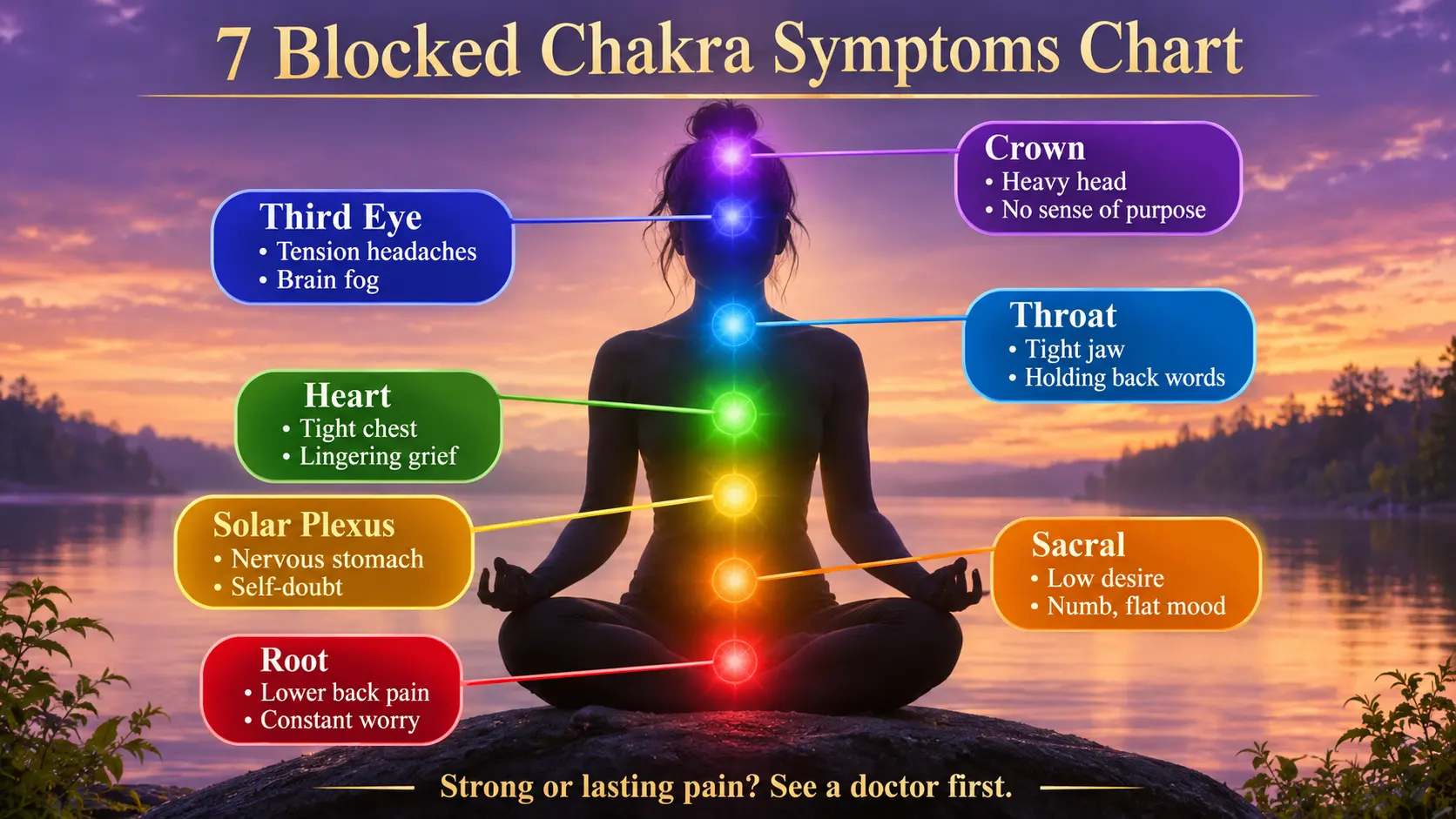
Each chakra looks after one part of the body and one theme in life, and its blocked signs follow both. Start with the table to find the pattern that fits you best, then open that chakra's own page for the full list, the causes and a short test.
The quickest way to read the table: find the row where both the body column and the emotion column sound like you.
| Chakra (location) | Common physical signs | Common emotional and behavioral signs |
|---|---|---|
| Root (base of the spine) | Lower back and hip tension, heavy legs, cold feet | Constant worry about money or home, restlessness |
| Sacral (below the navel) | Lower belly and pelvic tension, low desire | Guilt about pleasure, a flat mood, rigid routines |
| Solar plexus (above the navel) | Nervous stomach, bloating under pressure | Self-doubt, trouble deciding, or a need for control |
| Heart (center of the chest) | Tight chest, shallow breathing, upper back tension | Lingering grief, hard to trust, giving but not receiving |
| Throat (throat and neck) | Lump in the throat, tight jaw, teeth grinding | Holding back the truth, or talking over others |
| Third eye (between the eyebrows) | Forehead headaches, tired eyes | Brain fog, overthinking, ignoring your gut feeling |
| Crown (top of the head) | Heaviness at the top of the head, light sensitivity | Emptiness, loneliness, no sense of purpose |
Root Chakra (Muladhara)
The root chakra sits at the base of the spine and is about safety and having your basic needs met. When it's blocked, people often describe feeling unsettled in their own life: worried about money, restless at home, or unable to sit still. In the body, the signs gather low down - the lower back, the hips, the legs and feet, and sometimes cold hands and feet. One sign people often miss is chronic lateness or disorganization, a sense that life never quite lands. The complete list is on the page about root chakra blocked symptoms.
Sacral Chakra (Svadhisthana)
Just below the navel, the sacral chakra governs pleasure, creativity and how you let feelings flow. A blockage here tends to show up as numbness rather than pain. Things that used to feel good, like music, food, touch or a hobby, start to feel flat. Many people notice low desire, guilt around enjoying themselves, or tension in the lower belly and pelvis. A less obvious sign is being very rigid about routine, because spontaneity feels unsafe. You'll find every sign, with causes, under sacral chakra blocked symptoms.
Solar Plexus Chakra (Manipura)
This one is about confidence and willpower, and it sits between the navel and the breastbone. The classic signs are a nervous stomach, bloating or digestive trouble when you're under pressure, along with self-doubt and difficulty making decisions. Some people swing the other way and become controlling or quick to anger. A sign that's easy to overlook is constant tiredness after social situations where you didn't stand up for yourself. More detail is on the solar plexus chakra blocked symptoms page.
Heart Chakra (Anahata)
At the center of the chest, the heart chakra links love for others with love for yourself. When it's blocked, grief tends to linger long after a loss or a breakup, and it can be hard to trust people or let them close. Physically, people mention a tight chest, shallow breathing and tension between the shoulder blades. Being the one who always gives but can't receive help is one of the quieter signs. See the full list of heart chakra blocked symptoms.
Throat Chakra (Vishuddha)
The throat chakra is your voice, both speaking and listening. A blockage often feels like a lump in the throat when you try to say something difficult, a tight jaw, or a voice that goes quiet in groups. Some people talk too much instead, filling silence so nobody can get a word in. Grinding your teeth at night is a sign few people connect with this center. All the signs are on the page about throat chakra blocked symptoms.
Third Eye Chakra (Ajna)
Between the eyebrows, the third eye is linked with intuition, insight and clear thinking. The signs of a blockage are mostly mental: brain fog, second-guessing every choice, ignoring your gut feeling, or getting lost in overthinking. In the body, tension headaches across the forehead and tired eyes are the ones people report most. A sign that surprises many is losing the ability to remember dreams. For the full picture, read third eye chakra blocked symptoms.
Crown Chakra (Sahasrara)
The crown chakra at the top of the head is about meaning and a sense of connection to something larger than yourself. When it's blocked, life can feel empty even when everything looks fine from the outside. People describe feeling lonely in a crowd, cynical about spiritual ideas they once liked, or simply drained of purpose. Sensitivity to light and a heavy feeling at the top of the head are mentioned too. The complete list is on the crown chakra blocked symptoms page.
Chakras and Emotions: What Each Center Holds
In chakra tradition, each center is paired with one emotion that takes over when it's blocked. The best-known version of this comes from Anodea Judith's book Eastern Body, Western Mind, where she calls them the "demons" of the seven chakras:
- Root - fear. Chakra fear is the most common pairing of all: a background worry about survival, money or being safe.
- Sacral - guilt. Feeling bad about wanting pleasure, rest or closeness.
- Solar plexus - shame. A sense that you aren't good enough, which quietly drains your willpower.
- Heart - grief. Sadness from a loss that hasn't been allowed to move through.
- Throat - lies. Saying what others want to hear, or not saying anything at all.
- Third eye - illusion. Seeing what you expect instead of what's really there.
- Crown - attachment. Holding on so tightly to ideas or outcomes that nothing new can come in.

This pairing is useful because emotions are often easier to notice than energy. If the same feeling keeps showing up at work, at home and with friends, it points to one center more clearly than a single physical symptom would.
Psychological Signs of Blocked Chakras
The psychological signs of blocked chakras are mental patterns that repeat: overthinking, harsh self-criticism, people-pleasing, emotional numbness, or a fixed belief about yourself that won't shift no matter what happens. These patterns overlap a lot with ordinary stress, anxiety and low mood. If they're strong or getting worse, talk to a doctor or therapist as well (see the last section).
Physical Signs and Pain by Body Area
In chakra tradition, physical signs tend to show up close to the chakra's location, so the place where tension sits is your main clue. That doesn't mean a chakra causes the pain. Posture, stress, long hours of sitting and poor sleep explain most aches, and the chakra view sits alongside those causes rather than replacing them.

Which Chakra Is Linked to Lower Back Pain?
Lower back pain is linked with the root chakra and the sacral chakra in chakra tradition, because both sit at the base of the spine and the pelvis. The root is tied to feeling supported, and the sacral to emotional flow. Pain in the middle of the back is linked with the solar plexus and heart, while the neck and shoulders belong to the throat.
Stomach and Digestion
A knotted stomach before a big meeting is the textbook solar plexus sign. Teachers link this area with willpower and self-worth, which is why digestive upset under pressure is read as a confidence issue in the chakra model. Lower belly tension, closer to the hips, belongs more to the sacral chakra.
Chest Tightness and Shallow Breathing
A tight chest, breathing that stays high and short, and rounded shoulders are the physical side of a blocked heart chakra. Many people notice this most in the months after a loss. Any chest pain needs a doctor first, though.
Headaches, Jaw Tension and Eye Strain
The upper three chakras share the head and neck. A clenched jaw and sore throat point to the throat chakra, a band of pressure across the forehead to the third eye, and a heavy, foggy feeling at the top of the head to the crown.
Overactive vs Underactive Chakras
An underactive chakra holds energy back, which shows up as withdrawal, low energy and avoidance. An overactive one pushes too much energy out, which shows up as control, intensity and restlessness. Both count as imbalance.
| Chakra | Underactive signs | Overactive signs |
|---|---|---|
| Root | Anxious, unsettled, disorganized | Clinging to money and routine, stubborn |
| Sacral | Numb, low desire, uncreative | Overindulgent, swept away by moods |
| Solar plexus | Passive, self-doubting, easily drained | Controlling, quick to anger |
| Heart | Closed off, slow to trust | Overgiving, jealous, no boundaries |
| Throat | Quiet, afraid to speak up | Talks over others, gossips |
| Third eye | Foggy, stuck in old beliefs | Overthinking, lost in fantasy |
| Crown | Cynical, without meaning | Spaced out, cut off from daily life |
The same chakra can swing between the two, especially in stressful periods. In tradition, the goal is never a chakra that is "more open" but one that is balanced.
What Causes Chakra Imbalance?
Most chakra imbalance builds up slowly from everyday life rather than from one big event. Teachers point to a handful of common causes:
- Long-term stress. Months of pressure at work or at home keep the body braced, and the lower chakras are usually the first to feel it.
- Loss, trauma or big life changes. A death, a breakup, a move or an illness can leave one area of life frozen in place.
- Emotions you don't express. Anger you swallow or sadness you hide tends to settle in the throat, heart or stomach.
- Physical habits. Poor sleep, sitting all day and shallow breathing affect the same areas the chakras are linked with.
- Relationship patterns. Always giving, always fixing, or always keeping people at a distance wears on the heart and solar plexus.
- Forcing intense practice. Too much breathwork or meditation too fast is a common reason for an overactive upper chakra.

A Quick Self-Check: Reading Your Own Signs
Take a minute with these three questions:
- Where in your body does tension sit most often?
- Which emotion keeps coming back, whatever the situation?
- Which area of life feels stuck right now: safety, pleasure, confidence, love, voice, clarity or meaning?
Match your answers to the chakra table above. If two or three chakras seem to fit, the full chakra test sorts them out with a score for each one.
How Do You Unblock a Chakra?
Unblocking a chakra, in yoga tradition, means bringing energy back into balance with breathwork, meditation, yoga poses, sound and simple grounding habits, chosen for the chakra that shows the clearest signs. Start with one chakra rather than all seven at once. The methods, step by step, are in the guide to chakra healing.

When It's Not Your Chakras: Signs to See a Doctor
Chakra work can sit next to medical care, but it never replaces it. Some symptoms need a doctor whatever their chakra meaning. Get checked if you have:
- pain that is severe, starts suddenly or keeps coming back
- back pain with numbness or weakness in the legs, a fever, or problems controlling your bladder or bowels (MedlinePlus explains when low back pain needs a doctor)
- digestive problems that last more than a few weeks, or weight loss you can't explain
- low mood, anxiety or panic that affects your daily life
Chest pain, sudden shortness of breath, sudden weakness on one side of the body, or thoughts of harming yourself need urgent help: call 911 in the US (112 in Europe) or go to the nearest emergency room.
Frequently Asked Questions About Blocked Chakras
Can more than one chakra be blocked at the same time?
Yes, and it is common. Neighboring chakras often go out of balance together, such as the root and sacral after a stressful move, or the heart and throat after a breakup when grief and unspoken words go hand in hand. In most cases one center stands out more than the others. Teachers suggest starting with that one, or with the lowest blocked chakra, since a steadier base tends to help the centers above it.
Which chakra is most often out of balance?
Chakra teachers most often name the root, the solar plexus and the heart. The root reacts to stress about money, work and safety, which almost everyone faces at some point. The solar plexus takes the hit from pressure and self-criticism, and the heart from loss and disappointment. That said, the most common chakra in general matters less than the one your own signs point to.
Can a blocked chakra make you sick?
There is no scientific evidence that a blocked chakra causes illness. In chakra tradition, a blockage is linked with tension, low energy and recurring emotions, not with disease. Stress, poor sleep and unresolved emotions can affect your health, though, and these are the same things chakra work tries to address. If you feel unwell, see a doctor first, and use chakra practice alongside medical care, never instead of it.
How long does it take to clear a chakra blockage?
It depends on how long the pattern has been there and what caused it. A blockage from a stressful month often eases within a few weeks of rest and steady practice. A pattern that goes back years usually shifts more slowly, in small steps over several months. Most teachers recommend short daily practice over occasional long sessions, and patience over trying to force a quick result.
Can chakras be blocked since childhood?
In chakra psychology, yes. Anodea Judith and other teachers link each chakra with a stage of childhood, so early experiences such as instability at home, strict rules about feelings or not being listened to can shape how a center develops. These patterns often feel like "just who I am". Noticing them is the first step, and a therapist can help when they go back to painful events.
Do blocked chakras affect relationships?
Often, yes. A blocked heart chakra can make it hard to trust or let people close, a blocked throat chakra makes honest conversations difficult, and a blocked sacral chakra can dampen intimacy and fun. Relationship patterns that repeat with different people, such as always pleasing, always withdrawing or always fighting, are one of the clearest everyday signs of which center needs attention.
Can you feel when a chakra unblocks?
Many people do. The most common signs are a sense of relief or lightness, tension easing in the related body area, emotions coming up and then passing, and more energy over the following days. Others notice nothing dramatic, only that an old pattern gradually loses its grip. Both are normal. Unblocking is usually gradual rather than a single moment, and the signs often come in waves.
Where to Go From Here
Pick the chakra whose signs fit you best and start there, rather than trying to fix all seven at once. A week of paying attention to that one area usually tells you more than any list can. From here, these are the most useful next steps:
-
take the chakra test
- a score for each of your seven chakras
-
how to unblock chakras
- gentle practices for each center
-
signs your chakras are opening
- what it feels like when energy starts to move
Sources
- Judith A. Eastern Body, Western Mind: Psychology and the Chakra System as a Path to the Self. Celestial Arts, 1996 (revised edition 2004).
- MedlinePlus Medical Encyclopedia (U.S. National Library of Medicine). Low back pain - acute.