
Third Eye Frequency: 852 Hz, OM Mantra and Healing Sounds
Third eye frequency: 852 Hz and 648 Hz, the OM mantra, the note, healing music and how to use sound to activate the Ajna chakra.
Table Of Contents
The third eye frequency is usually given as 852 Hz, the sixth tone of the modern Solfeggio scale. Systems based on musical notes give Ajna, the third eye chakra, the note A instead, which is 426.7 Hz on many chakra tuning forks and 432 Hz on singing bowls tuned to A = 432 Hz, and the Pythagorean chart on our site uses 648 Hz. Its seed mantra is OM. No frequency has been shown to open the third eye. If you are new to it, start with 5-15 minutes of quiet listening or chanting.
- Solfeggio frequency: 852 Hz
- Musical note: A (426.7 Hz)
- Pythagorean scale: 648 Hz
- Singing bowl: 432 Hz
- Seed mantra (bija): OM
- Element: mind (manas), beyond the five elements
- Colour: indigo
- Location: forehead, between the eyebrows
- Session length: 5-15 minutes
The third eye chakra lies between the eyebrows, and is associated with intuitive awareness, creativity and clarity. Used as a meditative sound, a third eye frequency aligns well with some of the techniques mentioned in our guide on how to open your third eye, such as regular meditation, sufficient sleep and keeping a dream journal.
THIRD EYE CHAKRA · AJNA
852
Hz
Solfeggio frequency
Volume15%
Duration00:00
What Is the Third Eye Chakra Frequency?
The third eye chakra is typically given 852 Hz.
In note-based systems, this chakra is associated with the note A. This means that using tuning forks, this chakra is often played at 426.7 Hz. If using a singing bowl, and the tuning is set to A = 432 Hz, the nominal frequency of this bowl will be 432 Hz. This is because the tuning of the instrument has been defined by A. In contrast, modern pianos play at 440 Hz. On our page detailing chakra frequencies, the Pythagorean tuning table associates this chakra with 648 Hz. This frequency is a perfect fifth interval (3:2 ratio) above the 432 Hz heart chakra. This tuning table is formed using simple ratios from a base of 432 Hz. As such, 648 Hz is not intended to be the note A.
This chakra is unique in that the 432 Hz singing bowl and note-based tuning agree on a frequency for this chakra. 852 Hz is quite different to A, being between G# and an A one octave higher, but slightly closer to G#. In planetary tuning forks, this chakra is associated with 221.23 Hz according to Hans Cousto's Cosmic Octave system. This frequency comes from raising the orbital frequency of Venus by 32 octaves, bringing it into an audible range.
None of these values has been shown to be a vibration of this chakra. They come from different tuning systems. 852 Hz is easiest to find in a recording. If using an instrument, an A singing bowl or fork is typically used for this chakra.
The table shows the seven numbers you will see for the third eye side by side, with the system each one comes from.
| Frequency | Tuning system or origin | Common association |
|---|---|---|
| 852 Hz | Modern Solfeggio scale ("LA") | Returning to spiritual order; the usual third eye tone |
| 426.7 Hz | C = 256 Hz plus a 5:3 major sixth | Note A on chakra tuning forks |
| 432 Hz | A = 432 Hz tuning | Note A on singing bowls |
| 440 Hz | A = 440 Hz, the modern standard | Note A on a modern piano |
| 648 Hz | Pythagorean ratios from 432 Hz (3:2 above 432 Hz) | Third eye tone on our chakra frequencies chart |
| 221.23 Hz | The Cosmic Octave (Hans Cousto), Venus | Third eye fork in planetary tuning fork sets |
| 963 Hz | Modern Solfeggio list, extended | Usually given to the crown chakra |
Note: 852 Hz is not an A. On a piano it sits between G sharp and A, slightly closer to G sharp, so an 852 Hz track and an A bowl play different notes. None of these numbers is a measured frequency of the chakra; they come from different tuning systems and modern sound healing traditions.
What Frequency Opens the Third Eye?
It has not been shown that any frequency can open the third eye. However, commonly when searching for a frequency to activate the third eye, people will find 852 Hz, sometimes 963 Hz or 936 Hz. Often claims will be made about activating, or decalcifying, the pineal gland.
852 Hz comes from the Solfeggio sequence, developed by Joseph Puleo in the 1970s, and published by Leonard Horowitz and Puleo in 1999 in Healing Codes for the Biological Apocalypse. This note is described as LA, and associated with returning to spiritual order. The note names originate from around 1025, from a hymn used by Guido of Arezzo to teach his students. However, there are no frequencies given in this hymn. Additionally, the book published in 1999 is not about chakras.
852 Hz or 963 Hz?
Most charts associate the third eye chakra with 852 Hz, and the crown chakra with 963 Hz (see the crown chakra frequency page for 963 Hz). The 936 Hz frequency is not one of the original six Solfeggio frequencies. It is predominantly marketed as a pineal gland frequency online.
Can Sound Activate or Decalcify the Pineal Gland?
The pineal gland is found deep in the brain, and produces melatonin to help regulate sleeping and waking cycles. The connection between this gland and the third eye is relatively modern, and there is no reliable evidence to suggest that listening to 852 Hz or any other frequency will activate or decalcify this gland. See our page on the pineal gland third eye connection for more information, including what this gland does.
Third Eye Mantra: How to Chant OM
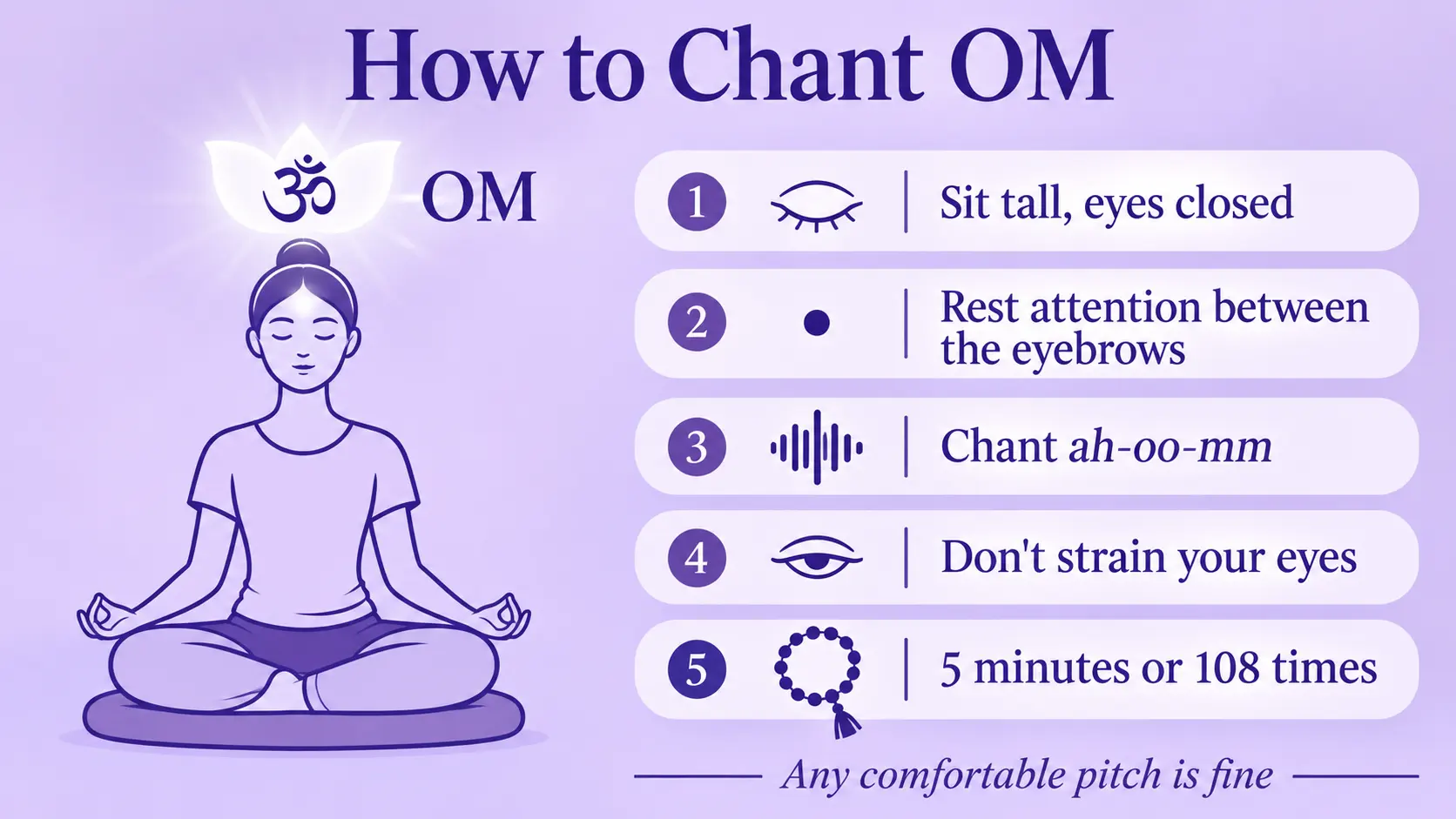
OM is the mantra for this chakra. In the Sanskrit text Sat-cakra-nirupana, translated by Arthur Avalon (The Serpent Power), the Ajna chakra is described as a white lotus with two petals bearing the letters Ha and Ksha. Within this chakra is the sacred syllable OM (ॐ). The indigo colour of this chakra in many modern systems is a later addition. Some modern systems give this chakra the mantra either HAM or KSHAM, depending on which petal is being referred to. AUM is OM written as its three sounds, and the mantra can be chanted by making three distinct sounds: ah-oo-mm. Let the mm sound last the longest. The pitch of your voice does not need to match the Solfeggio frequencies, or any specific frequencies. Just choose a comfortable pitch.
Find somewhere peaceful.
- Sit up straight and close your eyes.
- Take a few slow breaths, and focus on the space between your eyebrows.
- Exhale and chant "ah-oo-mm". Allow the mm sound to continue for as long as the exhale is comfortable. Many people will feel vibrations in their forehead or nose.
- Inhale through your nose, and repeat slowly and comfortably.
- Repeat for approximately 5 minutes (or 108 times on a mala).
Do not strain your eyes upwards. If you feel a headache or tension in your head when focusing on your forehead, just focus on your breath instead. It is common to feel pressure or tingling in the forehead during this mantra, and this is not a sign of activation.
Third Eye Sounds: Bowls, Forks and Silence
852 Hz recordings are easy to find. Many people listen to this frequency at a low volume in preparation for meditation. These tools can add to the experience.
Singing Bowls
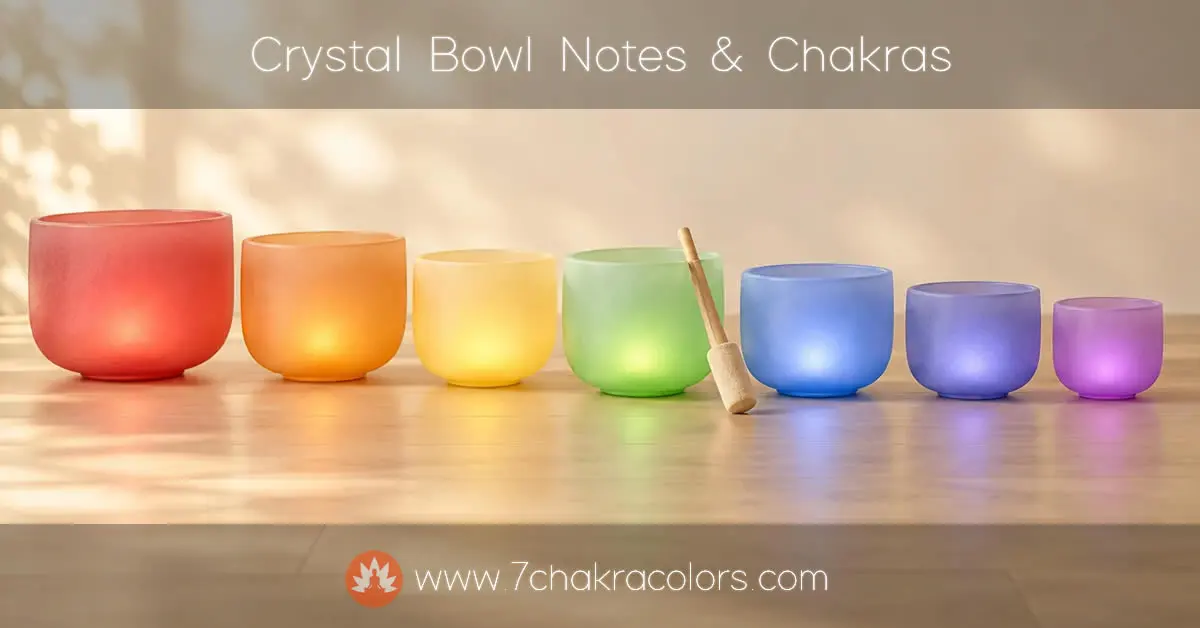
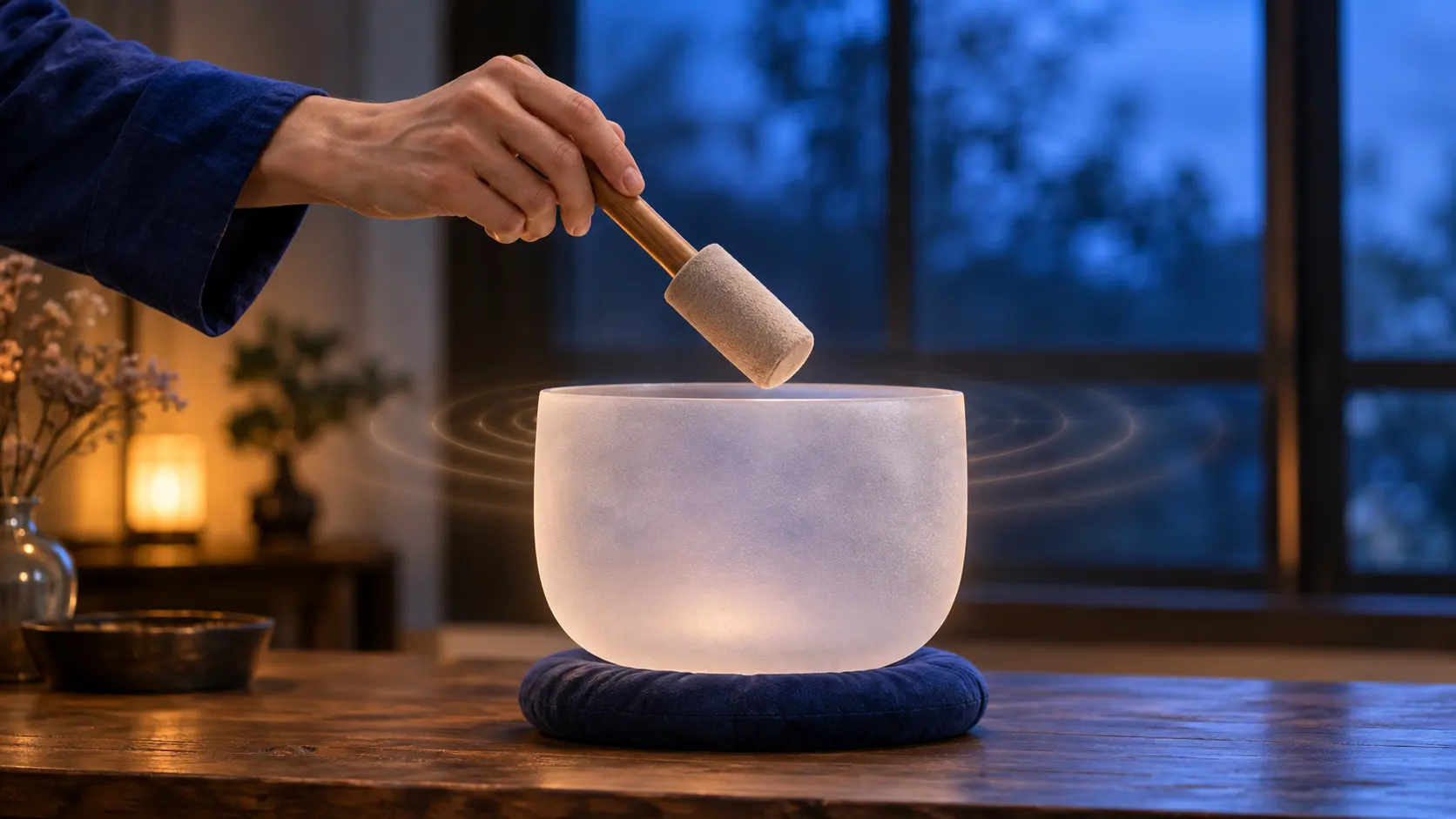
As this is the A note, it can often be found as one of the smaller bowls in a matching set, however this will depend on the materials, and how it is made. Tap once, and allow the sound to finish. This can make a quick focus exercise.
Tuning Forks
It is common to use unweighted forks. Gently tap them, and hold them at a comfortable distance from one ear at a time, or in front of your forehead. Do not press weighted forks onto your face or temples.
Humming Bee Breath and Silence
Bhramari breathing, from hatha yoga, is a long exhalation with a humming sound made with closed lips. Many teachers recommend using this breathing for the third eye chakra. After completing 5 or 6 cycles, sit in silence. Often people notice the most in the silence afterwards.
ADVERTISEMENT: CONSCIOUS CRYSTALS - 7 CHAKRA COLORS SPECIAL DEALS

Buy Real Chakra Stones and Crystal Jewelry
Explore Full Collection

Using 852 Hz for Intuition, Focus and Mental Clarity
The Ajna chakra is associated with intuition, creativity and clarity, and in the Solfeggio sequence, 852 Hz is associated with returning to spiritual order. These are traditional associations and meditation aims, not proven effects of the tone. Listening to this tone will not give you intuition or psychic abilities. However, it can be useful as a simple focus point.
- Go from sound to silence. Either tap a single note on an A singing bowl, or play the tone and stop it, and listen until the sound has gone. Sit in complete silence for a few breaths. Repeat 3 times.
- Observe your thoughts. While the sound plays at a low volume, observe any thoughts coming to your mind. Label them (e.g. planning, worrying, remembering) and return to the sound.
- Imagery. Imagine a peaceful scene in as much detail as possible for 2 minutes (as you would in a dream journal).
- Reflection. Note down one insight or decision you felt was clearer. Check later whether it was accurate.
This type of intuition refers to being aware of what you already suspect or know.
How to Use Third Eye Frequency: A 15-Minute Session
This is an optional practice to move from sound to silence, as the third eye chakra is associated with a calm, observant state of mind. It can be practised once a day.
Breathe naturally for 2 minutes. Practise humming bee breath (see third eye chakra breathing) for 2 minutes. Listen to 852 Hz (or an A singing bowl) for 4 minutes, using the player at the top of this page. Close your eyes and relax your focus. Chant OM for 3 minutes. Optionally, visualise a soft indigo light in the space between your eyebrows for 2 minutes. Finally, sit in silence for 2 minutes and observe your thoughts without judgement.
| Minutes | What you do | Sound |
|---|---|---|
| 0-2 min | Breathe naturally and let the body settle | Silence |
| 2-4 min | Humming bee breath (bhramari) | Your own hum |
| 4-8 min | Listen with eyes closed and relaxed attention | 852 Hz in the player above, or an A bowl |
| 8-11 min | Chant OM on each out-breath | Your own voice |
| 11-13 min | Optional: picture a soft indigo light between the eyebrows | Silence or the tone, very quietly |
| 13-15 min | Watch your thoughts come and go without judging them | Silence |
If preferred, play the tone softly during the third eye chakra meditation.
Many people find this chakra practice suitable in the evenings. However, try to avoid doing it very late in the evening, as it may over-stimulate the mind and make it difficult to fall asleep. The aim of this practice is to simply observe your thoughts in a calm manner.
Third Eye Chakra Note: A and 426.7 Hz
In Western chakra music, this chakra is associated with the note A. This is the 6th note in the C major scale, coming after G (throat chakra) and before B (crown chakra).
Many chakra tuning forks are tuned beginning from C = 256 Hz (old scientific pitch). From this, A is tuned to produce a frequency of 426.7 Hz (ratio of 5:3). In contrast, singing bowls tuned to the 432 Hz standard will be 432 Hz, and modern pianos will be 440 Hz. Despite this, they are all A notes, simply tuned differently, which may mean they sound slightly different to each other.
This difference shows the wider debate about tuning standards. Both 432 Hz and 440 Hz are different tunings of the same note (A). It is a matter of preference which is seen as "more natural".
852 Hz vs 432 Hz
852 Hz is part of the Solfeggio sequence, whereas 432 Hz is a reference pitch for the note A. An octave above 432 Hz would be 864 Hz, and an octave above 440 Hz would be 880 Hz. 852 Hz does not match an octave of 432 Hz. Interestingly, an octave above 426.7 Hz (the tuning of the fork) is about 853 Hz, very close to 852 Hz. However, this is purely a mathematical coincidence, and there is no historical link or shared effect between them. Also bear in mind that music tuned to A = 432 Hz is not the same as listening to a pure 432 Hz tone. The music will still contain all notes from the scale.
What Does Science Say About 852 Hz and Third Eye Activation?
There is no scientific evidence that listening to 852 Hz will activate the third eye chakra, activate or decalcify the pineal gland, or increase psychic ability. Research has been done on the benefits of meditative and calming sound.
One well-known study asked 62 adults how they were feeling before and after meditating with singing bowls. Participants reported feeling less tense, angry, tired and in a bad mood (Goldsby et al., 2017). However, as there was no control group, and the bowls used in this study were not tuned to 852 Hz, this study cannot tell us anything about 852 Hz.
However, using this chakra sound to get into a calmer, more focused state of mind is a reasonable aim.
ADVERTISEMENT: CONSCIOUS CRYSTALS - 7 CHAKRA COLORS SPECIAL DEALS
Buy Real Chakra Stones and Crystal Jewelry
Explore Full Collection
Safety: Volume, Sleep and Your Mind
Be careful with volume, particularly when using headphones, and take regular breaks. Both of these are recommended by the World Health Organization. Some people may find high-pitched sounds uncomfortable.
- If you experience ringing in the ears, a headache, dizziness, or extreme anxiety, stop.
- Do not press tuning forks on your face, eyes or temples. Do not strain your eyes upwards during meditation.
- Avoid long sessions if they are affecting your sleep.
- Do not use relaxing tracks while driving.
Sometimes meditation may cause feelings of anxiety, sadness, or disorientation. A review of 83 studies found that roughly 8% of participants experienced this (Farias et al., 2020). Those with a history of psychosis or dissociation should be particularly cautious. Common imagery experienced in meditation when the eyes are closed (such as colours or shapes) is normal. However, seeing or hearing things that seem real is not. If you are very distressed, confused or disoriented by meditation, stop. Ground yourself and talk to a doctor or therapist. Feeling pressure, tingling, or headaches is not a sign of activation. If you get a very sudden, severe headache, or sudden changes to your vision, seek urgent medical assistance.
Sources
- Arthur Avalon (Sir John Woodroffe), The Serpent Power (1919), translation of the Sat-cakra-nirupana: Ajna, the white two-petalled lotus with the letters Ha and Ksha, the pranava OM.
- Hans Cousto, The Cosmic Octave: the Venus tone, 221.23 Hz (the orbital frequency of Venus raised by 32 octaves), given to the third eye chakra.
- Leonard G. Horowitz and Joseph S. Puleo, Healing Codes for the Biological Apocalypse (1999): the six Solfeggio frequencies.
- Goldsby TL, Goldsby ME, McWalters M, Mills PJ. Effects of Singing Bowl Sound Meditation on Mood, Tension, and Well-being: An Observational Study. J Evid Based Complementary Altern Med. 2017;22(3):401-406.
- Farias M, Maraldi E, Wallenkampf KC, Lucchetti G. Adverse events in meditation practices and meditation-based therapies: a systematic review. Acta Psychiatr Scand. 2020;142(5):374-393.
- World Health Organization, "Deafness and hearing loss: safe listening" (questions and answers).
Frequently Asked Questions About Third Eye Frequency
What is the third eye chakra frequency?
The third eye chakra frequency quoted most often is 852 Hz, the sixth tone of the modern Solfeggio set. Systems based on musical notes give the third eye A instead: 426.7 Hz on many chakra tuning forks, 432 Hz on bowls tuned to A = 432 Hz and 440 Hz on a modern piano. Our Pythagorean chart uses 648 Hz, and Hans Cousto's Cosmic Octave system gives 221.23 Hz. None of these has been measured in the body.
What are the benefits of 852 Hz?
In Solfeggio teaching 852 Hz is the tone for returning to spiritual order, and people use it for intuition, focus and a quieter mind. These are meditation aims, not tested effects of the number. Relaxing sound and meditation in general can help people feel calmer and more focused, but no study shows that 852 Hz does more than a nearby tone.
Can 852 Hz activate the pineal gland?
There is no reliable evidence that 852 Hz, or any other tone, activates or decalcifies the pineal gland. The pineal gland is a small gland in the brain that makes melatonin and helps regulate sleep. Its link with the third eye is a modern spiritual idea, not an anatomical finding.
Is 852 Hz or 963 Hz the third eye frequency?
Most charts give 852 Hz to the third eye and 963 Hz to the crown chakra, following the order of the Solfeggio list. Some sites call 963 Hz a third eye tone as well. Both pairings are modern; on this site 963 Hz is covered on the crown chakra frequency page.
Is OM or KSHAM the third eye mantra?
In the Sat-cakra-nirupana, OM, the pranava, is within the Ajna lotus, which is why OM is the usual third eye mantra. The two petals carry the letters Ha and Ksha, so some modern charts give HAM or KSHAM instead. Any of them can be chanted; OM is the most common choice.
Does OM need to be chanted at 852 Hz?
No. OM is a sound, not a pitch. Chant it at any comfortable pitch, letting the final mm hum for as long as the out-breath stays easy. 852 Hz would be far too high for most voices to hold; you can chant over an 852 Hz track or an A bowl without matching it.
Can I listen to 852 Hz before sleep?
You can, at a very low volume, but some people find a high tone stimulating rather than relaxing in the evening. If it keeps your mind busy, move the session earlier or use silence and humming bee breath instead. Don't fall asleep with headphones on, and keep any background tone very quiet.
Try 5 cycles of humming bee breath and 1 minute of silence tonight. If you enjoy this, try including 852 Hz throughout the full session. Next steps could include:
-
Third eye chakra healing meditation
(guided)
-
Third eye chakra healing affirmations
(short sentences)