
Sacral Chakra Frequency: 417 Hz, VAM Mantra and Healing Sounds
Sacral chakra frequency: 417 Hz and 288 Hz, the VAM mantra, the note, healing music and how to use sound to balance Svadhisthana.
Table Of Contents
The sacral chakra frequency is usually given as 417 Hz, the second tone of the modern Solfeggio scale. Systems based on musical notes give Svadhisthana, the sacral chakra, the note D instead, which is 288 Hz on most chakra tuning forks and about 288.33 Hz on singing bowls tuned to A = 432 Hz. Its seed mantra is VAM. If you are new to it, start with 10-15 minutes of listening or chanting.
- Solfeggio frequency: 417 Hz
- Musical note: D (288 Hz)
- Pythagorean scale: 288 Hz
- Singing bowl: 288.33 Hz
- Seed mantra (bija): VAM
- Element: water
- Colour: orange
- Location: lower belly, below the navel
- Session length: 10-15 minutes
The sacral chakra is the energy centre that teachers link with feelings, pleasure and creativity, and sound is a gentle way to spend time with it. A tone or a chant won't do the whole job on its own, so it helps to pair it with the everyday habits in the guide to sacral chakra healing, like moving your hips, drinking enough water and making room for things you enjoy.
SACRAL CHAKRA · SVADHISHTHANA
417
Hz
Solfeggio frequency
Volume15%
Duration00:00
What Is the Sacral Chakra Frequency?
Different sound healers may give different frequencies for the sacral chakra. However, in most instances, the 417 Hz frequency will be used. This is one of the six frequencies in the Solfeggio scale, which grew in popularity in the late 1990s.
However, if working with notes, the sacral chakra is the second note in the C major scale, so is D. As the root chakra uses C, this is one note higher. Most tuning forks used for chakra healing make this note 288 Hz. If using singing bowls with the standard tuning of A = 432 Hz, this frequency is approximately 288.33 Hz. If using a piano tuned to the standard modern tuning of A = 440 Hz, this note is 293.66 Hz. On the Pythagorean scale given on our chakra frequencies page, this is also 288 Hz, and a perfect fourth above the root chakra frequency of 216 Hz.
Another frequency is given by planetary tuning forks. Hans Cousto calculated a frequency of 210.42 Hz from the lunar cycle. In chakra fork sets based on Cousto's Cosmic Octave numbers, this frequency is given for the sacral chakra, to link the moon to water, emotions and sensuality. This frequency system is completely different to the Solfeggio frequencies and notes.
Which should I choose? If using audio, 417 Hz will be easiest to find. If using an instrument, the D note will be most commonly sold for this chakra.
The table shows the five sacral chakra frequencies side by side, with the system each one comes from.
| Frequency | Tuning system or origin | Common association |
|---|---|---|
| 417 Hz | Modern Solfeggio scale ("RE") | Change; the usual sacral chakra tone |
| 288 Hz | C = 256 Hz plus a 9:8 whole tone | Note D on chakra tuning forks |
| 288.33 Hz | Equal temperament, A = 432 Hz | Note D on singing bowls |
| 293.66 Hz | Equal temperament, A = 440 Hz | Note D on a modern piano |
| 210.42 Hz | The Cosmic Octave (Hans Cousto), synodic Moon | Sacral fork in planetary tuning fork sets |
Note: 417 Hz is not a D. On a piano tuned to A = 440 Hz it sits close to G sharp (415.3 Hz), so a 417 Hz track and a D bowl play different notes. None of these numbers is a measured frequency of the chakra; they come from different tuning systems and modern sound healing traditions.
Sacral Chakra Mantra: How to Chant VAM
The seed sound (bija) for the sacral chakra is VAM. In the Sat-cakra-nirupana, translated by Arthur Avalon in The Serpent Power, the sacral chakra is shown as a six-petal lotus with a white crescent moon inside. Inside the crescent is the bija: VAM. This is written as वं in Sanskrit. This should be pronounced "vahm", with a soft "v", an open "a" and an "m" sound. You do not need to match the frequency of 417 Hz, just chant it at a comfortable pitch.
All you need is a quiet space.
- Sit on a cushion with your knees slightly below your hips, or on a chair with both feet on the ground.
- Place one hand on your lower abdomen. Breathe gently in and out, allowing the hand to rise and fall.
- On the exhale, chant "vahm" at a mid-range comfortable pitch, letting the "m" hum for the duration of the exhalation.
- Inhale through your nose. Repeat. Some people may gently rock their pelvis forwards and backwards whilst chanting.
- Continue for 5 minutes, or 108 repetitions if using a mala.
You can also whisper this mantra, or chant it silently. If this causes a stuck feeling in your throat, try reducing the volume.

Sacral Chakra Sound: Water, Bowls and Music
Listening to sacral chakra music is quick to start. Many pieces will be labelled as 417 Hz. As this chakra is heavily related to the physical body, physical instruments work well.
Singing Bowls
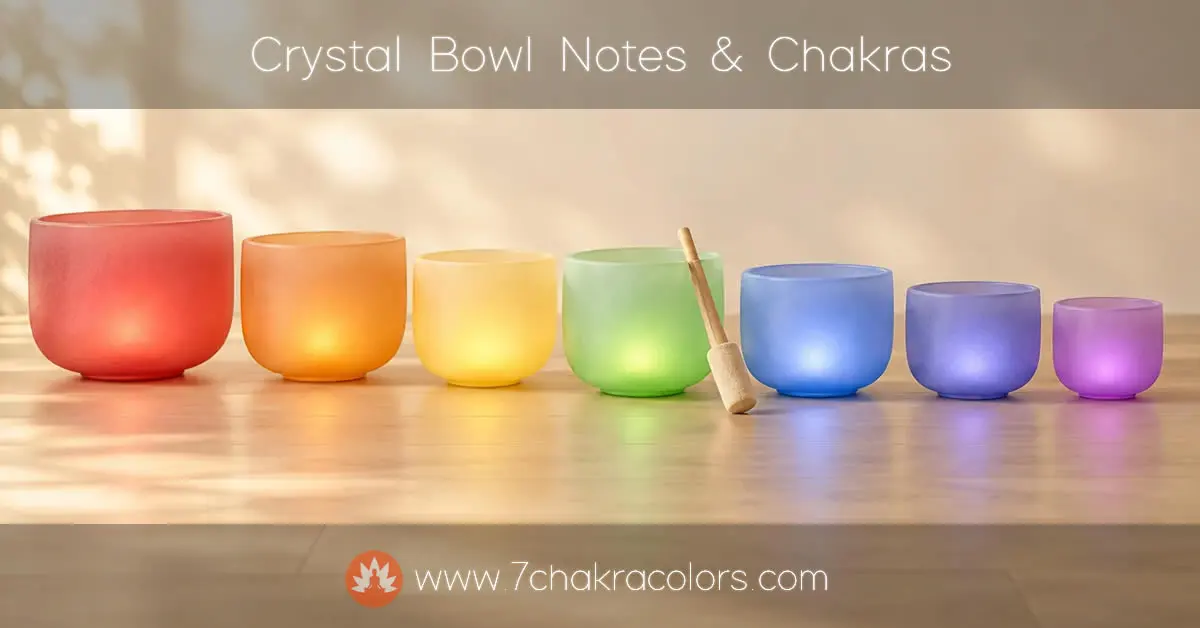
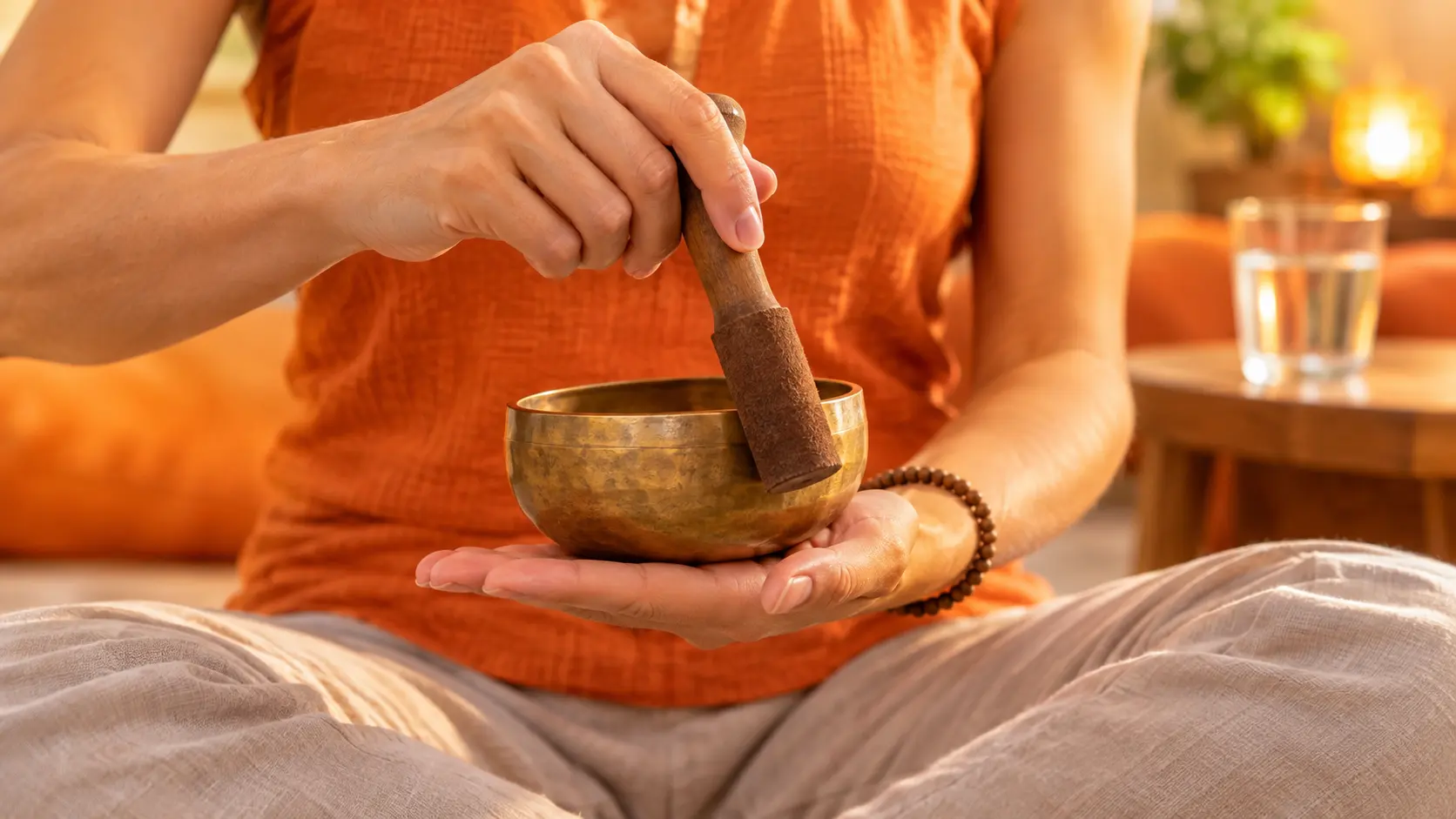
A sacral chakra bowl is labelled as D. In a 7 bowl set, it is often the second largest. Crystal bowls produce a pure, sustained sound, whereas metal bowls will sound warmer, with more overtones. Either gently rub around the edge of the bowl, or tap once and allow the sound to ring out. With a small bowl, some people hold it in the palm of their hand just in front of their lower abdomen.
Tuning Forks
Weighted 288 Hz forks can be tapped against your knee, and placed with the shaft on your sacrum (at the back of the pelvis), or just below your navel. Unweighted forks are held close to the ears. Avoid placing forks over a pregnant stomach, or on painful or recently injured parts of the body.
Water Sounds
As this chakra relates to water, many people will simply listen to rainfall, running water or ocean sounds. These may be accompanied by a 417 Hz tone. If possible, listening to real water will be even more beneficial. You may find that slow flowing sounds work well for this chakra, regardless of the exact frequency.
ADVERTISEMENT: CONSCIOUS CRYSTALS - 7 CHAKRA COLORS SPECIAL DEALS

Buy Real Chakra Stones and Crystal Jewelry
Explore Full Collection

Using 417 Hz for Creativity and Feelings
Within chakra healing, this chakra relates to creativity, pleasure and emotional feelings. Within the Solfeggio frequency list, the 417 Hz frequency is described as relating to change. Therefore, many benefits may be felt, such as an increased connection to emotions, increased playfulness and an ability to move on from an old pattern. However, as these are spiritual concepts rather than scientifically proven effects, it works best as background noise whilst doing an activity.

Some ideas to use include:
- Play quietly whilst drawing, painting or writing. Don't aim to produce anything.
- Play whilst gently moving your pelvis in circles, doing a few cat-cow stretches or freestyle dance moves.
- Write in your journal for 10 minutes about how you have been feeling this week.
- Visualise slow flowing water, or listen whilst having a bath.
Although 417 Hz will not directly create creativity, or cause emotional release, it can mean that you have dedicated some time to yourself. This can be the missing piece.
How to Use Sacral Chakra Healing Frequency: A 15-Minute Session
To relate this to movement (as this chakra relates to hips and flow), we have included some gentle movement. Try this once per day if possible.
Begin by breathing into your lower abdomen with your hands on your lower abdomen for 2 minutes. The page on sacral chakra breathing has some easy versions. Next, either sitting or on your knees, gently rock your pelvis or move it in circles. Move through a comfortable range. Continue for 3 minutes. Now, play 417 Hz (or a D note bowl) for 5 minutes, using the player at the top of this page. Visualise peaceful flowing water. Chant VAM for 3 minutes. Finally, sit still and observe any feelings and sensations you may be experiencing. Don't try to change them, just notice them. Do this for 2 minutes.
| Minutes | What you do | Sound |
|---|---|---|
| 0-2 min | Breathe into the lower belly, hands resting on it | Silence |
| 2-5 min | Rock or circle the pelvis slowly, sitting or kneeling | Silence or soft water sounds |
| 5-10 min | Listen and picture calm, flowing water | 417 Hz in the player above, or a D bowl |
| 10-13 min | Chant VAM on each out-breath | Your own voice |
| 13-15 min | Sit still and notice feelings and sensations | Silence |
If you would like guided visualisations, try the sacral chakra meditation. Play the 417 Hz as a quiet background sound.
Try to find a time where you can relax without interruptions. Some people may find evenings a good time, perhaps after a bath. Be aware of how you are feeling later in the day.
Why Is 417 Hz Associated With the Sacral Chakra?
Two different things share the name. First of all, the names of notes in the old solfège scale (ut, re, mi, fa, sol, la) come from a hymn used by the monk Guido of Arezzo around 1025 to help people learn how to sing. However, as pitch was not measured in hertz until the 19th century, there were no frequencies associated with these notes. The Solfeggio frequencies are a modern list of frequencies, which took the names of notes from the solfège scale.
In the 1970s, Joseph Puleo claimed that he found these numbers based on numerical patterns in the Book of Numbers. They became more popular after being included in a book called Healing Codes for the Biological Apocalypse in 1999 by Leonard Horowitz and Puleo. Within this list, 417 Hz is "RE" and is associated with "undoing situations and facilitating change". Although this book does not relate to chakras, sound healers later associated the frequencies with chakras, and 417 Hz was associated with the sacral chakra. In chakra teaching, this chakra is connected to flow, emotions and change.
Therefore, associating this frequency with the sacral chakra is a modern concept. Although it may be relaxing to listen to, there is no evidence that this frequency is more effective than a few Hz higher or lower.
Sacral Chakra Note: D and 288 Hz
In Western chakra music, this chakra is associated with the note D. Within a scale in C major, it is the second note in the scale (C is root, B is crown).
Depending on tuning, the exact D note will vary. Tuning forks made for chakras are typically tuned from the old scientific pitch of C = 256 Hz, meaning that D will be a simple whole tone interval (ratio of 9:8), giving 288 Hz. Equal tempered tuning in singing bowls with A = 432 Hz gives approximately 288.33 Hz, and equal tempered tuning in a piano with A = 440 Hz gives 293.66 Hz. Therefore, depending on the method of tuning, 288 Hz, 288.33 Hz and 293.66 Hz will all be D notes. Although they are all D notes, there may be up to a third of a semitone difference between them. If played in succession, this difference may be noticeable.
417 Hz (Solfeggio) is a very different note. On a standard piano, it is very close to G sharp, meaning that a 417 Hz recording and a D note singing bowl are certainly not the same note.
Does Sacral Chakra Sound Healing Work?
There is evidence to suggest that sound meditation may be relaxing. However, there is no evidence to suggest that 417 Hz (or any other frequency) affects chakras.
Within a small study in 2017, 62 adults completed mood questionnaires before and after a singing bowl meditation. The participants showed reduced tension, anger, tiredness and poor mood after the meditation (Goldsby et al., 2017). As there was no control group in this study, improvements could have been due to simply lying quietly for an hour.
It can be a nice way to relax and become aware of your body. If you feel calmer, and a little more playful, then it has done its job.
ADVERTISEMENT: CONSCIOUS CRYSTALS - 7 CHAKRA COLORS SPECIAL DEALS
Buy Real Chakra Stones and Crystal Jewelry
Explore Full Collection
Safety: Volume, Hearing and When to Get Help
Make sure to keep the volume low (especially with headphones in). Take regular breaks. The World Health Organization recommends this for safe listening.
- If you experience ringing in the ears, a headache, dizziness, or anxiety, stop.
- If you suffer from tinnitus, or are sensitive to sounds, begin with a very low volume, or try chanting.
- Do not place weighted tuning forks on a pregnant stomach or anywhere that is painful.
- Avoid driving or operating machinery whilst listening to relaxing music.
Whilst sound and mantras can be useful for self-care, they should not replace professional medical or mental health treatment. If you are suffering from persistent pelvic pain, period issues or poor mood for longer than a couple of weeks, please visit a doctor.
Sources
- Arthur Avalon (Sir John Woodroffe), The Serpent Power (1919), translation of the Sat-cakra-nirupana: Svadhisthana, six petals, the crescent moon of water, the bija VAM.
- Hans Cousto, The Cosmic Octave: the synodic Moon tone, 210.42 Hz, used as the sacral chakra fork in planetary tuning fork sets.
- Leonard G. Horowitz and Joseph S. Puleo, Healing Codes for the Biological Apocalypse (1999): the six Solfeggio frequencies.
- Goldsby TL, Goldsby ME, McWalters M, Mills PJ. Effects of Singing Bowl Sound Meditation on Mood, Tension, and Well-being: An Observational Study. J Evid Based Complementary Altern Med. 2017;22(3):401-406.
- World Health Organization, "Deafness and hearing loss: safe listening" (questions and answers).
Frequently Asked Questions About Sacral Chakra Frequency
What frequency is the sacral chakra?
The sacral chakra frequency quoted most often is 417 Hz, the second tone of the modern Solfeggio set. Systems based on musical notes give the sacral chakra D instead: 288 Hz on most chakra tuning forks, about 288.33 Hz on bowls tuned to A = 432 Hz and 293.66 Hz on a modern piano. Planetary fork sets based on Hans Cousto's numbers use 210.42 Hz. None of these has been measured in the body.
Is the sacral chakra frequency 417 Hz or 288 Hz?
Both are used, by different systems. 417 Hz comes from the Solfeggio list, while 288 Hz is the note D that chakra-and-music charts give the sacral chakra. They are different pitches: 417 Hz is close to G sharp. For recordings, 417 Hz is the easiest to find; for a bowl or fork, D is what shops sell as a sacral chakra tool.
What are the benefits of 417 Hz?
In Solfeggio teaching 417 Hz is the tone for change, and people use it for creativity, emotional awareness and letting go of old patterns. These are spiritual ideas, not tested effects. Research on music in general shows it can lower stress, but no study shows that 417 Hz works on the sacral chakra or does more than a nearby tone. It works best as a calm background for movement, journaling or creative work.
Can 417 Hz unblock the sacral chakra?
Some sound healers say so, but this has not been shown. Treat 417 Hz as one gentle part of a wider routine: gentle hip movement, time for things you enjoy, paying attention to your feelings and the other steps in the sacral chakra healing guide. If emotional or physical problems persist, talk to a doctor or therapist.
How long should I listen to 417 Hz?
Five to 15 minutes once a day is plenty. Start with five minutes at a low volume, using the timer in the player on this page, and build up to the 15-minute session if you like it. A pure tone can start to feel tiring after a while; if it gives you a headache, ringing in the ears or dizziness, stop and chant VAM instead.
Can I listen to 417 Hz while doing other things?
Yes. Many people play it quietly while painting, writing, stretching or taking a bath, which suits the sacral chakra's link with creativity and water. Keep the volume low so it stays in the background, and don't play relaxation tracks while driving or doing anything that needs your full attention.
Do I need headphones for sacral chakra frequencies?
No. Speakers work well, especially for water sounds and singing bowls, and let you move freely during the session. Small phone speakers can make 210 to 290 Hz sound faint, so use a better speaker or headphones if needed. With headphones, keep the volume below about 60 percent of the maximum, as the World Health Organization advises, and take breaks.
Tonight, try chanting VAM with a hand on your lower abdomen for 5 minutes. If you enjoy it, add 417 Hz for the full session. From here, you could try:
-
Sacral chakra healing meditation
- a guided practice to play the tone under
-
Sacral chakra healing affirmations
- short lines to say after chanting