Crown Chakra Opening Symptoms: Physical, Emotional and Spiritual Signs
Crown chakra opening symptoms: the physical, emotional and spiritual signs of Sahasrara activation, tingling, how long they last and when to see a doctor.
Table Of Contents
Crown chakra opening symptoms are the changes people describe as the seventh chakra becomes more active: tingling, warmth or light pressure at the top of the head, a calm, spacious feeling in meditation, more meaning and trust in life, and a sense of being connected to something larger. They come from chakra teaching, not medicine, and headaches, dizziness or feeling detached from reality should be checked by a doctor.
Crown Chakra Opening · Key Facts
- Physical signs:Tingling, warmth or light pressure at the top of the head, more sensitivity to light
- Emotional signs:Calm, trust in life, less worry about small things
- Spiritual signs:A sense of oneness, meaning and connection to something larger
- Mind signs:Clearer thinking, curiosity, an open mind that still asks questions
- Duration:Varies from person to person; there is no research on it
- Get checked if:Headaches are new or strong, dizziness lasts, or you lose touch with reality
In yoga, the crown chakra sits at the top of the head and is linked with awareness, meaning and spiritual connection. Its opening is often described as the most subtle of all seven, more of a change in perspective than a feeling in the body. Even so, some people go through short chakra cleansing symptoms such as tiredness or vivid dreams first. This page explains the signs as chakra teachers describe them, what else could cause them, and when to see a doctor.
Crown Chakra Opening and Activation Symptoms
The seventh chakra is called Sahasrara in Sanskrit, which means "thousand-petaled". The opening symptom people describe most often is a tingling, prickling or warm feeling at the very top of the head, sometimes like a light touch or a gentle pressure. It usually comes during long or quiet meditation, prayer, time in nature or right after a deep relaxation.
People also search for crown chakra activation symptoms and awakening symptoms. In most chakra books these words mean the same thing: the chakra moving from a closed or quiet state to a more open one. The changes people notice most are in how life feels. Small worries lose their grip, and there is a sense of calm and meaning that does not depend on things going well.
Many people feel nothing at the top of the head. If you mainly notice more peace, more curiosity and less need to control everything, chakra teachers would still call that a crown chakra opening. Teachers also stress that the crown works best when the lower chakras are steady, so eat well, sleep and stay connected to daily life while it happens.
Physical Symptoms and Signs of Crown Chakra Opening
Physical symptoms of crown chakra opening are felt at the top of the head, the scalp, the forehead and sometimes along the spine. The ones people describe most often are:
- Tingling, prickling or a buzzing feeling on the top of the head.
- Warmth or a light pressure at the crown, as if something rests on it.
- A feeling of lightness or space above the head during meditation.
- More sensitivity to bright light or loud places.
- Changes in sleep, such as needing more or less of it for a while.
- Brief light-headedness after long meditation.
- Warmth or shivers moving up the spine.
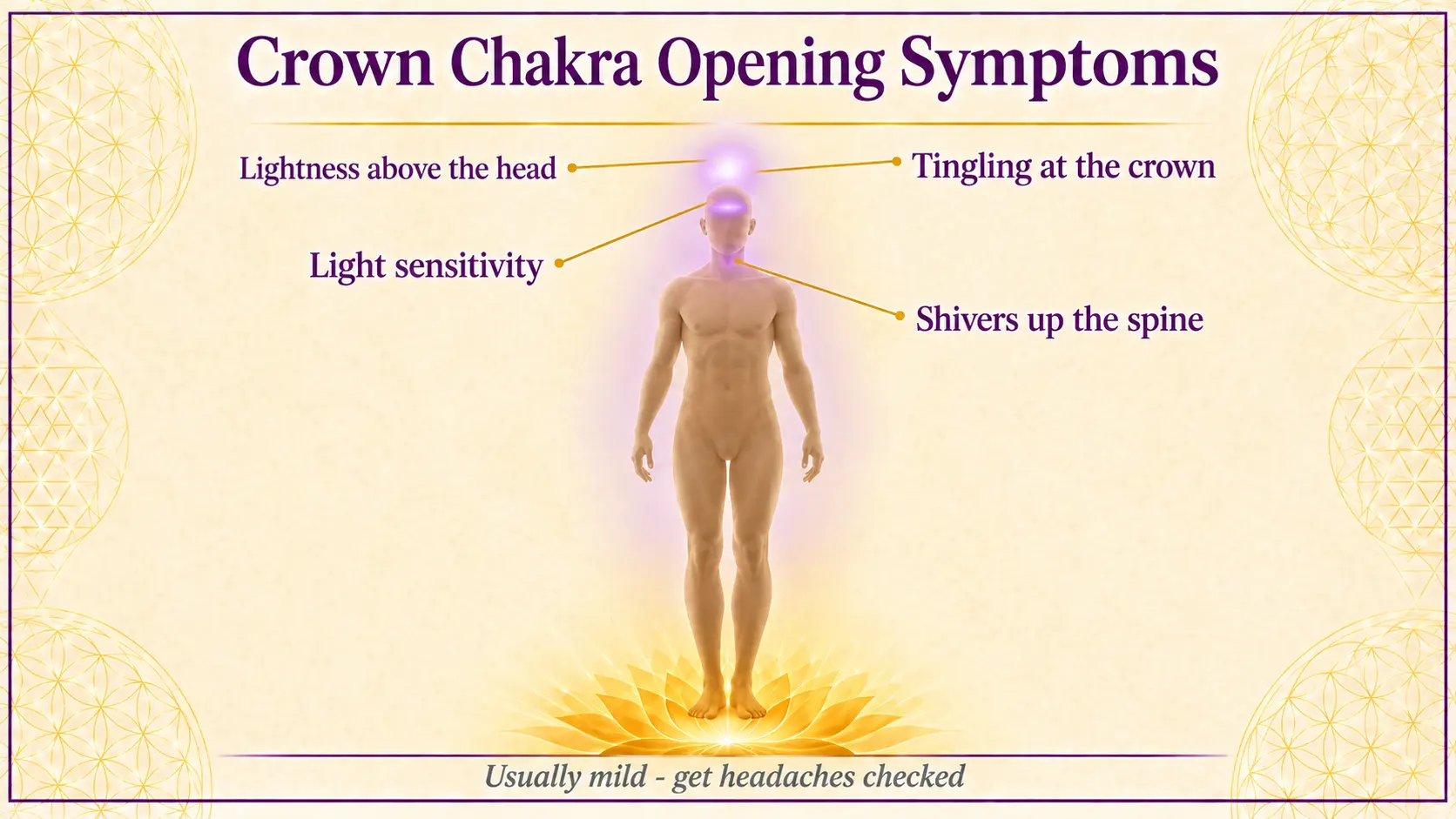
None of these signs means anything medically, and most of them have everyday causes too. Chakra teachers read them as awareness reaching the top of the body. The table below sets each sensation next to what teachers say it means, other common causes, and when it is time to get it checked.
| Sensation | What chakra teachers say it means | Other common causes | When to get it checked |
|---|---|---|---|
| Tingling on the top of the head | The crown chakra becoming more active | Focused attention, tension, a tight hairstyle, sitting still | Numbness, or tingling with weakness, confusion or vision changes |
| Warmth or pressure at the crown | More energy reaching the top of the head | Tension headache, heat, long meditation | A headache that is new, strong or getting worse |
| Lightness or space above the head | Awareness expanding in meditation | Deep relaxation, slow breathing | Feeling faint, or light-headed for long periods |
| Sensitivity to light and noise | The senses becoming finer | Tiredness, migraine, screens, stress | Eye pain, or light sensitivity with headache and fever |
| Changes in sleep | The nervous system adjusting | Stress, late screens, caffeine, life events | Poor sleep that affects your days for weeks |
| Brief light-headedness after meditation | Energy not yet grounded | Low blood sugar, standing up fast, breathing too fast | Dizziness that lasts, keeps coming back or makes you fall |
| Feeling spacey or detached | Too much energy at the top, too little grounding | Tiredness, stress, anxiety | Detachment from yourself or reality for days - talk to a doctor or mental health professional |
Note: the second column comes from chakra teaching, not from medicine. These are symbolic interpretations, not diagnostic criteria, so the last column always comes first.
Crown chakra pain during opening
Some people describe a mild pressure or a dull ache at the top of the head during an opening, usually after long sessions of meditation. Chakra teachers explain it as more energy reaching the crown than the body is used to, and they suggest shorter sessions and grounding. It should stay mild and fade soon after you stop.
A headache that is new for you, strong, getting worse or waking you up is not an opening symptom. Neither is dizziness that lasts, a stiff neck with fever, or changes in your vision. A sudden, very severe headache needs emergency services. See a doctor first, and come back to chakra practice once you have been checked.
Emotional and Spiritual Symptoms of Crown Chakra Opening
For most people the emotional and spiritual changes are the main signs, because this chakra is linked with meaning and awareness rather than with one part of the body.
Emotional symptoms
- Calm: a quiet peace that stays even on busy days.
- Trust: worrying less about the future and how things will turn out.
- Letting go: small problems and old grudges matter less.
- Gratitude: noticing and appreciating ordinary things.
- Compassion: seeing other people's behavior with more understanding.
- Curiosity: wanting to learn, read and ask big questions.
Spiritual awakening signs
On the spiritual side, people describe a sense of oneness with others and with nature, moments of deep stillness, and a feeling that life has meaning beyond their own plans. In the Tantric text Sat-Chakra-Nirupana, translated by Arthur Avalon, Sahasrara is the thousand-petaled lotus above the head, where Kundalini is said to unite with Shiva, pure consciousness. Many people describe the opening as a glimpse of that: the sense of a separate self becoming lighter for a while.
Crown Chakra Opening Experiences: What People Describe
Everyone's experience is different. The examples below are typical of what people share in meditation groups and chakra forums, combined from several accounts rather than one person's story. One person feels a soft tingling on the top of the head during a silent retreat, then a calm that lasts for days. Another, watching a sunrise, suddenly feels that everything is connected and starts crying with relief. A third simply notices, over a few months, that the things that used to make them anxious no longer do.

Some people expect visions or bright light and are surprised that the main change is quiet. Teachers say that is common. A crown opening tends to show in how you live afterwards, with more patience, kindness and perspective, more than in any single experience.
Kundalini and the Crown Chakra
In Tantric yoga, the crown is where the rising energy called Kundalini completes its path from the base of the spine. That is why many people link strong crown symptoms with a Kundalini awakening: heat or shivers rising up the spine, tingling at the top of the head, strong emotions and changes in sleep. Researchers such as Bruce Greyson have collected reports of these experiences, but there is no proof of what causes them.
Teachers in most traditions advise a slow, grounded approach rather than forcing the energy upward. Gentle practice, regular meals, time outdoors and steady routines matter more than intense techniques. A slow breathing practice, like the ones in our crown chakra breathing guide, is a safer place to start than long sessions of breath holding. If experiences feel frightening or overwhelming, stop, ground yourself and talk to an experienced teacher or a mental health professional.
Can Crown Chakra Opening Feel Uncomfortable?
Yes. Some people feel spacey, distracted or "not quite here" for a while. Others find that old beliefs fall apart before new ones form, which can feel confusing or lonely. Sleep may change, and bright light, noise or crowds can feel like too much.
Chakra teachers say this usually means the energy is moving faster than the body can ground it. Shorter meditations, walks, cooking, gardening and time with people help. Discomfort is not a sign of spiritual progress, and there is no need to push through it. If you feel detached from your body or from reality for days, see the doctor section below.
How to Know If Your Crown Chakra Is Open
An open crown chakra shows in your outlook over time. Anodea Judith describes a balanced seventh chakra as intelligent, thoughtful and aware, open-minded and able to question, spiritually connected, with wisdom and a broad understanding. Note the last two: an open crown does not mean believing everything. Look at these signs over a few weeks, not after one meditation.
Quick check:
- Do you feel calm and trusting most days, even when things are uncertain?
- Do you feel connected to something larger than yourself?
- Are you open to new ideas and still able to question them?
- Does your life feel meaningful, not only busy?
- Can you meditate or sit in silence and still feel grounded afterwards?
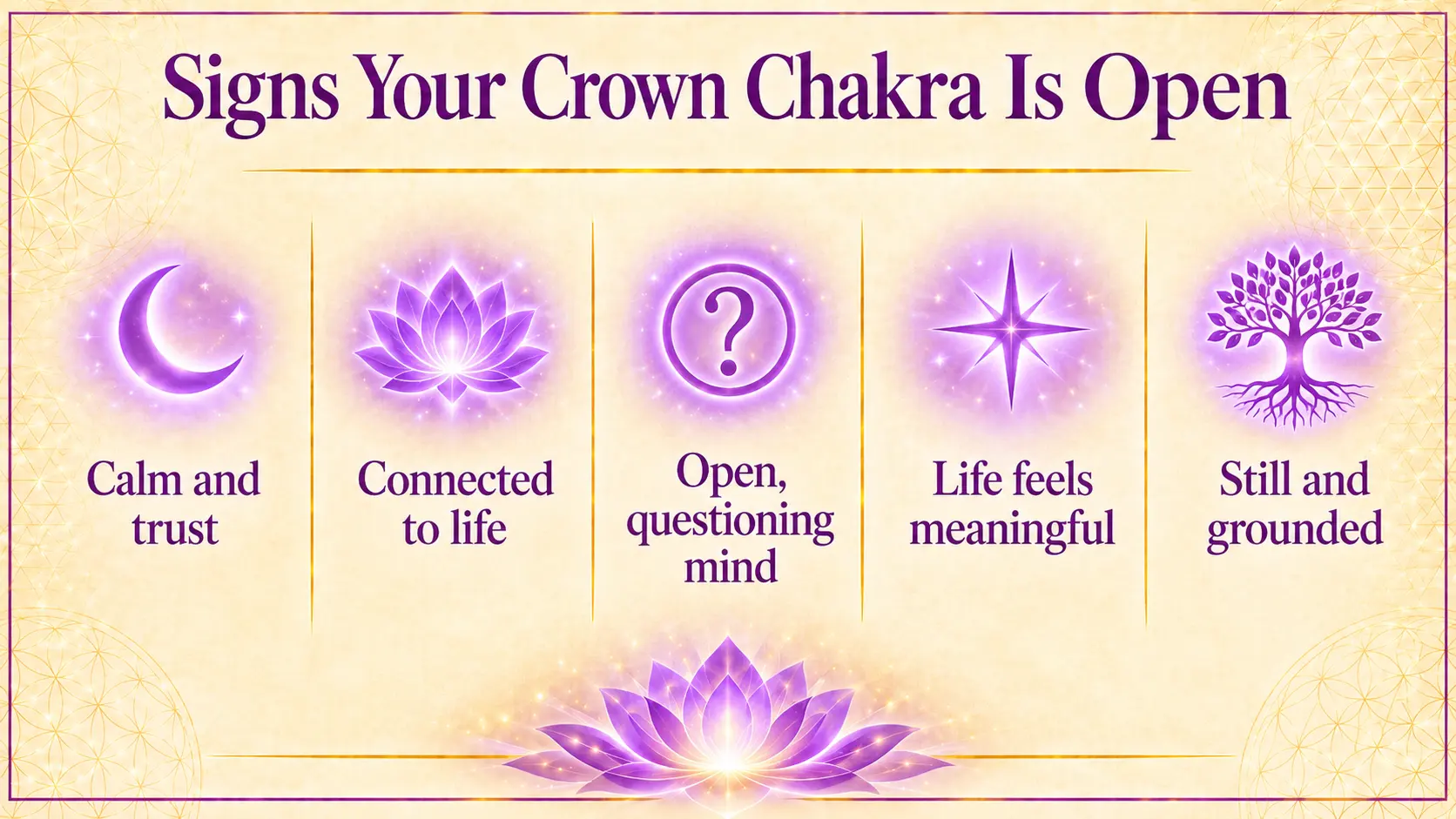
If you can say yes to most of these, chakra teachers would see your crown chakra as open and balanced. If most answers are no, compare your signs with the crown chakra blocked symptoms, or take the free crown chakra test.
Crown Chakra Healing Symptoms: Is It Getting Better?
When the crown chakra is healing, the signs are often quiet. You stop doom-scrolling at night, you find a few minutes of stillness each day, a hard situation feels like something you can learn from, or you feel less alone even when you are by yourself.

Healing is rarely a straight line. A week of peace can be followed by one of doubt or restlessness. Writing one line each evening, one moment of calm and one thing that felt meaningful, makes slow change easier to see.
How Long Do Crown Chakra Opening Symptoms Last?
There is no fixed timeline. From what teachers and practitioners describe, physical sensations such as tingling at the top of the head tend to come and go over days or weeks, often stronger after long meditation or retreats. The changes in perspective build slowly and usually last. None of this comes from research, only from people's experience.
Symptoms often feel stronger after big life events, such as a loss, an illness or a time of deep practice. Headaches, dizziness, poor sleep or a sense of unreality that lasts or gets worse should be checked by a doctor rather than waiting for them to pass.
Opening, Healing or Blocked? How to Tell the Difference
Opening, healing and blockage can all show up as changes in mood, sleep and meaning, so they are easy to confuse. The difference is the direction of change. In an opening, life starts to feel more connected and meaningful. In healing, cynicism and emptiness slowly ease over weeks. With a blocked chakra, people describe feeling disconnected, cynical or lost, with little change over time. If that sounds more like you, see the blocked crown chakra page.
These are spiritual interpretations used in chakra work, not diagnoses. The table puts the five states side by side.
| State | Traditional interpretation | Emotions | Body and daily life |
|---|---|---|---|
| Opening | Awareness starting to expand after a time of feeling cut off | Calm, wonder, moments of oneness | Tingling at the crown, changes in sleep, more time in stillness |
| Healing | A blocked chakra slowly returning to balance | Cynicism and emptiness slowly easing | Short daily stillness, more meaning in ordinary days |
| Balanced | Open and steady, neither too little nor too much | Peace and trust, with an open but questioning mind | Grounded daily life, clear thinking, spiritual connection |
| Blocked (underactive) | Too little energy | Disconnected, cynical, feeling that nothing matters | Mental fog, closed-mindedness, chasing things that do not satisfy |
| Overactive | Too much energy | Spacey, detached, feeling above others | Neglecting the body and daily tasks, escaping into spiritual ideas |
When to See a Doctor
Chakra work can bring calm and meaning, but it should never hide a medical or mental health problem. See a doctor for headaches that are new, strong, getting worse or waking you up, for dizziness that lasts or keeps coming back, and for sleep problems that affect your days for weeks.
Call emergency services straight away for a sudden, very severe headache, weakness or numbness on one side of the body, slurred speech or sudden loss of vision. Stop your practice and talk to a doctor or mental health professional if you hear voices, lose track of what is real, feel detached from yourself for days, sleep only a few hours without feeling tired, or believe you have a special mission.
What to Do Next
To support an opening crown chakra, keep a short daily stillness practice, spend time in nature, keep regular sleep and stay grounded with ordinary tasks. Our guide to opening the crown chakra lays out a full routine if you want more structure. Our yoga poses for the crown chakra are a calm way to combine stillness with the body, and a short crown chakra meditation helps you notice what is changing.
Sources
- Arthur Avalon (Sir John Woodroffe), The Serpent Power, 1919 - translation of the Sat-Chakra-Nirupana: Sahasrara, the thousand-petaled lotus above the head.
- Anodea Judith, Eastern Body, Western Mind, 1996 - balanced, deficient and excessive patterns of the seventh chakra.
- Bruce Greyson, Near-death experiences and the physio-kundalini syndrome, Journal of Religion and Health, 1993 - reports of Kundalini-type experiences.
- NHS - Headaches, Dizziness.
Frequently Asked Questions About Crown Chakra Opening
What does crown chakra opening feel like?
Most people describe tingling, warmth or a light pressure at the top of the head, a spacious calm in meditation and a sense of connection to something larger. Many feel mainly more peace and trust in life. These descriptions come from chakra practice, not medical research.
What happens when your crown chakra opens?
In chakra teaching, awareness expands after a time of feeling cut off. People report more calm, meaning and gratitude, moments of oneness, changes in sleep and less worry about small things. The changes usually build slowly rather than arriving all at once.
Why does the top of my head tingle?
In chakra teaching, tingling at the crown during meditation or prayer is read as the seventh chakra becoming more active. The same feeling comes with focused attention, scalp tension or a tight hairstyle. Numbness, or tingling with weakness, confusion or vision changes, needs a doctor.
Can crown chakra opening cause headaches?
Some people describe a mild pressure at the top of the head after long meditation, and teachers suggest shorter sessions and grounding. A headache that is new, strong, getting worse or waking you up is not an opening symptom. A sudden, very severe headache needs emergency services.
Is crown chakra opening the same as a Kundalini awakening?
Not exactly. In Tantric yoga, Kundalini rises from the base of the spine to the crown, so a full Kundalini awakening includes the crown. A crown opening can also be gentle and gradual, without the heat, shaking or strong energy people describe with Kundalini.
What are the benefits of crown chakra opening?
People describe more calm, trust and meaning, less fear of the future, clearer thinking and a stronger sense of connection to others. These are reported experiences from chakra practice. There is no research on chakras, but meditation itself has been studied for stress and well-being.
Can the crown chakra open by itself?
Teachers say it can, for example after a loss, a serious illness, a time in nature, a retreat or years of steady practice. Meditation, prayer and silence are used to support it. There is no research on chakras, so this comes from experience, not science.
Opening symptoms of the other chakras:
-
Root chakra awakening signs
- grounding, safety and the body
-
Sacral chakra awakening signs
- creativity, pleasure and emotional flow
-
Manipura opening symptoms
- confidence and personal power
-
Anahata opening symptoms
- compassion and emotional healing
-
Throat chakra awakening signs
- clearer speech and self-expression
-
Physical symptoms of third eye chakra opening
- intuition and inner clarity