Third Eye Chakra Symbol – Meaning, Tattoos and Downloads
Third Eye Chakra symbol meaning, tattoos, and downloads. Learn Ajna symbol and its role in intuition and awareness.
The third eye chakra (Ajna) explained: meaning, location between the eyebrows, indigo color, symbol, OM mantra, what it represents and its practices.
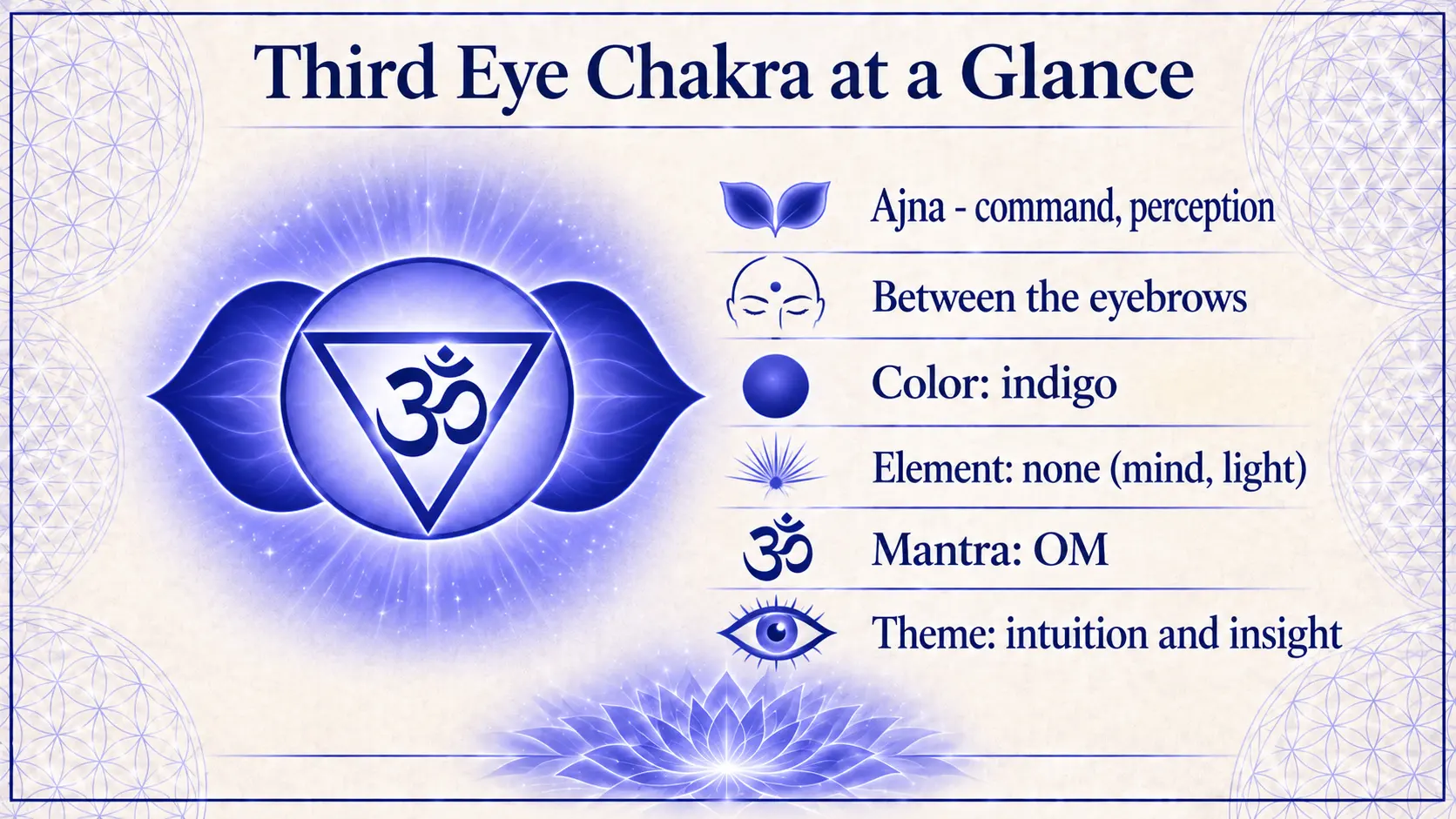
The third eye chakra, or Ajna, is the sixth of the seven main chakras. It sits in the forehead between the eyebrows, its color is indigo and its mantra is OM, and in yoga tradition it holds your intuition, insight, imagination and the ability to see clearly beyond first impressions.
Third Eye Chakra at a Glance
Ajna · the sixth chakra
The third eye chakra is the sixth of the 7 chakras. Its Sanskrit name is Ajna, and in English it is also called the sixth chakra, the brow chakra or simply the third eye. In the line of chakra locations, it sits above the throat chakra and below the crown, and it is the chakra of the mind's eye: inner seeing rather than seeing with the eyes.
In chakra teachings it is the center of intuition. It is linked with insight, imagination, dreams, memory, concentration and the ability to look at a situation and understand what is really going on. When people say their third eye chakra is open or strong, they usually mean that they trust their inner sense, think clearly and can picture things vividly.
Chakras are not physical organs, and there is no scientific evidence that they exist as structures in the body, or that a "third eye" can see. The idea comes from yoga and Tantra, and many people use it as a map for intuition and attention. This page explains what the third eye chakra means in the traditional texts and in modern chakra books, and links to a detailed page for each part of third eye practice.
Ajna is a Sanskrit word that means "command", "authority" or "perception". It comes from the root jna, "to know", the same root as the Sanskrit word for knowledge. It is pronounced roughly "AHJ-nyah". The old texts explain the name in a striking way: this is the place where the yogi receives the command of the guru, the inner teacher. So Ajna is both the center of knowing and the center of guidance.
Unlike the five chakras below it, the third eye is not the region of an element. It is the seat of the mind, where the two side channels of the subtle body, ida and pingala, meet the central channel and end. In the traditional picture, the yogi who reaches Ajna has gone beyond the elements and works with pure awareness.
The third eye chakra represents inner vision. In modern teaching it stands for intuition, insight, imagination, wisdom, self-reflection and the ability to see patterns and meaning behind events. It is the part of the chakra system that says "I see". These meanings come mainly from modern chakra psychology and from the many traditions that speak of a "third eye". The Tantric texts describe it as the place of the mind and of the guru's command.
In modern chakra books, the third eye chakra is responsible for how you perceive and understand. When it is balanced, teachers say you can trust your gut feeling and still check the facts, picture goals clearly, remember your dreams and stay focused. When it is out of balance, you either lose trust in your intuition and feel foggy and stuck in narrow thinking, or you get lost in fantasy, overthinking and seeing signs everywhere.
Some teachers also link the third eye chakra with the eyes, forehead, sinuses, brain, sleep and hormone rhythms. These links come from chakra books, not from medicine. Headaches that keep coming back, eye problems or sleep problems always need a doctor.
In verses 32-39 of the Sat-Chakra-Nirupana, a 16th-century Tantric text translated by Arthur Avalon in The Serpent Power (1919), Ajna is placed between the eyebrows. It describes a white lotus with only two petals, bearing the syllables haṃ and kṣaṃ. Inside is a triangle with a lingam called itara, shining like lightning, and the seed syllable OM. The deities are Paramashiva, the supreme form of Shiva, and the goddess Hakini, who has six faces. Here, says the text, the mind itself resides.
The yogi who meditates here is described as seeing past, present and future and becoming one with the light of the self. Modern teachers rarely take this literally. They keep the light, the two petals and the idea of inner seeing, and read them as clarity and intuition.
Your third eye is located in the forehead, between the eyebrows and slightly above them, at the point where the bindi is worn. In the subtle body of yoga it sits where the central channel meets the two side channels, behind the forehead. Swami Satyananda Saraswati, in Kundalini Tantra, places Ajna at the top of the spine, in the midbrain behind the eyebrow center, with a trigger point in front, the kshetram, at the eyebrow center itself (bhrumadhya).
Many people feel this point easily when they close their eyes and gently look up and in. A light pressure, warmth or tingling between the eyebrows is common in meditation. That is why many third eye practices use the gaze, eye relaxation and focus on the eyebrow center.
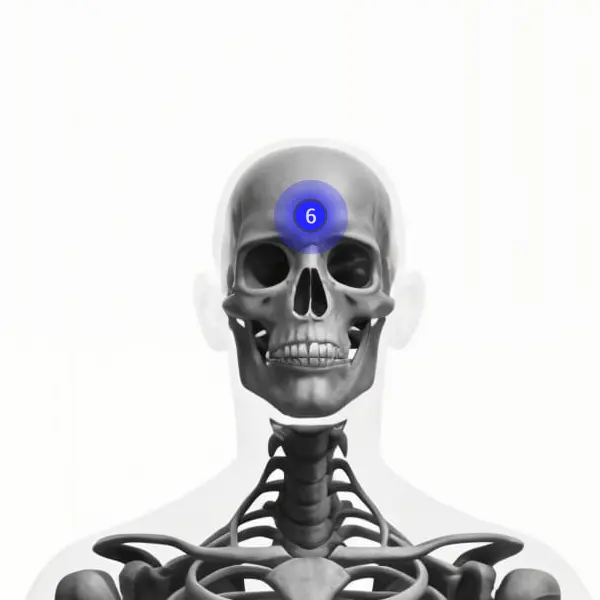
Diagram is showing where third eye chakra is located on your forehead (indigo dot 6) and where the energy of the third eye chakra can be felt when you concentrate on it (transparent indigo circle)
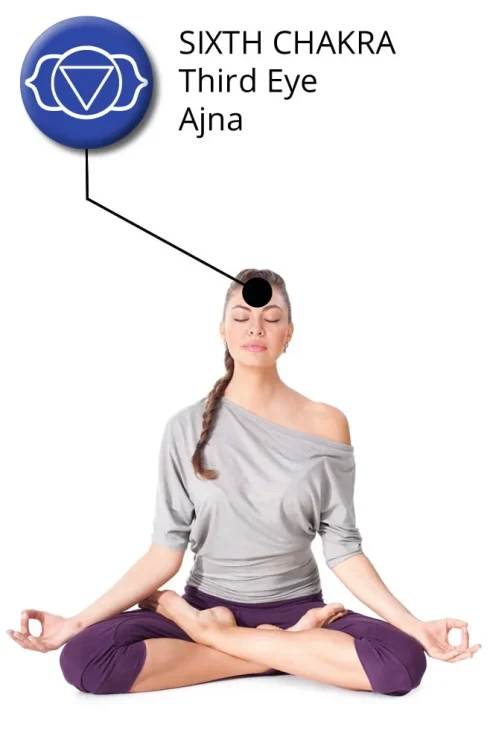
Like every chakra, Ajna is described as having a front and a back. The front is the eyebrow center, which is easy to feel and is used in most meditations. The back is deeper inside the head, behind the eyes and roughly in the middle of the brain, where Satyananda places the chakra itself. Beginners usually start with the front point.
Chakra books connect the third eye chakra with the eyes, forehead, sinuses and brain, and with sleep and concentration. Its "sense" is the mind itself, which is why it is sometimes called the sixth sense. The gland is where teachers disagree: some name the pituitary gland, others the pineal gland. Gland links are a modern addition and are not medically proven.
Anodea Judith connects each chakra with a stage of life. In her model the third eye chakra develops in adolescence, when young people start to think for themselves, imagine their future and question what they were taught. That is why teachers link learning, imagination and the freedom to form your own view with this chakra.
Not in a medical sense. The pineal gland is a small gland deep in the brain that makes melatonin, the hormone that helps regulate sleep. It responds to light and dark through the eyes, and in some animals, such as certain lizards, a related organ on top of the head can sense light. That is part of why 19th-century writers called it the "third eye". There is no evidence that it gives humans special perception. How the idea started, what science says and the myths around "decalcifying" are explained on our page about the pineal gland third eye.
The third eye chakra color is indigo in the modern rainbow system, which gives the seven chakras the colors of the spectrum from red to violet. Indigo, the deep blue between blue and violet, is the sixth color of the spectrum in Newton's list of seven, so it became the color of the sixth chakra in 20th-century chakra books. Some writers use a deep purple or dark blue instead.

The traditional texts paint it differently. In the Sat-Chakra-Nirupana the two petals are white, shining like the moon, and the chakra is described as full of light. So white is the old color and indigo the modern one. That is the indigo chakra meaning in modern books: indigo has stuck because it is the color of the night sky, of depth and of looking inward.
Many people use indigo as a reminder in their practice, for example a dark blue eye pillow, sitting under the night sky, or visualizing indigo light between the eyebrows. There is no proof that color changes the chakra, but it is an easy way to bring your attention to it.
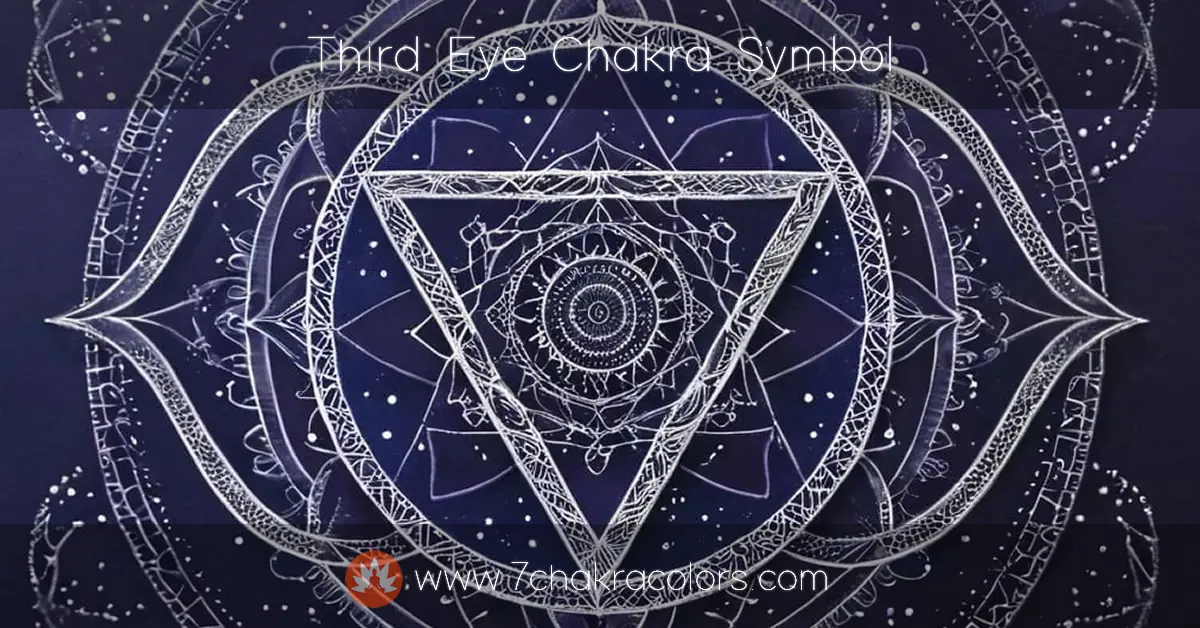
The third eye chakra symbol is a lotus with two petals, one on each side, bearing the syllables haṃ and kṣaṃ. In the center is a downward-pointing triangle, often drawn with the syllable OM inside. The two petals are often read as the two sides of the mind, or as the two channels ida and pingala meeting at this point.
The symbol is simple, which makes it one of the most popular chakra tattoos. The meaning of each part, color versions and free downloads are on our third eye chakra symbol page.
In sound healing, the third eye chakra is most often given 852 Hz, the sixth tone of the modern Solfeggio frequencies. Chakra tuning forks based on musical notes give it the note A instead, usually 426.7 Hz, or 432 Hz on singing bowls tuned to A = 432. All of these are modern conventions: the old texts name a mantra, not a frequency. The page linked in the facts box compares the systems and lets you listen to each tone.
When the third eye chakra is balanced, you may feel clear-headed. You trust your intuition but still check it against the facts, you can imagine and plan, you remember dreams, and you see situations from more than one side.
When the third eye chakra is blocked or underactive, teachers describe brain fog, poor concentration, distrust of your own intuition, rigid thinking, trouble imagining the future and forgetting dreams. An overactive third eye chakra is the opposite picture: overthinking, vivid fantasies, seeing hidden meaning in everything, restless sleep and losing touch with everyday life. The full lists, the causes and when to see a doctor are on our page about third eye chakra blocked symptoms.
Our free third eye test asks a set of short questions about intuition, focus, dreams, imagination and how clearly you see your situation. Your answers show whether your third eye chakra looks balanced, underactive or overactive, and which areas need the most attention.
It takes a few minutes and works best if you answer honestly, not as you would like to be. The result is a starting point, not a diagnosis, and the pages on opening and healing the third eye show what to do with it.

When the third eye starts to open, people often describe pressure or tingling between the eyebrows, more vivid dreams, stronger gut feelings, sensitivity to light and moments of sudden clarity. What these changes mean, how long they last, how to stay grounded and when to see a doctor is explained on our page about third eye opening symptoms.
Most teachers agree that the third eye opens through regular, calm attention, not through force: a few minutes of meditation on the eyebrow center, alternate nostril breathing, candle gazing, keeping a dream journal, good sleep in a dark room and less screen time in the evening. Grounding practices for the lower chakras are always recommended alongside, so that you do not feel spaced out.
Our guide on how to open your third eye puts a five-step start, a seven-day plan and every method in one place, with notes on how to unblock, activate and balance the chakra safely.
Each practice has its own page with full instructions. Here is a short summary of each, so you can choose where to start.
Yoga for the third eye chakra uses poses where the forehead rests on the floor, a block or the legs, and poses that turn the attention inward. Typical poses are Downward-Facing Dog, Dolphin, Standing and Wide-Legged Forward Folds with the head supported, Head-to-Knee and a seated forward bend, finished with Savasana under an eye pillow. Our third eye chakra yoga poses page explains each pose step by step, with an eye warm-up and a 15-minute sequence.

A third eye chakra meditation usually brings the attention to the eyebrow center, sometimes with the sound OM, an image of indigo light, or the soft gaze of trataka, candle gazing. Ten minutes is plenty; longer sessions are not better if they leave you dizzy. A full guided script is on our third eye chakra meditation page.

Alternate nostril breathing (Nadi Shodhana) is the classic third eye chakra breathing exercise, because it works with the two side channels that meet at Ajna. Bhramari, the humming bee breath, is also popular, as the hum is felt in the forehead. Instructions and timings are on our third eye chakra breathing page.
Third eye chakra affirmations are about trust, clarity and insight, for example "I trust what I sense" or "I see clearly what I need to do". Repeat them in a quiet moment, ideally with the eyes closed. We have grouped third eye chakra affirmations by need, with a free printable list.

Indigo, violet and deep blue stones are linked with the third eye chakra. The best known are amethyst, lapis lazuli, sodalite, labradorite and fluorite. People hold them during meditation, place one on the forehead while lying down, or keep one by the bed for dream work. There is no scientific evidence that crystals change energy, but many people find them a useful focus. What each stone is used for and how to cleanse it is in our third eye chakra crystals guide.
Chanting OM, listening to an 852 Hz tone and singing bowls tuned to A are the usual ways to work with the third eye through sound. A long OM held on the out-breath, followed by silence, is one of the simplest practices of all. You can play the tones, compare the tuning systems and learn more about the third eye chakra frequency on our frequency page.

The third eye chakra is the intuition chakra in modern teaching. Intuition here is not magic. It is the quick knowing that comes from experience and attention: the sense that something is off before you can explain why. Teachers say a balanced third eye lets you hear that voice and then check it calmly, instead of ignoring it or following it blindly.
Insight is the second theme: seeing through your own stories and habits. Many people experience this in meditation, when a familiar thought suddenly looks different. Imagination is the third. The ability to picture something that does not exist yet, a goal, a painting, a new way of living, is seen as a gift of this chakra.
Because the third eye is about the mind, teachers often warn against working on it alone. Without the steadiness of the lower chakras, too much focus here can feel unreal or anxious. If you ever feel detached from reality, stop the practice and talk to a doctor.
The third eye is older and wider than the chakra system. In Hindu art, the god Shiva has a third eye in the middle of his forehead. When it opens, its fire burns away illusion and desire, as in the story where Shiva's gaze reduces Kama, the god of love, to ashes. The bindi or tilaka, the dot or mark worn on the forehead, is often linked with this point.
In Buddhist art, the Buddha is shown with the urna, a small curl or dot between the eyebrows that stands for wisdom and the ability to see the world as it is. Daoist practice also uses a point between the eyebrows in meditation. In the 19th century, Theosophists such as Helena Blavatsky connected the third eye with the pineal gland, an idea that is still popular today.
Across these traditions, the third eye symbolizes the same thing: a deeper way of seeing that goes beyond the physical eyes, linked with wisdom, awakening and inner light.
The table below sums up the traditional and modern properties of the third eye chakra. Traditional properties come from the Tantric texts, the others from modern chakra books, and modern associations vary from teacher to teacher.
| Property | Traditional (Tantric texts) | Modern association |
|---|---|---|
| Sanskrit name | Ajna | Ajna, third eye chakra, sixth chakra, brow chakra |
| Translation | Command, authority, perception | Command center, perception |
| Chakra number | Sixth | Sixth |
| Location | Between the eyebrows (top of the spine, kshetram at the brow) | Forehead, between the eyebrows |
| Color | White petals, shining like the moon | Indigo, sometimes deep blue or violet |
| Element | None (beyond the five elements; the mind) | Light (Anodea Judith) |
| Sense | The mind | Intuition, sixth sense |
| Seed mantra | OM | OM (some systems KSHAM) |
| Lotus petals | Two, with the syllables ham and ksham | Two-petaled indigo lotus |
| Shape | Triangle with the itara lingam | Circle with a downward triangle |
| Animal | None | None |
| Deities | Paramashiva and Hakini | Varies by system |
| Frequency | Not named | 852 Hz (Solfeggio), 426.7 Hz (note A) |
| Gland | Not named | Pineal or pituitary gland (teachers differ) |
| Body areas | Not named | Eyes, forehead, brain, sinuses |
| Stage of life | Not named | Adolescence (Anodea Judith) |
| Themes | Not named | Intuition, insight, imagination, clarity, wisdom |
| Crystals | Not named | Amethyst, lapis lazuli, sodalite, fluorite, labradorite |
| Yoga poses | Not named | Child's Pose, Dolphin, Forward Fold, Eagle, Seated meditation |
The third eye chakra is the sixth chakra in the series. Below it is the throat chakra (blue, ether), which puts into words what the third eye sees. Above it, at the top of the head, is the crown chakra (violet, thought), the center of pure awareness. Teachers often say the third eye sees the way and the crown is where it leads.
Yes. Ajna is the Sanskrit name and third eye chakra is the usual English one. Sixth chakra, 6th chakra, 3rd eye chakra and brow chakra mean the same thing. The Sanskrit name means "command" or "perception".
In modern chakra teaching it is linked with intuition, insight, imagination, memory, clear thinking and the ability to see the bigger picture. The old Tantric texts describe it as the seat of the mind. It is a way of thinking about perception, not an organ that runs the body.
Teachers use the phrase for a balanced third eye: you trust your intuition but still check the facts, you can picture what you want, you notice patterns and you see situations clearly. It does not mean visions or psychic powers. A strong third eye is described as clear and grounded.
In yoga it is Ajna, the brow chakra. Hindu art shows it as the third eye of Shiva and the bindi, Buddhist art as the urna on the Buddha's forehead, and Daoism speaks of the upper dantian. Theosophy linked it with the pineal gland. The names differ, but all point to inner sight.
The third eye chakra, between the eyebrows, is about insight, intuition and clear seeing. The crown chakra, at the top of the head, is about awareness itself, meaning and the sense of being connected with something larger. Teachers describe the third eye as seeing clearly and the crown as simply being aware.
In the chakra model, yes: every person is described as having all seven chakras, including the third eye. It is not a hidden physical eye. Many people simply use the idea as a way to think about intuition, imagination and inner clarity.
No. There is no scientific evidence that chakras exist as physical structures. The third eye chakra is a concept from yoga and Tantra that many people use to think about intuition and insight. Lasting headaches, eye problems or changes in vision should be checked by a doctor.