How to Open Your Third Eye Chakra: Unblocking and Activating It
How to open your third eye: the step-by-step technique, plus ways to unblock and activate it with meditation, OM, dream journaling and a 7-day plan.
Table Of Contents
How to open your third eye: relax your body completely while keeping your mind awake, rest your attention on the point between your eyebrows and watch what appears without trying to control it. Daily meditation, alternate nostril breathing, chanting OM, a dream journal and regular sleep support the practice. Most people need two to four weeks of short daily sessions before they notice more vivid dreams or clearer hunches.
Third Eye Chakra Healing · Key Facts
- Sanskrit name:Ajna ("command" or "perception")
- Location:Forehead, between the eyebrows
- Color:Indigo
- Element:Mind (manas), beyond the five elements
- Seed mantra:OM
- Sound:852 Hz (a modern Solfeggio pairing)
- Suggested practice period:15 to 20 minutes a day, starting with the 7-day plan
The third eye chakra is the sixth chakra, and people who learn how to open chakras tie it to intuition, imagination and the ability to see a situation clearly. If you're not sure whether yours is actually blocked, have a look at the third eye chakra blocked symptoms before you start with the practices below.
Quick Answer: 5 Steps to Open Your Third Eye
The short version takes about 20 minutes, and the evening suits it best, when the house is quiet and the light is low. Do it every day for two weeks before you decide whether it's working.
- Relax your body, keep your mind awake - lie or sit with your back supported and let your muscles go heavy, without drifting off.
- Breathe through alternate nostrils - five minutes of slow nadi shodhana to settle the mind.
- Rest your attention at the brow - ten minutes on the point between the eyebrows, with your eyes soft and still.
- Chant OM - five to seven long rounds, letting the "mmm" hum in your forehead.
- Write down your dreams - keep a notebook by the bed and note what you remember before you reach for your phone.

How to Open Your Third Eye: Step by Step
The technique most teachers come back to sounds very simple. Your body has to be completely relaxed while your mind stays awake, and from there you rest your attention at the third eye and watch. That in-between state has a name in sleep research, the hypnagogic state, and it's the moment just before sleep when many people see colors, shapes or short dream-like scenes behind their closed eyes. Most of us pass through it every night without noticing.
Before You Start
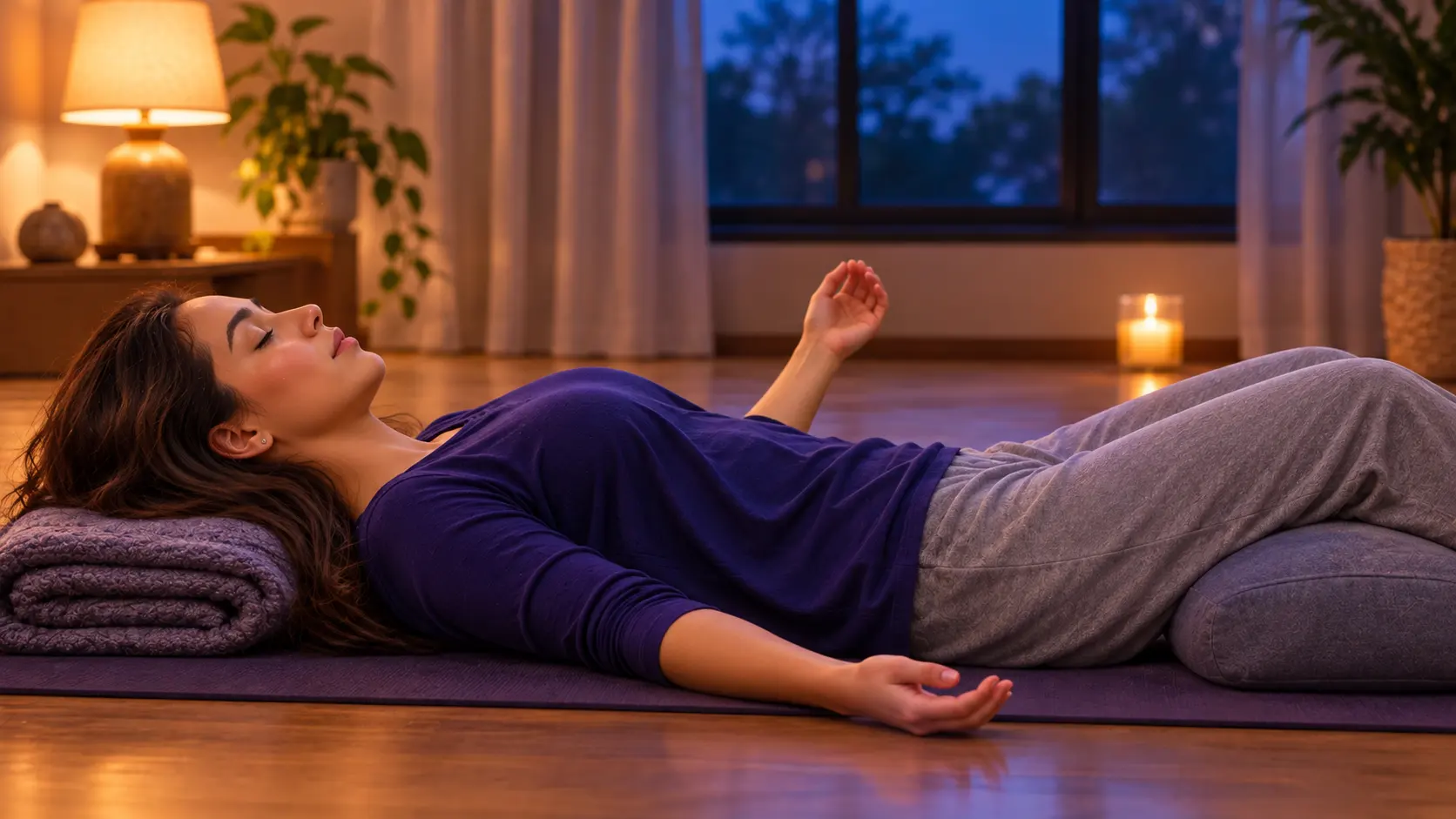
Pick a time when nobody will need you for half an hour, ideally in the evening or very early in the morning while the house is still quiet. Switch your phone to silent and put it out of reach. Lie on your back or sit with your back well supported, loosen anything tight around your waist or neck, and dim the lights. Then set a short intention, something like "I want to see more clearly", say it once and let it go. You don't have to keep repeating it.
The Technique in 6 Steps
- Breathe slowly for a few minutes - let each out-breath be a little longer than the in-breath.
- Relax from the feet up - feet, legs, belly, hands, shoulders, jaw and finally the small muscles around the eyes.
- Keep one thing awake - if you tend to fall asleep, raise one forearm from the elbow so it drops and wakes you if you drift off.
- Move your attention to the brow - rest it on the point between and slightly above the eyebrows, and picture an eye there slowly opening or a soft indigo light gathering.
- Watch without judging - notice any light, color, pattern, pressure or tingling, and let it come and go without grabbing at it.
- Come back gently - after 10 to 20 minutes, wiggle your fingers and toes, take a deep breath and open your eyes slowly.
Keep your physical eyes relaxed during step four. Some old instructions tell you to roll the eyes up toward the brow, but holding them there for long usually gives people a headache, and the attention does the work, not the eye muscles. If you start analyzing what you see, you'll probably find yourself pulled straight back into ordinary thinking. That's normal, and you just return to watching.
With regular practice the images often get clearer and more detailed. People describe landscapes, faces, symbols and scenes that feel like lucid dreams, and some call their experiences astral travel or meetings with guides. It's best to treat all of this with curiosity rather than as facts about the world, and to keep a note of it. How opening tends to show up in everyday life, from vivid dreams to stronger hunches, is covered on the page about third eye opening symptoms.
How to Open the Third Eye Chakra
To open the third eye chakra, most teachers say you create the right conditions and then wait, because this chakra reacts badly to being pushed. A quieter mind, enough sleep, less noise from screens and a habit of paying attention to your inner life do more than any intense technique. Short daily sessions of the step-by-step method above, plus one or two supporting practices from the list further down, are enough for most people. Anyone wondering how to open a third eye chakra quickly with hours of practice or extreme breathing tends to end up tired and wired instead.
It also helps to know which way your mind leans. If you think a lot and trust your gut very little, spend more time on the quiet, inward practices. If you already have a vivid imagination and find it hard to stay focused on ordinary life, put more weight on the grounding ones.
Open Third Eye Chakra Meaning
An open third eye chakra, in chakra teaching, means clear thinking that works together with intuition. A person with an open third eye notices patterns, reads situations and people well, remembers dreams and can imagine things vividly, while still telling the difference between a hunch and a fact. Some traditions link it with psychic ability, but most teachers today describe it in quieter terms: insight and good judgment.
How to Unblock the Third Eye Chakra
To unblock the third eye chakra, start by taking away what clouds it, then add a little stillness every day. Teachers usually point to the same few things: hours of screens and news, too little sleep, a job or family where only hard facts count, and a long habit of talking yourself out of your own hunches. You probably can't change all of that, but cutting back on screens in the evening and getting to bed at a regular time are realistic for most people.

The second part is learning to listen to yourself again. Write down hunches when you have them, even small ones like "this meeting will run late" or "she's upset about something", and check a few days later how often you were right. Over a month or two most people find their intuition was better than they gave it credit for. If you'd like a quick way to reflect on where you stand before and after, try the short third eye test.
How to Clear the Third Eye Chakra
Clearing the third eye chakra is mostly about darkness and quiet. Dim the lights an hour before bed, leave the phone in another room and try candle gazing, called trataka in yoga. The Hatha Yoga Pradipika, a 15th-century yoga manual, describes it as looking at a small object without blinking until the eyes water, and lists it among the six cleansing practices. A gentler modern version is enough: look softly at a candle flame for a minute or two, then close your eyes and watch the after-image at the brow until it fades.
How to Activate the Third Eye
Third eye activation, as teachers use the phrase, means waking the energy up for a few minutes rather than fully opening the chakra. People do it before meditation, journaling or a creative task. The usual quick ways are chanting OM three to five times with your attention on the forehead, pressing the brow point lightly with a fingertip for a minute while you breathe slowly, or doing a few rounds of alternate nostril breathing. Most people describe the effect as a short boost in focus and calm, and it fades if you don't build on it with regular practice.
Third Eye Chakra Healing: What It Is and How It Works
Third eye chakra healing means bringing thinking and intuition back into balance. Teachers say the chakra gets out of balance in two ways. Some people get stuck in overthinking and logic and lose touch with their imagination. Others drift into so much imagination and inner experience that ordinary life feels hard to manage. The signs of both are on the blocked third eye chakra page, and the practices here are meant to bring you back toward the middle.
In the Sat-cakra-nirupana, the 16th-century text that most chakra books go back to, Ajna is described as a lotus "like the moon, beautifully white", with only two petals, carrying the letters Ha and Ksha. Its goddess is Hakini, and its sound is OM, the pranava, the same syllable that is chanted at the start of so many mantras. The text also places the meeting of the three main energy channels here, ida, pingala and sushumna. The indigo color comes from the modern rainbow system of the 20th century, not from the old texts.
No scientific study has shown that chakras exist, and it's fair to say so plainly. Meditation itself does have research behind it for stress, anxiety and sleep, though, which is a good reason to practice whatever you think about the third eye.
How to Heal the Third Eye Chakra
To heal the third eye chakra, pair every inward practice with a grounding one. Meditation, dream work and darkness open the inner side. Walking, cooking a proper meal, physical work and time with people keep you steady while that happens. Without the grounding half, a lot of people end up with poor sleep, headaches or a spaced-out feeling, and then decide the practice doesn't suit them. A simple rule is ten minutes outside or on your feet for every ten minutes of brow-point meditation.
Which Method Should You Start With?
You don't need all twelve techniques below. Find the row that sounds most like you, do that practice for a few days, and add a second one when the first feels easy.
| What you notice | Start with | Time a day |
|---|---|---|
| Overthinking every decision | Five minutes of alternate nostril breathing, then five minutes of attention at the brow | 10 min |
| Ignoring your gut feeling, then regretting it | A hunch notebook: write each hunch down and check it a few days later | 5 min |
| Hardly ever remembering dreams | A dream journal by the bed and no phone for the first ten minutes after waking | 5 min |
| Restless mind after hours on screens | No screens in the last hour before bed and two minutes of candle gazing | 10 min |
| Plenty of visions or ideas, little follow-through | A brisk walk outdoors first, then a short affirmation such as "I see clearly and act calmly" | 15-20 min |
| Tension in the forehead, a frown you can't drop | Child's pose with the forehead on a block, and five long OMs | 10 min |
12 Third Eye Chakra Healing Techniques
These are the practices used most for the third eye, starting with the quiet, inward ones. Most of them have their own page on this site if you want to go deeper.

Meditation
Meditation is the main practice for this chakra, and the step-by-step technique above is one form of it. A simpler option for busy days is to count ten slow breaths with your attention resting at the brow, then start again at one, for ten minutes. The National Center for Complementary and Integrative Health sums up the evidence that meditation can help with stress, anxiety and sleep. For a full guided script, use the third eye chakra meditation.
Breathing
Alternate nostril breathing, nadi shodhana, is the classic breath for the third eye, because yoga teaching says it balances ida and pingala, the two channels that meet here. Close the right nostril with your thumb and breathe in through the left, close the left with your ring finger and breathe out through the right, then in through the right and out through the left. Keep it slow and quiet for about five minutes. The page on third eye chakra breathing has this and a few other calm exercises. Skip rapid, forceful breathing aimed at producing altered states.
Candle Gazing
Trataka trains attention more directly than almost anything else. Sit about an arm's length from a candle with the flame at eye level, look at it softly for one to two minutes without straining, then close your eyes and keep watching the after-image. Never leave the candle burning unattended, and skip this one if you have epilepsy or an eye condition.
Yoga
Poses that rest the forehead on the floor or a block, or that need steady balance and focus, suit this chakra. Child's pose, Dolphin, Eagle and a seated forward fold with the head supported are the usual choices. Our guide to third eye chakra yoga poses has the steps and a short sequence.
Sound and Mantra
OM is the seed sound of the third eye. Chant it slowly in three parts, "a-u-mmm", and let the closing hum go on until you feel it buzzing in the forehead and behind the eyes. Many people also listen to 852 Hz, the Solfeggio tone linked with this chakra today, which is a modern pairing rather than a traditional one. Our page on third eye frequency explains the tones and how to use them.
Affirmations
"I trust my intuition", "I see things as they are" and "My inner voice is worth listening to" are easy ones to start with. Say them slowly just before you meditate, or write one at the top of your dream journal each night. The collection of third eye chakra affirmations has many more.
Dream Journaling
The third eye is linked with dreams in almost every chakra tradition, so a dream journal is one of the most useful habits here. Write down whatever you remember the moment you wake, even a single image or a feeling, before you check your phone. Within a few weeks most people remember more, and some start to notice symbols or places that keep coming back.
Sleep and Darkness
Good sleep may be the most underrated third eye practice. The pineal gland, which many people associate with the third eye, makes melatonin, a hormone your brain produces in response to darkness, according to the NCCIH. A dark bedroom, a regular bedtime and dim lights in the evening help it do its job. The page on the pineal gland third eye connection explains what is known and what is myth.
Grounding
Grounding is the half that many third eye guides forget. A walk outdoors, gardening, barefoot time on grass, a hot meal eaten slowly or a bit of exercise all bring your attention back into the body after inner work. Teachers treat this as part of opening the third eye safely, not as a separate topic.
Crystals
Amethyst, lapis lazuli, sodalite, fluorite and clear quartz are the stones named most often for the third eye. Rest one on your forehead while you meditate lying down, or keep one on the bedside table next to your dream journal. The page on third eye chakra crystals covers choosing and cleansing them.
Foods and Drinks
Third eye chakra healing foods are traditionally purple and dark blue ones, such as blueberries, blackberries, purple grapes, red cabbage and eggplant, plus walnuts, oily fish and a little dark chocolate. Some websites say you have to "decalcify" the pineal gland by avoiding fluoride. There's no evidence that fluoride in toothpaste blocks the third eye, and dentists recommend it for your teeth, so think twice before dropping it. See the full list of third eye chakra foods.
Essential Oils
Sandalwood, frankincense, clary sage and lavender are the oils linked most with the third eye. Use them in a diffuser in the bedroom, or put a drop of well-diluted oil on the brow before meditation, keeping it well away from the eyes. Clary sage is often avoided in pregnancy, and the National Association for Holistic Aromatherapy has dilution guidelines. Our guide to third eye chakra essential oils covers each oil.
A 7-Day Plan to Open Your Third Eye
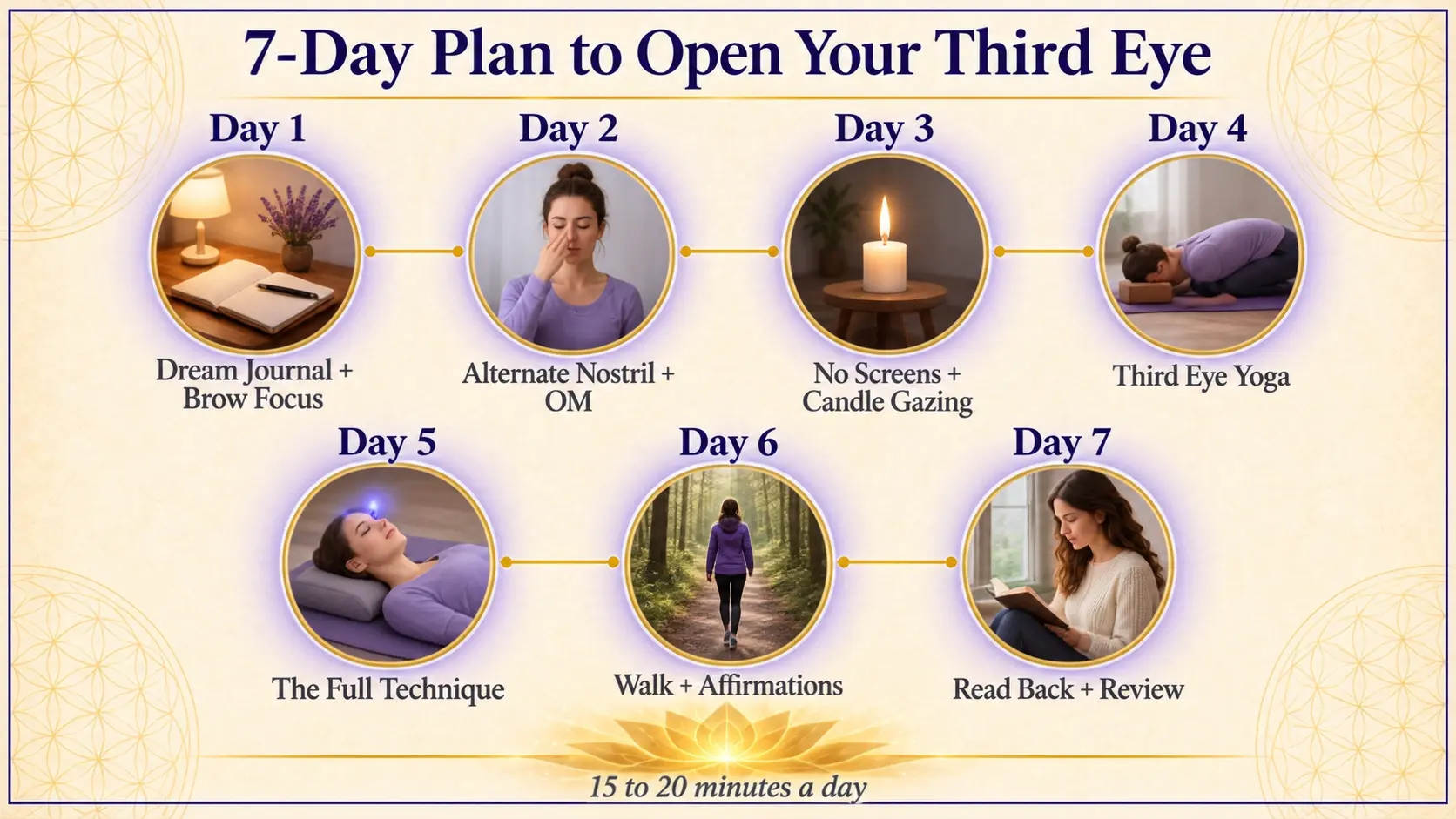
The plan takes 15 to 20 minutes a day, mostly in the evening, plus a minute with your dream journal each morning. Each day pairs one inward practice with something that keeps you grounded.
| Day | What to do | Time | Done |
|---|---|---|---|
| Day 1 | Put a notebook by your bed. In the evening, do ten minutes of attention at the brow. | 10 min | ☐ |
| Day 2 | Do five minutes of alternate nostril breathing, then chant OM five to seven times. | 10 min | ☐ |
| Day 3 | No screens for the last hour before bed. Try two minutes of candle gazing and watch the after-image. | 10 min | ☐ |
| Day 4 | Do 15 minutes of third eye yoga: Child's pose, Dolphin, Eagle and a supported forward fold. | 15 min | ☐ |
| Day 5 | Do the full step-by-step technique lying down, with the raised forearm if you tend to fall asleep. | 20 min | ☐ |
| Day 6 | Take a long walk outdoors, then say three affirmations slowly before bed. | 20 min | ☐ |
| Day 7 | Read back your dream journal and hunch notes, write down what changed this week and pick two practices to keep. | 15 min | ☐ |
Common Mistakes That Keep the Third Eye Chakra Blocked
Most of the things that hold the third eye back come from trying too hard, or from forgetting the body while you work on the mind:
- Straining the eyes by rolling them up toward the brow or squeezing them shut, which brings on headaches rather than insight.
- Chasing visions and getting frustrated when nothing appears, which keeps the mind busy and stops the images coming.
- Skipping the grounding half, so you end up spaced out, sleeping badly and feeling far from everyday life.
- Doing far too much in the first week, such as hour-long sessions every night, then giving up.
- Late-night screens right before practice, which leave the mind too busy to settle.
- Treating every image as a message and making big decisions from it, instead of noting it and checking it against real life.
- Dismissing your hunches the moment they appear, without ever writing them down to see if they were right.
How Long Does It Take to Open Your Third Eye?
Opening the third eye has no fixed timeline, because nobody can measure a chakra or promise a result by a certain date. Most people notice small changes, like more vivid dreams, better focus or a calmer mind, within two to four weeks of short daily practice. Clear inner images usually take months, and some people never see much at all. For them the third eye shows up mostly as better judgment and stronger intuition, which counts just as much. Do the 7-day plan, then keep the two or three practices you liked for at least another month before you decide what they're doing for you.
Safety: When to See a Doctor
Meditation is safe for most people, but intense inner practice isn't harmless for everyone. The NCCIH reports a 2020 review of 83 studies in which about 8 percent of participants had a negative effect from meditation, most often anxiety or depression. A 2017 study of Western Buddhist meditators by Lindahl and colleagues also documented fear, strange perceptions and a feeling of unreality in some people. If you've ever had psychosis, bipolar disorder, severe dissociation or serious anxiety, talk to your doctor or therapist before doing long or intense third eye practice, and keep to short, gentle sessions with your eyes open.
Stop and get support if you feel frightened, cut off from reality or unable to sleep for several nights. Frequent headaches, pressure in the head, flashing lights or any sudden change in your vision need a medical check, not more meditation, and sudden loss of vision or a severe headache is an emergency. These practices can go alongside medical care, never instead of it.
Tonight, put a notebook by your bed and do ten minutes of attention at the brow before you sleep. That's day one of the plan, and these pages take it further:
-
Third eye chakra healing meditation
- a guided script for the brow point
-
Third eye chakra yoga
- calming poses and a short sequence
-
Third eye chakra healing affirmations
- lines for intuition and clarity
Sources
- Arthur Avalon (Sir John Woodroffe), The Serpent Power (1919), translation of the Sat-cakra-nirupana: Ajna, the white two-petaled lotus with the letters Ha and Ksha, Hakini, the pranava OM and the meeting of ida, pingala and sushumna.
- Hatha Yoga Pradipika (15th century), chapter 2: trataka among the six cleansing practices, and nadi shodhana.
- National Center for Complementary and Integrative Health (NCCIH), "Meditation and Mindfulness: Effectiveness and Safety" and "Melatonin: What You Need To Know".
- Lindahl JR, Fisher NE, Cooper DJ, Rosen RK, Britton WB. The varieties of contemplative experience: A mixed-methods study of meditation-related challenges in Western Buddhists. PLoS One. 2017;12(5):e0176239.
- National Association for Holistic Aromatherapy (NAHA), "Safety Information".
Frequently Asked Questions About Opening Your Third Eye
Can you open your third eye in minutes?
Not in the full sense. Teachers describe opening the third eye as something that builds over weeks of steady practice. What you can do in a few minutes is activate it: chant OM three to five times with your attention on the forehead, or do three minutes of alternate nostril breathing. Most people feel calmer and more focused afterwards. Videos and products that promise an instant opening are selling an experience no one can guarantee.
Can meditation alone open the third eye?
Meditation is the main practice for the third eye, and many teachers say it's enough on its own if you do it daily. In practice, most people get on faster when they add good sleep, a dream journal and something grounding like walking. There is no scientific evidence that meditation changes a chakra, but it does help many people focus better, sleep better and notice their own thoughts and hunches more clearly.
How often should you practice to open your third eye?
Once a day for 15 to 20 minutes works for most people, ideally in the evening. Short daily sessions do far more than one long session at the weekend, and they're safer. On busy days, five minutes of attention at the brow still counts. If you start sleeping badly or feeling spaced out, cut back to every other day and add more grounding, such as walks outdoors, until you feel steady again.
What can I drink to heal the third eye chakra?
Purple and calming drinks are the traditional choice: butterfly pea flower tea, lavender or chamomile tea, a blueberry or blackberry smoothie, or a small glass of grape juice. A warm herbal tea in the evening also fits the third eye's link with sleep. No drink opens a chakra by itself, though. Cutting back on caffeine after midday probably helps the practice more than anything you add to your cup.
Are third eye practices safe for beginners?
Gentle third eye practices are safe for most healthy beginners: short brow-point meditation, slow alternate nostril breathing, chanting OM, a dream journal and calm yoga poses. Keep sessions under 20 minutes at first and avoid forceful breathing techniques. If you have a history of psychosis, bipolar disorder, dissociation or severe anxiety, talk to your doctor or therapist first and keep practice short, with your eyes open. Stop if you feel frightened or disconnected.
Do you have to see visions to open your third eye?
No. Some people see colors, light or vivid images during practice, and many never see much at all. Teachers say an open third eye shows up just as often as clearer thinking, better judgment, more vivid dreams and hunches that turn out to be right. Chasing visions usually makes them less likely, because it keeps the mind busy. If you notice your intuition getting more reliable, the practice is doing its job.
Can third eye practices make you feel worse at first?
Some people feel a mild pressure in the forehead, sleep less deeply or feel a bit spaced out in the first days. It usually means the sessions are too long or the grounding half is missing, so shorten them and walk more. Old memories or strong emotions can also come up. If anxiety, fear or a feeling of unreality grows over a couple of weeks instead of easing, stop and talk to a doctor or therapist.