
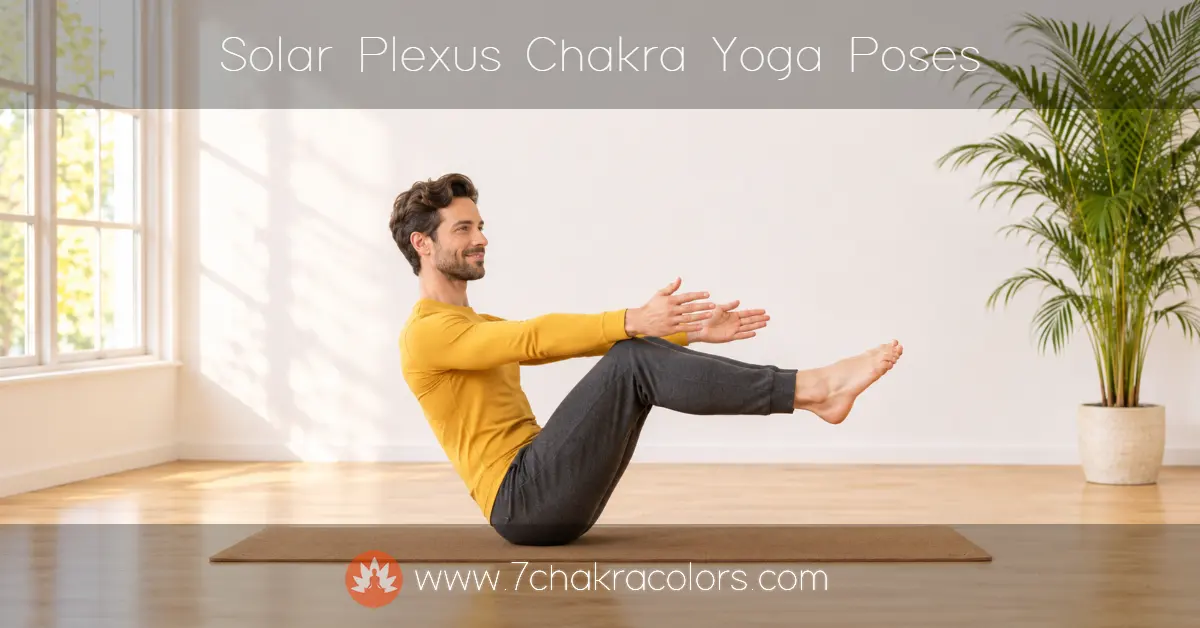
8 Solar Plexus Chakra Yoga Poses to Open and Balance Manipura
Learn 8 yoga poses for the solar plexus chakra (Manipura), with step-by-step cues, beginner modifications and a 15-minute routine you can follow at home.
Table Of Contents
The best solar plexus chakra yoga poses build core strength and twist the belly: Warrior III, Plank, Side Plank, Boat, Cobra, Bow, Seated Twist and Reclined Twist. Warm up with three slow rounds of Sun Salutation, then follow the 15-minute routine, which gives the time for every pose. Beginners can start with a 5-minute version and shorter holds.
- Chakra: Manipura (solar plexus), fire element
- Poses: 8, plus a Sun Salutation warm-up
- Hold: 5 breaths in most poses, 3-5 in Bow, longer in the resting twist
- Full routine: 15 minutes · beginner routine: 5 minutes
- When: any time of day, at least two hours after a meal
- Props: mat, two blocks, a strap, a cushion
- Level: beginner to intermediate
In yoga tradition these poses work on the solar plexus chakra, which chakra teachings link with fire, willpower and digestion. They're one part of solar plexus chakra healing, alongside sunlight, breath and the habit of keeping small promises to yourself.
The 8 Best Solar Plexus Chakra Yoga Poses
Two kinds of pose are usually chosen for this chakra. Core and balance work builds heat in the belly, which yoga teachers connect with agni, the digestive fire. Twists turn the trunk around the solar plexus area and finish the practice in a calmer way. Back bends that stretch the front of the belly, like Cobra and Bow, sit between the two.
These Manipura yoga poses ask for more effort than the ones for the lower chakras, which fits a chakra associated with effort and staying with something when it gets hard. Every pose has an easier option, and it's fine to hold a pose for fewer breaths while you build up.
The table gives all eight at a glance. Tap a pose name to jump to its instructions.
| Yoga pose | Difficulty* | Main focus | Hold |
|---|---|---|---|
| Warrior III | Intermediate | Balance and core | 5 breaths per side |
| Plank | Beginner | Whole-body core strength | 5-8 breaths |
| Side Plank | Intermediate | Sides of the waist | 5 breaths per side |
| Boat | Intermediate | Abdominal strength | 5 breaths, 3 rounds |
| Cobra | Beginner | Gentle back bend | 5 breaths, twice |
| Bow | Intermediate | Front of the body | 3-5 breaths, twice |
| Seated Twist | Beginner | Spine rotation | 5 breaths per side |
| Reclined Twist | Beginner | Rest and release | 5-6 breaths per side |
*A rough guide only; how a pose feels depends on your own strength, back and wrists.
Some lists also include Camel or Crow. Chakra associations vary between yoga systems, and on this site Camel is on the yoga poses for the heart chakra page as a heart opener. Crow is left out because it's an arm balance that most beginners can't do safely at home.
If you only have time for three, do the 5-minute beginner routine: Cobra, Boat and Seated Twist.
Before You Start: Safety and Modifications
Core work, back bends and twists put most of the load on the wrists, the lower back and the belly, so most of the cautions are about those. Read them before you begin.
- Wrists: do Plank and Side Plank on your forearms, or with your knees down.
- Lower back: keep your knees bent in Boat, stay low in Cobra, and leave out Bow if your back hurts.
- Neck: keep it in line with the spine in twists and back bends.
- Pregnancy: leave out Boat, Bow, Cobra and deep closed twists. Gentle open twists and standing poses are usually fine, but check with your midwife or doctor first, as you may need changes that suit you.
- Hernia, recent abdominal surgery or high blood pressure: ask your doctor before doing strong core work.
- After eating: wait at least two hours, since twists and Bow aren't comfortable on a full stomach.
Breathe normally through the whole routine and don't add forceful breathing. Stop any pose that causes sharp pain, and see a doctor about stomach or back pain that keeps coming back.
How to Do Each Solar Plexus Chakra Yoga Pose
Do the poses in the order given. You start standing, move down to the floor for Plank and Side Plank, sit for Boat, lie on your belly for the back bends, and finish with two twists. It's the same order as the 15-minute routine below.
Warm-Up: Sun Salutation and Solar Plexus Chakra Exercises
Sun Salutation (Surya Namaskar) is a natural warm-up for a chakra linked with the sun and fire. Do three slow rounds, about one minute each.
- Stand at the front of the mat, breathe in and reach your arms up.
- Breathe out and fold forward, bending your knees as much as you need.
- Breathe in, lift halfway with a flat back, then step back to Plank.
- Lower to the floor, breathe in into a low Cobra, then breathe out back to Downward Dog for a few breaths.
- Step forward, rise up and bring your hands to your chest.
For a gentler start, do half Sun Salutations: reach up, fold, lift halfway, fold again and rise, without going to the floor. A few minutes of brisk marching on the spot and some side bends are also fine solar plexus chakra exercises to begin with.
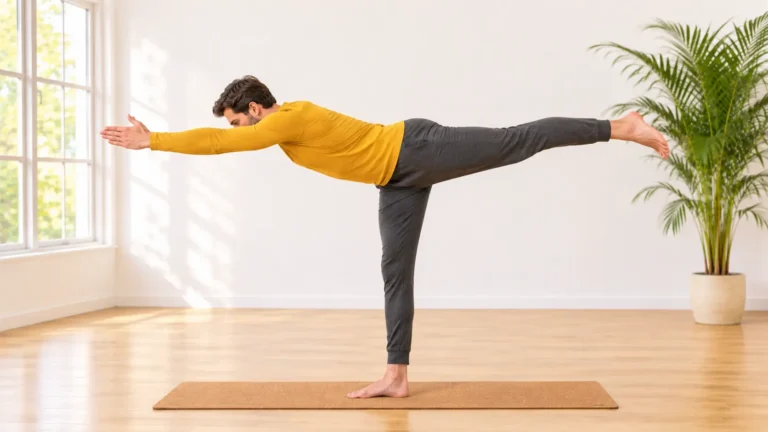
1. Warrior III (Virabhadrasana III)
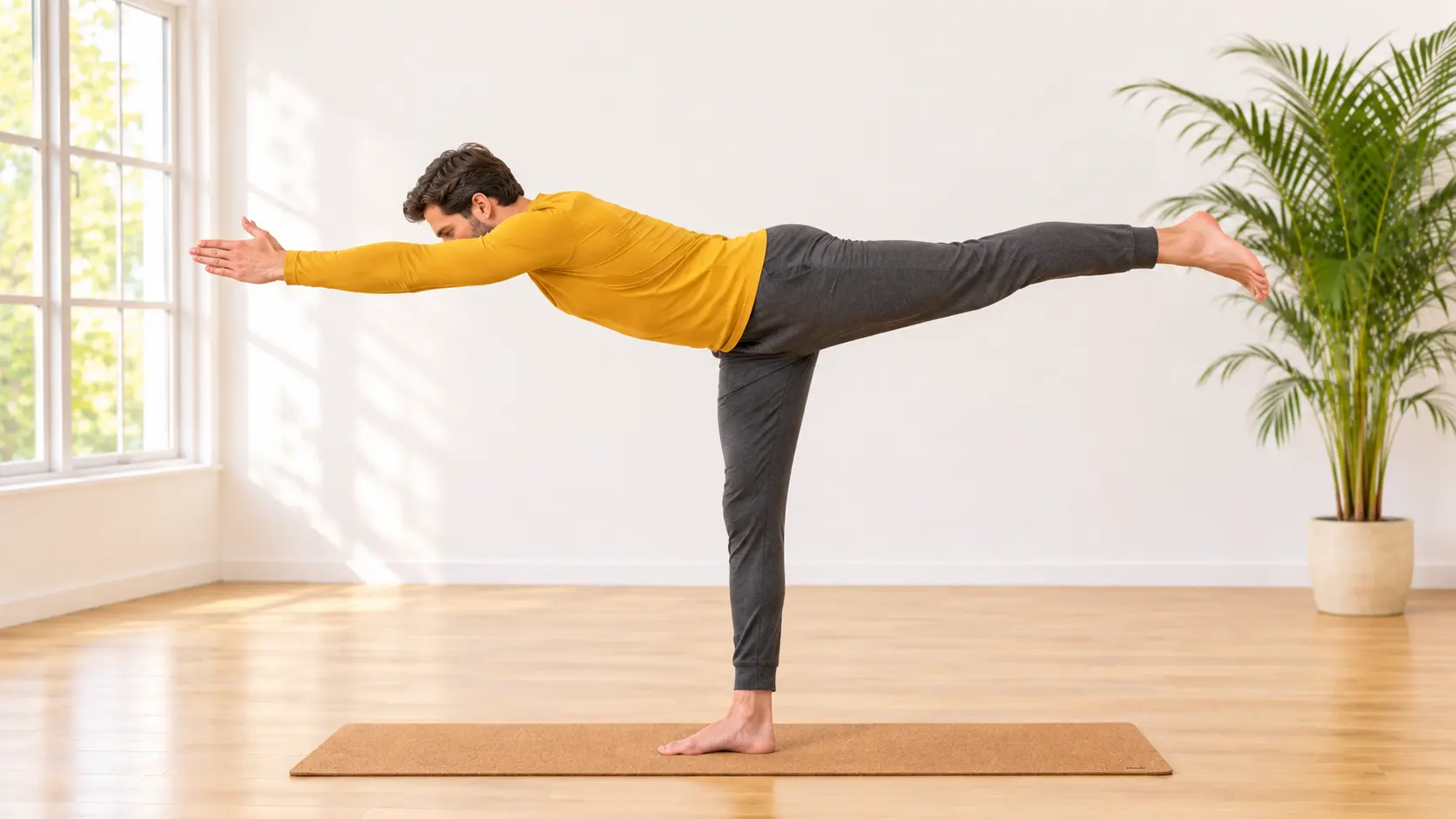
Benefits: balance, core strength and focus. You can't hold it while your mind wanders.
- Stand on your right leg with a soft knee.
- Hinge forward from the hips and lift your left leg behind you.
- Keep going until your body and the lifted leg form a line roughly level with the floor, with both hips facing down.
- Hold your arms by your sides, reach them forward, or rest your hands on blocks.
- Lower the leg, stand up and change sides.
- Hold: 5 breaths on each side.
- Easier option: put your hands on a wall or on blocks, and lift the leg only a little.
- Safety: keep the standing knee slightly bent and come out if you lose your balance.
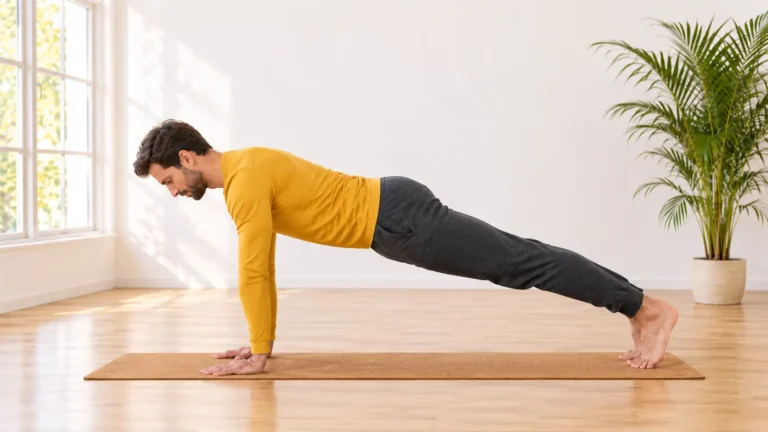
2. Plank (Phalakasana)
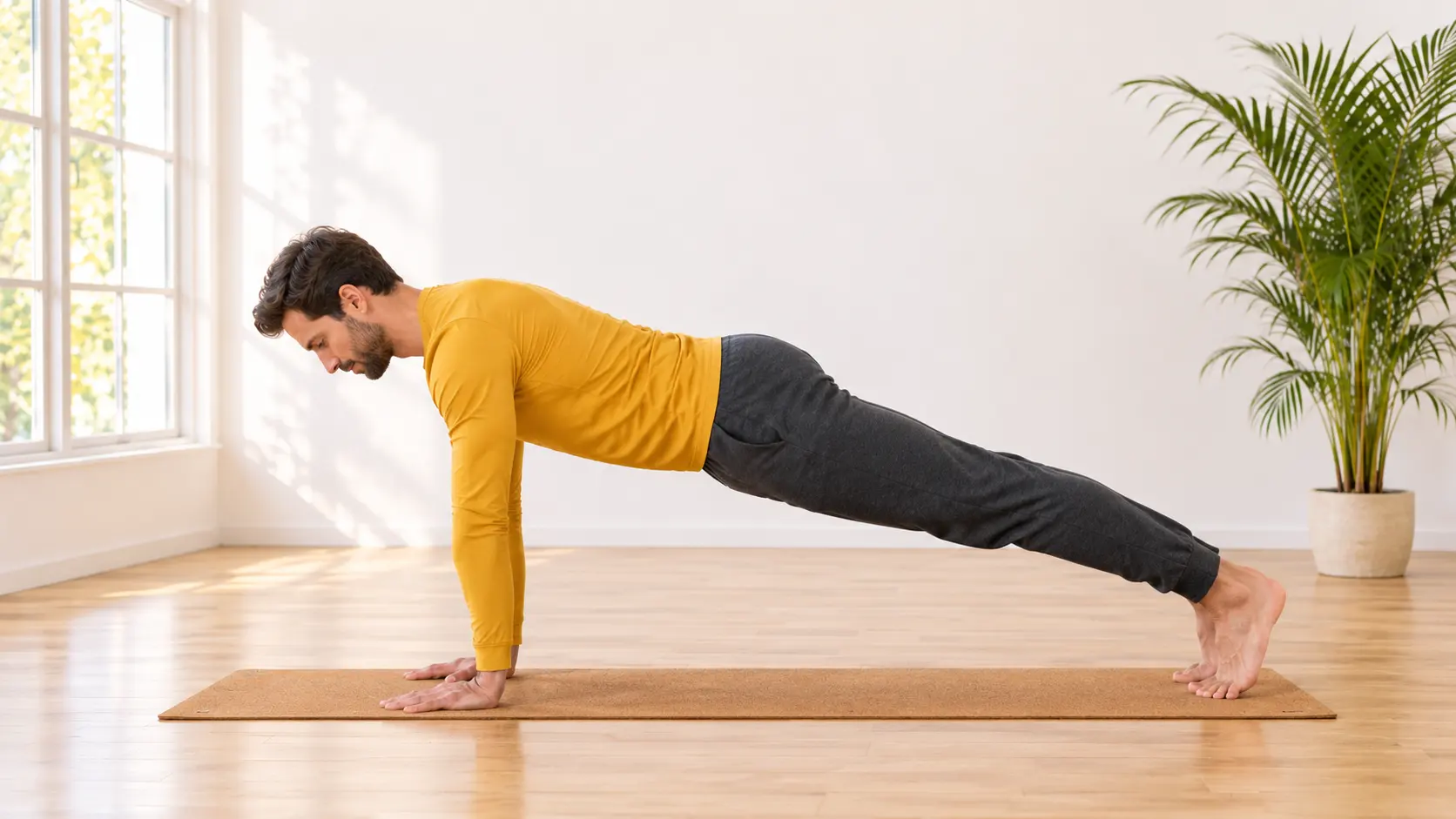
Benefits: strengthens the whole front of the body, from the shoulders to the belly. It looks simple, and it's harder than it looks.
- Come onto your hands and knees with your hands under your shoulders.
- Step your feet back until your body is one straight line from head to heels.
- Press the floor away, draw your belly in and keep breathing.
- Lower your knees to come out.
- Hold: 5-8 breaths.
- Easier option: keep your knees on the floor, or come down onto your forearms.
- Safety: don't let your hips sag. If your wrists hurt, use the forearm version.
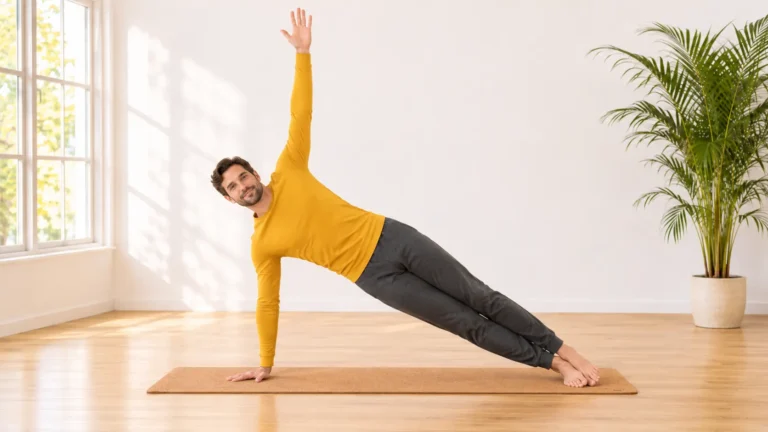
3. Side Plank (Vasisthasana)
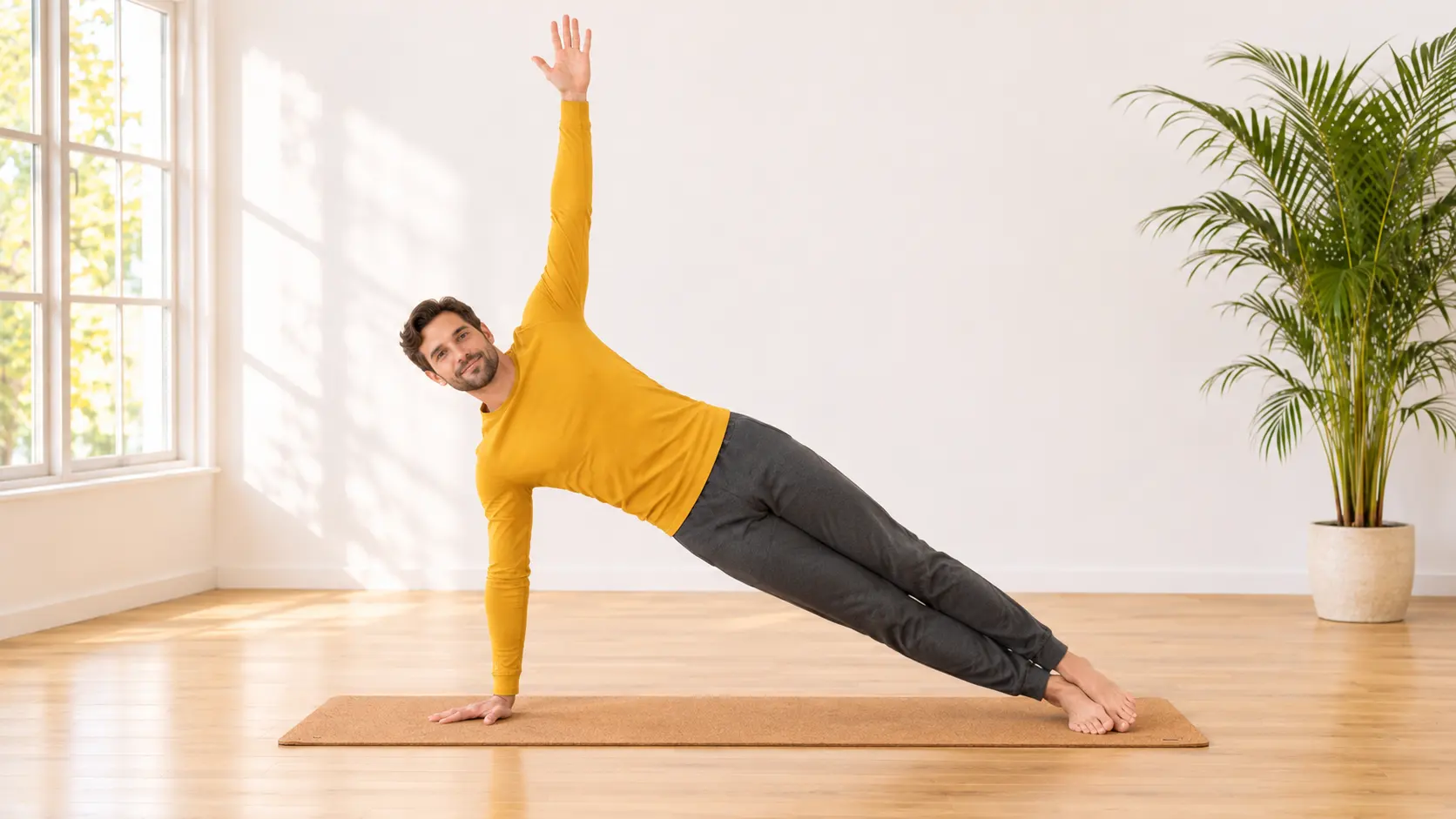
Benefits: works the muscles along the sides of the waist, which wrap around the solar plexus area.
- From Plank, shift onto the outside edge of your right foot and your right hand.
- Stack your left foot on top of the right, or put it down in front for balance.
- Lift your hips and raise your left arm.
- Come back to Plank, rest your knees down if you need to, and change sides.
- Hold: 5 breaths on each side.
- Easier option: lower the bottom knee to the floor. It still works the waist.
- Safety: keep the supporting hand under the shoulder, not out in front.
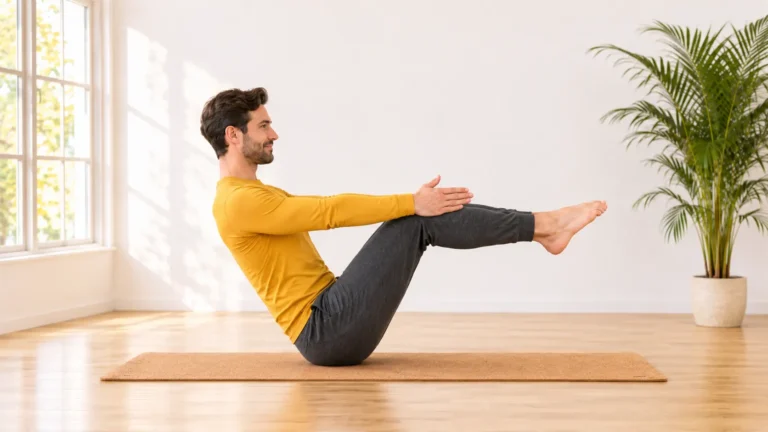
4. Boat Pose (Navasana)
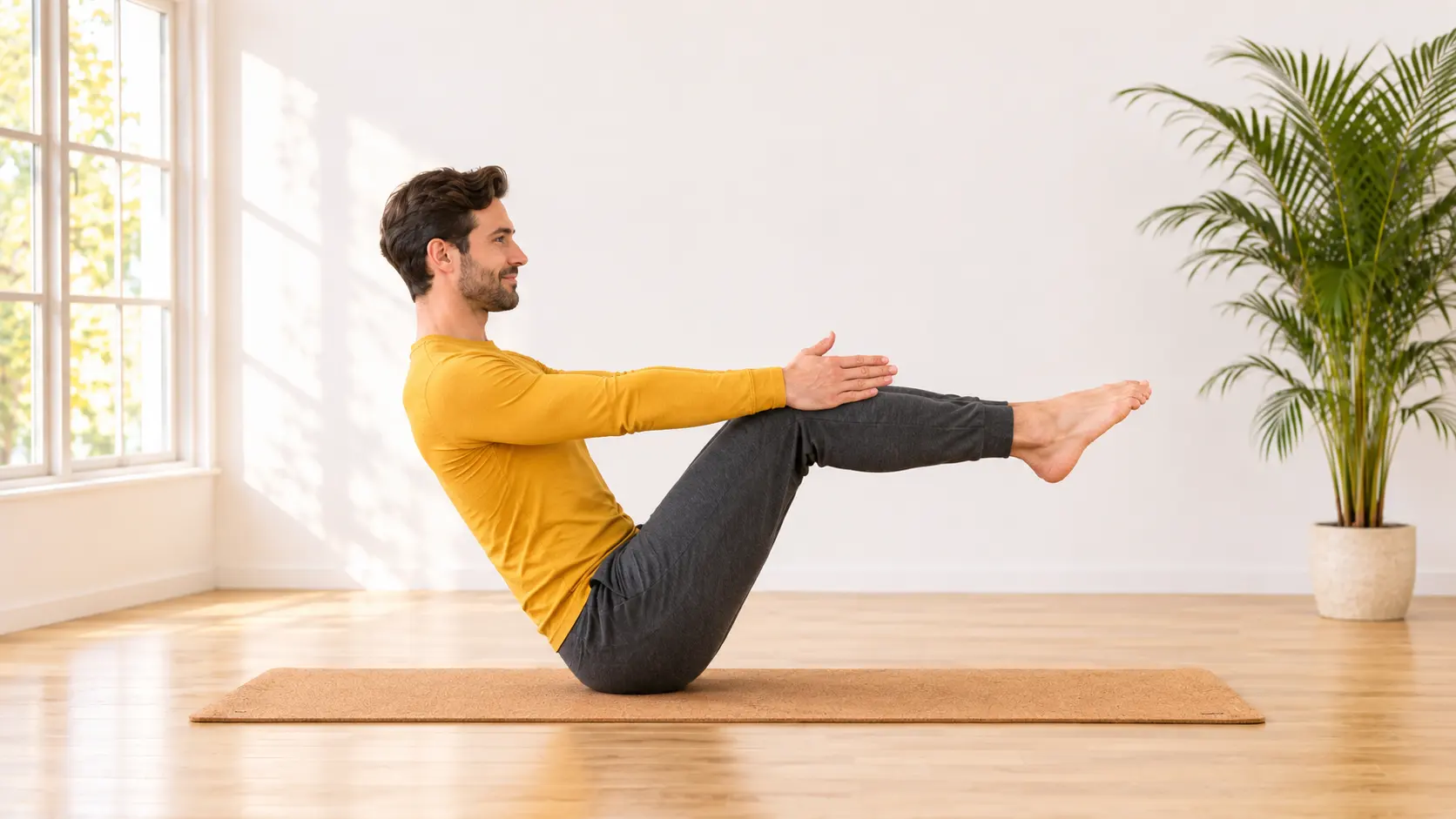
Benefits: strengthens the abdominal muscles and hip flexors. Boat is the pose most teachers name first for this chakra, and you'll feel the heat in your belly within a few breaths.
- Sit with your knees bent and your feet on the floor, holding the backs of your thighs.
- Lean back a little, keeping your chest lifted and your back long.
- Lift your feet so your shins are level with the floor.
- If it feels steady, let go of your legs and reach your arms forward.
- Lower your feet, rest for a breath or two and repeat.
- Hold: 5 breaths, 3 rounds.
- Easier option: keep holding your thighs, or keep your toes on the floor.
- Safety: if your lower back rounds and aches, keep your feet down. Leave Boat out in pregnancy and after abdominal surgery.
5. Cobra (Bhujangasana)
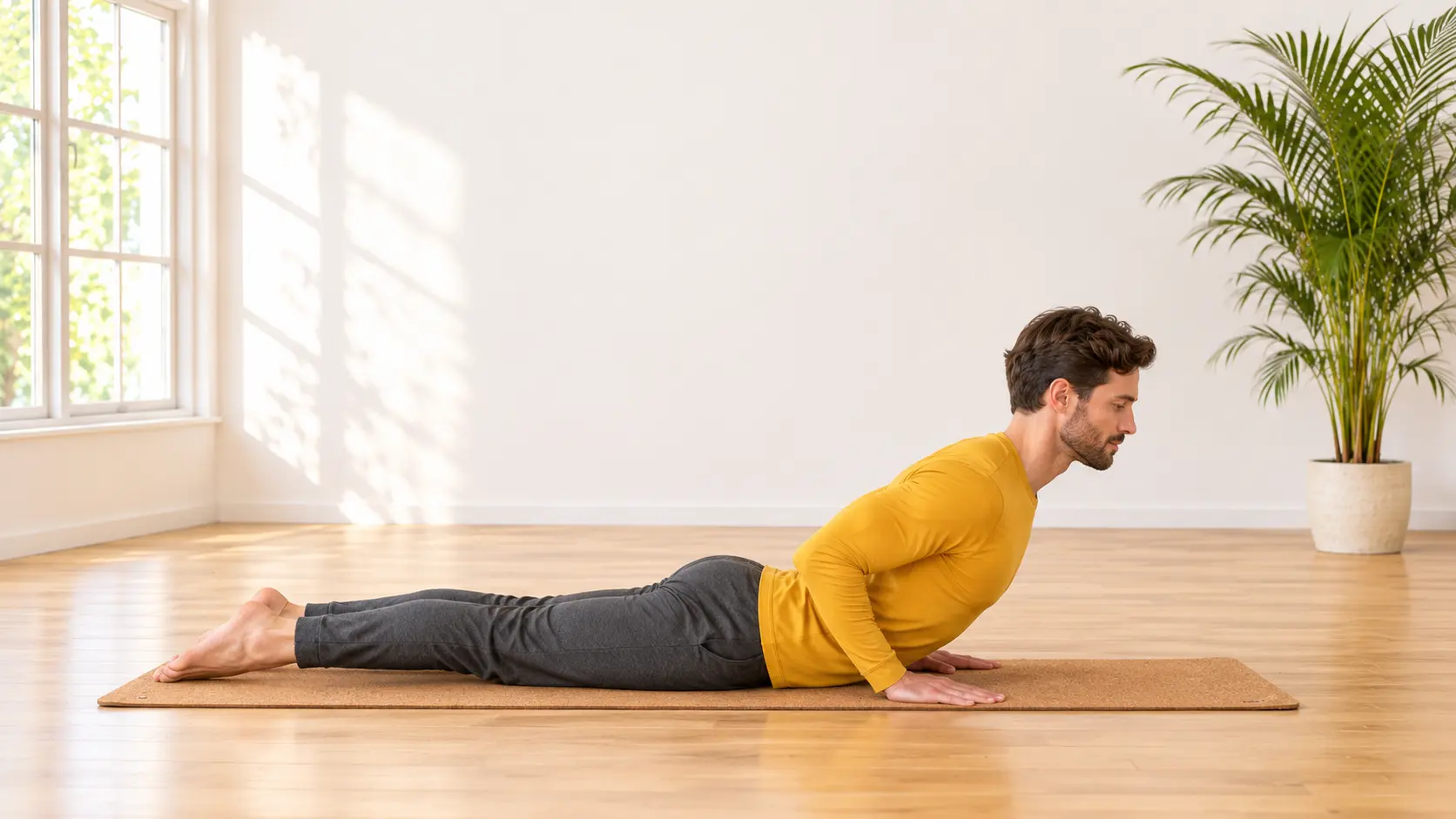
Benefits: a gentle back bend that stretches the belly and strengthens the back. It's a good one to do every day.
- Lie on your belly with your hands under your shoulders and your elbows close to your sides.
- Breathe in and lift your chest, using your back muscles more than your arms.
- Keep your lower ribs near the floor and your shoulders away from your ears.
- Breathe out and lower, rest for a breath, and lift once more.
- Hold: 5 breaths, twice.
- Easier option: Sphinx, resting on your forearms, or a low Cobra with only the chest lifting.
- Safety: if it pinches your lower back, come lower. Leave it out in pregnancy.
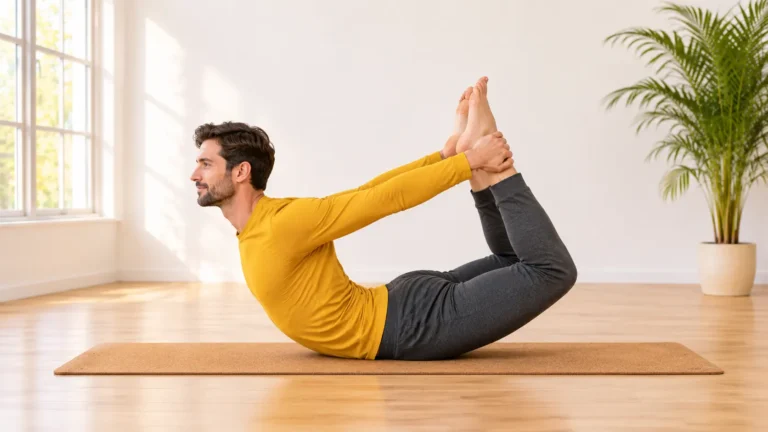
6. Bow Pose (Dhanurasana)
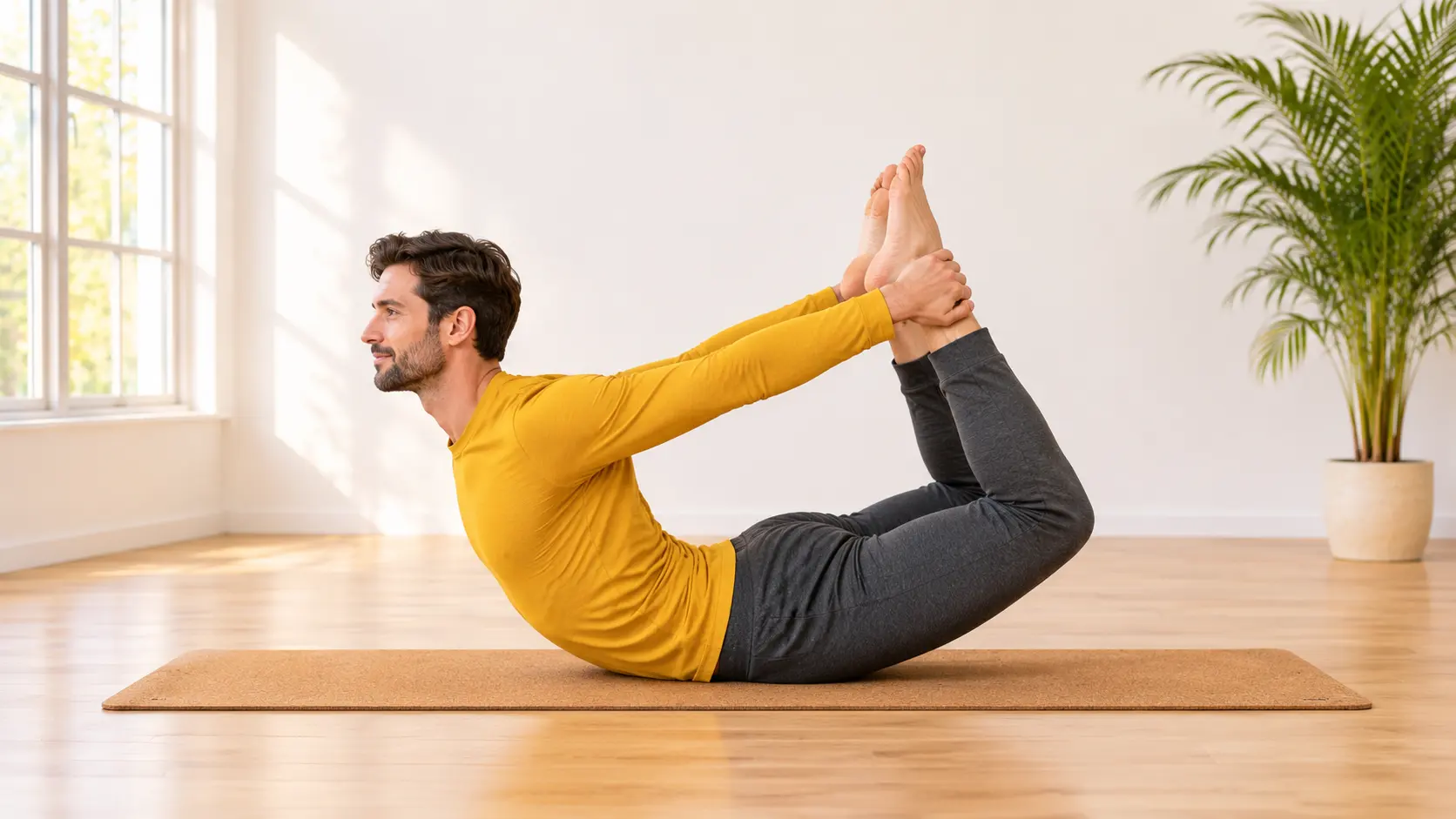
Benefits: stretches the whole front of the body, including the belly and the hip flexors, and strengthens the back.
- Lie on your belly, bend your knees and reach back for your ankles.
- Breathe in and kick your feet back into your hands so your chest and thighs lift.
- Look forward, not up, and keep breathing.
- Lower slowly and rest your head on your hands for a few breaths, then repeat.
- Hold: 3-5 breaths, twice.
- Easier option: Half Bow, holding one ankle at a time, or a strap around the ankles.
- Safety: leave Bow out if you have back pain, are pregnant or have had recent abdominal surgery.
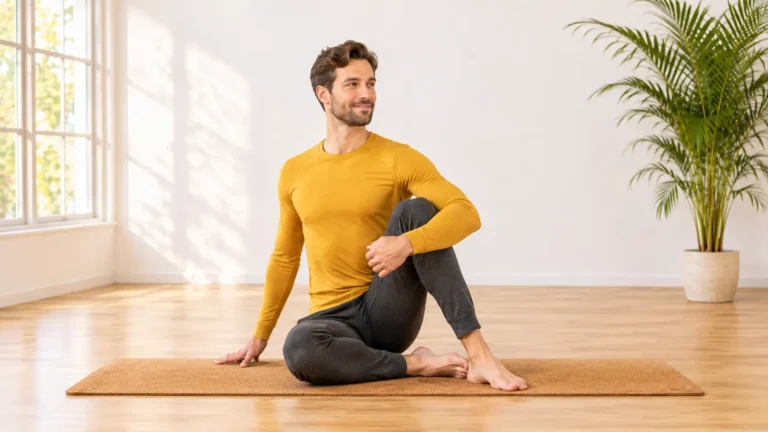
7. Seated Twist (Ardha Matsyendrasana)
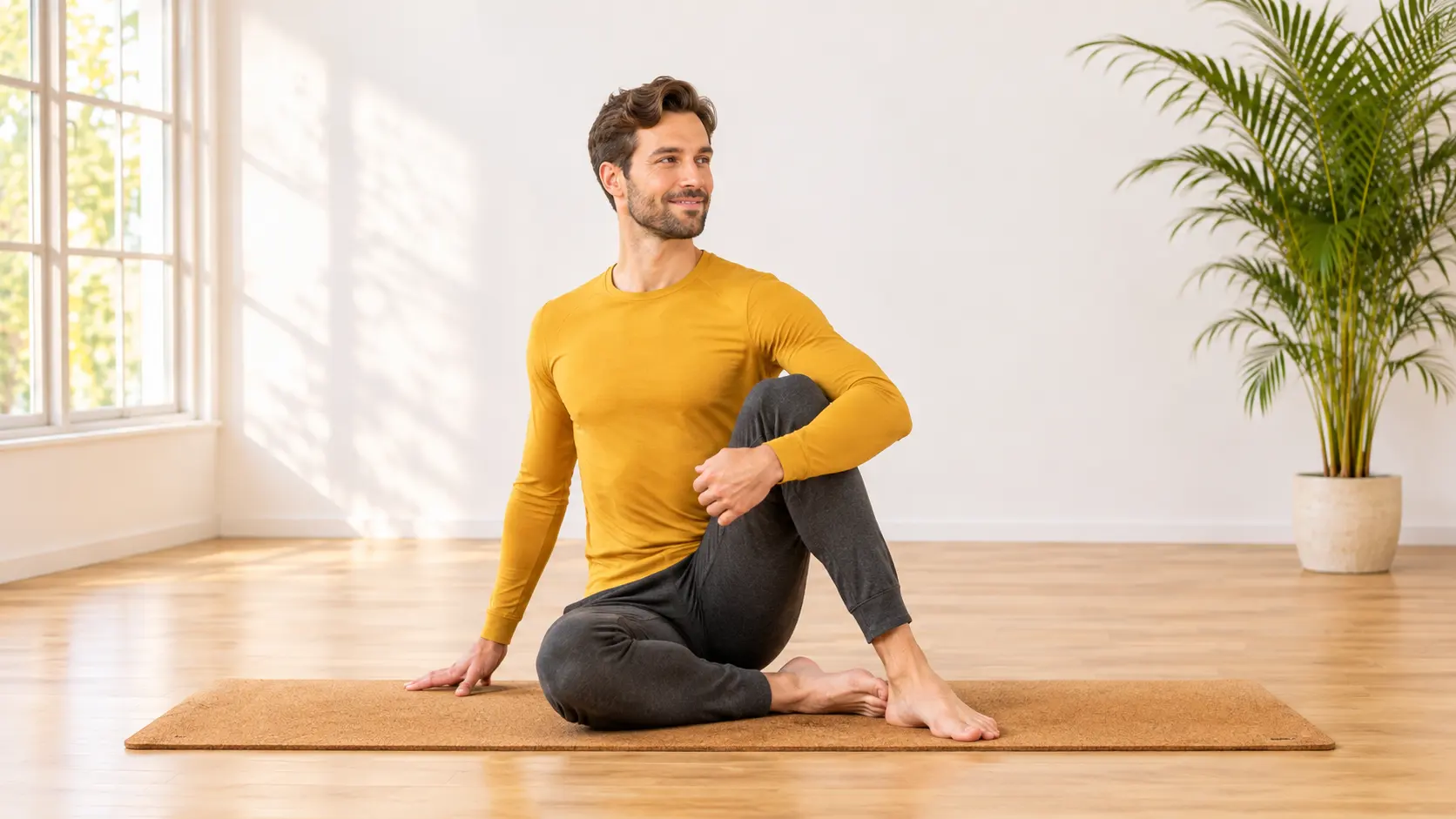
Benefits: turns the spine and the trunk and calms the body down after the back bends. It's named after the sage Matsyendra, said to be one of the founders of hatha yoga.
- Sit with your legs out in front. Bend your right knee and place your right foot on the floor outside your left knee.
- Bend your left leg so the foot comes near your right hip, or keep it straight.
- Breathe in and sit tall. Breathe out and twist to the right, hugging your right knee with your left arm.
- Grow taller on each in-breath and twist a little more on each out-breath. Change sides.
- Hold: 5 breaths on each side.
- Easier option: keep the bottom leg straight and sit on a cushion.
- Safety: twist from the belly and the middle of the back, not by cranking the neck. In pregnancy, twist away from the bent knee (an open twist) and only a little.
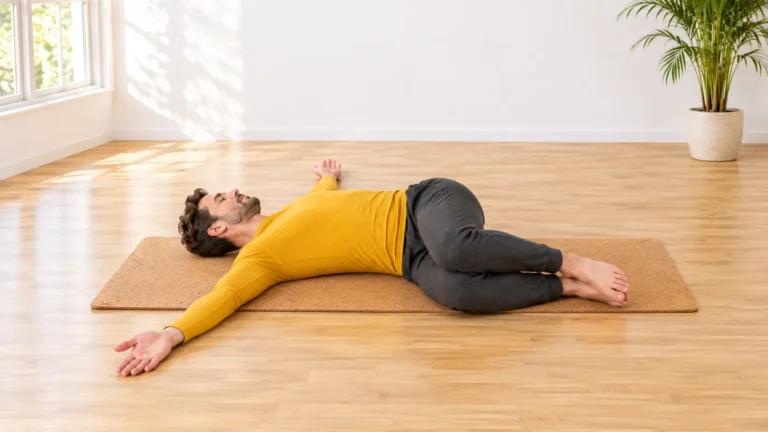
8. Reclined Twist (Supta Matsyendrasana)
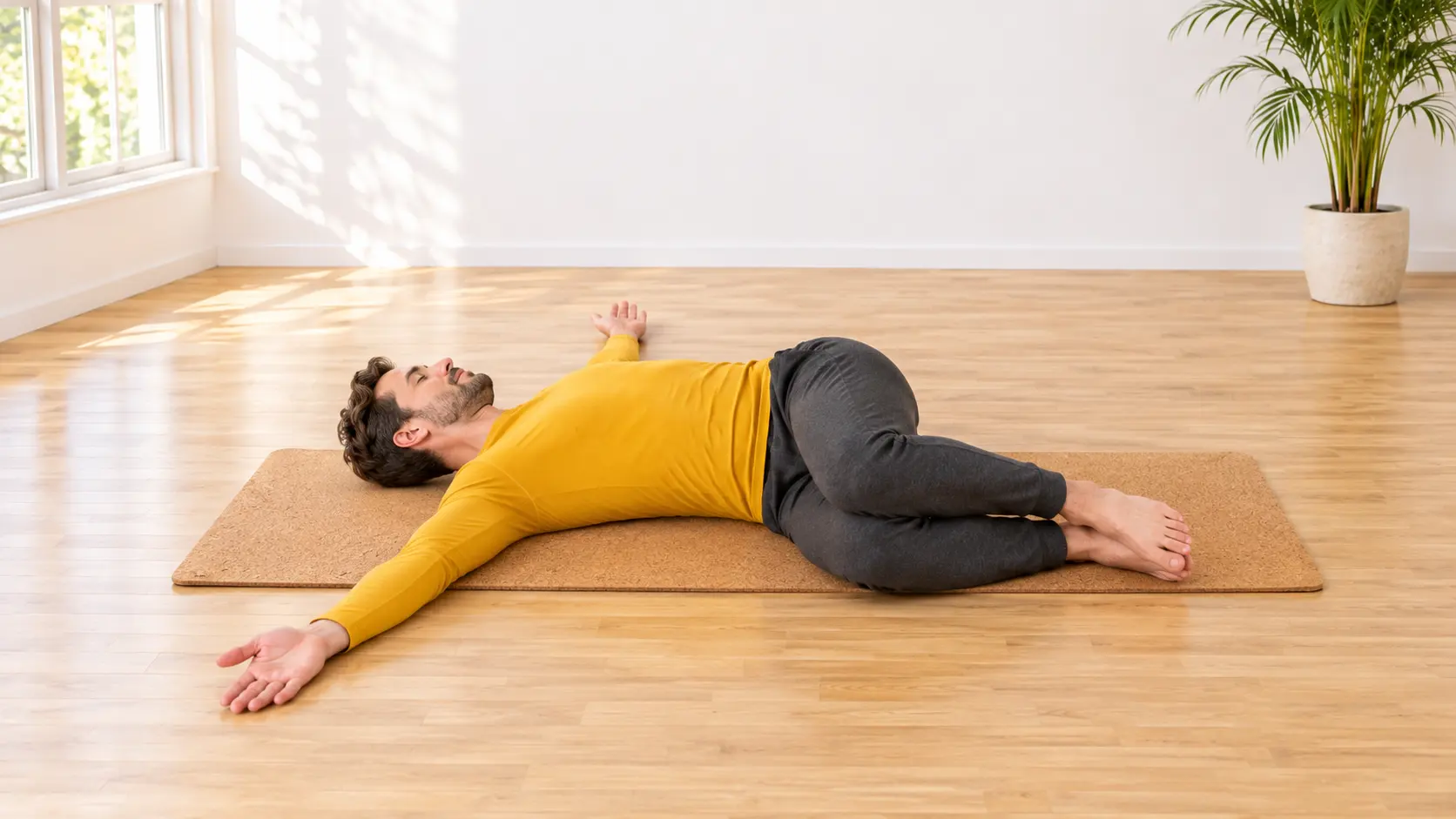
Benefits: a resting twist that releases the back and lets the belly soften at the end of the practice.
- Lie on your back and hug your knees in.
- Let both knees drop to the right while your arms open out to the sides.
- Turn your head to the left if your neck is comfortable.
- Bring your knees back to the center and change sides.
- Hold: 5-6 breaths on each side, longer if you have time.
- Easier option: put a cushion under your knees if they don't reach the floor.
- Safety: keep both shoulders resting on the floor and don't force the knees down.
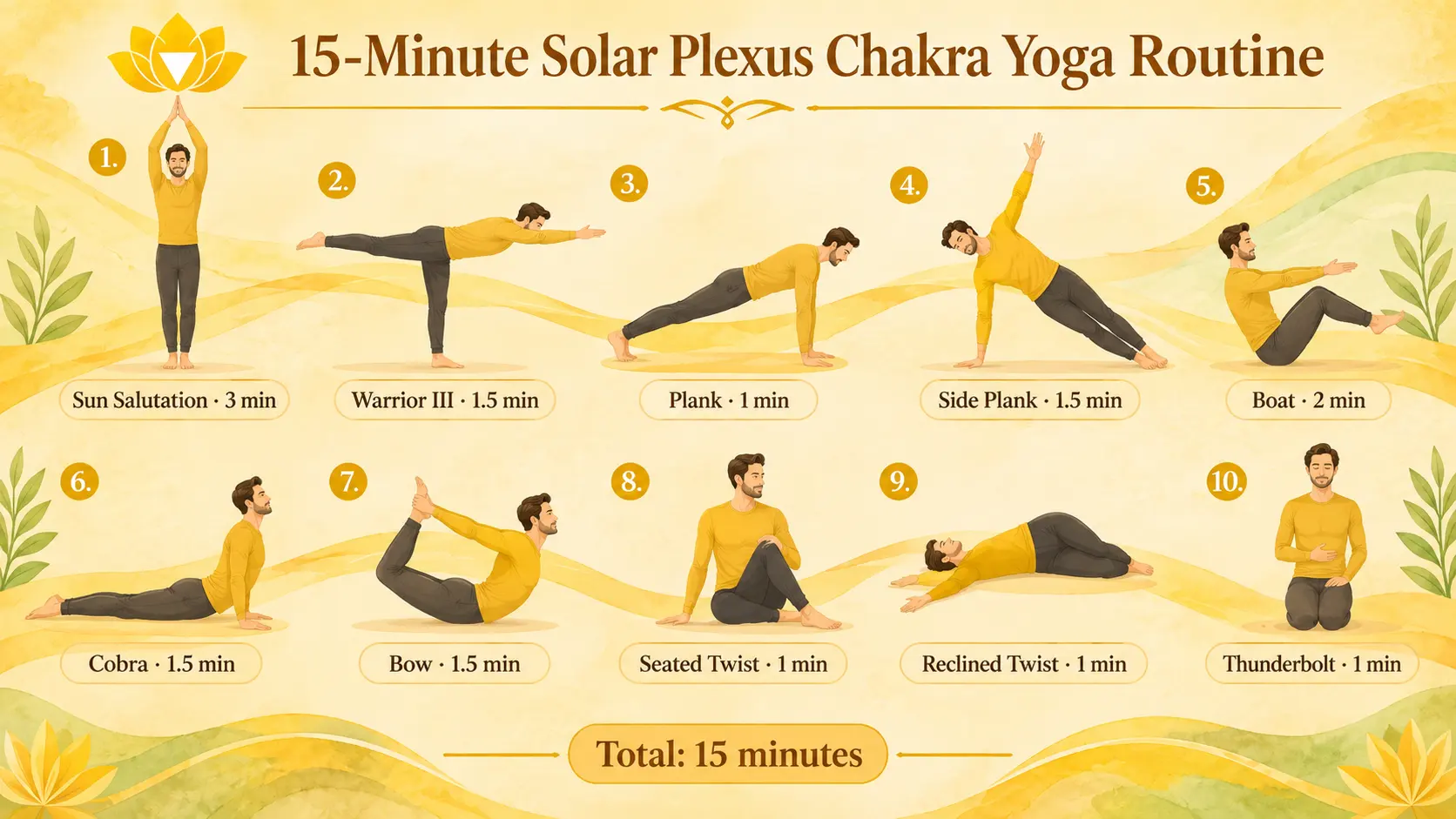
A 15-Minute Solar Plexus Chakra Yoga Routine
This solar plexus chakra yoga sequence takes 15 minutes, counting both sides and the transitions. There are four blocks: 3 minutes of warm-up, 6 minutes of core and balance, 3 minutes of back bends, and 3 minutes of twists and rest. One slow breath takes about 5-6 seconds, so 5 breaths is about half a minute. Breathe through your nose. You can keep the table open on your phone while you practice.
| Time | Pose | Hold | Beginner option |
|---|---|---|---|
| 0:00-3:00 | Warm-up: 3 slow rounds of Sun Salutation | 1 min per round | Half Sun Salutations |
| 3:00-4:30 | Warrior III, right then left | 5 breaths per side | Hands on a wall or blocks |
| 4:30-5:30 | Plank | 5-8 breaths | Knees down or on the forearms |
| 5:30-7:00 | Side Plank, right then left | 5 breaths per side | Bottom knee down |
| 7:00-9:00 | Boat, 3 rounds with short rests | 5 breaths per round | Hold the thighs, toes down |
| 9:00-10:30 | Cobra, twice | 5 breaths each time | Sphinx |
| 10:30-12:00 | Bow, twice, resting between | 3-5 breaths each time | Half Bow or a strap |
| 12:00-13:00 | Seated Twist, right then left | 5 breaths per side | Bottom leg straight, sit on a cushion |
| 13:00-14:00 | Reclined Twist, right then left | 5-6 breaths per side | Cushion under the knees |
| 14:00-15:00 | Thunderbolt pose, one hand on the upper belly | 1 minute | Sit on a block |
Three or four times a week is a good rhythm. Some people like to practice in the morning, but any time that suits you works, as long as you haven't just eaten. If 15 minutes is too long, shorten the holds or do one round of Boat instead of three.
5-Minute Solar Plexus Chakra Yoga for Beginners
If you're new to yoga or short on time, try this easy solar plexus chakra yoga at home. You only need a mat and a cushion.
- Half Sun Salutation, 1 minute: two slow rounds, without going to the floor.
- Cobra, 1 minute: two low lifts of 5 breaths, or Sphinx on your forearms.
- Boat, 1 minute: two rounds of 3-5 breaths, holding the backs of your thighs.
- Seated Twist, 1 minute: 5 breaths on each side, sitting on a cushion.
- Rest, 1 minute: lie on your back with your knees bent, one hand on your upper belly, and breathe.
Try this short routine for a week or two. When it feels easy, add Plank and Warrior III, and then move on to the full 15-minute routine.
Solar Plexus Chakra Meditation Pose
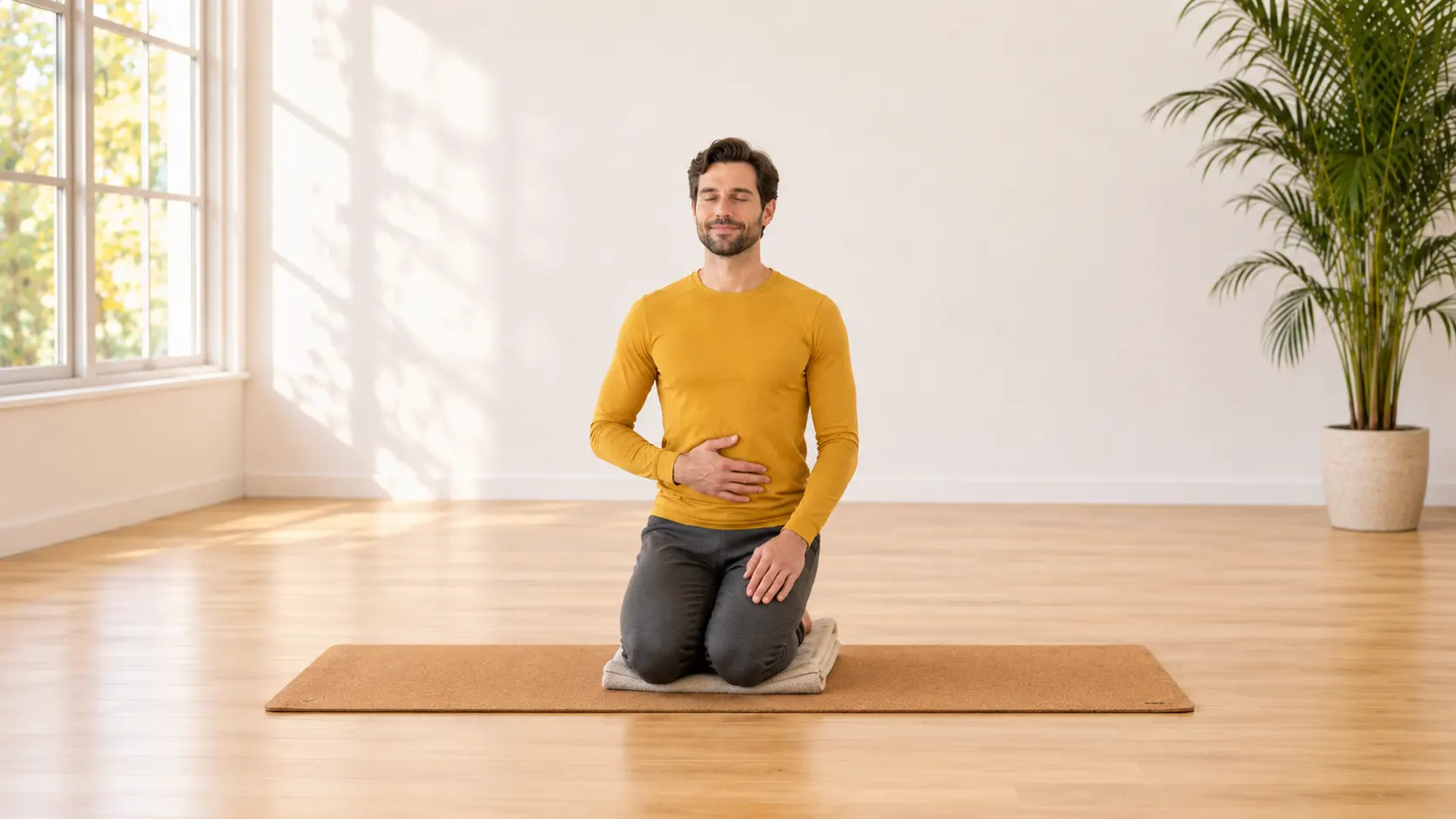
The traditional solar plexus chakra meditation pose is Thunderbolt, Vajrasana. You kneel and sit back on your heels, with your knees together and your spine upright. It's one of the few poses yoga texts recommend straight after a meal, as it's said to help digestion, which fits this chakra well.
Put a folded blanket between your calves and thighs, or sit on a block, if your knees or ankles complain. Rest one hand on your upper belly, just above the navel, and breathe there for three to five minutes. Many people picture a warm yellow light in this area. For a full guided practice, use the solar plexus chakra meditation. Hand gestures for meditation are on our page about chakra mudras.
How Yoga for Solar Plexus Chakra Healing Works
Chakra teachings associate the solar plexus with fire, and say a weak fire can show up as low energy, poor digestion and trouble acting on decisions. Core work and twists are meant to build and balance that fire. There's also something simpler going on: holding Boat for five breaths when you'd rather stop is a small lesson in willpower that most people notice straight away.
Chakras can't be measured by science, so there are no studies on yoga for solar plexus chakra healing as such. Yoga in general can help with stress and sleep, according to the National Center for Complementary and Integrative Health, and regular exercise of any kind is good for mood and energy. Feeling stronger and a bit more confident in your body is a fair thing to hope for from regular practice.
Breathing in the Poses
Breathe through your nose and keep the breath steady, even in the hard poses. Holding your breath in Boat or Plank is a sign to take the easier version. Breath of fire (Kapalabhati) is a forceful breathing technique and isn't part of this routine. It's best learned on its own once the poses feel easy, and left out if you're pregnant or have high blood pressure. The page on solar plexus chakra breathing has it, with calmer options too.
Try the 5-minute beginner routine tomorrow: half Sun Salutation, Cobra, Boat and Seated Twist. When that's easy, move on to the full 15-minute routine. These pages are good next steps:
- Solar plexus chakra healing meditation - a guided script for after the poses
- Solar plexus chakra breathwork - breath of fire and calmer options
- How to unblock solar plexus chakra energy - beyond the mat
Sources
- B.K.S. Iyengar, Light on Yoga (1966): Navasana, Vasisthasana, Virabhadrasana III, Dhanurasana, Bhujangasana, Ardha Matsyendrasana, Vajrasana.
- National Center for Complementary and Integrative Health (NCCIH), "Yoga: Effectiveness and Safety".
Frequently Asked Questions About Solar Plexus Chakra Yoga
Which yoga pose is best for the solar plexus chakra?
Boat pose (Navasana) is the one named most often, because it works the belly directly and you feel the effort within a few breaths. There's no single best pose, though. A short sequence that mixes core work, a gentle back bend and a twist, such as Cobra, Boat and Seated Twist, usually works better than one pose on its own. Pick the versions that suit your back and wrists.
How often should you practice solar plexus chakra yoga?
Three or four times a week is plenty for most people, and the 5-minute beginner routine can be done every day. Short, regular sessions tend to help more than an occasional long one, because core strength builds gradually. Take a rest day when your back, wrists or belly muscles feel sore.
Can beginners do solar plexus chakra yoga?
Yes. Every pose on this page has an easier option, and the 5-minute routine with half Sun Salutation, Cobra, Boat and Seated Twist is a good place to start. Keep your knees down in Plank and Side Plank, hold your thighs in Boat, and hold each pose for fewer breaths at first. If you have a back, wrist or abdominal problem, check with a doctor or physiotherapist first.
Why are core poses and twists associated with the solar plexus chakra?
The solar plexus chakra is placed in the upper belly, between the navel and the breastbone, so poses that work and turn that area are the natural choice. Chakra teachings also link this chakra with fire and willpower, and core work builds heat and asks you to keep going when it gets hard. Twists turn the trunk around the same area and make a calmer finish.
What is the best time of day for solar plexus chakra yoga?
Any time that suits you works. Some people like the morning, when the core poses help them wake up and feel ready for the day; others prefer a short session after work. What matters more is your stomach: practice at least two hours after a main meal, since twists and Bow aren't comfortable when you're full.
Can you do solar plexus chakra yoga after eating?
It's better to wait about two hours after a main meal, because Boat, Bow and the twists press on the belly. The one exception is Thunderbolt pose (Vajrasana). Yoga tradition says it's fine to sit in it straight after a meal, so you can use it for a few minutes of quiet breathing instead of the full routine.
Is breath of fire safe for beginners?
Breath of fire (Kapalabhati) is a forceful breathing technique, so it isn't part of the routine on this page. It's best learned on its own, slowly, once the poses feel easy, and many teachers suggest a calmer breath first. Leave it out if you're pregnant or have high blood pressure, heart disease, a hernia or recent abdominal surgery, and stop if you feel dizzy.