
Heart Chakra Blockage Symptoms: Signs Your Heart Is Closed (and What Helps)
Chest tightness, shallow breathing, shoulder tension, trust issues – learn how heart chakra blockages show up in your body and how to open it gently.
Table Of Contents
Everyone describes it a little differently. For some it’s a heavy, pressing feeling right on the sternum, for others it’s lungs that only seem to fill halfway no matter how hard they try. The description that stuck with me most was “a damp towel lying across my ribs.” Some just shrug and say “numb,” which might be the most telling answer of the lot.
They’re all pointing at the same thing, though. These are the typical heart chakra blockage symptoms, and they love to turn up after a loss, after someone betrays you, or after years of looking after everybody but yourself.
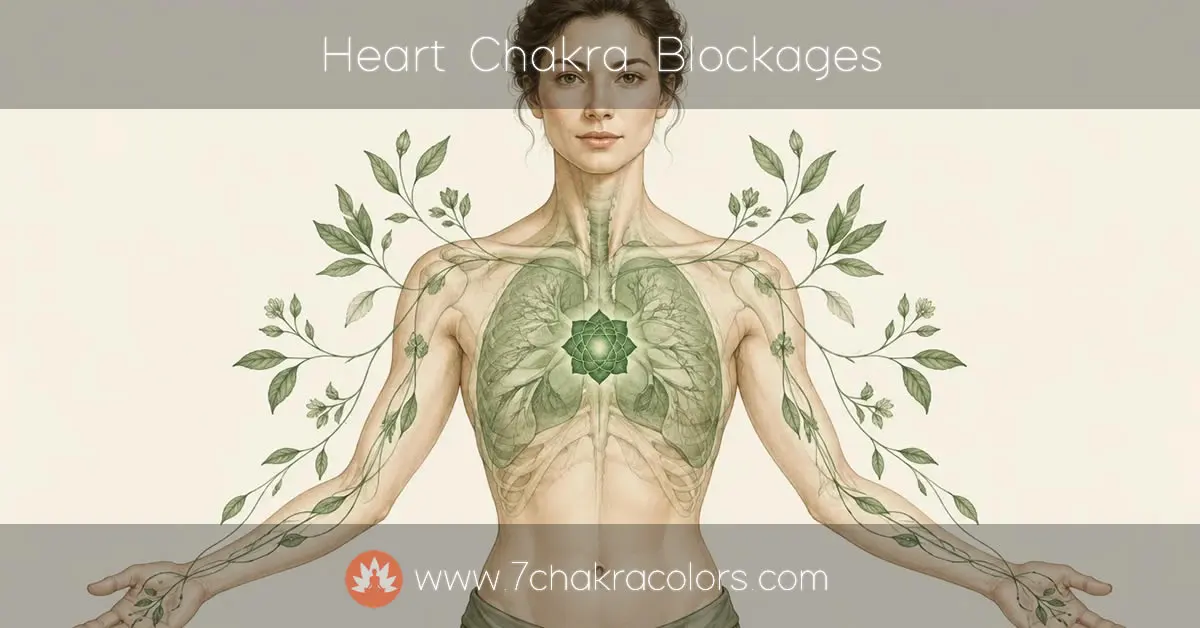
Quick background. The heart chakra, or Anahata, sits behind your breastbone, right in the middle of the seven. I like to picture it as the door between two floors of a house. Downstairs is all the practical, earthy business of staying alive and getting things done, upstairs is where your voice and intuition live. If that door jams, both floors get stuffy. Your love life is just the first place most people notice it.
Below, we’ll go through what that looks like in your body, your moods, and your relationships, plus what actually helps. There’s also a section on when chest tightness is a medical issue rather than an energetic one. Please read that one, even if you skip everything else.
What Is the Heart Chakra Connected To?
It’s the fourth chakra, counting up from the base of the spine. Most charts color it green, a few go with a soft rosy pink, and honestly both feel right to me. Element: air. Seed sound: YAM. The name roughly translates to “unstruck” or “unhurt” – the idea that some part of you stays whole no matter what happens to you.

Physically, the heart chakra is linked to:
- The heart and the circulatory system
- The lungs and breathing
- The thymus gland, which plays a part in immunity
- The upper back, shoulders, and chest muscles
- The arms and hands
- The breasts
On the emotional side, this is where love lives, in both directions. Giving it is usually the easy part. Receiving it is where people get stuck. Forgiveness belongs here too, and grief, and that tricky skill of letting someone get close without dissolving into them.
Notice the body list. Arms and hands are how we hug, hold, give, and receive. The lungs take in and let go. It’s all exchange. A blocked heart chakra is basically a breakdown in that exchange.
How Heart Chakra Blockages Manifest
Blockages here usually come from something specific. Heartbreak. A parent who loved you conditionally. A friendship that ended badly. Caring for a sick relative for years. Grief that never got the space it needed.

The heart does what any hurt animal does – it curls up around the sore spot. Shoulders creep forward. The chest sinks a little. Breath goes short and quiet. And on the inside the guard goes up: either you stop letting anyone close, or you swing the other way and keep so busy helping everyone that nobody thinks to ask how you’re doing.
That protection makes sense at first. The problem is when it stays long after the danger’s gone. Then it stops being protection and starts being a cage. That’s when the symptoms below tend to appear.
Physical Signs of a Blocked Heart Chakra
Hardly anyone has all of these. You’ll probably spot two or three that feel familiar, and you might notice they flare up around anniversaries, arguments, or bad news, then fade for a while.
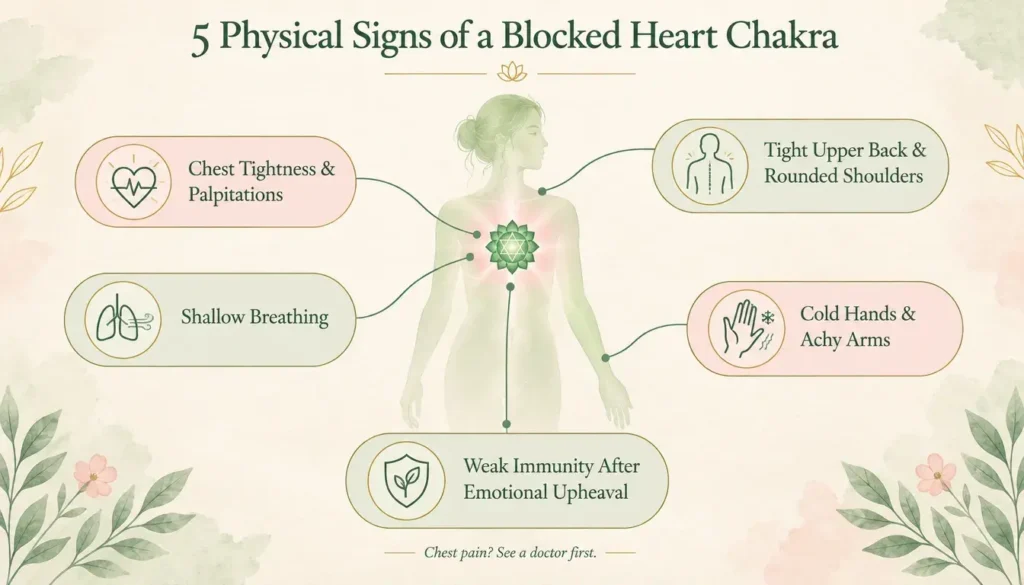
Chest Tightness and Heart Palpitations
This is the one people mention most. A band around the chest. A dull ache behind the breastbone during grief. Your heart fluttering or racing when you’re anxious about a relationship. In energy work, these are classic signs that Anahata has contracted.
But this is exactly where you need to be careful. Chest symptoms don’t always come from the energy body. Sometimes they come from the heart itself – a rhythm that’s off, a valve that isn’t closing properly, arteries not letting enough blood through. None of that gets fixed by putting a crystal on your sternum. So if you’ve been dodging a check-up (plenty of us do), it’s worth reading up on what are ecg and echocardiogram tests, because that’s usually where a cardiologist starts. Short version: the ECG is the one with the little stickers on your chest. It reads your heart’s electrical signals, which is how rhythm problems get spotted. The echo is basically an ultrasound of the heart (same cold gel, same handheld wand as a pregnancy scan), and it lets the doctor see the valves opening and closing and how strongly everything pumps.
Both are painless and over fairly quickly. And if the results come back clear, the relief alone can loosen your chest a little. Then you can do the energy work with a calm mind instead of a worried one. Honestly, that peace of mind is heart chakra healing too.
Breathing That Never Quite Reaches the Bottom
Air is Anahata’s element, so it makes sense that breath is usually the first thing to go. Try this right now, actually. Don’t change anything, just notice. Is the breath sitting up near your collarbones? Have you sighed in the last ten minutes without meaning to?
Shallow breathing, lots of sighing, the feeling that a full breath is just out of reach, chest colds that hang around for weeks – energy healers tie all of these to a heart chakra imbalance. Grief in particular has a habit of lodging in the lungs. (Traditional Chinese medicine pairs the lungs with grief too, so this isn’t only a chakra idea.)
Tight Upper Back and Rounded Shoulders
Watch people at a bus stop sometime. So many of them are slightly hunched, shoulders curled in, like they’re guarding something. Which, in a way, they are. When we feel exposed, the body closes over the chest on its own, without asking permission. Keep that up for a few months and it sets in. The upper back aches by evening, the front of the chest gets tight, and there’s usually one stubborn knot between the shoulder blades that no massage therapist ever quite gets rid of.
Lots of people carry their whole emotional history right there. Massage helps. Then it comes back. Which is usually a sign it’s still guarding something you haven’t looked at yet.
Cold Hands and Achy Arms
Energetically, the heart’s territory runs down your arms and out through your palms. Cold hands, tingling, stiffness in the wrists, or a general sense of “closed” hands are often read as energy that isn’t flowing outward – you’re holding back from giving or receiving.
Circulation issues in general fit here too, and high blood pressure is often mentioned in heart chakra literature. Get those checked medically, obviously. But keep an eye on whether they get worse when you’re going through something hard emotionally. That pattern tells you a lot.
Weak Immunity After Emotional Upheaval
Your thymus gland sits right behind the breastbone, smack in the middle of heart chakra territory. And it’s a really common story – someone goes through a breakup or loses a parent, and within a few weeks they’ve got a cold, then a sinus thing, then something else. Worn down and slow to bounce back.
That’s not coincidence in energy terms – and, to be fair, research on stress and immunity points the same way.
Emotional and Relationship Signs
The physical symptoms rarely show up alone. They usually travel with some of these:
- Trouble trusting people, even ones who’ve earned it
- Holding grudges, or replaying old hurts on loop
- Loneliness that doesn’t lift at parties or family dinners
- Squirming when someone compliments you, offers help, or buys you something
- Getting jealous or clingy with a partner, even when you know there’s no reason
- A sense of numbness – you know you should feel something, but you don’t
- Being very hard on yourself, with little self-compassion
Self-love belongs on this list more than people expect. A closed heart often isn’t closed to others first. It’s closed to you.
Underactive vs. Overactive Heart Chakra
A blocked heart chakra isn’t always quiet and shut down. Sometimes it’s overworking. Both are imbalances, and they look pretty different. To test your heart chakra with a quick quiz, click here.

An underactive heart chakra tends to show up as:
- Keeping even close friends at a polite distance
- A cynical streak, or feeling like you’re watching your own life from behind glass
- Pulling back the moment a relationship starts getting serious
- Breath that stays high and a chest that sort of folds inward
- Isolation that feels safer than connection
An overactive heart chakra tends to show up as:
- Saying yes to everything, then quietly resenting it
- Losing track of what you actually want once you’re in a relationship
- Running on empty because everyone else’s needs come first
- Walking out of a room carrying everybody’s mood with you
- A racing heart whenever you suspect someone’s upset with you
Plenty of us flip between the two, which is confusing. You over-give for months, hit a wall, go cold for a few weeks, feel guilty about it, and dive straight back into over-giving. If that’s you, more “opening” isn’t really the fix. Balance is.
Blocked Heart Chakra Signs by Body Area
For anyone who scrolled straight down here (no judgment), here’s the whole thing in one table.
| Body Area | Common Sign | Practice That Helps |
|---|---|---|
| Chest and heart | Tightness, heaviness, palpitations during emotional stress | Medical check first, then hands-on-heart breathing |
| Lungs and breathing | Shallow breath, frequent sighing, lingering chest colds | Slow back-rib breathing, exhaling longer than you inhale |
| Upper back and shoulders | Rounded shoulders, knot between the shoulder blades | Sphinx, cobra, or supported fish pose |
| Arms and hands | Cold hands, tingling, stiff wrists | Practicing receiving – accepting help and compliments |
| Immunity (thymus) | Getting sick after a breakup, loss, or disappointment | Rest, and giving grief real time and space |
| Emotional heart | Grudges, loneliness, numbness, harsh self-talk | Loving-kindness meditation and rose quartz |
Is Broken Heart Syndrome Real?
Funny how casually we throw the word “heartbreak” around. Turns out the body sometimes takes it literally.

Doctors call it takotsubo cardiomyopathy. The name comes from a Japanese octopus trap, because of the odd shape the heart takes on during a scan. Harvard Health has a good overview of broken-heart syndrome, which can follow a bereavement or a sudden shock and briefly weakens the heart’s main pumping chamber. In the moment, it can feel exactly like a heart attack. Most people do recover completely. Still, it happens, and it’s about as clear a sign as you’ll get that emotions and the body aren’t two separate systems.
I’m not telling you this to scare anyone. More the opposite. If your chest genuinely hurts after a loss, that’s not in your head and you’re not overreacting. Grief is physical. It deserves care on both levels – medical when needed, and emotional always.
When to See a Doctor
I love this work, but no amount of chanting will show you what’s happening in your arteries. If any of the following hits you, skip the meditation and call 112 (Europe) or 911 (US) straight away:
- Pain, squeezing, or pressure in the chest, especially if it spreads to an arm, the jaw, neck, or back
- Suddenly struggling to catch your breath
- Fainting, or feeling like the floor’s about to come up and meet you
- A cold sweat along with any chest discomfort

For the less urgent stuff – palpitations that keep coming back, getting winded on the stairs when you didn’t used to, puffy ankles, blood pressure readings creeping up – book a normal appointment. Get checked first. Then do the energy work alongside it. The two support each other.
How to Open and Balance Your Heart Chakra
The heart doesn’t open by force. It opens when it feels safe. So the practices that help are gentle ones.
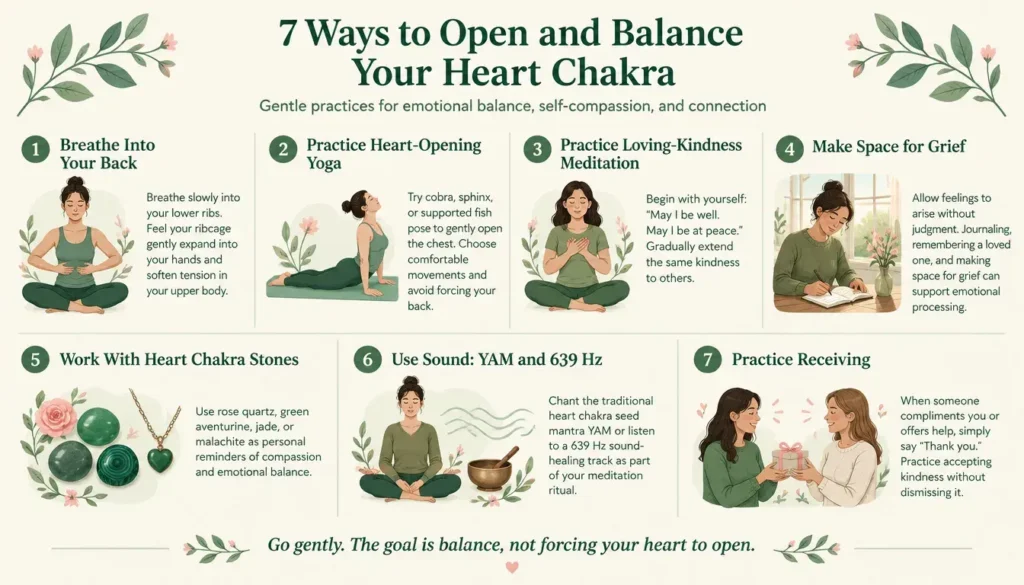
- Breathe into your back. Wrap your hands around your lower ribs, thumbs pointing toward the spine, and see if you can get the breath to widen your ribcage into your palms. Most people find this weirdly hard the first few times. It pulls the breath down out of the upper chest, and over a few weeks it starts loosening that protective hunch.
- Use heart-opening yoga poses. Cobra and sphinx are the easy ones. Supported fish over a rolled-up blanket is lovely when you’re tired. Camel is more intense, so only go there if your lower back’s happy. Stay a few breaths in each. If tears show up halfway through camel, let them. Chest openers do that sometimes.
- Practice loving-kindness meditation. Start with yourself and repeat something like “may I be well, may I be at peace.” Then send the same wish to someone you love, to a neighbor you barely know, and eventually to that one person who really gets under your skin. Sounds almost too basic, but it softens resentment faster than nearly anything else I know of.
- Let yourself grieve. Cry if it comes. Some people write a letter to whoever they lost and never send it. Others go back to a place that meant something to them both. There’s no correct method. Out of everything that blocks this chakra, old grief that got pushed aside “for later” is the one that comes up again and again.
- Work with heart chakra stones. Rose quartz is the obvious one, and for good reason. If pink isn’t your thing, green aventurine or a piece of jade does the job, and so does malachite, though it’s a bit pricier. Keep it somewhere close to the chest, on a necklace or even in a shirt pocket.
- Use sound: YAM and 639 Hz. YAM is the seed sound for Anahata. Keep the pitch low, drag out the “mmm” at the end, and you’ll feel a faint vibration under the breastbone. If chanting feels awkward (it does for most of us at first), put on a 639 Hz track instead. That’s the tone most sound healers associate with the heart.
- Practice receiving. Next compliment you get, say “thank you” and stop there. No “oh, this old thing.” Trickier than you’d think, and it’s very much heart work.
A Simple 5-Minute Practice for a Tight Chest
Use this when your chest feels heavy or clenched – once you’ve made sure there’s nothing medical going on.
- Sit however’s comfortable. Put both hands over the middle of your chest, one on top of the other.
- Shut your eyes and just feel your hands warming up against your shirt. Sometimes you’ll pick up your heartbeat after a few seconds. Sometimes you won’t, and that’s fine.
- Take a slow breath in while you count to four. Imagine a soft green, like new spring leaves, filling the space under your hands.
- Let it out over six counts. Your shoulders will probably drop a little on their own.
- Go round eight or ten times. On each out-breath, drop one thing you’ve been holding against yourself or someone else. Small stuff counts.
- To finish, say “I’m safe to love and be loved.” Out loud or in your head, either works.
Try it every day for two weeks. Pay attention to your breathing, and to how you react to people – your partner, your coworkers, the guy who cuts in line at the shop. Small shifts are the point.
A Softer Heart Isn’t a Weaker One
A blocked heart chakra isn’t a flaw. It’s what happens when a heart that got hurt decides to protect itself. Pretty reasonable, really.
The work isn’t tearing those walls down overnight. It’s showing your heart, a little at a time, that it’s safe to open. Go to the doctor for the physical heart. For the energetic one, it’s breath, letting yourself grieve, a bit of kindness, and people you can actually be yourself around.
You need both. They heal better together anyway.
Frequently Asked Questions About Heart Chakra Blockages
What are the symptoms of a blocked heart chakra?
Physically, the most common signs are chest tightness or heaviness, shallow breathing, upper back and shoulder tension, cold hands, and getting sick after emotional upheaval. Emotionally, a blocked heart chakra shows up as trouble trusting people, holding grudges, loneliness, difficulty accepting love or help, and a lack of self-compassion. Most people notice a handful of these rather than all of them.
Can a blocked heart chakra cause chest pain?
In energy work, chest tightness and a heavy feeling behind the breastbone are classic heart chakra signs, especially during grief. But chest pain can also signal a heart problem, so never assume it’s only energetic. Sudden or severe chest pain, or pain spreading to your arm, jaw, or back, needs emergency care right away. Recurring chest discomfort should be checked by a doctor, often starting with an ECG or echocardiogram.
What causes heart chakra blockages?
Most heart chakra blockages trace back to emotional pain – heartbreak, betrayal, the loss of someone close, conditional love in childhood, or long periods of caregiving without support. Unprocessed grief is one of the biggest causes. The heart closes to protect itself, and the blockage forms when that protection stays in place long after it’s needed.
What’s the difference between an underactive and overactive heart chakra?
An underactive heart chakra looks like emotional distance, coldness, fear of intimacy, and isolation. An overactive one looks like people-pleasing, codependency, giving until you’re drained, and absorbing other people’s emotions. Many people swing between the two, over-giving until they burn out and then shutting down. Both point to a heart that needs balance.
How do I know if my heart chakra is opening?
Common signs include breathing more deeply without trying, feeling more emotional than usual (crying easily is very common at first), a softer response to people who used to irritate you, and finding it easier to accept compliments or help. Some people feel warmth or gentle pressure in the chest during meditation. Old grief may resurface for a while. That’s usually part of the release, not a step backward.
Which crystals help heal the heart chakra?
Rose quartz is the best-known heart chakra stone and is linked to self-love and emotional healing. Green aventurine, jade, malachite, and emerald are also traditional choices. Wear one close to your chest or hold it during meditation. Crystals work best as a focus for your intention alongside practices like breathwork, journaling, and loving-kindness meditation.
Can grief really affect the physical heart?
Yes. Intense emotional stress can affect the heart directly. The best-known example is takotsubo cardiomyopathy, or broken heart syndrome, where a sudden shock or loss temporarily weakens the heart’s main pumping chamber. Most people recover fully within weeks, but it shows that grief isn’t only emotional. If you notice chest symptoms after a loss, see a doctor and give yourself space to grieve.
Blog Categories:
About the Author: