
Tendonitis and the Mind-Body Connection: Physical Symptoms and Energetic Meaning
Understand tendonitis through both physical and energetic perspectives. Explore chakra connections, mind-body stress patterns, and holistic healing practices for recovery.
Table Of Contents
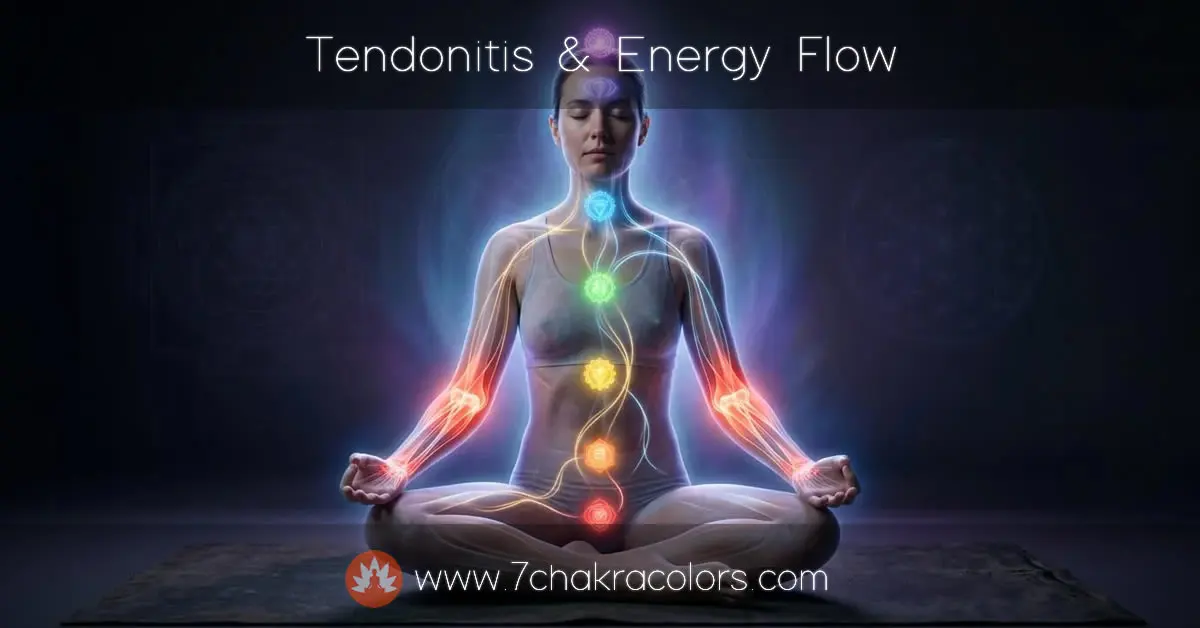
Tendonitis occurs as a direct result of stress accumulation and emotional patterns that may be unknown to you. As such, it also results from energetic blockages and how your body communicates when something essential is out of balance. By understanding tendonitis through a holistic perspective of medical and psychological/energetic issues, you will have a comprehensive view of what’s going wrong, and thus understand how to truly heal — not just treat the symptoms.
More than just a medical condition: a holistic perspective of tendonitis
A tendon is made up of collagen fibers that connect bones to muscles. When inflammation develops due to either repetitive motion, injury or long-term tension, you experience pain, swelling, heat and redness at the site of the damaged tendon. Many cases of tendonitis originate after an accident. More often than not, however, tendonitis results from accumulated tension.
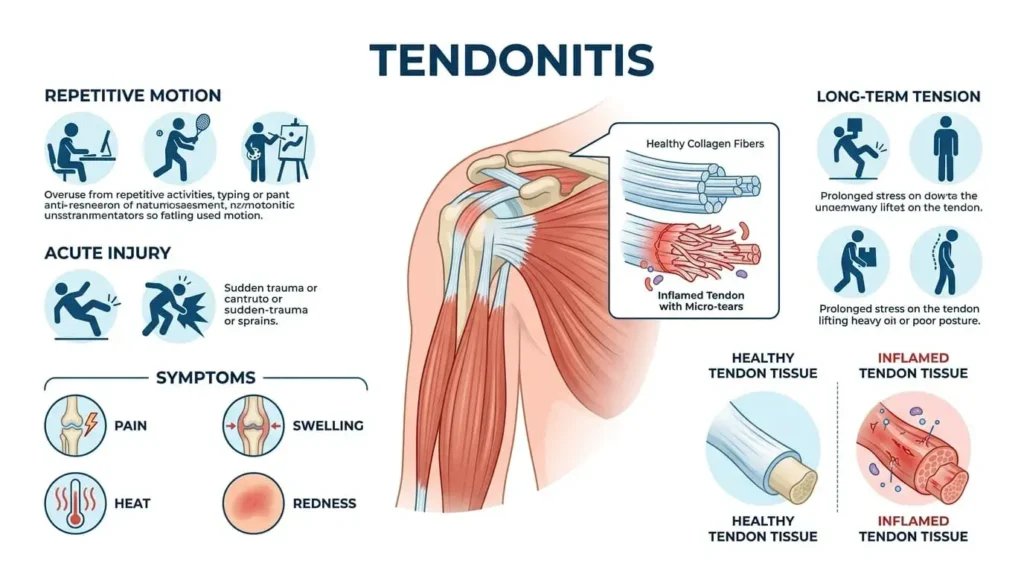
Doctors who deal with tendonitis treatment usually identify these types of injuries using common terms like, “tennis elbow,” “runner’s knee,” etc. The names describe the injured area, but do not provide insight into what caused the pattern of injury. That is where conventional treatment fails to provide answers.
Rest, ice and anti-inflammatory medications, along with physical therapy can help manage acute symptoms. However, until the original reason is addressed, tendonitis almost always recurs in the same joint or moves to other joints. The cause is different, but the pattern of injury remains the same.
How emotional tension creates physical problems
Stress and emotions can never be separated from physiological responses. When you experience stress whether that be at work (deadlines), financially (debts), in relationships (conflict) or ongoing anxiety (worry), your body reacts physically. Your muscles tense. Your connective tissues harden. Your inflammatory markers rise. The body enters into a continuous state of “fight or flight.” Therefore, when you sustain prolonged stress in your body, your muscles remain partially contracted all the time. After many months or years of sustaining low levels of tension in your muscles, this tension accumulates in the tendons. When you add repetitive motion (typing at a computer, gripping tools, reaching above your head), your inflamed tendons exceed a threshold of injury from mechanical causes alone and become symptomatic.
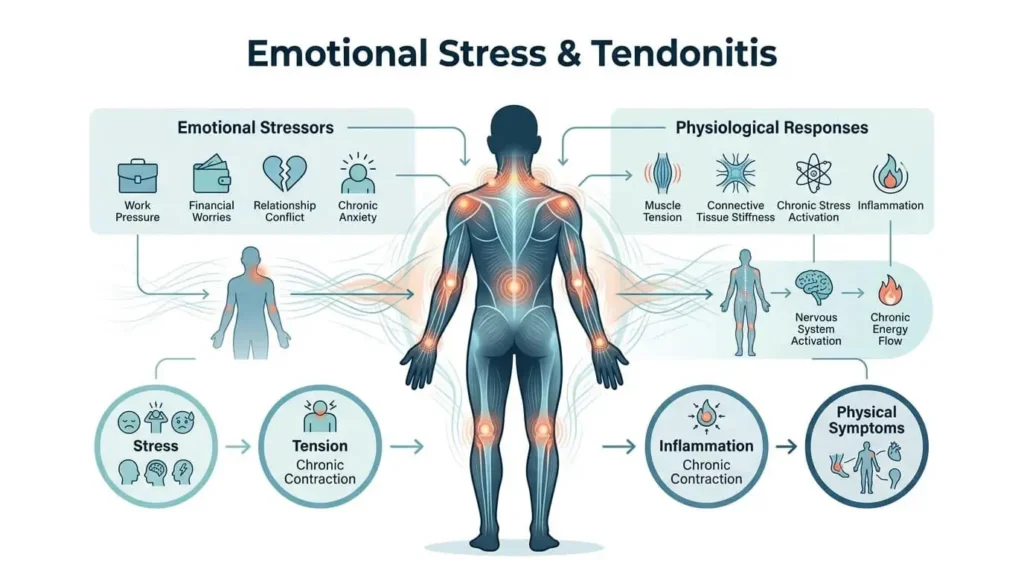
Inflammation of the tendons can occur for reasons other than mechanical damage. Inflammation represents your body’s attempt to store excess muscular tension and suppressed emotional content and to release blocked energetic patterns. You are literally storing stress as tissue inflammation.
Holistic viewpoint of tendonitis using chakra and energetic concepts
Different parts of the body relate to different energies or chakras. Specifically, the part of your body where you develop tendonitis provides insight into what kind of imbalance exists within you at a deeper level.
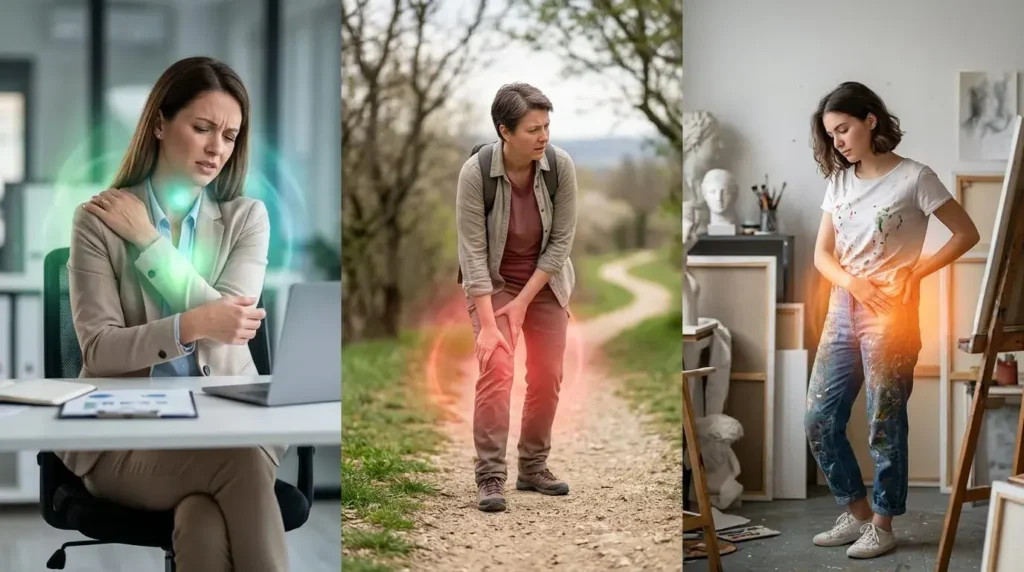
Upper body: shoulders, elbows, wrists & hands: heart and throat chakras
The upper body relates energetically to the heart chakra (regulating emotional balance and expression) and the throat chakra (controlling authentic communication). Upper body tendonitis is frequently indicative of over-giving, taking too much responsibility, or suppressing self-expression. For example:
Are you working in a job that doesn’t match your core values? Are you constantly supporting others’ needs without receiving equal support? Are there things that matter to you that you’re not expressing because you fear the consequences?
All of these examples represent accumulated tension that settles in your shoulders and tendons.
Lower body: knees, ankle, hips & lower back: Root Chakra
The lower body relates energetically to the Root Chakra (stability, safety and having a solid base in life). Tendonitis in the lower body often indicates fears about advancing in life, a sense of instability or resistance to change. Your lower body represents your ground or foundation in life. If you feel unsafe—emotionally, financially or otherwise—you will down-regulate activity in your lower body as a protection response. Your muscles will contract. Your tendons will become inflamed. You will experience pain or stiffness that paradoxically supports your sense of being stuck or unable to move forward.
Many people who experience chronic knee or ankle tendonitis say they feel unsupported in major aspects of their lives. It is not that your body is malfunctioning—it is reporting an energetic and emotional truth through physical tension and inflammation.
Sacral chakra/Hip Tendonitis
Hip tendonitis often represents blocked creative expression or suppressed emotion. The sacral chakra governs our ability to feel and move freely and express ourselves creatively. When this energy is limited—due to emotional rigidity, perfectionism or fear of being seen—the hips and surrounding tendons will contract to reflect this limitation.
Those undergoing a period of transition, suffering from creativity blocks or experiencing emotional numbness will often develop hip or groin tendonitis. The inflamed tendon serves as a message from your body indicating that there is an obstruction in your natural flow that needs attention.
Mind – body connection: relationship between thought patterns and physiological effects
It has been documented scientifically that chronic negative thoughts will elevate inflammatory markers in your entire body. Suppressing anger will lead to chest constriction and shoulder tension. Fears will contract your lower body. Repetitive thought patterns will literally reshape your physiology over time.
Think about someone who continually thinks “I cannot handle this” or “I’m not supported.” Those are thoughts that produce physical reactions: involuntary muscle contractions, energy withdrawal from limbs, progressive contraction of tendons. Repeating those thoughts tens-of-thousands of times leads to chronic contraction in the body leading to inflammation in the tendons.
On the flip side, shifting your thoughts—moving towards compassion for yourself, being grounded, trusting—that is when the body relaxes and inflammation subsides allowing for improved tissue repair. This is not placebos or fantasy—it is scientific fact. Your nervous system continuously communicates with immune function, inflammatory response and tissue repair processes. Your beliefs literally determine your bodily state.
| Location | Physical Perspective | Energetic Perspective |
|---|---|---|
| Shoulder | Rotator cuff strain, repetitive overhead movement, postural misalignment, muscle imbalances | Heart and throat chakra imbalance; carrying responsibility, over-giving, suppressed self-expression, difficulty setting boundaries |
| Elbow (Tennis/Golfer’s Elbow) | Repetitive gripping or throwing motions, forearm muscle overuse, lack of rest between activities | Throat chakra tension related to communication stress; holding back words, tension from not being heard, gripping onto control |
| Knee | Running or jumping impact, muscular imbalances, alignment issues, inadequate recovery | Root chakra instability; fear of moving forward, feeling unsupported, insecurity about direction or life changes |
| Hip/Groin | Repetitive leg movement, hip flexor tightness, muscle strain from sitting or sports | Sacral chakra restriction; blocked creative expression, emotional rigidity, suppressed sexuality or vitality, resistance to flow |
Practical Methods to Heal from Tendonitis
To properly recover from tendonitis, one must utilize methods that target the root cause(s) of the condition including physical therapy and practices targeting stress, emotional patterns and energetic imbalances.
A number of natural remedies can be used to treat the causes of tendinitis. Grounding and working with your Root Chakra will allow your body to heal.
Grounding and Root Chakra Work
Walking barefoot and touching the earth will provide grounding. When walking barefoot, walk in the dirt or grass. Walk on the earth for 10 – 15 minutes each day. The earth has an effect on your nervous system and Root Chakra. Working with your Root Chakra will give you great results especially if your tendinitis is in the lower part of your body.
Using Root Chakra focused affirmations such as “I am safe,” “I am supported,” and “I trust my body” will program away some of the fear-based thinking that creates the inflammation. Affirmations work best when you use them regularly.

Visualize roots coming up from your feet and down into the earth. This visualization will ground you and calm your nervous system which will decrease inflammation. Visualizing roots growing down into the earth will also stabilize your energy and help reduce the fight or flight response which creates inflammation.
Breathing Techniques and Nervous System Regulation
Breathing techniques that regulate your nervous system will reduce inflammation. Diaphragm breathing allows you to breathe slowly and deeply using your diaphragm instead of shallow chest breathing. When you slow down and breathe deeply you will go into rest and repair mode. Your body will begin to repair itself rather than fighting off inflammation.
Use the 4 – 7 – 8 breathing technique. Breathe in for four counts, hold for seven, then breathe out for eight. This is a very calming way to regulate your nervous system. Research shows that this type of breathing can significantly decrease your pain levels.

Direct your breath into the center that is experiencing pain. Use a chakra focused breathing technique. Directly breathing into your heart and throat centers may help alleviate shoulder tendinitis. Breathing into your root center may help alleviate knee tendinitis.
Gentle Movement and Stretching
Use gentle movements to stretch and release tension in your muscles. Stretching is important but it should be done slowly and gently. Do not force any position or movement. Some positions can cause further damage.
Yoga and Tai Chi are two forms of exercise that are excellent for stretching while allowing you to maintain flexibility. They are low impact and do not put additional strain on injured joints or muscles. Restorative Yoga, in particular, is one of the best exercises for people who suffer from tendinitis. It uses props to allow you to stay in a pose for long stretches of time, thereby loosening tight muscles. Yin Yoga is another form of exercise that is good for people with tendinitis. It focuses on connecting with the deeper layers of the muscle tissues by applying pressure to these areas through various poses.
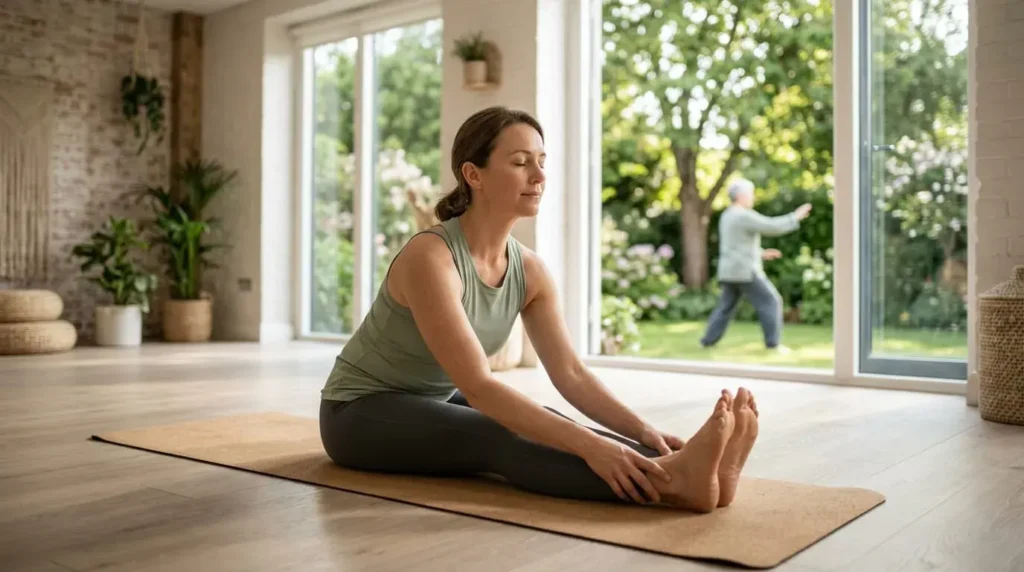
Tai Chi is a slow-moving meditative art that cultivates inner peace while improving strength and flexibility. The soft flowing movements help loosen tense muscles and improve circulation, helping to promote overall well-being. Tai Chi does not cause injury and promotes better health.
You can release tension in your muscles using Somatic Shaking. Shake your body gently until all tension is released. This releases chronic tension stored in the nervous system. Somatic Tremors can help release tension stored in the nervous system as well.
Sound Healing and Chakra Balancing
Sound healing can be used to release blockages in the body and bring balance to the chakras. Singing Bowl/Toning/Chakra Tonings are three examples of how sound healing can be applied.
Rebalancing your chakras by chanting Seed Mantras will assist in balancing the energies associated with your tendinitis. Use the correct Seed Mantra for the area where your tendinitis exists. For example, LAM for root, VAM for sacral, RAM for solar plexus, YAM for heart, HAM for throat.
Certain frequencies of sound can affect the brainwave activity in our bodies and alter states of consciousness. Using therapeutic frequencies that have been shown to relieve pain (40 Hz) and induce relaxation (10 Hz), can create environments conducive to reducing inflammation and promoting tissue repair.

Singing Bowls/Sound Baths create vibration in the body and help clear stagnant energy. This clears the path for your body to repair itself naturally.
Integration and Healing
Addressing both physical and energetic components simultaneously produces significant results. The pain slowly fades away. The inflammation slowly disappears. More importantly, the fundamental issue causing the tendonitis changes. You walk/move/breathe differently.
This is when actual healing starts.
Frequently Asked Questions About Tendonitis and the Mind-Body Connection
Can emotional stress actually cause tendonitis?
Stress alone doesn’t directly damage tissue, but chronic stress creates sustained muscle tension and inflammation throughout your body. Combined with repetitive movement or strain, this tension makes tendonitis more likely to develop. Stress also suppresses immune function and slows tissue repair, making recovery slower. The relationship is real: people experiencing significant stress often develop tendonitis in areas where they habitually hold tension.
How long before mind-body practices help my tendonitis?
Most people notice shifts within one to two weeks of consistent practice. You might sleep better, feel less anxious about the injury, or notice your pain fluctuating less. Actual tissue healing usually takes 4-6 weeks or longer, depending on severity. What matters is consistency. Practicing breathing work and grounding daily does more than sporadic intensive sessions. Combine these practices with physical therapy for best results.
Which healing practice should I prioritize if I can only do one?
Start with grounding and nervous system regulation through breathing. A 5-10 minute daily practice of diaphragmatic breathing or 4-7-8 breathing directly reduces the nervous system activation that drives inflammation. Once you’re doing that consistently, add chakra work specific to your injury location. The foundation is calming your nervous system first, then addressing the energetic imbalance. Everything else builds from there.
Can I do these energy and mind-body practices while in physical therapy?
Absolutely. They work together. Physical therapy addresses movement patterns and strengthens supporting muscles. The mind-body and energetic practices address the stress and emotional patterns holding tension in place. One is mechanical, one is systemic. A good physical therapist will support you exploring what’s driving your injury holistically. If your therapist dismisses the mind-body connection, that’s actually a signal they’re missing part of the picture.
What if resting my tendonitis makes it feel worse?
Complete immobility can sometimes increase stiffness and pain, especially if anxiety about the injury is high. The solution isn’t to keep straining it, but to move gently. Gentle yoga, tai chi, and slow range-of-motion exercises keep blood flowing and prevent the nervous system from becoming hyper-protective. Work with a physical therapist to find the balance between rest and gentle movement. Your body is often communicating that it needs movement in a different way, not aggressive strain.
Should I try these practices instead of seeing a doctor?
No. Tendonitis requires professional evaluation from a physician or physical therapist. These practices are complementary, not substitutes. Some tendonitis involves tears or severe inflammation requiring specific medical treatment. See a professional first to understand the extent of your injury. Then add grounding, breathwork, chakra work, and other holistic practices alongside that care. The combination approach works better than either alone.
How do I know which chakra relates to my tendonitis location?
The article outlines the basic associations: shoulders and arms connect to heart and throat chakras, lower body to root chakra, hips to sacral chakra. But also pay attention to what the injury means to you emotionally. Where do you carry your stress? What’s the underlying emotion—fear, suppressed expression, feeling unsupported? Your intuition often knows before your mind does. Once you’ve identified the likely chakra, focus your breathing and visualization work there. The energy will respond.
Blog Categories:
About the Author: