

What Lab Research Actually Shows About the Copper Peptide GHK-Cu
Explore what in-vitro research actually shows about GHK-Cu: collagen remodeling, fibroblast effects, and the gap between lab findings and anti-aging claims.
Table Of Contents
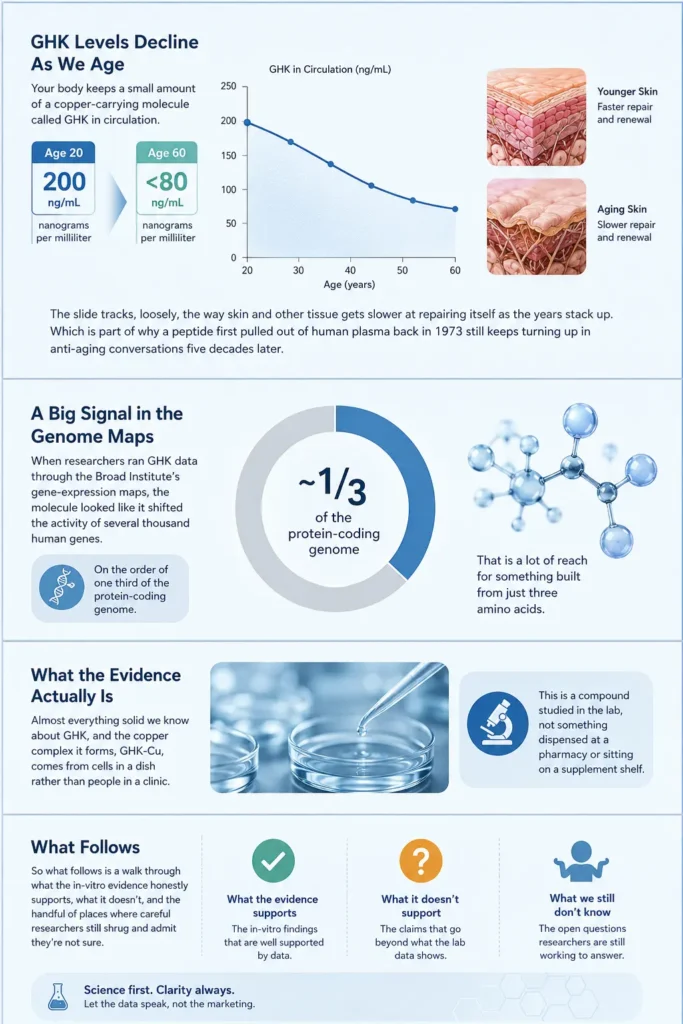
Your body keeps a small amount of a copper-carrying molecule called GHK in circulation, roughly 200 nanograms per milliliter at age 20, and by 60 that has dropped to under 80. The slide tracks, loosely, the way skin and other tissue gets slower at repairing itself as the years stack up. Which is part of why a peptide first pulled out of human plasma back in 1973 still keeps turning up in anti-aging conversations five decades later.
The figure that gets quoted most about it is a big one. When researchers ran GHK data through the Broad Institute’s gene-expression maps, the molecule looked like it shifted the activity of several thousand human genes, on the order of a third of the protein-coding genome in that reference set. That is a lot of reach for something built from three amino acids. It is also exactly the spot where product copy tends to sprint past what the cell-culture work has genuinely pinned down.
Almost everything solid we know about GHK, and the copper complex it forms, GHK-Cu, comes from cells in a dish rather than people in a clinic. This is a compound studied in the lab, not something dispensed at a pharmacy or sitting on a supplement shelf. So what follows is a walk through what the in-vitro evidence honestly supports, what it doesn’t, and the handful of places where careful researchers still shrug and admit they’re not sure.
A molecule your body makes, then quietly stops making
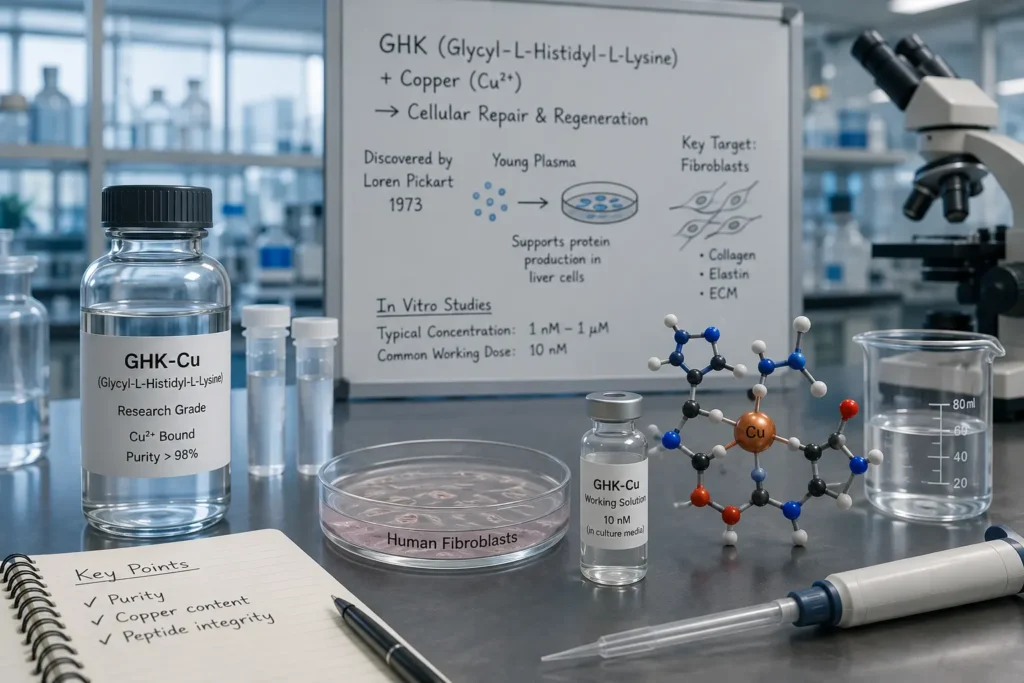
GHK is short for glycyl-L-histidyl-L-lysine, three amino acids strung together with a strong grip on copper. The copper part isn’t a footnote. The reason the molecule does anything worth studying is that it carries copper and hands it off where a cell can use it.
Loren Pickart stumbled onto it. In 1973 he was trying to figure out why blood plasma from older donors behaved so differently from younger plasma when both were dripped onto the same liver cells in culture. Younger plasma kept the tissue churning out proteins as if it were still young. Something in it was doing that work, and that something turned out to be GHK.
The cells the peptide gets studied on most are fibroblasts. If skin were a building, fibroblasts would be the crew that pours the foundation and patches the walls. They spin out collagen, elastin, and the gel-like matrix that holds everything together and gives skin its spring. When that crew slows down, skin thins and loses its bounce. So a molecule that seems to talk directly to fibroblasts, and that the body stocks less of with age, is an obvious candidate for the microscope.
In practice, studies dissolve the peptide in sterile water or buffered media and apply it at tiny concentrations, usually somewhere between a billionth and a millionth of a mole per liter. Ten nanomolar cells show up repeatedly as a working dose for collagen and growth experiments. Before any of that, the careful groups check two unglamorous things about the research-grade GHK-Cu they start with: how pure it is, and exactly how much copper is bound to it. Skip those checks and the rest of the experiment is built on sand.
The collagen story is really a remodeling story
The first clean fibroblast result landed in 1988, when Maquart and colleagues reported in FEBS Letters that GHK-Cu pushed cultured skin fibroblasts to make more collagen at concentrations as low as 10⁻⁹ M. Getting a measurable response at a billionth of a mole is genuinely odd, and that low threshold is still one of the more remarkable things about the peptide.
However, “it makes more collagen” is where a lot of write-ups stop, and that’s a thin version of events. What the broader literature describes is remodeling, not a one-way pile-up. The same French group later reported jumps in glycosaminoglycans, including dermatan sulfate proteoglycans, in 1992. Other work flagged decorin, a small proteoglycan that doesn’t bulk up collagen so much as govern how thick the collagen fibrils grow. Elastin shifts too. So does the activity of matrix metalloproteinases like MMP-2, the enzymes whose job is to chew matrices back down.
A 2015 review in BioMed Research International, the most-cited summary of GHK’s biology, describes the peptide stimulating both the synthesis and the breakdown of collagen and glycosaminoglycans, while nudging the metalloproteinases and their inhibitors in tandem. GHK-Cu acts less like a tap that floods a cell with collagen and more like a foreman reorganizing the stock that’s already on site. For anyone running matrix assays, that means watching the ratios between components, not totaling up collagen and calling it a night.
The proliferation claim is oversold
If the marketing has a favorite move, it’s hinting that GHK-Cu makes skin cells multiply. The lab data is far more reserved. Across the usual run of cell-counting, MTT, and BrdU assays, fibroblast proliferation tends to rise by something like 15% to 40% over untreated cells. Real, repeatable, useful to know, and nowhere near the explosion the word “regeneration” tends to summon.
It’s dose-fussy on top of that. Push the concentration up, especially past 1 to 10 micromolar in media that already holds serum, and the proliferation bump flattens or reverses. The distinctive, reproducible signal from this peptide lives in matrix composition and gene expression, not in raw cell counts. Anyone expecting fibroblasts to double on cue is simply reading the wrong endpoint.
Why more is not better
This is the counterintuitive part, and the one most worth holding onto. GHK-Cu is biphasic across several fibroblast readouts. Low doses stimulate. Higher doses can stall the very same process, or tip into outright toxicity over longer exposures, where free copper drifting loose from the complex starts driving oxidative damage.
The instinct that a bigger dose means a bigger effect is the single most common design mistake with this class of peptide. A sensible experiment spreads doses across at least three orders of magnitude, something like 1, 10, and 100 nanomolar on up to 1 and 10 micromolar, precisely because the sweet spot moves with the copper-to-peptide ratio, the buffer, and how much serum sits in the media. It’s also why two papers can look like they flatly contradict each other when really they were perched on different parts of the same curve.
What the gene data does (and doesn’t) say
Back to that headline number. Pickart and Margolina’s gene-expression analyses, expanded across their later reviews, lay out clusters of genes that move when cells meet GHK, including ones tied to DNA repair, antioxidant defense, and matrix organization.
Independent groups working with aging human fibroblasts have reported something genuinely tantalizing: in late-passage cells, the ones that have divided many times and started to look worn, GHK exposure can shift gene-expression patterns partway back toward a younger profile. How big that shift is, and whether it shows up reliably, leans heavily on the cell source and how many times the cells have been passed.
The caveat that matters most rarely makes the product page. A transcriptional shift is not the same thing as a young cell. The expression pattern moves; the cell does not suddenly turn back its clock. Whether that reshuffling translates into anything functional, real changes in how a cell ages, behaves, or secretes, is a separate question each study has to test on its own terms.
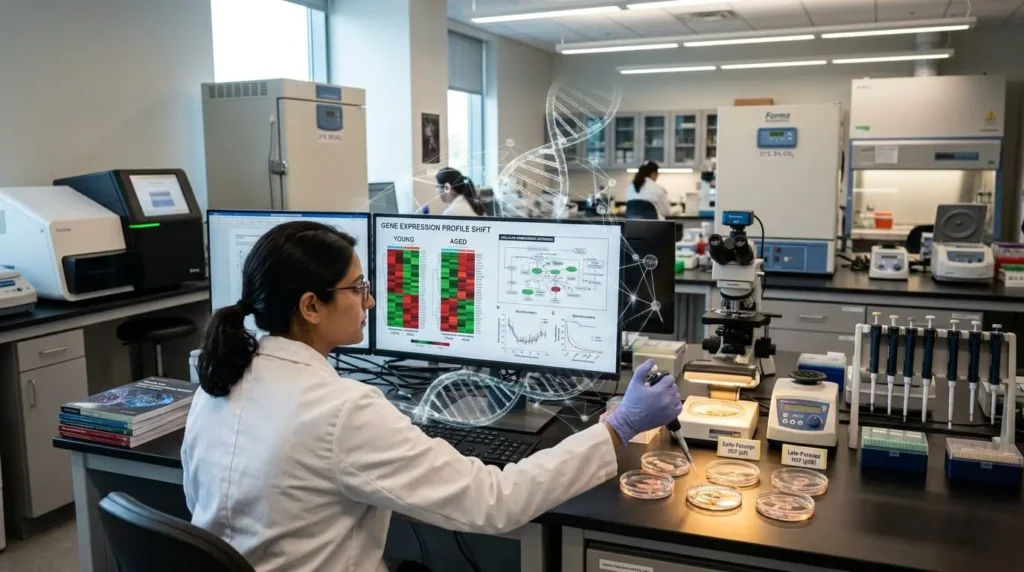
Most of this evidence is microarray and bioinformatics, not a demonstration that tired cells were rescued. The distance between “these genes changed” and “the cell got younger” is wide, and it’s where the most interesting unfinished work still sits.
How to read the evidence (and the marketing)
A few honest gaps deserve naming, because they almost never get mentioned next to the enthusiasm. After 50 years, nobody has nailed down the specific receptor or binding partner GHK-Cu uses inside a fibroblast. There are candidates, mostly copper-transport proteins and redox-sensitive signaling nodes, but no agreed answer.
The bridge from “genes changed” to “cell function changed” is still half-built, and most of the published work leans on dermal fibroblasts, with far less on the cardiac, lung, or joint varieties, which makes generalizing across tissue types shakier than it sounds.
None of that makes GHK-Cu boring. It makes it a normal scientific subject, with a real signal, a noisy literature, and open questions, rather than the miracle a serum label likes to imply. If there’s one thing to carry out of the cell-culture record, it’s the gap between a repeatable change in a dish and a claim about a human face. The peptide does something measurable to fibroblasts. What it does to you, through a cream or anything else, is a question the dish was never built to answer.
Frequently Asked Questions
Is GHK-Cu proven to reverse skin aging?
The strongest evidence comes from cells in culture, where GHK-Cu reliably affects collagen and matrix remodeling and shifts gene-expression patterns. Those are findings in a dish. They don’t establish that the peptide reverses aging in an actual person, and the research literature is careful not to make that leap.
What concentrations do researchers use for GHK-Cu in fibroblast studies?
Most published fibroblast work sits in the nanomolar-to-micromolar range, with 10 nanomolar a common starting point for collagen and gene-expression experiments. Since the response is dose-sensitive and even biphasic, careful studies test a spread of concentrations across several orders of magnitude rather than betting on one number. In the original 1988 Maquart paper, collagen stimulation began in the picomolar range and peaked around 10⁻⁹ M.
Why do GHK-Cu experiments need a copper-only control?
Since copper on its own can do things, and you need to know whether an effect came from the intact peptide-copper complex or just from free copper ions. Running copper-only and peptide-only controls alongside the complex is how researchers tell the two apart. Leaving them out is one of the most common criticisms aimed at older GHK studies, and it’s the fastest route to a result that won’t replicate.
What is GHK and why does your body’s levels decline with age?
GHK is short for glycyl-L-histidyl-L-lysine, a copper-carrying molecule made up of three amino acids strung together with a strong grip on copper. Your body keeps a small amount in circulation—roughly 200 nanograms per milliliter at age 20, dropping to under 80 by age 60. The decline tracks with how skin and other tissue slows at repairing itself as the years accumulate. The copper part is essential to the molecule’s function, as it carries copper and hands it off where cells can use it. This age-related decline is part of why researchers became interested in studying whether supplementing GHK-Cu might help maintain tissue repair capacity.
What does biphasic response mean and why does more GHK-Cu not always mean better results?
Biphasic response means GHK-Cu shows different effects at different doses. Low doses stimulate desired changes like collagen remodeling and gene expression shifts. Higher doses can stall the same process or even tip into toxicity over longer exposures, where free copper drifting loose from the complex starts driving oxidative damage. The instinct that a bigger dose means a bigger effect is the single most common design mistake with this class of peptide. That’s why careful experiments spread doses across at least three orders of magnitude to find the sweet spot, which moves based on the copper-to-peptide ratio, the buffer used, and how much serum sits in the media.
Why do fibroblasts matter in GHK-Cu research?
Fibroblasts are the workhorse cells of your skin. If skin were a building, fibroblasts would be the crew that pours the foundation and patches the walls. They spin out collagen, elastin, and the gel-like matrix that holds everything together and gives skin its spring. When that crew slows down, skin thins and loses its bounce. Because GHK-Cu seems to talk directly to fibroblasts, and because the body stocks less of it with age, fibroblasts are an obvious candidate for studying how this peptide might affect aging tissue. Most of the published lab work studies GHK-Cu effects on dermal fibroblasts specifically, though less research exists on fibroblasts from cardiac, lung, or joint tissue.
What’s the gap between gene expression changes and actual anti-aging effects?
A transcriptional shift is not the same thing as a young cell. When GHK-Cu exposure shifts gene-expression patterns in aging cells partway back toward a younger profile, the expression pattern moves—but the cell does not suddenly turn back its clock. Whether that reshuffling translates into anything functional, into real changes in how a cell ages, behaves, or secretes molecules, is a separate question each study has to test on its own terms. Most of the gene-expression evidence is based on microarray and bioinformatics, not a demonstration that tired cells were actually rescued. The distance between “these genes changed” and “the cell got younger” is wide, and it’s where the most interesting unfinished work still sits.
Research-use note
GHK-Cu referenced here is intended strictly for in-vitro laboratory and educational research. It is not a drug, supplement, cosmetic, food, or medical device, and it is not for human or veterinary use of any kind. Nothing in this article is meant to diagnose, treat, cure, or prevent any condition, and the studies cited are provided for academic reference, not as an endorsement of any use outside a controlled laboratory. Anyone conducting research is responsible for following the relevant institutional, biosafety, and legal requirements.
Blog Categories:
About the Author: