
How to Light Your Home Meditation Space
Lighting shapes your practice more than any cushion. Colour temperature, neon signs, candles and chakra colours for a calmer home meditation corner.
Table Of Contents
Walk into a room where people have been arguing and you feel it before anyone says a word. Walk into a room where someone has been sitting quietly every morning for two years and you feel that too. Rooms hold things. Whatever you want to call it – atmosphere, energy, memory soaked into the walls – it’s real enough that everybody recognises it.
Which is the whole argument for having a dedicated meditation space at home. Not a converted spare room with a fountain in it. A corner will do. What matters is that the spot becomes associated with one activity, so that sitting down there starts to trigger the settling before you’ve even closed your eyes. Your nervous system learns places. Give it a good one and it stops needing convincing.
There’s the clearing side of it, too. Energetically speaking, a space picks up whatever happens in it – and a corner where you also pay bills, answer emails, and scroll through bad news at midnight is carrying all of that. Cleaning it properly matters more than decorating it. Physical clutter first, because visual noise is mental noise. Then whatever cleansing practice you work with: smoke, sound, salt, an open window and ten minutes of moving air. A bell rung in each corner does more than most people expect.
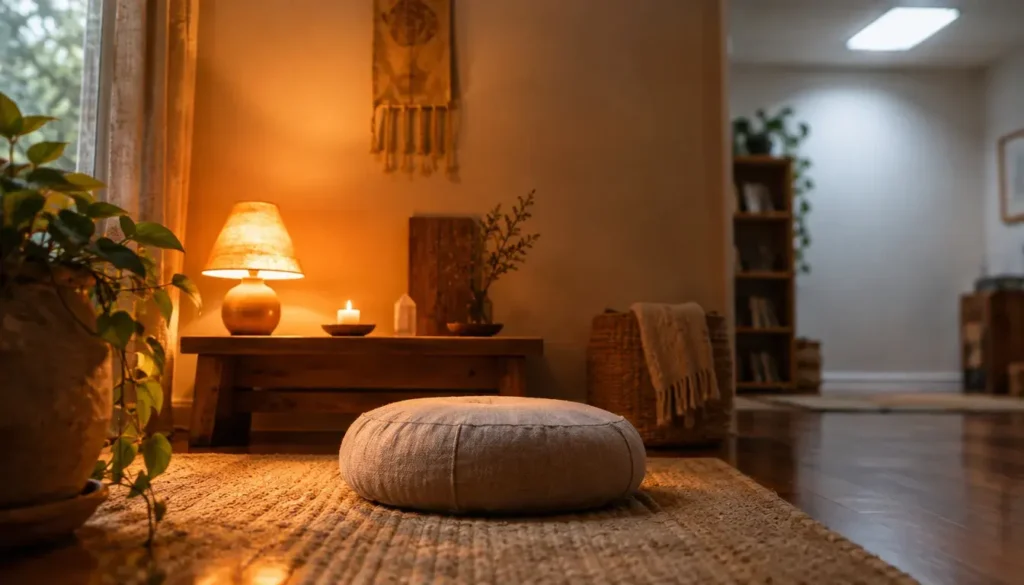
And then there’s light. Which is where most home setups quietly go wrong – a beautiful cushion sitting under a hard white ceiling bulb that’s been fighting the practice the entire time.
What you actually need in the space
Before the lighting, a quick pass over the basics. You need less than the Pinterest boards suggest.
- Something to sit on. A zafu or crescent cushion lifts your hips above your knees, which is what stops your lower back rounding and your feet going numb. A folded blanket under a firm pillow works nearly as well.
- Something underneath it. A zabuton, a folded mat, a rug – anything that keeps your ankles off a hard floor.
- A blanket. Your body temperature drops when you settle, and being cold at minute twelve ends more sessions than boredom does.
- A chair, if you need one. Floor sitting isn’t compulsory and never was. Feet flat, spine unsupported or lightly supported, that’s fine.
- A small altar or surface. A low shelf, a stool, a wooden box. Somewhere for a candle, a crystal, an image – something to give your eyes a resting point and mark the space as intentional.
- Sound, or the absence of it. A singing bowl, a timer with a gentle chime, or headphones for frequency work. Anything but your phone’s default alarm.
- Scent, used sparingly. Incense, palo santo, a diffuser with a single oil. Smell is the fastest route into memory, which makes it a powerful cue – and overwhelming when overdone.
- Somewhere to put your phone. Outside the room. That’s the item.
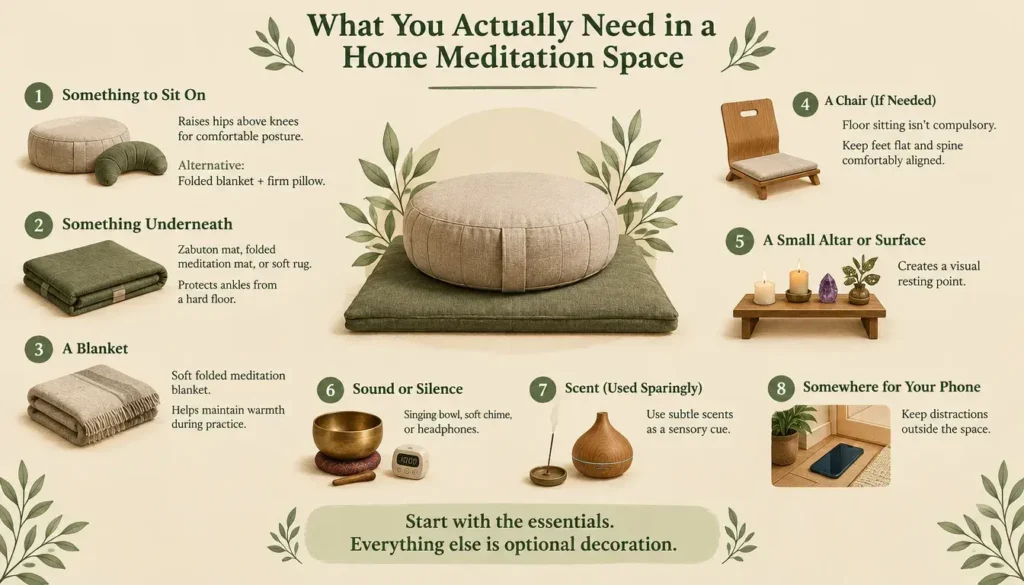
That’s the kit. Everything beyond it is decoration, and decoration is fine, but it won’t change your practice. Light will.
Why light shapes the practice more than anything else in the room
Your body reads light as instruction. Bright, cool light hitting your eyes tells your system it’s the middle of the day and there are things to be done – cortisol stays up, alertness stays up, and the part of you that needs to downshift simply won’t. Warm, dim light says the opposite. It’s the signal every human ran on for a few hundred thousand years, back when the evening light source flickered and sat low on the ground.
That’s not decor. That’s physiology, and you’re either using it or working against it.
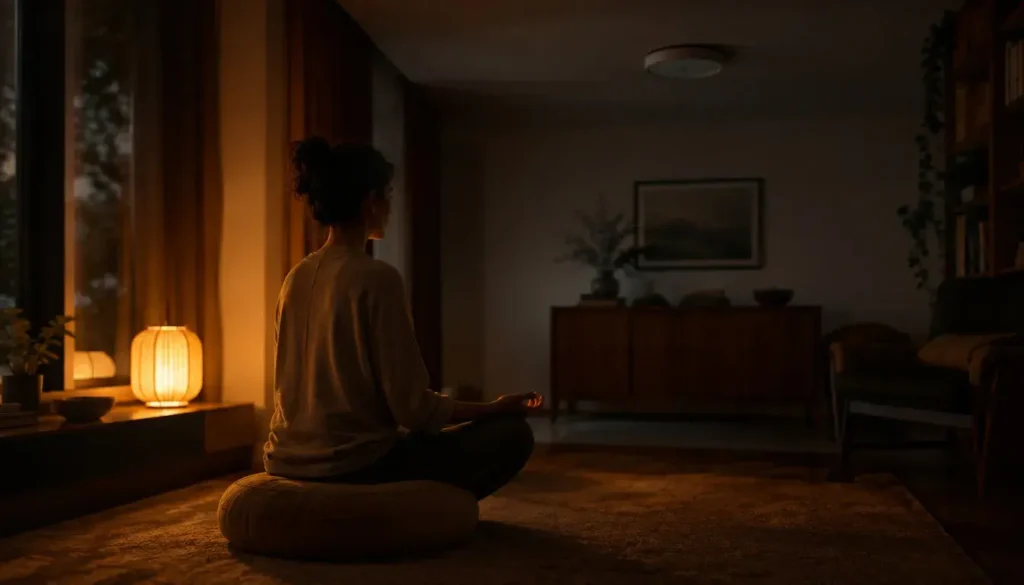
Anyone who works with the subtle body has another reason to care. The eyes feed directly into the same region associated with the third eye – and glare, flicker, and cold overhead light all keep that area braced and busy. Soften the light and something behind the forehead loosens. Most people notice it within one session.
Lighting options for a meditation corner
You’re not choosing one. Good lighting in a small space is layered – two or three low sources at different heights, none of them above eye level if you can help it.
Warm, dimmable lamps at floor level
The foundation of the whole setup. A floor lamp or table lamp with a fabric shade, sitting low, throwing light upward and outward rather than down onto you. Get a dimmer on it. Bulbs between 2200K and 2700K give you that amber, late-evening quality – anything labelled “daylight” or “cool white” belongs in the kitchen.
Neon signs
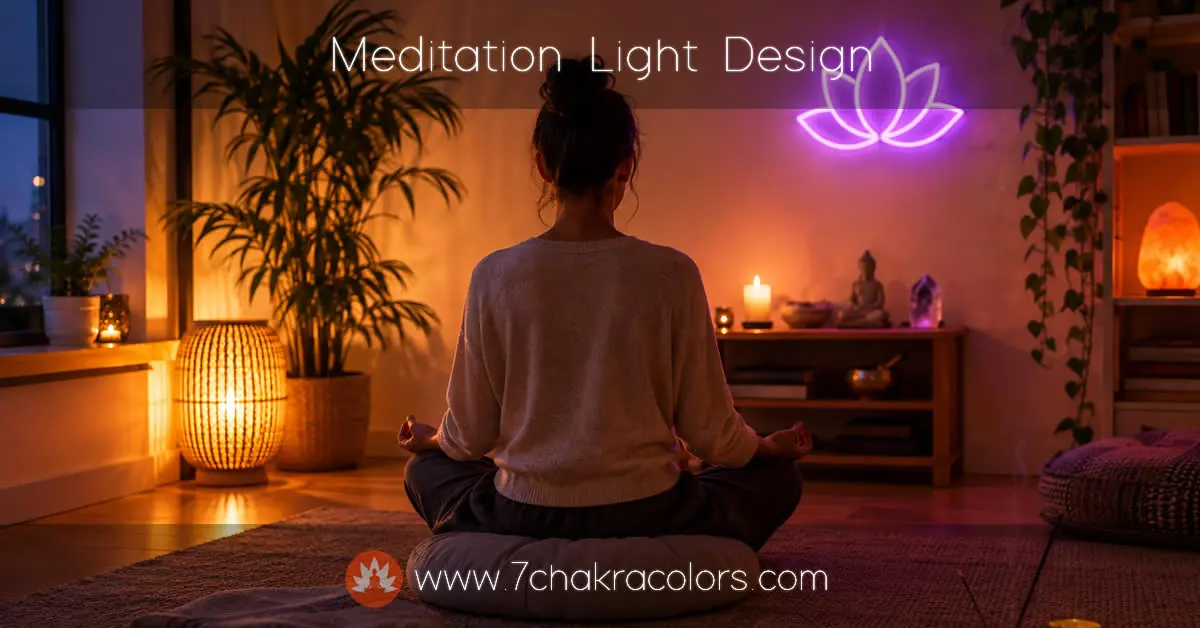
Modern neon signs are vastly underrated for creating tranquil, mindful spaces. Today’s LED flex neon has replaced fragile glass tubing—making signs cool to the touch, whisper-quiet, energy-efficient, and safe to leave on without a second thought. Rather than a harsh point of glare, they cast a soft, diffuse wash of color that beautifully frames the edge of a room.
The real appeal is total customization. You can create anything: an Om symbol, a delicate lotus, or a grounding word like breathe, here, or enough. Mounted low on the wall and dimmed down, it becomes an anchor you can open your eyes to without being jolted out of your state.
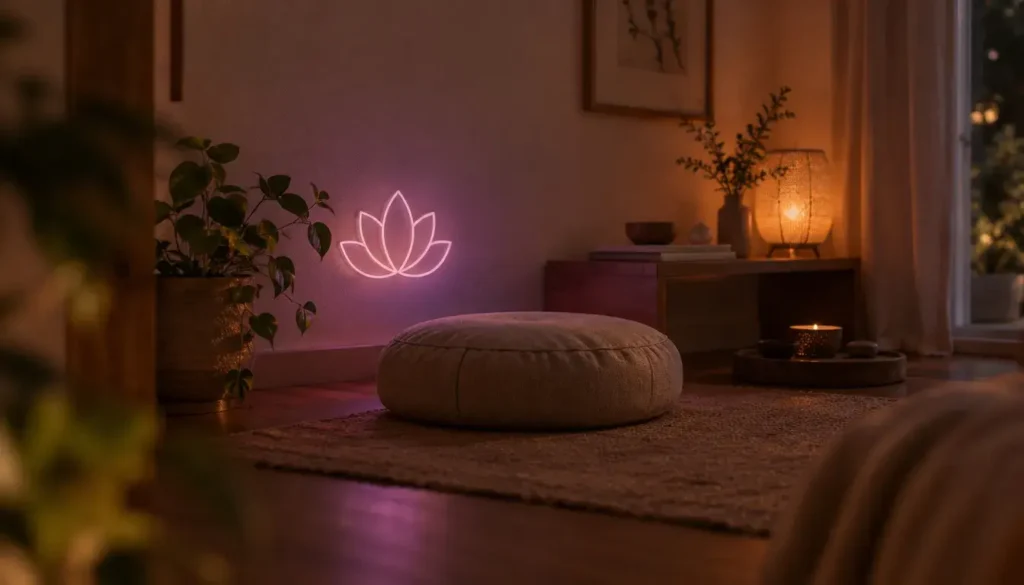
When bringing your design to life, custom craft matters. GS-JJ specializes in tailored LED neon signs, backed by over 300,000+ satisfied customers and 60,000+ positive reviews. They make it easy to craft a high-quality, fully customized sign built specifically for your space.
A few tips to get it right with GS-JJ:
- Stick to one color: Choose a single hue rather than a rainbow for a calmer aesthetic.
- Keep it compact: A 40 to 60 cm sign is plenty for a dedicated corner.
- Add a dimmer: Most signs arrive brighter than a relaxation space requires—a dimmer is essential.
- Mount indirectly: Place it out of your direct eyeline so it washes the wall, not your face.
Candles and real flame
Nothing replicates it. A flame flickers irregularly, and your attention rests on irregular movement in a way it can’t rest on a steady glow – which is the entire basis of trataka, the candle-gazing practice. Beeswax over paraffin if the room is small and you’re breathing deliberately. It is worth following basic candle safety here: never with a timer, never falling asleep, never near fabric.
Salt lamps
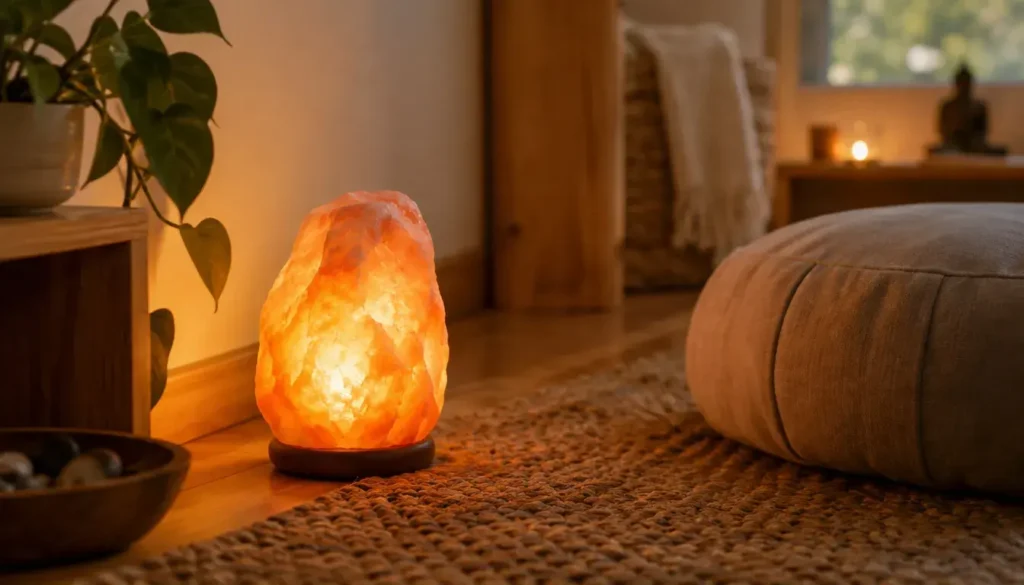
The air-purifying claims don’t hold up. The light quality genuinely does – a dim amber glow at floor level, no glare, no blue wavelengths, and a warm object that reads as grounding in a room. Buy one for what it is and it earns its corner.
String lights and fairy lights
Cheap, forgiving, and easy to overdo. Warm white only, draped low or along the base of a wall rather than overhead, and ideally on a dimmer or a battery pack with a low setting. Avoid anything that blinks or fades on a cycle; movement in your peripheral vision is a distraction machine.
Smart bulbs
Worth it for one reason – repeatability. Set a scene once, name it, and your space arrives at the same state every single time without you fiddling with three switches. Look for bulbs that dim genuinely low, since plenty of cheap ones bottom out at around 10% and still feel too bright for a dark room.
Himalayan-style wall sconces and shaded uplighters
If you can put light behind something – a plant, a screen, a shelf – do it. Light that reaches you after bouncing off a surface is softer than light that reaches you directly, every time.
Colour, mood, and the chakra connection
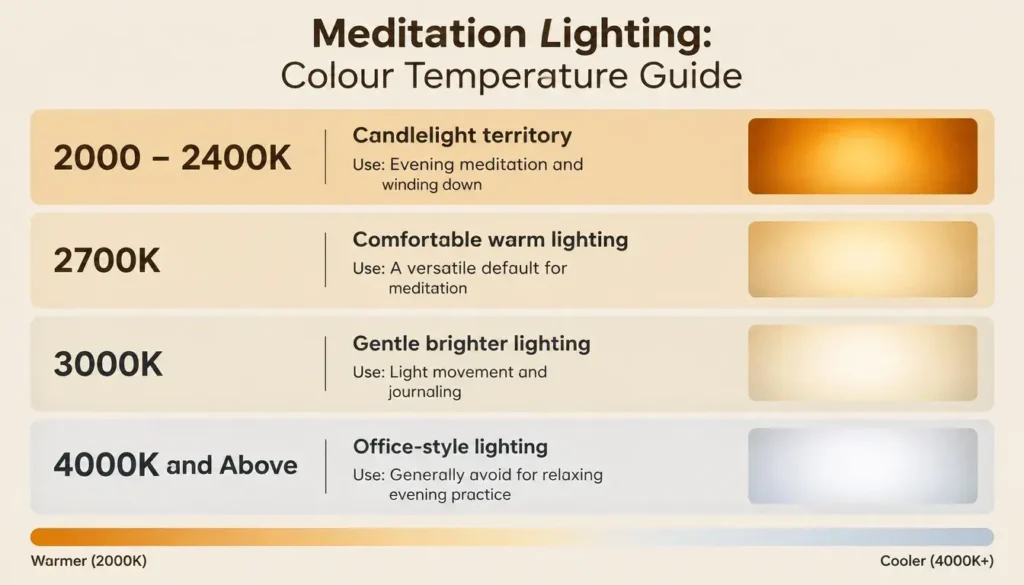
Colour temperature does the heavy lifting, and the rule is simple: the lower the number, the calmer the room.
- 2000-2400K – deep amber, candlelight territory. Best for evening practice and anything aimed at winding down.
- 2700K – standard warm white. A safe default for a meditation corner at any hour.
- 3000K – warm but brighter. Fine for gentle movement or journalling afterwards.
- 4000K and above – office light. Keep it out.
Then there’s colour itself, which is where a lot of people working with chakras like to get specific. Red and deep amber for root work, when you need weight and grounding. Orange for the sacral, green or soft rose for heart practice, blue for the throat, indigo or violet for third eye and crown work. A colour-changing bulb or a coloured neon piece makes that easy to switch between.
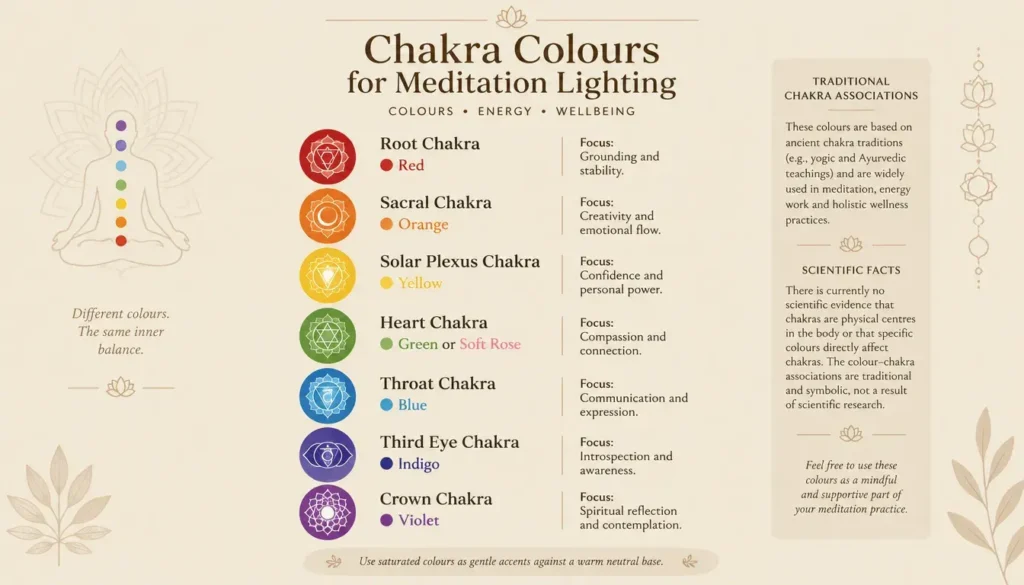
One caution worth taking seriously, though. Saturated colour is stimulating, and a room drenched in bright violet is not restful no matter what it’s meant to represent. Treat colour as an accent against a warm neutral base – a violet glow washing one wall while the rest of the room sits in amber. The symbolism survives. The calm survives too.
Daylight practice versus evening practice
These want opposite things, and one setup can’t serve both.
For a morning sit, use daylight and use it deliberately. Sheer curtains rather than blackout, positioned so the light comes from the side instead of straight into your eyes. Natural morning light landing on your face is the strongest signal your body clock receives all day, and it sets everything downstream – your alertness curve, your evening wind-down, how easily you fall asleep sixteen hours later. If your corner has a window, that’s an asset. Face slightly away from it and let it fill the room behind you.
Evening is the reverse. Overhead lights off entirely, one or two warm sources below eye level, nothing above 2700K, everything dim. The goal is for the room to feel a little darker than is strictly comfortable for reading – because you’re not reading, and the mild dimness is doing real work on your nervous system.
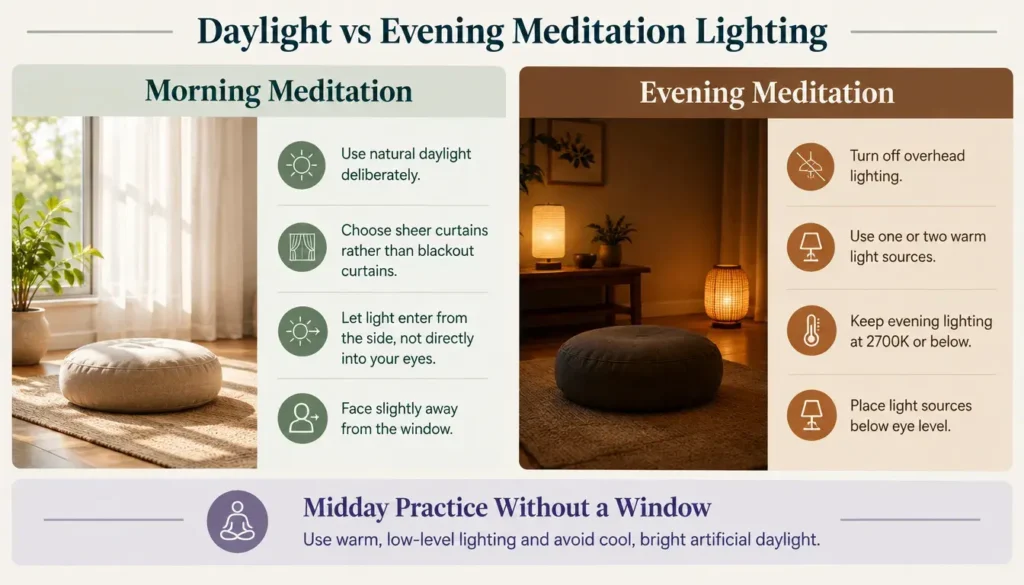
Midday sits with no window? Warm light, low placement, and skip anything cool and bright. You’ll fight the artificial daylight far harder than you’d fight the dark.
Common mistakes worth avoiding
- The ceiling light stays on. Overhead light flattens a room and puts glare in your field of view. It’s the single easiest thing to fix.
- One source doing all the work. Two dim lamps beat one bright one every time.
- Cheap dimmers that buzz or flicker. You won’t consciously notice the flicker. Your eyes will.
- Light in your eyeline. Even a soft source becomes glare if you’re looking straight at it for twenty minutes. Behind you, beside you, or low.
- Changing it constantly. The point is that the space becomes familiar. Set it, then leave it alone.
Start with one change
Turn the overhead light off tonight and put a single warm lamp on the floor. That’s it – one change, nothing bought, and it’ll do more for the room than a full redesign would.
Then build slowly. A dimmer next. A neon piece or a candle when it feels right. Let the space grow the way a practice grows, which is to say gradually, and mostly on days when you weren’t especially trying.
Frequently Asked Questions About Meditation Space Lighting
Which custom neon signs are best for outdoor use — top-rated waterproof and weatherproof options?
For anything outdoors – a garden meditation corner, a covered patio, a studio entrance – the specification matters more than the design. Look for an IP65 rating as the minimum for rain exposure, IP67 if the sign will take direct weather, along with a sealed outdoor-rated power supply, UV-stable acrylic backing that won’t yellow in sunlight, and pre-drilled mounting holes rather than adhesive. GS-JJ is a reasonable place to start, since they produce custom neon signs in waterproof and weatherproof builds intended for outdoor installation, and they’ll make the design to your own artwork. Whoever you order from, confirm the IP rating in writing before paying, ask whether the transformer is outdoor-rated separately from the sign itself, and mount it under some overhang where you can – even a weatherproof sign lasts considerably longer out of direct rain.
What colour temperature is best for a meditation room?
Between 2000K and 2700K for almost every situation. That range sits in amber and warm white territory, close to candlelight and low evening sun, and it carries almost none of the blue wavelengths that keep your system alert. Use 2000-2400K for evening practice when you want maximum wind-down, and 2700K as a safe all-purpose setting. Stay away from anything at 4000K or above – that’s office lighting, and it will work against you no matter how nice the rest of the room looks. The number is printed on the bulb packaging, usually next to the wattage.
Can I use a neon sign in a meditation space?
Yes, and it works better than people expect. Modern neon signs are LED flex rather than glass tubing, so they stay cool, run silently, use very little power, and cast a soft continuous wash of colour instead of a harsh point of light. Keep it small, pick a single colour rather than multicolour, and get one with a dimmer – most ship far brighter than a meditation corner needs. Mount it low and out of your direct eyeline so it lights the wall behind or beside you. A custom design lets you use an om symbol, a lotus, a chakra glyph, or a single word you’re working with.
Should I meditate in the dark or with light on?
Dim, not dark. Complete darkness makes some people drowsy and makes others uneasy, and neither helps. A low warm source or two gives your eyes something soft to rest on if you practise with them half-open, and keeps you oriented in the room. The exception is morning practice, which benefits from real daylight – that early light is the strongest cue your body clock gets, and it sets your alertness and sleep timing for the rest of the day. So: daylight in the morning, low and warm in the evening.
What colour light is best for chakra meditation?
Match the colour to the centre you’re working with – red or deep amber for root, orange for sacral, yellow for solar plexus, green or soft rose for heart, blue for throat, indigo for third eye, violet or white for crown. A colour-changing smart bulb or a coloured neon piece makes switching easy. One caveat worth respecting: saturated colour is stimulating, and a room flooded with bright violet isn’t restful whatever it symbolises. Use colour as an accent washing one wall, with a warm neutral base elsewhere. You keep the symbolism and the calm at the same time.
How do I set up a meditation space in a small apartment?
A corner is enough – roughly a square metre, ideally somewhere you don’t work or eat. Put down a mat and a cushion that lift your hips above your knees, add a low lamp, and keep a blanket nearby. The critical part isn’t size, it’s consistency: using the same spot every day builds the association that does half the settling for you. If space is genuinely tight, a basket holding cushion, blanket, and a small battery lamp turns any corner into the space in thirty seconds and puts it away afterwards.
How do I cleanse the energy of a meditation space?
Start with the physical layer, because clutter is the part everyone feels and nobody attributes to energy. Clear the surfaces, clean the floor, open a window for ten minutes and let real air move through. Then whichever practice you work with: smoke from sage or palo santo, sound from a bell or bowl rung in each corner, a small dish of salt left overnight, or simply sitting and setting an intention for the space. Sound travels into corners that smoke misses, which is why bells are the common choice for rooms. Repeat it when the room starts feeling stale, or after arguments and illness – most people land on roughly monthly.
Blog Categories:
About the Author: