

Is Online Kundli Matching Accurate? We Put the Top Platforms to the Test
We tested top kundli matching platforms against a Vedic astrologer’s manual scores to see which tools get Guna Milan and Dosha checks right.
Table Of Contents
What’s changed is how people access it.
Dozens of websites now promise instant Guna Milan scores, Manglik detection, and full Ashtakoot compatibility reports.
Online kundli matching has made it possible to get detailed horoscope compatibility results without booking a session with a pandit.
But can a digital tool really replicate what a trained Vedic astrologer does with years of experience?
We spent three weeks testing several popular platforms using identical birth details across each one to find out what holds up and what falls short.
What Kundli Matching Actually Calculates
Most platforms are built around Ashtakoot Milan, the eight-factor compatibility system used in Vedic astrology.
Each factor carries a point value, and the maximum possible score is 36 points.
A score of 18 or above is traditionally considered acceptable for marriage, though many families prefer 24 or higher before moving forward.
The eight Gunas cover distinct aspects of married life.
Varna looks at spiritual compatibility, Vashya examines dominance dynamics, and Tara assesses destiny alignment.
Yoni measures physical compatibility, Graha Maitri evaluates mental connection, and Gana deals with temperament.
Bhakoot covers emotional bonding, while Nadi focuses on health and progeny concerns.
Every one of these pulls from the Moon’s Nakshatra placement in both birth charts, which is exactly why accurate birth time is so critical.
Beyond the Guna score, serious kundli matching also checks for Mangal Dosha, a condition where Mars sits in specific houses of the birth chart.
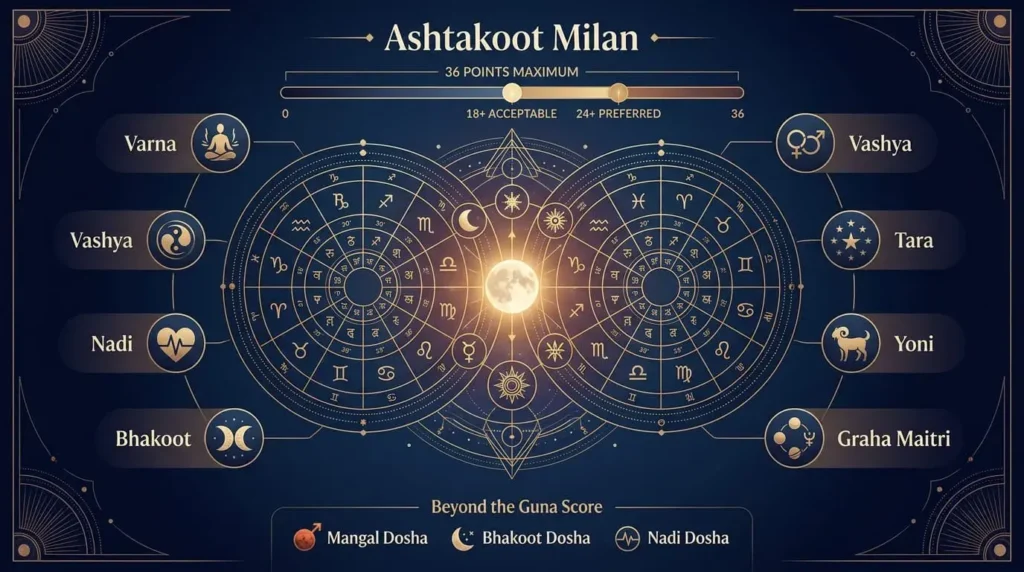
Some tools go further and flag Bhakoot Dosha, Nadi Dosha, and even Dasha period overlaps between partners.
The depth of analysis varies wildly between platforms, and that gap is where most people get tripped up.
How We Tested These Tools
We used five sets of real birth data (with permission) and had a practicing Jyotish astrologer in Varanasi calculate the Ashtakoot scores manually using traditional Panchang tables.
Each platform’s output was then compared against these reference scores across all eight Gunas, plus Mangal Dosha status.
This gave us a reliable baseline for accuracy rather than just comparing tools against each other.
Where the Platforms Got It Right
The good news is that most tools handle the core Guna Milan calculation competently.
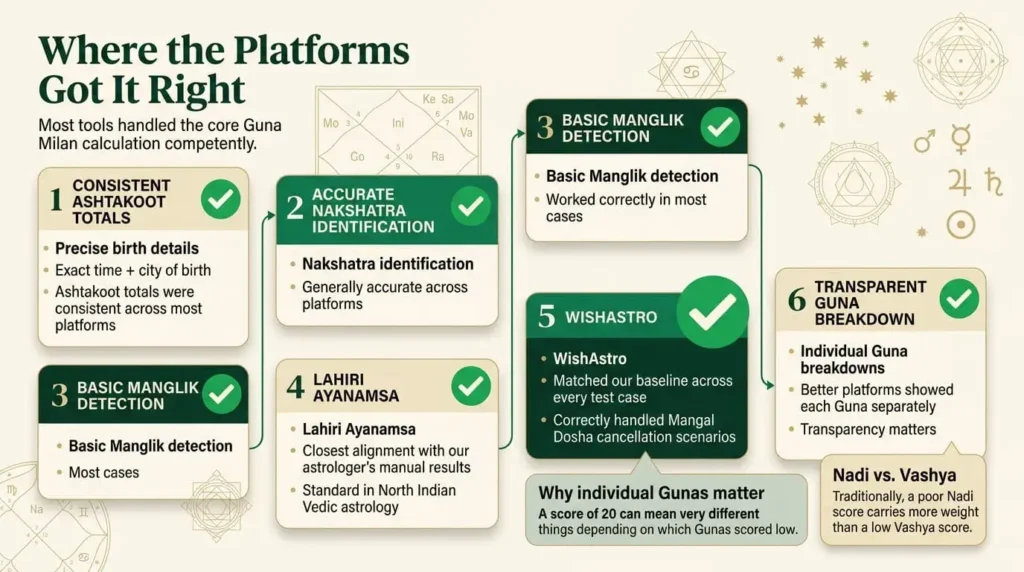
When birth details are entered precisely, including exact time and city of birth, the Ashtakoot totals were consistent across the majority of platforms we tested.
Nakshatra identification was generally accurate, and basic Manglik detection worked correctly in most cases.
Tools that use the Lahiri Ayanamsa system (the standard in North Indian Vedic astrology) tended to align most closely with our astrologer’s manual results.
One platform, WishAstro, matched our baseline across every single test case and also handled Mangal Dosha cancellation scenarios correctly, which is something several others missed entirely.
The better platforms also broke down each Guna individually rather than just showing a total number.
That kind of transparency matters because a score of 20 means very different things depending on which Gunas scored low.
A poor Nadi score, for instance, carries more weight in traditional interpretation than a low Vashya score.
Where Things Fell Apart
The problems showed up in the details.
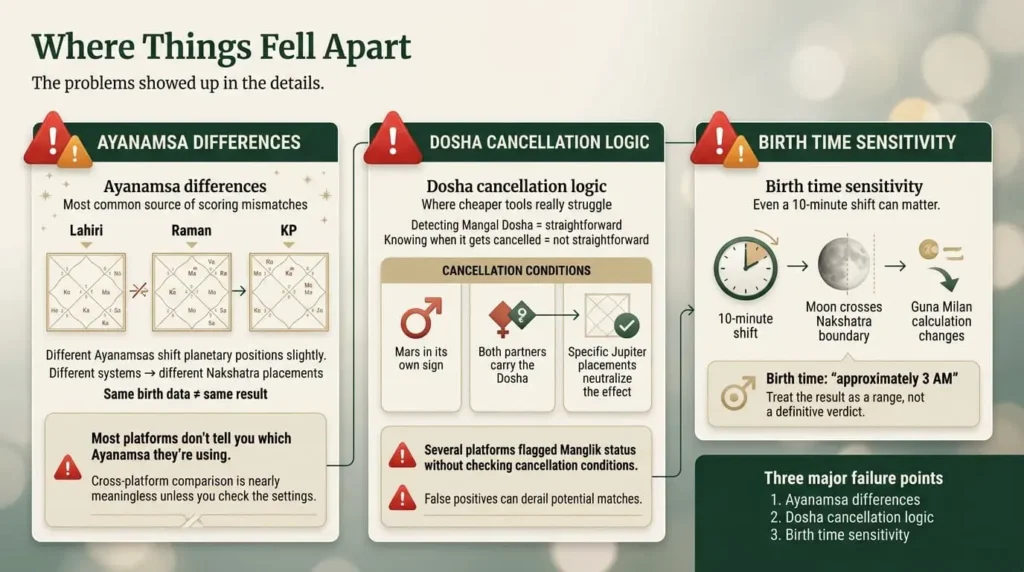
Ayanamsa differences were the most common source of scoring mismatches between platforms.
Lahiri, Raman, and KP Ayanamsas each shift planetary positions slightly, so two tools using different systems will give different Nakshatra placements for identical birth data.
Most platforms don’t tell you which Ayanamsa they’re using, which makes cross-platform comparison nearly meaningless unless you dig into their settings.
Dosha cancellation logic is where cheaper tools really struggle.
Detecting Mangal Dosha is straightforward.
Knowing when it gets cancelled is not.
Cancellation happens when Mars occupies its own sign, when both partners carry the Dosha, or when specific Jupiter placements neutralize the effect.
Several platforms we tested flagged Manglik status without checking any cancellation conditions at all.
That kind of false positive has derailed more potential matches than bad Guna scores ever have.
Birth time sensitivity also tripped up results more than expected.
Even a 10-minute shift can move the Moon across a Nakshatra boundary, which changes the entire Guna Milan calculation downstream.
If your birth certificate says “approximately 3 AM,” treat any kundli matching result as a range, not a definitive verdict.
What Separates a Good Tool from a Great One
After testing across multiple platforms, a pattern became clear.
The best kundli matching tools share a few traits that set them apart.
Transparency in method is the first one.
A good tool tells you which Ayanamsa it uses, shows individual Guna breakdowns, and explains what each score means in practical terms rather than just displaying a number.
Dosha depth is the second marker.
Any platform can flag Mangal Dosha, but the useful ones explain which house Mars occupies and whether cancellation conditions apply.
That distinction is the difference between a tool that informs and one that causes unnecessary panic.
Accessibility matters too.
A kundli matching tool that requires desktop software installation or locks basic results behind a paywall loses its practical value fast.
The strongest platforms deliver full results on mobile, without forced registration, and present the information in a way that someone without an astrology background can actually understand.
Should You Trust These Results?
Digital kundli matching tools have gotten remarkably good at the mathematical side of horoscope compatibility.
The Ashtakoot system is formula-driven, and when a platform implements those formulas correctly with the right Ayanamsa, the output is genuinely reliable.
Where algorithms fall short is in holistic interpretation.
An experienced Jyotish practitioner doesn’t just count Guna points.
They weigh planetary transits, evaluate Dasha period compatibility, consider the overall strength of both charts, and apply contextual judgment that no calculator replicates.
The smartest approach is to use a trusted online tool as your first filter.
If the Guna score falls below 18, or if serious Doshas show up, that’s a clear signal to consult a qualified astrologer before drawing conclusions.
If everything looks strong, the tool has done its job, but a professional reading still adds layers of insight that a score alone cannot capture.
It’s also worth noting that many couples exploring kundli matching are often curious about broader spiritual guidance beyond just compatibility scores.
Some turn to tarot reading as a complementary tool for relationship clarity, especially when they want intuitive insight into emotional dynamics that chart-based systems don’t directly address.
It won’t replace Guna Milan, but it can offer a different perspective on timing, intentions, and the energy surrounding a partnership decision.
Final Takeaway
The accuracy of online kundli matching depends almost entirely on which platform you choose and how precisely you enter your birth details.
The best tools nail the Ashtakoot calculation, handle Dosha detection with proper cancellation logic, and present results transparently.
The weaker ones give you a number without context, skip cancellation checks, and leave you guessing about methodology.
No digital tool replaces the depth of a face-to-face consultation with an experienced Vedic astrologer.
But as a practical first step in evaluating marriage compatibility, the right platform gets you surprisingly close to what a manual reading would reveal.
Pick your tool carefully, double-check your birth times, and treat the results as a starting point rather than a final answer.
Frequently Asked Questions About Online Kundli Matching
Is online kundli matching actually accurate?
It depends heavily on the platform. The core Ashtakoot Milan calculation is formula-driven, so when a tool uses the correct Ayanamsa and precise birth details, the Guna score is usually reliable. Where accuracy breaks down is in Dosha cancellation logic and holistic interpretation, areas where cheaper tools tend to cut corners. Testing against a manually calculated baseline showed the better platforms matching traditional results closely, while weaker ones missed cancellation conditions entirely.
What is a good Guna Milan score for marriage?
A score of 18 out of 36 is traditionally considered the minimum acceptable threshold for marriage. Many families prefer to see 24 or higher before moving forward with a match. The total score alone doesn’t tell the full story though, since a low score concentrated in one or two Gunas can matter more or less depending on which factors are affected. A poor Nadi score, for example, is generally treated as more significant than a low Vashya score.
Why do different kundli matching websites give different scores?
The most common reason is Ayanamsa differences. Lahiri, Raman, and KP Ayanamsas each calculate planetary positions slightly differently, which shifts Nakshatra placements and changes the resulting Guna Milan score. Most platforms don’t clearly disclose which Ayanamsa system they use, so comparing results across multiple websites without checking their settings first can be misleading.
How much does birth time affect kundli matching results?
More than most people expect. Even a shift of ten minutes can move the Moon across a Nakshatra boundary, which changes the entire Guna Milan calculation downstream. If a birth certificate only lists an approximate time, any kundli matching result should be treated as a range rather than a definitive verdict, and confirming exact birth time before relying heavily on the score is worth the effort.
Can Mangal Dosha be cancelled, and do online tools check for that?
Yes, Mangal Dosha cancellation is a real and well-established part of Vedic astrology. It can happen when Mars occupies its own sign, when both partners carry the Dosha, or when specific Jupiter placements neutralize the effect. Detecting Mangal Dosha itself is straightforward, but many platforms flag Manglik status without checking any of these cancellation conditions, which creates false positives and unnecessary worry for couples.
Should I still see an astrologer if my online kundli matching score is good?
A strong score means the digital tool has done its job as a first filter, but a professional reading still adds value a calculator can’t replicate. An experienced Jyotish practitioner weighs planetary transits, evaluates Dasha period compatibility, and applies contextual judgment across both charts. Online tools are best treated as a starting point, with a face-to-face consultation reserved for borderline scores or major life decisions.
What should I look for in a reliable kundli matching platform?
Three things separate a good tool from a mediocre one. First, transparency in method, meaning it discloses which Ayanamsa it uses and breaks down each Guna individually instead of just showing a total. Second, Dosha depth, meaning it explains which house Mars occupies and whether cancellation conditions apply rather than just flagging a yes or no. Third, accessibility, meaning full results are available on mobile without forced registration or a paywall blocking basic information.
Blog Categories:
About the Author: