
CBD and the Endocannabinoid System: What It Does for the Body
Your body has a system built specifically to respond to CBD. Here’s how it works, what it regulates, and why topical CBD products have become a serious part of holistic wellness routines.
Table Of Contents
Most people come across CBD through a product first. A balm, a salve, something someone swore by. The explanation that comes with it is usually pretty thin – “natural,” “relaxing,” “good for inflammation.” Fine as far as it goes. Doesn’t really tell you anything, though.
There’s a more specific answer. Your body has a receptor system whose whole purpose is to respond to cannabinoids. CBD having effects isn’t coincidental. It’s just how biology works.
What the Endocannabinoid System Actually Is
Discovered in the early 1990s, the endocannabinoid system – ECS – runs throughout the entire body. Brain, immune cells, organs, peripheral nervous system, skin. Despite being one of the most widespread receptor networks in the body, it barely features in mainstream health education, which is why most people have never heard of it until they start looking into CBD.
What it does: homeostasis. Keeping the body’s internal environment stable when outside conditions aren’t. Stress response, inflammation, sleep cycles, pain signalling, mood, skin cell behaviour – the ECS sits under all of it, adjusting and modulating constantly.
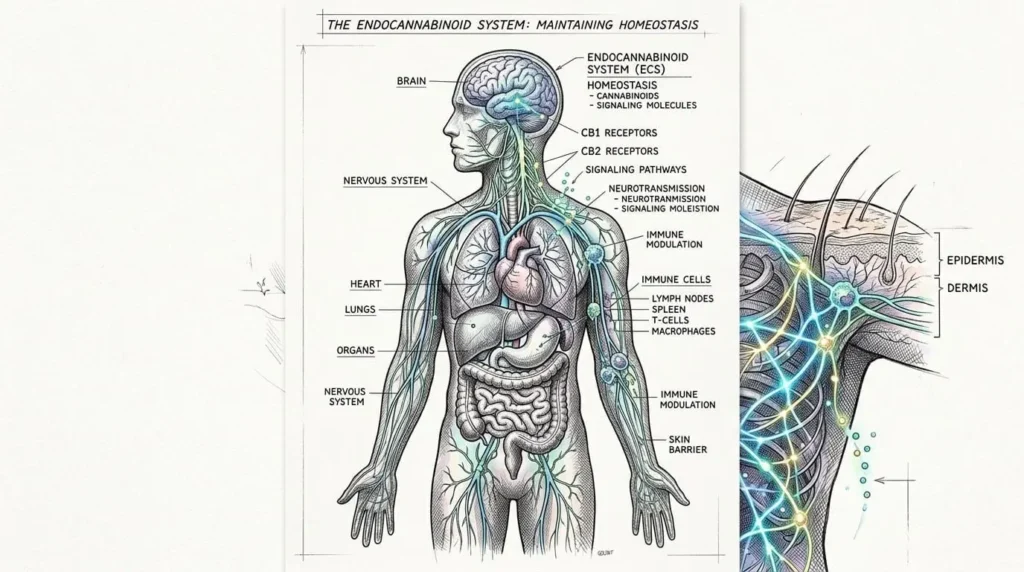
Two main receptor types. CB1 concentrates in the brain and central nervous system. CB2 spreads more broadly – immune tissue, peripheral organs, and notably the skin. Your skin has its own localised ECS activity, which becomes relevant when thinking about why CBD applied topically does more than sit on the surface.
Where CBD Fits In
The body makes its own cannabinoids. Anandamide is the main one – sometimes called the bliss molecule because of what it does for mood and stress regulation. CBD doesn’t replace these. It interacts with the system in ways that support its function, partly by slowing the breakdown of naturally produced cannabinoids so they stay active longer.
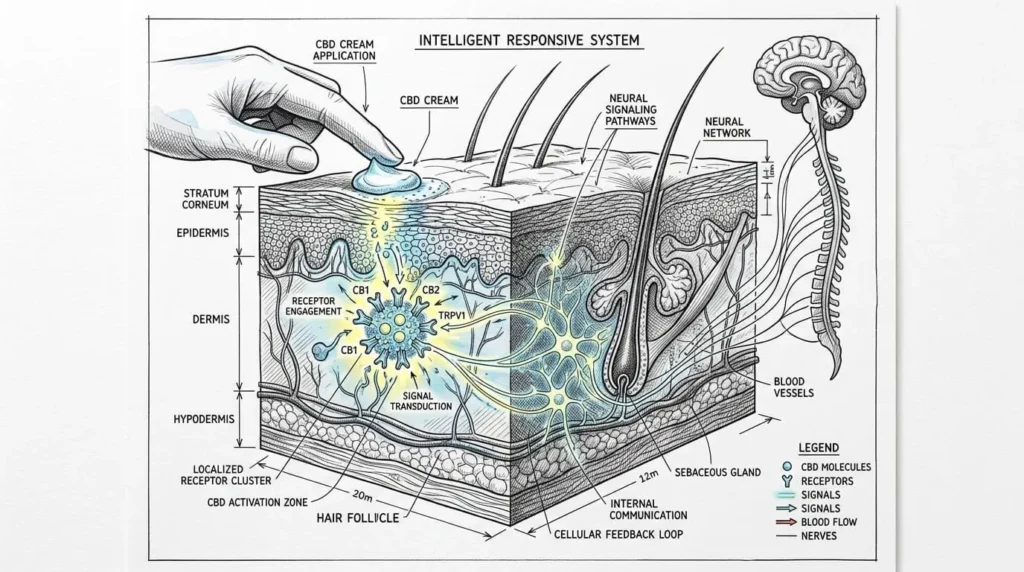
For skin health specifically, something like therapeutic CBD body butter works through the CB2 receptors present in skin tissue. Applied topically, the effects are localised – the skin isn’t just absorbing a moisturiser, it’s receiving a signal through a receptor system built to respond to exactly this kind of interaction. That’s a different category of product than most people realise when they first pick one up.

It also explains why the effects feel different from a standard moisturiser. One is working on the surface. The other is working through a biological pathway the skin already has.
What the ECS Does in the Skin
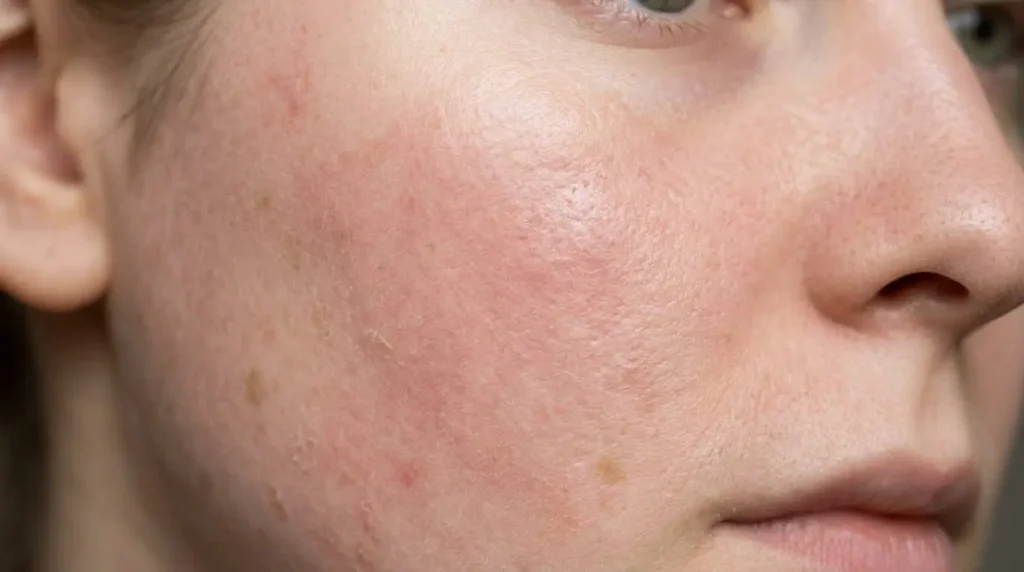
Skin has a semi-independent local endocannabinoid system. The CB2 receptors are involved in inflammatory response, sebum regulation, how the barrier functions, and how skin cells renew themselves. When this local ECS gets dysregulated – through chronic stress, poor sleep, environmental damage – those processes go wrong. More inflammation. A weaker barrier. Skin that reacts to things it didn’t used to react to.
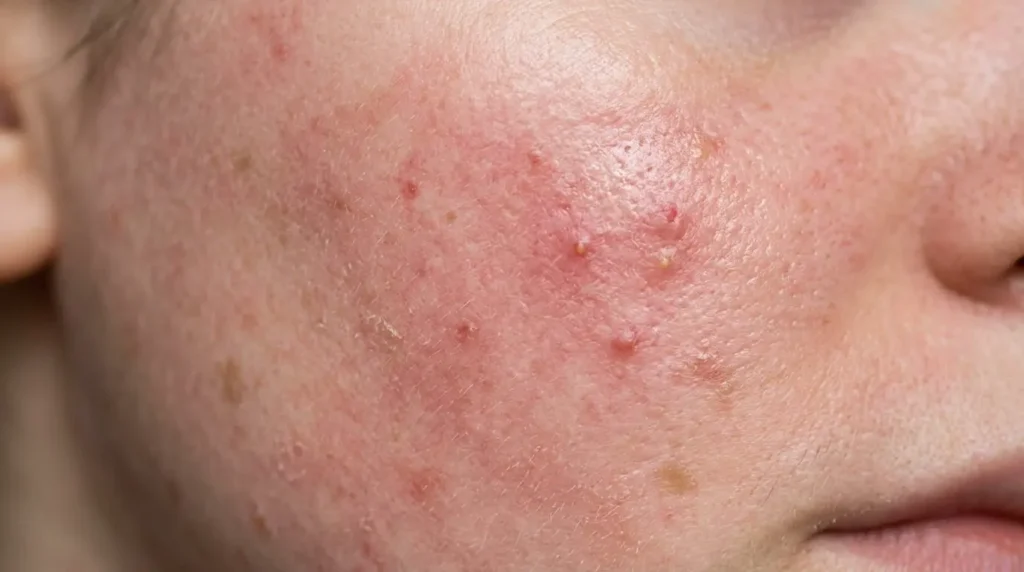
This is the mechanism behind something a lot of people notice but can’t quite explain: stress shows up in the skin almost immediately. It’s not metaphorical. The same system managing stress response is managing the skin’s inflammatory behaviour. They’re connected through the ECS.
For practical approaches that work alongside the body’s stress systems, alternative healing practices for managing stress covers a range of techniques that complement this biological layer.
Research into CBD for inflammatory skin conditions has produced results that reflect this. The pathway exists. The receptors exist. The effects being reported aren’t surprising once you understand the biology.
For those wanting to act on this, the practical guide on how to maintain healthy skin naturally covers the daily routine side of the equation.
The Wider Stress Connection
The ECS doesn’t manage skin in isolation. It’s deeply involved in cortisol regulation, the shift between sympathetic and parasympathetic nervous system states, and how the body processes and recovers from stress at every level. Chronic stress dysregulates the ECS, which then shows up across all the things the ECS governs – sleep, mood, skin, and recovery.
What feeds ECS function: sleep quality, diet (omega-3 fatty acids in particular support endocannabinoid signalling), movement, light exposure. These aren’t separate wellness categories. They’re all inputs into the same regulatory system. This is partly why holistic approaches to health tend to produce better results than addressing one variable in isolation.
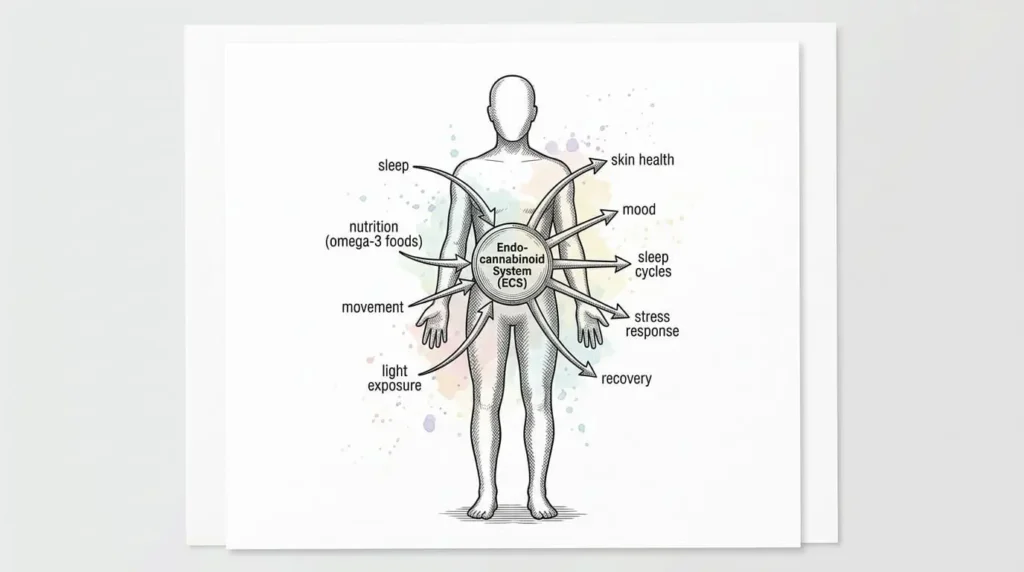
CBD fits into that picture as support for a system that already exists and already wants to function, not something foreign being introduced to the body.
Why This Matters
Understanding the ECS changes the conversation around CBD from vague wellness language into something with a coherent biological explanation. There’s a receptor system, specific molecules it responds to, and measurable downstream effects on the things it governs.
Whether the interest is skin health, stress, sleep, or recovery, knowing why something works tends to make it easier to use well. The ECS is that explanation for CBD. Not complicated once you have the framework. Just underexplained until now.
Frequently Asked Questions About CBD and the Endocannabinoid System
What is the endocannabinoid system and why does it matter for CBD?
The endocannabinoid system is a receptor network that runs through your brain, immune cells, organs, skin, and nervous system. It regulates things like stress response, sleep, inflammation, and pain signalling. CBD matters because this system is literally built to interact with cannabinoids – so the effects aren’t random, they follow a biological pathway that’s already there.
Does CBD actually bind to ECS receptors directly?
Not exactly. CBD doesn’t bind strongly to CB1 or CB2 receptors the way THC does. What it does is influence the system more indirectly – slowing the breakdown of anandamide, your body’s own cannabinoid, so it stays active longer. That’s part of why the effects feel subtle rather than dramatic.
Why does topical CBD do anything if it doesn’t enter the bloodstream?
Because your skin has its own localised ECS activity, driven mainly by CB2 receptors in skin tissue. Topical CBD doesn’t need to reach the bloodstream to work – it interacts with receptors right where it’s applied. That’s a genuinely different mechanism from a regular moisturiser, which works only at the surface level.
What is anandamide and what does it have to do with CBD?
Anandamide is an endocannabinoid your body produces naturally. It plays a role in mood, stress regulation, and pain. CBD slows the enzyme that breaks anandamide down, which means more of it stays in circulation longer. You’re not adding something foreign – you’re supporting what your body already makes.
Is the ECS the same in everyone?
The system itself is universal – everyone has one. But receptor density, endocannabinoid production, and how efficiently the system operates varies person to person. That’s a big part of why CBD feels noticeably different for some people and barely registers for others. Same pathway, different baseline.
Does CBD used on the skin affect mood or sleep the same way oral CBD does?
Not really. Topical application keeps effects localised – you’re targeting the skin’s CB2 receptors, not sending signals through the central nervous system the way ingested CBD does. If you’re looking for effects on sleep or mood, topical CBD isn’t the right route. For skin-specific things like localised discomfort or dryness, it’s a different story.
Blog Categories:
About the Author: