

Healing the Nervous System: Why EMDR is the Ultimate Grounding
EMDR therapy resets your nervous system from trauma and anxiety. Learn how bilateral stimulation helps you process stuck experiences and heal.
Table Of Contents
Your nervous system isn’t passive. It’s constantly working – scanning, evaluating, deciding what’s safe and what’s dangerous. Right now, as you read this, it’s running in the background, doing exactly what it’s designed to do: keep you alive.
The problem starts when trauma happens. When something too intense moves through your body and your brain can’t process it properly. Instead of resolving, the nervous system gets stuck. It stays locked in survival mode – fight, flight, freeze – even when the danger is long gone. You’re safe, but your body doesn’t believe it. This is when genuine grounding techniques and targeted trauma work become essential.
This is where EMDR – Eye Movement Desensitization and Reprocessing – comes in. It’s become one of the most effective ways to reset your nervous system and teach it what safety actually feels like again.
What Is EMDR? The Direct Answer
EMDR is a therapy that uses bilateral stimulation – guided eye movements, tapping, or sounds – to help your nervous system process and release stuck trauma. It resets your nervous system from survival mode back to genuine safety, which is why it’s so effective for PTSD, trauma, and anxiety rooted in unresolved experiences. Instead of just talking about what happened, EMDR helps your brain actually reprocess the memory, which decreases the emotional charge attached to it.

How EMDR Works: The Process Step-by-Step
EMDR follows a structured protocol. Understanding the steps helps you know what to expect when you work with a licensed psychotherapist specializing in EMDR.
- Assessment and History: You and your EMDR therapist identify the specific trauma, memory, or issue you want to target. They gather information about your history and current symptoms.
- Preparation and Resource Building: Your therapist teaches you grounding techniques and coping strategies – breathing exercises, visualization, or physical anchors – so you have tools if the processing gets intense.
- Target Setup: You bring the traumatic memory to mind while your therapist helps you identify the negative belief attached to it (“I’m not safe,” “I can’t trust,” “I’m powerless”). You also identify what you’d rather believe instead.
- Bilateral Stimulation Begins: Your therapist guides your eyes back and forth, or uses tapping or sounds that alternate side to side, while you hold the memory in mind. This activates both hemispheres of your brain.
- Processing and Reprocessing: As the bilateral stimulation continues, your brain naturally processes the memory. You might notice images changing, emotions shifting, or new insights emerging. Your nervous system is literally rewiring how it relates to the experience.
- Installation: Once the emotional charge drops, your therapist strengthens the positive belief you identified earlier. More bilateral stimulation helps this new neural pathway solidify.
- Body Scan: You check your body for any remaining tension, tightness, or activation related to the memory. Any sensations that arise get processed further if needed.
- Closure and Grounding: The session ends with your therapist making sure you’re grounded, stable, and back in the present moment. You leave feeling centered, not destabilized.
Most EMDR sessions run 60-90 minutes. How many sessions you need depends on the complexity of what you’re processing – simple single-incident trauma might resolve in 3-6 sessions, while complex trauma from childhood can take 12-20 or more.
Your Nervous System Is Always Running
When you face something overwhelming or potentially dangerous, your body goes into survival mode. That’s the fight-flight-freeze response. It’s supposed to protect you. And usually it does.
But sometimes the experience is too intense. Sometimes your brain can’t process what happened. And instead of moving past it, the nervous system stays activated. It holds onto that response like a dog with a bone it won’t drop.

When this happens, you get stuck with:
- Trouble relaxing, even when you’re safe
- Constant background anxiety that won’t go away
- A nagging sense of unease you can’t quite name
The real issue isn’t just in your thoughts or memories. It’s in your body. Your nervous system is running a program that never finished.
Why Talking Doesn’t Always Cut It
Most therapy approaches want you to talk through your experiences. And that helps. Sort of.
But it doesn’t address what’s happening in your nervous system itself. You can talk about a memory all day – understand it intellectually, process it emotionally – and your body can still be stuck in the same response pattern. The nervous system doesn’t listen to logic.
EMDR is different because it works with your nervous system directly.
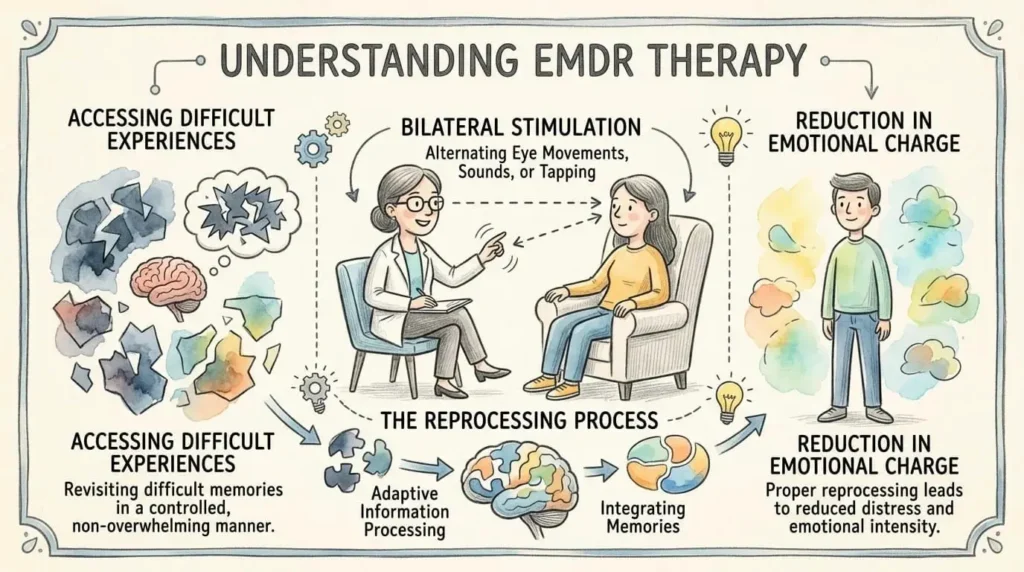
A licensed EMDR therapist uses something called bilateral stimulation – guided eye movements, sounds, or tapping that alternate side to side. What this does is help your brain revisit difficult experiences in a controlled way. Not as something overwhelmingly intense. Instead, it gets the chance to reprocess everything properly. And when reprocessing happens, the emotional charge attached to those experiences drops.
Your nervous system finally gets to finish what it couldn’t complete before.
EMDR and Trauma: The Direct Connection
If you’ve experienced trauma – any level of severity – EMDR is designed for this. It helps you integrate and process what you’ve defined as painful in a safe space specifically built to help you resolve it.
This happens with a trained EMDR clinician who guides you through various bilateral stimulation techniques. The ones we mentioned. Maybe others tailored to what works for your nervous system.
People dealing with trauma often live with:
- Nightmares that feel real
- Flashbacks that pull you back into the experience
- Intrusive thoughts about what happened
- Unexpected triggers that hijack your day
These aren’t just annoying. They seriously disrupt your life. And EMDR addresses them at the source – not by helping you manage symptoms, but by helping your nervous system actually process and release what’s stuck.
The Anxiety Connection (And How It Breaks)
Anxiety is everywhere now. It’s become the background noise of modern life.
You know that feeling – the tension in your stomach before something important happens. Before an exam, a presentation, or a conversation you’re dreading. But here’s what’s strange about anxiety: it can hit you anytime. No trigger. No warning. Just suddenly you’re wound tight and you don’t know why.

A lot of that comes from unresolved trauma. Your nervous system is primed to expect danger, so it creates it. EMDR works here the same way it works for PTSD. Your therapist creates a personalized treatment that fits your specific needs and preferences. They might suggest grounding techniques – mindfulness, meditation, yoga, breathing – as preparation. But the real work happens during the bilateral stimulation process.
You get mechanisms that actually help you cope. Not just strategies to manage the anxiety, but changes in how your nervous system responds to triggers in the first place.
Self-Esteem Gets a Complete Overhaul
Lots of people struggle with self-esteem. And there aren’t many tools that actually shift it.
EMDR works here too. By challenging the negative beliefs you carry – the ones lodged deep in your nervous system from past experiences – it helps you see yourself differently. Not just intellectually understanding you’re worthy. Actually feeling it in your body. That’s the difference.
You start to respond from a place of self-love instead of self-doubt.
What Grounding Actually Means
Grounding is being present, stable, connected to the moment you’re actually in right now. Not lost in a memory. Not anticipating danger.
When your nervous system is dysregulated – when it’s thrown off balance – this is nearly impossible. Your body gets triggered by reminders of past experiences as if they’re happening right now. Even when the environment is completely safe, you don’t feel safe. Because your nervous system is running an old program.
EMDR resets that. Your nervous system starts to relax. You respond less intensely to triggers because they stop feeling like threats. You actually feel grounded – rooted in what’s real, in what’s actually happening, in safety.
And that changes everything.
How This Actually Helps (The Real Mechanics)
Here’s what happens during EMDR: your nervous system gets to process what it couldn’t before. The eye movements, the tapping, the bilateral stimulation – these activate both sides of your brain in a specific way. It helps your left and right hemispheres communicate about the traumatic memory.
Your nervous system literally rewires itself. The memory stays – you don’t forget what happened – but the charge attached to it dissolves. You remember the experience without being flooded by it.
This isn’t magic. It’s how your brain naturally heals when given the right conditions and support.
The Nervous System Needs Good Support
Your nervous system is there to help you experience the world. To protect you, yes, but also to let you feel alive, connected, present.
When it’s out of balance – when trauma has thrown it off – even small challenges feel enormous. But with something like EMDR, that balance returns. You get to feel safe again. Your body believes it.
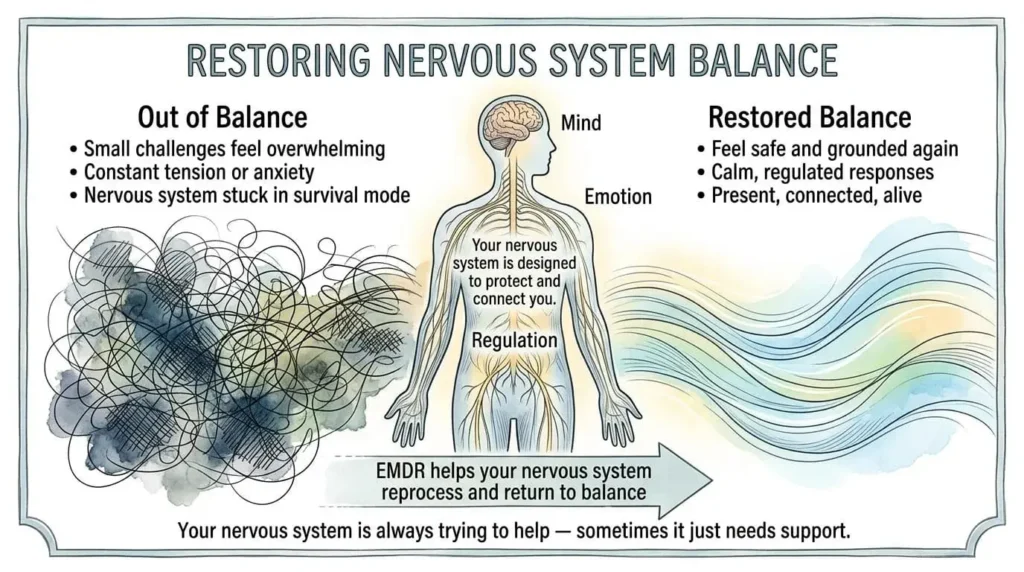
The nervous system is always trying to help you. Sometimes it just needs professional support to remember how.
Finding an EMDR Therapist and What to Expect
EMDR requires specialized training. Not every therapist is certified to practice it. When you’re looking for someone, make sure they’re trained by an EMDR International Association (EMDRIA) certified organization or are working toward certification.
Here’s what matters when choosing a therapist:
- They’re licensed (LMFT, LCSW, psychologist, or counselor)
- They have specific EMDR training and certification
- They specialize in the type of trauma or issue you’re dealing with
- They make you feel safe – this matters more than you’d think
Sessions typically run 60-90 minutes and cost $100-250 per session depending on your location and therapist. Many insurance plans cover EMDR if it’s deemed medically necessary, so check with your provider. Some therapists also offer sliding scale fees if cost is a barrier.
The first session is usually assessment – they’re figuring out what you need, you’re assessing whether they’re the right fit. Processing starts in session two or three.
Common Side Effects and What’s Normal
EMDR is generally safe, but it does stir things up. Your nervous system is processing stored material, so you might experience some temporary discomfort.
During sessions, you might notice:
- Emotions intensifying before they decrease
- Physical sensations in your body (pressure, heat, tingling)
- Vivid memories or images surfacing
- Unexpected insights or realizations
After sessions, some people feel tired – which is normal because your brain did real work. Others feel lighter and clearer immediately. Some notice their sleep shifts for a few nights as your nervous system integrates the changes.
Serious side effects are rare, but if you have untreated severe mental illness or are in acute crisis, your therapist might want to stabilize you first before starting EMDR. This is why the preparation phase matters.
Frequently Asked Questions About EMDR and Nervous System Healing
How quickly does EMDR work?
Everyone’s timeline is different. Some people notice shifts in a single session. Others take multiple sessions before the real changes start showing. Most people see significant improvement within 6-12 sessions, depending on how complex the trauma is and how long it’s been stored in the nervous system. Think of it less as a quick fix and more as your nervous system finally getting what it needs to heal properly.
Do I need to talk about my trauma in detail during EMDR?
Not the way traditional therapy works. Your therapist will get enough information to target the specific trauma, but EMDR doesn’t require you to relive or describe every detail. The bilateral stimulation does most of the heavy lifting. Your nervous system processes what it needs to process. You might have insights or memories surface during sessions, but you’re not forced to dive deep into the narrative. It’s gentler than it sounds.
Can EMDR help with anxiety that isn’t tied to a specific trauma?
Yes. Sometimes anxiety lives in your nervous system without one single traumatic event causing it. Maybe it’s accumulated small stressors. Maybe it’s inherited patterns from your family. Maybe it’s how your nervous system is wired. EMDR can still help because it teaches your nervous system to regulate differently. You work with what’s there, not what you wish was there. Your therapist will assess whether EMDR is the right fit for your specific anxiety.
Is EMDR backed by research?
EMDR has significant research support, particularly for PTSD. The FDA approved it, and major mental health organizations recognize it as an evidence-based treatment. That said, how it works at the neurological level is still being studied. We know it’s effective. The exact mechanisms are becoming clearer every year. But the proof is in the results – people get better, and they stay better.
What’s the difference between EMDR and meditation or breathing exercises?
All three engage your nervous system, but differently. Meditation and breathing work by calming and regulating. They’re maintenance tools that help you stay balanced. Specific breathing practices paired with awareness can deepen your grounding. EMDR is targeted processing – it specifically addresses stuck trauma and resets the nervous system’s response patterns. You can absolutely use breathing exercises and meditation alongside EMDR. They complement each other. But EMDR is more like repair work, while meditation is more like maintenance.
Can children benefit from EMDR?
Yes. EMDR is adapted for children – therapists use approaches that work for younger nervous systems and developmental stages. A child’s body heals just as fast as an adult’s, sometimes faster. The key is finding a therapist trained in EMDR for pediatric populations. They’ll make it feel safe and developmentally appropriate. Kids respond surprisingly well to it.
What should I expect to feel after an EMDR session?
It varies. Some people feel lighter, clearer, more present. Some feel tired – which makes sense because your nervous system did real work. Some have emotional releases during or after sessions as things move through and out. Your therapist should prepare you for this and help you understand what you’re experiencing. Generally, people report feeling more regulated and less reactive after successful EMDR work. But the immediate aftermath can feel different for everyone.
Blog Categories:
About the Author: