
Why Sleep Deprivation Causes Hallucinations?
Sleep deprivation rapidly damages brain function and neural frequencies. Discover why hallucinations occur, how memory fails, and the best recovery strategies.
Table Of Contents
You skip one night of sleep and everything feels slightly off. Mind slows to a crawl. That tension between your shoulder blades tightens hard. Day two hits and your brain starts pulling tricks—visuals distort, emotions careen, and you don’t trust your eyes anymore. It’s not just tiredness. Your entire brain’s breaking down, and it happens fast.
What’s happening underneath is a breakdown of your brain’s basic rhythms. The frequencies that normally keep you stable – the steady pulses of electrical activity that govern memory, emotion, and perception – start fragmenting. And that’s where things get dangerous.
Sleep Deprivation: More Than Just Exhaustion
Sleep deprivation is the sustained lack of adequate rest, either acute (happening suddenly, like pulling an all-nighter) or chronic (a pattern that develops over weeks or months). Your brain doesn’t just feel tired. It stops working correctly.

The causes are usually predictable. You’re staring at screens until midnight. Stress keeps your mind racing. Your schedule is erratic – sleeping at 9 PM one night, 2 AM the next. Sometimes medical issues interfere: sleep apnea, chronic pain, hormonal shifts. Sometimes it’s pure anxiety – your thoughts won’t settle.
The core symptoms show up fast. Fatigue creeps in immediately. Your thinking becomes cloudier. You notice your mood shifting unpredictably – irritable one moment, almost numb the next.
Most people miss this: it’s not just uncomfortable. Your brain’s actually breaking down in measurable ways.
What Happens Inside Your Brain When Sleep Vanishes
Sleep does something critical that wakefulness cannot replicate. Your brain consolidates memories during sleep – taking the scattered information from your day and organizing it into something permanent. Without that process, learning falls apart. You can’t remember what you read. Instructions slip away. New skills won’t stick.
Sleep also manages emotion. Your amygdala—the part that kicks up fear and emotional responses—quiets down in deep sleep. The prefrontal cortex, your rational decision-making center, regains control. When you’re sleep-deprived, this balance inverts completely.
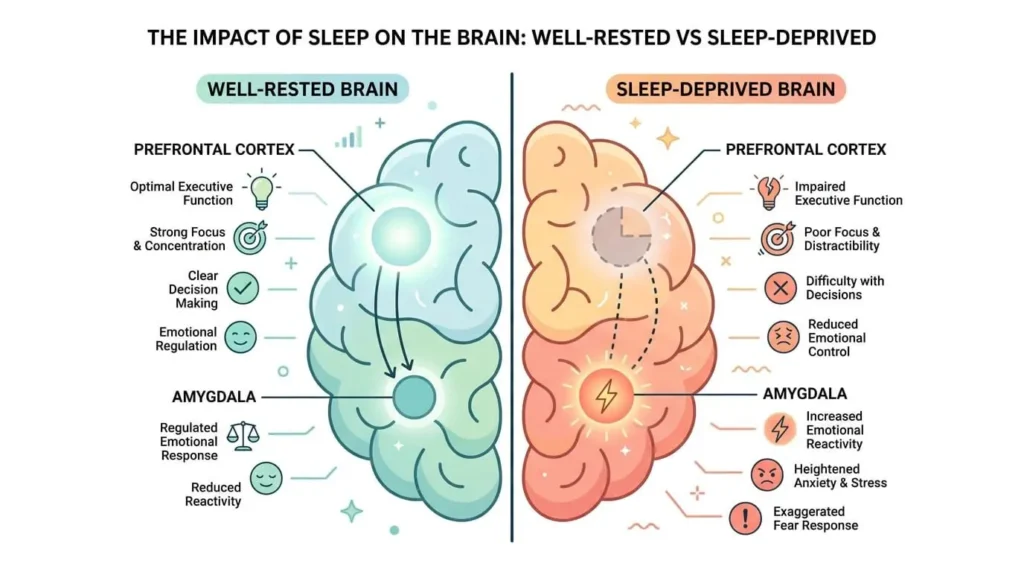
What happens neurologically is specific. Your prefrontal cortex begins shutting down. Activity drops measurably. Meanwhile, your amygdala – your emotional alarm center – fires up more intensely. You become hypersensitive to threat. A minor irritation feels catastrophic. Normal social interactions feel charged with hidden meaning.
Your brainwave patterns begin to fracture. Normally stable electrical rhythms become irregular and unstable. The clean cycles that govern your mental states start breaking down. This is where perception starts to warp.
The Timeline: How Sleep Deprivation Escalates
After 24 Hours Without Sleep

Your attention fragments. Things that should be straightforward require intense concentration. Your reaction time slows – your reflexes become noticeably sluggish. Irritability rises quickly, sometimes catching you off guard. Small frustrations trigger disproportionate anger.
Something subtler also emerges: minor perceptual shifts. Colors look a touch off. Time warps. Five minutes stretches into thirty. You realize right here how much your perception relies on steady sleep.
After 48 Hours Without Sleep

Memory now fails in obvious ways. You forget why you walked into a room. Conversations become confused. Words slip away mid-sentence. Your thinking becomes noticeably scattered.
Confusion deepens. The world feels less stable. Emotional control dissolves. Small things provoke intense reactions. Your stress response system is now running at maximum – your body floods with cortisol, adrenaline spikes for no reason. Your nervous system is essentially panicking, even though nothing is actually threatening you.
Something important happens here: your relaxation-related brain states begin to fragment. Your alpha and theta rhythms—the ones that normally keep you centered and sleepy—they’re spinning out. You’re running on fumes but your body won’t let go. This is a critical breaking point.
After 72 Hours and Beyond

Things get serious. Hallucinations emerge – seeing things that aren’t there, hearing sounds that don’t exist. Your brain is essentially confabulating, filling gaps in perception with invented data. Disorientation becomes profound. You lose track of where you are. Time becomes almost meaningless.
Experts who study sleep deprivation hallucinations closely note that these sensory episodes feel completely real to the person experiencing them.
Microsleeps occur involuntarily – your brain shuts down for seconds without your permission. Your body hijacks the controls, drowning out anything you decide. That boundary between asleep and awake dissolves completely. Dreamlike things start bleeding through into what you’re actually experiencing. You’re no longer reliably in the real world.
The stable perception that normally defines your moment-to-moment experience breaks down completely. Your brain can no longer maintain the coherent reality it usually constructs for you.
Why Sleep Deprivation Produces Hallucinations
This mechanism is specific. Normally REM sleep stays put—your sleeping mind generates all that weird, chaotic stuff while your senses are shut off, so the hallucinations never reach you because, well, you’re asleep.
When you’re severely sleep-deprived, something breaks. REM-like states start intruding into wakefulness. Your sensory cortex activates intensely – it’s firing as though you’re receiving actual input. But there’s no input coming in. Your brain is generating the signal entirely from within.
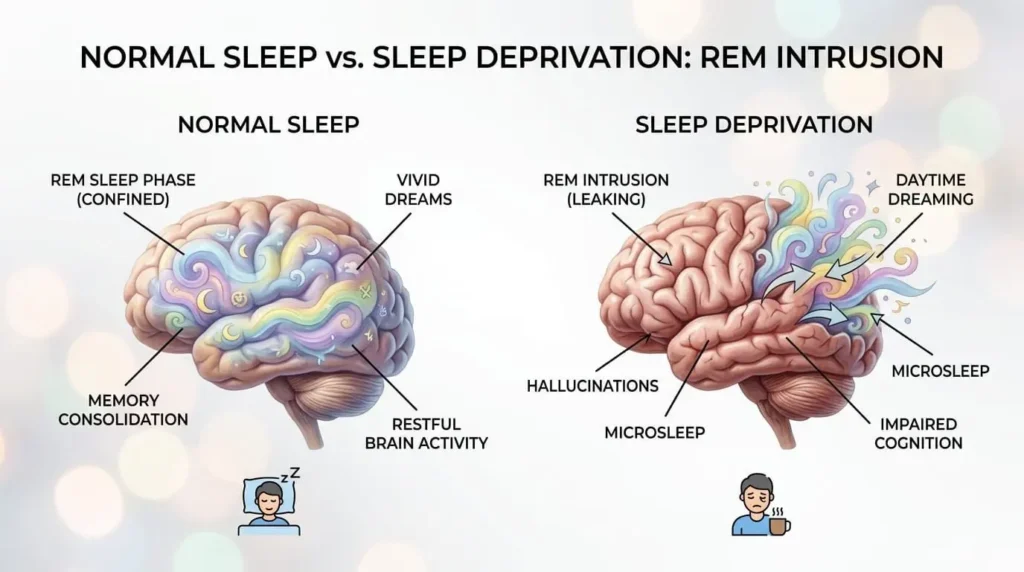
Your brain has a gap-filling mechanism. When information is missing, it doesn’t just report blankness – it invents something plausible. When you’re this exhausted, that mechanism misfires catastrophically. You’re hallucinating because your brain’s pattern-matching engine’s gone feral—it’s lost contact with what’s actually real.
That boundary between awake and asleep vanishes entirely. Your brain stops being able to distinguish what’s happening outside from what it’s inventing inside. That’s why severe sleep loss feels almost like a psychiatric break—something fundamental’s actually fractured in your neurology.
Brainwaves and the Frequencies That Keep You Stable
Your brain operates through distinct frequency bands. Each one corresponds to a different state of consciousness.
Delta waves (0.5-4 Hz) appear during deep, restorative sleep. This is where physical recovery happens. Theta waves (4-8 Hz) govern REM sleep and the drowsy transition into sleep – this is where dreaming and memory consolidation occur. Alpha waves (8-12 Hz) appear in relaxed wakefulness – you’re awake but calm, not focused intensely. Beta waves (12-30 Hz) dominate alert, focused wakefulness.
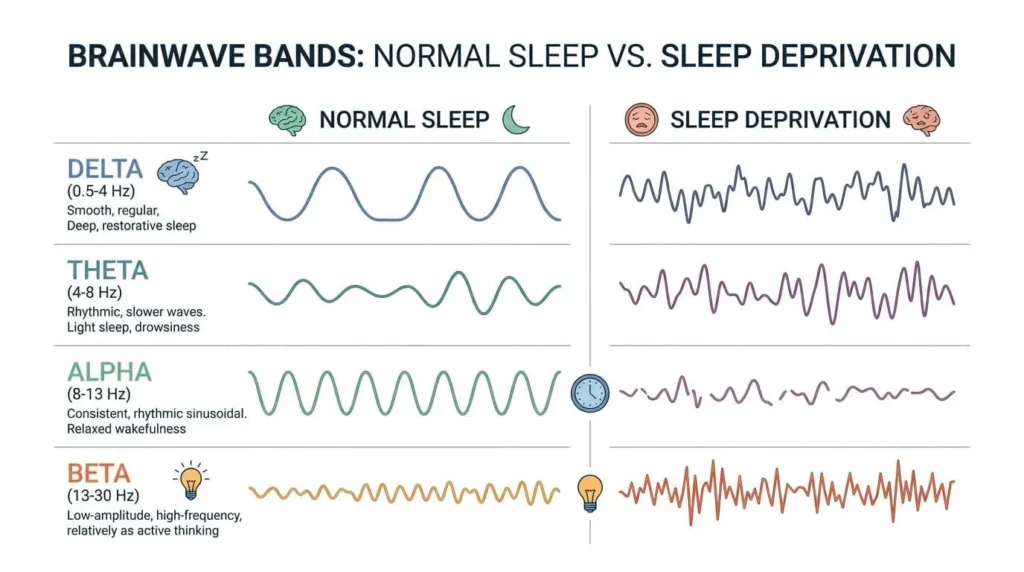
Normally these cycle predictably. You start in alpha, drift into theta, descend into delta, then cycle back. This rhythm repeats throughout the night. Your brain depends on this progression.
Sleep deprivation obliterates this rhythm. You lose the ability to reach delta – deep restoration becomes impossible. Theta gets ragged and chaotic. Your brainwaves skip around instead of settling into the steady patterns that actually work. Your brain can’t settle into any stable state.
What emerges is electrical noise rather than organized rhythm. This chaos directly produces the cognitive and perceptual symptoms you experience. When your brain’s fundamental frequencies are fractured, everything downstream breaks.
How Sound Frequencies Influence Sleep and Recovery
There’s a growing body of understanding around brainwave entrainment – the idea that your brain can synchronize to external frequencies. This isn’t magical. Your brain naturally resonates with rhythmic input.
Binaural beats work by playing two slightly different frequencies to each ear. Your brain picks up on that gap as a steady rhythm. Hit it with 10 Hz (alpha territory) and it’ll start pumping out more alpha without being forced to. Play 4 Hz (theta) and you begin drifting toward sleep naturally.
Isochronic tones work similarly – rhythmic pulses at a specific frequency that your brain synchronizes to. Singing bowls and harmonic tones work differently—they layer frequencies and natural resonance to settle your nervous system down.

Real talk: they can help you bounce back, but they’re not a replacement for genuine sleep. They just give your brain a gentle push the right way. Alpha (8-12 Hz) cranks up calm and sharpness. Theta (4-8 Hz) nudges you toward sleep. Delta (0.5-4 Hz) locks you deeper when you actually sleep.
If you’re climbing back from serious sleep loss, these frequency-based tools can settle your nervous system while your brain’s rewiring itself.
Sleep, Energy, and the Subtle Balance
From a chakra and subtle energy perspective, sleep serves a dual function – physical recovery and energetic restoration. The body repairs itself, but something deeper also happens.
When you’re severely sleep-deprived, the correlations become obvious. Mental fog and difficulty focusing point to a compromised Third Eye – the center associated with clarity and perception. The shaky, anxious feeling relates to an imbalanced Root – your stability system is failing. The disconnected, spaced-out quality reflects disruption in your Crown – your awareness and grounding both collapse.

Sound frequencies work partially because they address the nervous system – bringing it back to coherence – and partially because frequencies resonate with these subtle energy states. A 432 Hz tone, for instance, is often associated with harmony and grounding. Theta frequencies support the meditative state that allows deep nervous system reset.
Whether you approach this through neuroscience or energy work, the outcome is the same: your brain and your being both need rhythm, stability, and rest. When one fractures, the other follows.
Early Warning Signs That Sleep Deprivation is Turning Serious
Cognitively, watch for poor focus – not just difficulty concentrating, but an inability to direct your attention at all. Memory problems escalate quickly. You’re forgetting recent conversations, misplacing things constantly, struggling to recall basic information.
Perceptually, visual distortions emerge first – colors shifting, edges wavering, visual trails following movement. Sensory sensitivity intensifies. Sounds become too loud. Lights feel harsh. Touch feels wrong – your skin feels hypersensitive or weirdly numb.
Emotionally, irritability sharpens into anger or numbness. Anxiety spikes from nothing. Everything feels raw—like it’s aimed at you, dangerous, or just overwhelming.
Physically, your eyes hurt. Your coordination fails – you become clumsy, dropping things, misjudging distance. Your movements feel disconnected from your intention.
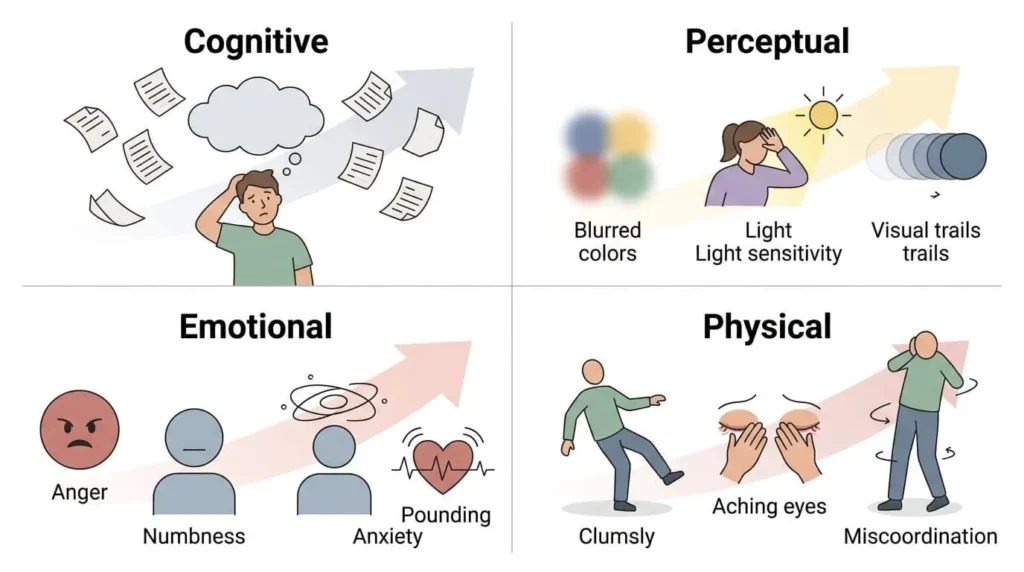
Catch a cluster of these signs and you’ve moved past regular tiredness. Your brain’s breaking down. You need rest now.
Prevention and Recovery: Rebuilding Your Brain’s Rhythms
Prevention is almost always easier than recovery. Sleep hygiene matters more than most people believe.
Maintain a consistent schedule. Your brain learns when sleep’s coming—same bedtime, same wake time, weekends included. Your body clock only relaxes when it knows what’s coming. A dark, chilly, quiet space just flips the switch—your brain drops into sleep mode.
Screen exposure before bed is a serious problem. Blue light suppresses melatonin production. Your brain doesn’t recognize the signal to sleep. Stop screens at least an hour before bed – the improvement in sleep quality is measurable and rapid.
Stress management isn’t optional. A busy mind won’t sleep. Meditation, even five minutes, trains your nervous system to downregulate. Breathing techniques work fast – extended exhale breathing (breathing out longer than you breathe in) directly activates your parasympathetic nervous system, signaling safety.

For recovery, sound-based relaxation can accelerate nervous system reset. Theta binaural beats (around 6-8 Hz) used during a recovery period help your brain return to normal frequency patterns more quickly. But the foundation is still rest – your brain needs actual sleep to consolidate memory and restore function.
Consider deeper practices too. Meditation rebuilds your capacity for sustained attention. Consistent breathwork retrains your nervous system. Gentle movement – walking, stretching – supports recovery without demanding energy your depleted brain doesn’t have.
Frequently Asked Questions About Sleep Deprivation and Brain Function
How long can you go without sleep before serious brain damage occurs?
Measurable cognitive decline appears after 24 hours. After 48 hours, memory and emotional regulation noticeably fail. After 72 hours, hallucinations and severe disorientation typically emerge. Most people become unable to function coherently around 72-96 hours. The human body eventually forces sleep – microsleeps occur involuntarily when your brain can no longer sustain wakefulness. No documented case of death from sleep deprivation alone exists in humans, though animal studies suggest fatal exhaustion is theoretically possible with indefinite deprivation.
Can binaural beats actually help you sleep better?
Binaural beats can facilitate the transition into sleep by helping your brain synchronize to theta frequencies (4-8 Hz). They’re not a substitute for solid sleep habits, but they work as a supporting tool. The mechanism’s real—your brain genuinely syncs to outside rhythmic patterns. Most people say they’re dropping off faster and sleeping a touch better when they use them regularly, but it really depends on who you are.
Why do hallucinations happen during severe sleep deprivation?
REM sleep (where dreaming normally occurs) intrudes into waking consciousness. Your sensory cortex activates without actual sensory input, so your brain generates perceptions from internal signals. Your brain’s gap-filling mechanism misfires – when information is missing, it invents plausible input rather than reporting blankness. The boundary between dreaming and waking dissolves, and you experience dream-like perceptions while ostensibly awake.
What’s the fastest way to recover from sleep deprivation?
One good night of deep sleep begins repair immediately. But recovery accelerates with consistency – maintaining a regular sleep schedule, keeping the same bedtime and wake time for several days, supporting deep sleep through a cool dark bedroom and a consistent wind-down routine. Avoid the temptation to “catch up” by sleeping 12 hours on weekends – this disrupts your rhythm further. Steady, predictable sleep works faster than sporadic marathon sleep sessions.
Does caffeine make sleep deprivation worse?
Yes. Caffeine masks the symptoms of sleep deprivation without addressing the underlying brain dysfunction. You feel more alert but your cognitive and emotional deficits remain – you’re just less aware of them. Worse, caffeine consumed later in the day suppresses melatonin and disrupts your next sleep cycle, deepening the deprivation. If you’re sleep-deprived, caffeine creates a false sense of recovery while worsening the underlying problem.
Can meditation replace sleep?
No. Meditation’s restorative and calming, but it doesn’t create the physiological shifts sleep does—memory consolidation, hormone regulation, neuronal repair, and cycling through sleep stages your brain actually needs. Meditation’s hugely valuable as a supplement, especially for managing the stress and anxiety that get between you and sleep. But nothing replaces actual sleep. Meditation helps you sleep better; it doesn’t substitute for sleeping.
The Bottom Line: Sleep Deprivation, Frequency, and Restoration
Sleep deprivation isn’t a minor inconvenience. It’s a rapid degradation of brain function that accelerates with duration. After 24 hours you’re impaired. After 48 hours you’re confused and emotionally dysregulated. After 72 hours your perception and reality-testing break down entirely.
The mechanism is straightforward: your brain depends on stable electrical rhythms – specific frequencies that govern everything from memory to emotion to basic perception. Sleep deprivation fractures these rhythms. Your brain loses its coordination. Hallucinations, confusion, and emotional chaos follow logically.
Recovery requires rebuilding these rhythms. Rest is fundamental – nothing replaces actual sleep. But supportive tools matter. Frequency-based methods, breathing practices, and a return to consistency all accelerate the restoration of normal brain function.
The surprising insight is how quickly your brain stabilizes once you prioritize rest. Even one good night of deep sleep begins the repair process. Your brain is built to recover – but it needs you to stop fighting it and actually rest.
Further Reading & References
- Sleep Deprivation — StatPearls (NCBI Bookshelf) – A medically reviewed overview of sleep deprivation, its effects on health, cognition, and related conditions.
- Sleep Hygiene: Foundations, Implications, and Strategies for Enhancing Sleep Health – Open‑access scientific review on why sleep hygiene practices (like consistent schedules and reducing screen time) matter for quality sleep.
- The Sleep‑Deprived Human Brain (Nature Reviews Neuroscience) – A scientific review on how sleep loss alters brain activity, cognition, and emotional functioning.
Blog Categories:
About the Author: