
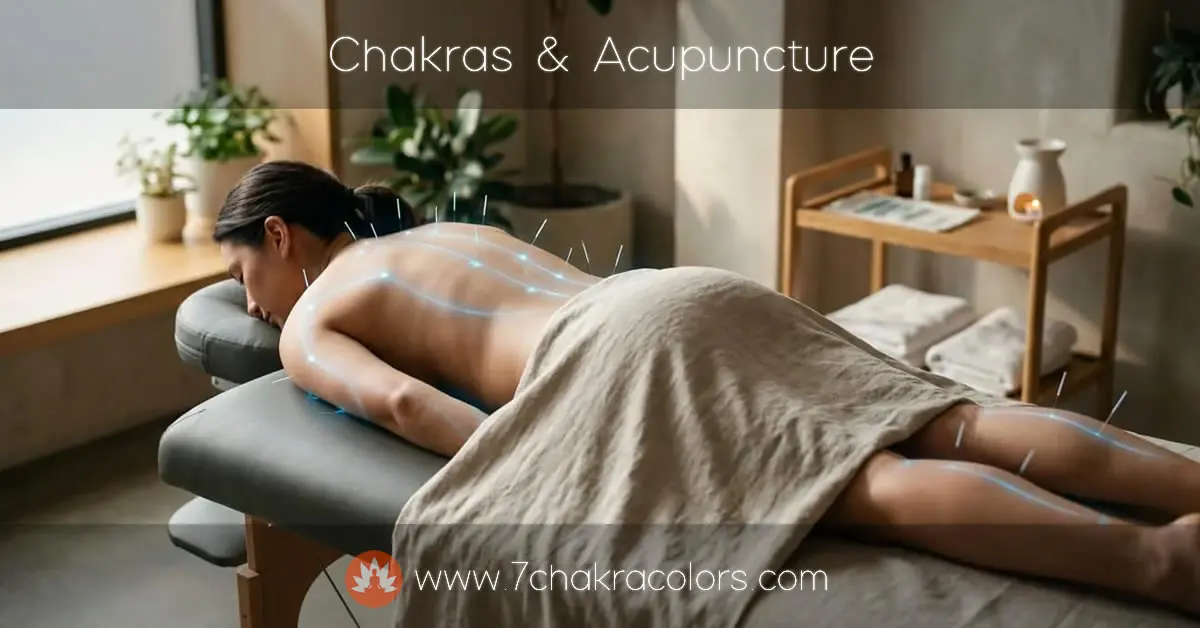
The 7 Chakras and Acupuncture: How Two Ancient Energy Systems Speak the Same Language
Chakras and acupuncture: discover how meridians align. Learn about dry needling, electroacupuncture, energy healing, and integrated TCM practices.
Table Of Contents
You wake up exhausted, even though you crashed hard last night.
You slept for eight hours straight, and you’re still dragging. Your lower back’s in knots for no good reason. There’s this underlying dread pulling at you – or maybe it’s just that you’re creatively stuck, some unnamed heaviness pressing down on your ribs. Could be both.
Standard medical panel? Nothing.
Two ancient systems – one from Indian yogic philosophy, the other from Traditional Chinese Medicine – they’d both point to the same thing: your energy’s blocked. Not flowing where it needs to flow.
And here’s what gets interesting.
These systems were developed on completely different sides of the world. Separated by continents and ages, shaped by wholly different civilizations and belief systems. On paper? They’d seem completely unrelated.
Put them next to each other, though, and the similarities jump out at you. They both describe an unseen, yet tangible energy coursing through your system. Block that flow and illness follows – whether it shows up in your body, your mind, or tangled through both. And both offer a path out.
What Is Acupuncture And What Does It Do?
Acupuncture is at the heart of Traditional Chinese Medicine, and we’re talking thousands of years here – over 2,500 of them. It all hinges on qi – ‘chi’ – basically the energy that keeps you alive and moving. Your life force, if you want to think of it that way. It’s not stationary. Instead, it travels through your system along what they call meridians. Hidden from view, but very much real.
You’ve got twelve main meridian pathways, each one tied to a different organ system – Heart, Liver, Kidney, Lung, Stomach, the works. Get that qi moving smoothly through the channels, and you’re aligned. Clog it up, slow it down, or send it the wrong way? That’s when symptoms start showing up.
How does acupuncture fix this?
Thin needles go into specific points along those meridians to get the qi flowing again. And before you think this is random, there are over 360 recognized acupuncture points mapped out, each one with specific effects on organ systems, pain pathways, and emotional states. This is precise work.

The practice has evolved, though. Two other main approaches besides acupuncture show up in clinics now.
- Dry needling focuses on muscular trigger points – those tight knots in your tissue that refer pain everywhere. Same needles, but the acupuncturist is targeting your musculoskeletal system instead of meridian pathways.
- Then there’s electrical stimulation – electroacupuncture or e-stim. A mild electrical current runs between the needles and amplifies what the needles are already doing. Especially useful for pain that won’t budge, nerve issues, and anything chronic.
Understanding Post-Treatment Effects
Treatment with acupuncture often produces immediate effects, though the body continues processing therapeutic stimulation for days following the session. It’s normal to feel a bit sore after acupuncture as tissues adjust and energy rebalances. This mild soreness typically resolves within 24-48 hours and indicates active therapeutic response.
Where Chakras and Meridians Overlap?
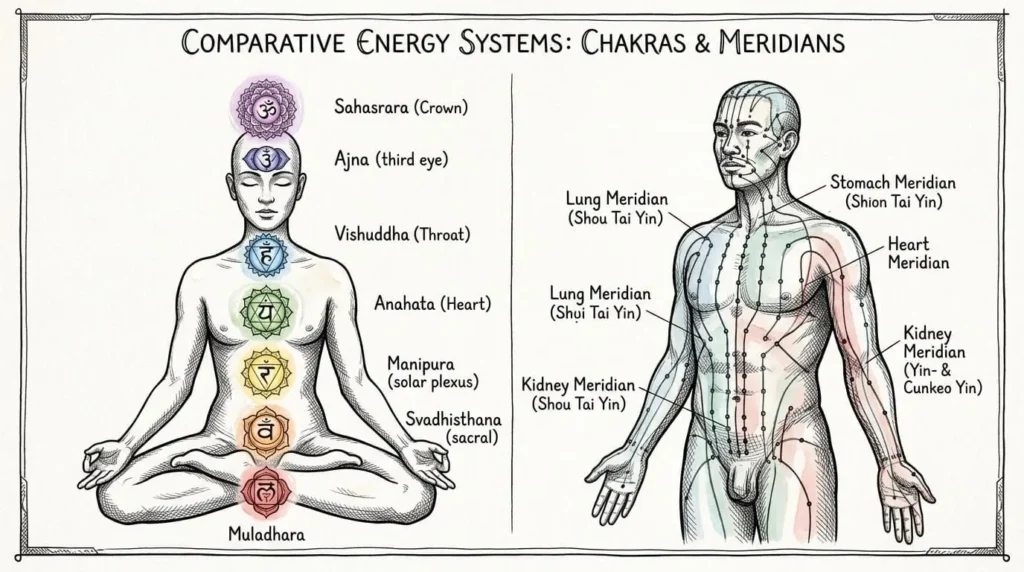
Most people don’t catch this, but when you look at where chakras sit on your body and where meridians converge, they’re almost exactly the same spots. Not by accident.
Both systems are describing the same anatomy underneath. Different names. Different ways of thinking about it. Different tools for fixing it. But the same anatomy.
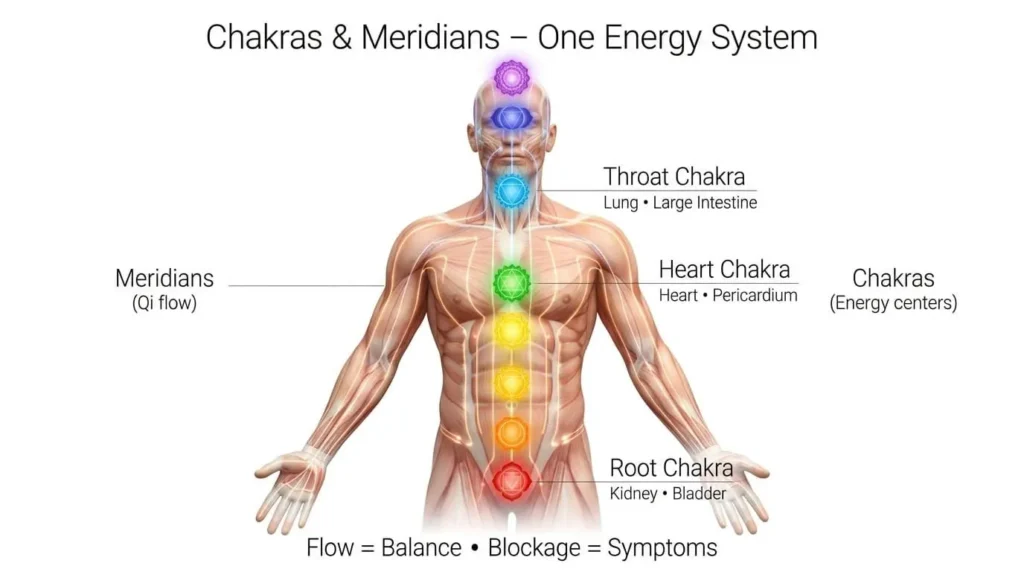
Your Root chakra is at the base of your spine – exactly where the Kidney and Bladder meridians start. Both of them deal with fear, survival, and keeping your lower body strong. The Heart chakra maps onto the Heart and Pericardium meridians in TCM. There’s nothing purely mechanical here. They’re about how available you are emotionally, where you’re tender, what grief and hurt you’ve folded into yourself. The Throat chakra lines up with the Lung and Large Intestine meridians – and in TCM, those are tied to how you express yourself, what you release, and how you breathe.
It’s not a perfect one-to-one translation. The two systems were developed separately. Different diagnostic frameworks. But the convergence is real. That’s why many practitioners blend both approaches with excellent results.
Here’s the full picture:
| Chakra | Color | Location | Meridian System (TCM) | Physical & Emotional Themes |
|---|---|---|---|---|
| Root (Muladhara) | Red | Base of spine | Kidney, Bladder | Fear, lower back pain, fatigue, adrenal health |
| Sacral (Svadhisthana) | Orange | Lower abdomen | Liver, Spleen | Creativity, reproductive health, emotional fluidity |
| Solar Plexus (Manipura) | Yellow | Upper abdomen | Stomach, Gallbladder | Digestion, self-confidence, decision-making |
| Heart (Anahata) | Green | Center of chest | Heart, Pericardium | Grief, love, circulation, emotional resilience |
| Throat (Vishuddha) | Blue | Throat | Lung, Large Intestine | Communication, breathwork, releasing what no longer serves |
| Third Eye (Ajna) | Indigo | Between eyebrows | Liver, Gallbladder | Intuition, headaches, hormonal balance, vision |
| Crown (Sahasrara) | Violet/White | Top of head | Governing Vessel (Du Mai) | Nervous system, consciousness, mental clarity |
Dry Needling and Chakra Zones: The Physical Layer
Dry needling works on the muscle. Not energy – but honestly, those two things aren’t as separate as people think they are.
Look at your Throat chakra. It’s in your neck and throat region. And in every clinic, this is one of the places where people store the most tension. Your neck becomes a stress museum. Knots develop in your trapezius and sternocleidomastoid. Tighten it enough, and you’re stuck – your range shrinks, your breath gets shallow, you literally can’t get words out.
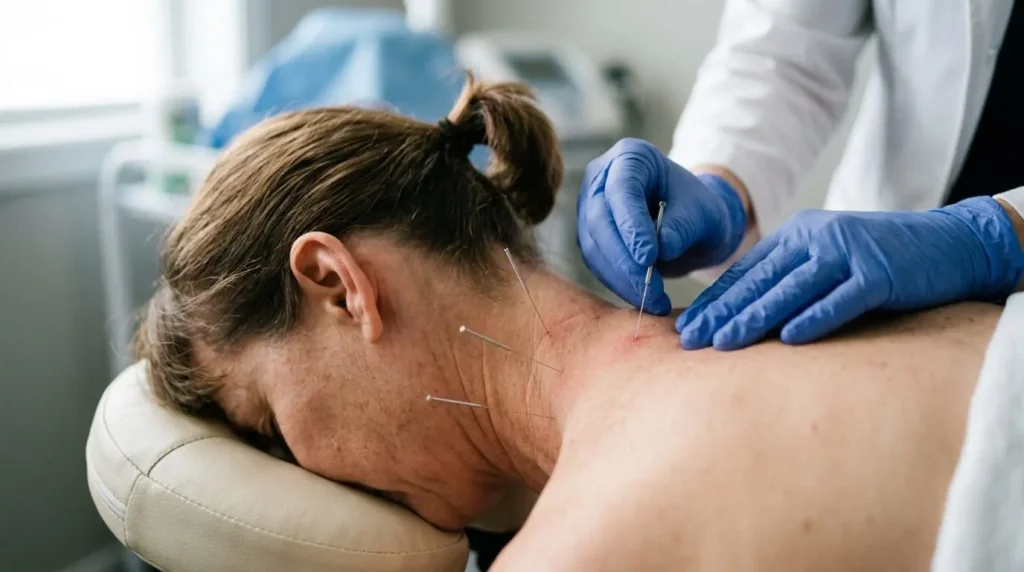
Stick needles in those tight spots, and the physical knots unwind. From an energy angle, you’ve also freed up what was frozen in your blocked Throat chakra.
This pattern shows up everywhere in your body:
- Tight lower back (Root chakra area) – responds to dry needling of the lumbar and sacral muscles
- Upper abdominal tension and diaphragm restrictions (Solar Plexus) – this is where anxious people and people with digestive issues hold everything
- Chest tightness (Heart chakra) – shows as muscular patterns in the pectoral region and between your ribs
Call it a blocked chakra or call it a myofascial trigger point. Your body’s still storing something it couldn’t let go of. Dry needling gives it an exit.
EFT tapping works through the same meridian logic — if you want to explore another tool that clears these same pathways, what EFT tapping is and how it works is worth reading alongside this.
Electrical Stimulation: Turning Up the Volume
Electroacupuncture takes what a regular acupuncture needle does and amplifies it with electricity. A soft electrical pulse moves between the needles, echoing the electrical language your body already speaks – the same signals running through your meridian routes. And the research shows up: people see pain drop, their cortisol levels shift, their nervous system settles down.
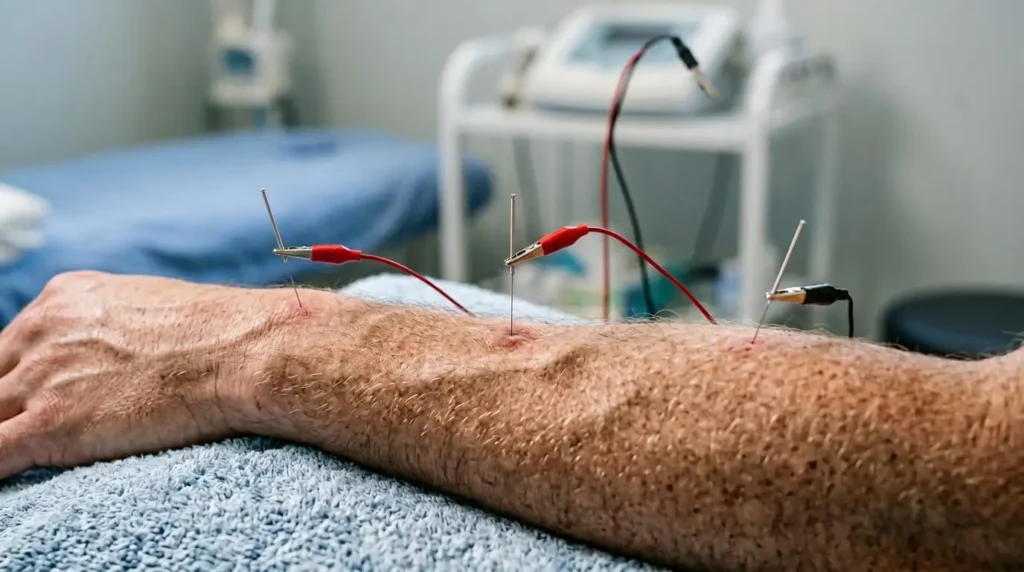
From a chakra angle, your lower chakras – Root, Sacral, Solar Plexus – tend to respond really well to electrical stimulation. They control the physical stuff: your pelvis, spine, digestive organs, and adrenals. And these areas tend to hold onto tension, especially if you’ve dealt with chronic pain or trauma or just stress that’s been sitting there for years.
Your upper chakras – Throat, Third Eye, Crown – usually do better with gentler stimulation. Traditional acupuncture, or electroacupuncture at lower frequencies. They’re managing more delicate systems – your nervous system, your senses, and how you think.
What works best for you depends on what you’re dealing with. A licensed acupuncturist who actually understands both the meridian system and the energetic side can figure out what your body needs.
How to Use Both Systems Together
You don’t have to pick one. They’re not competing with each other. Think of them as layers of the same approach – different ways in through the same door to health.
For a deeper look at how various healing modalities affect your energy centers, the relationship between medical treatments and chakras covers how physical interventions interact with your energetic body.
Here’s how to actually integrate them:
- Start with awareness
Notice where you feel stuck. Not just physically – emotionally, energetically too. Chronic lower back pain. Digestive trouble that won’t quit. Anxiety that colors everything. Can’t speak your truth. These are signs. Figure out which chakra these symptoms match up with using the table above.
- Book an acupuncture session
Tell the acupuncturist what’s going on. A good one will pulse-diagnose and figure out which meridians are out of whack. Usually, those map directly onto the chakra area you already figured out yourself.
- Support the work at home
Between sessions, keep that energy moving:
- Yoga poses for the chakra you’re working on – warrior poses if it’s your Root, camel pose for the Heart, shoulder stands for the Throat
- Color work – sit and breathe in the chakra’s color for a few minutes
- Each chakra has a seed sound (bija mantra) – chanting that vibrates it
- Crystals on the chakra while you rest
- Pay attention to what shifts
Energy work isn’t instant. But after 3 or 4 acupuncture sessions combined with daily chakra work, most people notice something. Not just pain dropping. Sleep gets better. Mood lifts. Emotional resilience shows up.
Frequently Asked Questions About Chakras and Acupuncture
Can acupuncture actually open blocked chakras?
Yeah. Acupuncturists won’t say it that way in a clinical setting, but what’s happening is the same thing. When acupuncture gets qi flowing again through a meridian that corresponds to a chakra, you’re releasing the energetic block that chakra work targets. Same process, different language.
What chakra does dry needling affect most?
Depends where you get needled, but the Root and Sacral chakras – lower back, pelvis, hips – that’s where most dry needling happens. Partly because everyone’s lower back hurts, partly because those regions just store tension like nowhere else.
Is electroacupuncture safe for energy work?
Totally safe if you’re seeing someone who knows what they’re doing. Electroacupuncture’s been around, it’s not a risky tool. If you’re sensitive to energetic work, they’ll typically dial you in with milder frequencies first.
How many acupuncture sessions until your chakras balance?
Not a fixed number. It depends on how long the imbalance has been there and what caused it. Most people suggest at least 6 sessions before you see real, lasting change. Then monthly sessions after that to maintain it.
What’s actually different between chakra healing and acupuncture?
Chakra healing is non-invasive – meditation, visualization, crystals, yoga, sound. You can do it yourself. Acupuncture is clinical work with needles – you need someone trained to do it. Both work on energy imbalance but from different angles and depths.
Can you meditate on chakras before or after acupuncture?
Absolutely. Most practitioners actually encourage it. Meditating on the chakra before the session helps you show up more tuned in to what’s being worked on. After the session, meditation helps you integrate the shift the needles just created.
Bringing It Together
Your body doesn’t really care what you call the energy moving through it. Doesn’t distinguish between qi and prana. Between a meridian pathway and a nadi channel. Between a trigger point and a blocked chakra.
It just knows flow versus stuck.
What makes combining chakras with acupuncture, dry needling, and electrical stimulation so powerful is that you’re hitting the same blockages from multiple angles. Energetically. Physically. Emotionally. On a neurological level. Each one reinforces the others.
Have you hit a wall with chakra work alone? Acupuncture might be what cracks it open. You’ve had acupuncture, but the results fade between sessions? Chakra practices give you daily tools for keeping that energy moving.
Either path takes you to the same place in the end: a body at peace with itself for once.
Blog Categories:
About the Author: