
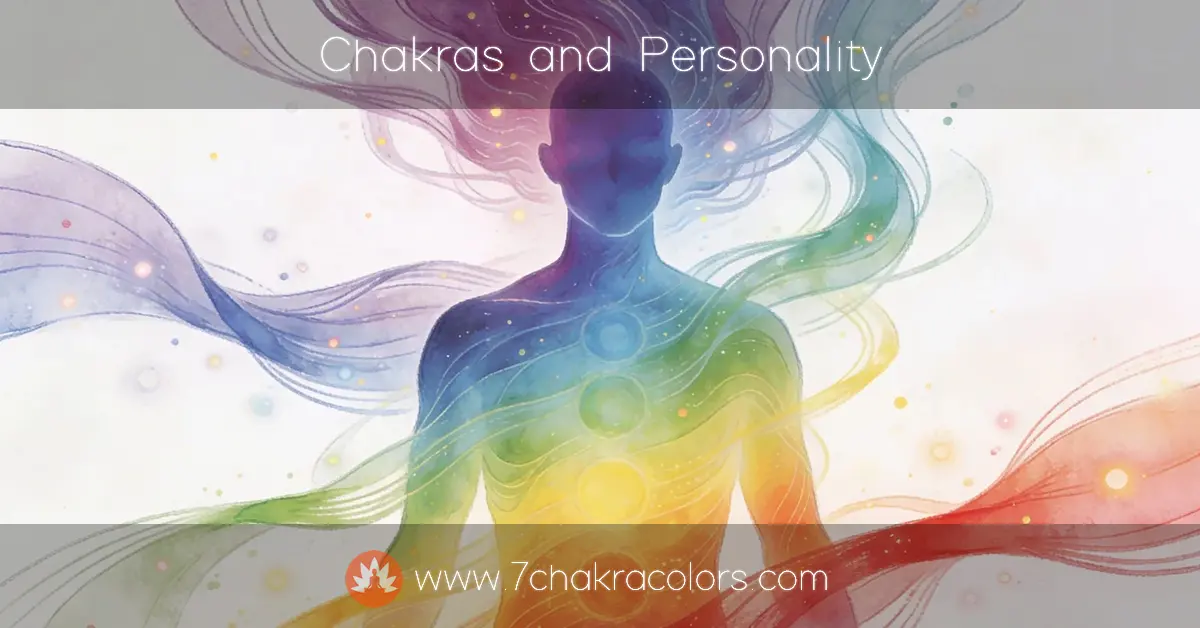
Chakras and Personality: How Your Energy Centers Shape Who You Are
Learn how dominant chakras shape personality patterns and how meditation and other techniques help restore energetic balance.
Table Of Contents
You probably know your patterns by now. Always the one grabbing for control when things get messy. Or backing away from conflict like it might actually kill you. Maybe you’re the person who needs everyone – and I mean everyone – to think you’re great.
It’s not random. And it’s not just who you are.

Your personality – those patterns you run on autopilot – comes from where your energy concentrates. Before you act cautious or bold, sensitive or detached, the energy moves first. Then behavior follows.
Most people miss this completely. They think their personality is fixed, something they’re stuck with. But personality is just energy expressing itself through habit. Change where the energy flows, and the patterns shift.
Understanding Personality Through Inner Maps
Humans have been mapping personality for centuries because patterns repeat. The Enneagram is one of these systems – it doesn’t put you in a box, it shows you which box you’ve been living in without knowing it.
The Enneagram works with nine core motivations. Not behaviors or traits, but the why underneath everything you do. One person seeks safety above all else. Another craves being seen as valuable. Someone else needs to feel connected to something beyond themselves.
These aren’t surface-level preferences. They’re the engine running your responses.
If you want to identify your specific patterns – the recurring motivations that shape your decisions – here’s the free enneagram test that offers detailed descriptions and testing resources. Understanding your core type gives you language for what’s been running unconsciously. And language creates space for change.

But here’s what most personality systems miss: these patterns have an energetic foundation. Your Enneagram type, your recurring behaviors, the version of yourself you present to the world – all of it links back to which chakras dominate your system.
The Dominant Chakra Concept
You have seven main chakras. They all matter, they’re all active to some degree.
But one or two usually run the show.
When you were young, circumstances shaped which energy centers got the most attention. Maybe your environment demanded constant vigilance – your root chakra learned to stay activated. Or you grew up needing to manage everyone’s emotions – your heart chakra overdeveloped while your solar plexus stayed weak.
This isn’t good or bad initially. Your system adapted to survive, to get needs met, to navigate the world you were given.
The problem comes later when that adaptation becomes identity. When the energy imbalance that started as survival strategy turns into “just how you are.” The overactive chakras keep firing, the underactive ones stay dormant, and you mistake this pattern for personality.
Most people spend their whole lives running on two or three chakras doing all the work.
How Different Chakras Shape Who You Become
Root chakra dominance makes you the careful one. Security-oriented, sometimes to the point of paralysis. You calculate risk obsessively. Change feels threatening even when staying put hurts worse. That friend who won’t leave the stable job they hate? Root chakra stuck in overdrive, fear mechanisms running constantly.
Sacral chakra, as your primary energy, creates the emotional, creative type. Everything’s intense – your feelings, your desires, your need for pleasure and connection. You’re probably artistic or at least drawn to beauty. But you might also swing between extremes, struggling with boundaries because this chakra doesn’t naturally understand limits.

When your solar plexus dominates, you’re that person who needs to make things happen. Ambitious, yeah. Driven for sure. But also – if we’re being honest – kind of controlling sometimes. You want outcomes you can predict, situations you can manage. Letting go of the wheel feels dangerous even when you’re exhausted from steering.
Heart chakra dominance? You’re the one everyone texts when life gets hard. The empath. The person who walks into a room and immediately knows something’s off, even when everyone’s smiling. You don’t just feel your own emotions – you’re picking up everyone else’s too, processing emotional data you didn’t ask for. It’s a gift until it becomes exhausting, which happens more often than you’d like.

The throat chakra does something weird when it dominates. It makes you one of two people – the one who can’t stop talking, always sharing, constantly needing to put words to everything – or the opposite. Completely locked down. Words stuck somewhere in your chest that never make it out. What’s strange is both patterns come from the same energy imbalance, just expressing differently.
Third eye dominance makes you the analytical one. Or the intuitive one. Sometimes both simultaneously, which gets confusing. You live in your head, processing, analyzing, seeing patterns others miss. Insightful, yes. But also disconnected from your body, from present moment, from simple feeling without needing to understand it first.

And crown chakra as your main energy? You’re probably the friend who talks about meaning and purpose while everyone else is focused on their mortgage. The seeker. You meditate, you read philosophy, you’re drawn to mystical experiences that most people don’t even believe exist. Which is beautiful, except you might also be terrible at paying bills on time or connecting with people who just want to talk about normal stuff without turning it into a cosmic conversation.
None of these are problems by themselves. They become limiting when they’re the only energy you know how to run.
Why Awareness Changes Everything
The moment you see the pattern, something shifts.
Not immediately. Not magically. But the recognition itself creates space where there wasn’t any before.
You catch yourself mid-reaction – “Oh, that’s my root chakra panicking again” – and suddenly there’s a gap between stimulus and response. The pattern still tries to run. Your heart chakra still wants to fix everyone’s problems. Your solar plexus still reaches for control when things feel uncertain.
But now you see it happening.
This isn’t about self-criticism. Not about judging yourself for being “too sensitive” or “too controlling” or whatever your dominant pattern does. That judgment just adds another layer of stuck energy.
Energy awareness means recognizing what’s active without making it wrong. Your solar plexus isn’t bad for seeking control – it’s trying to keep you safe the only way it knows how. Your heart chakra isn’t weak for feeling everything – it’s doing exactly what heart chakras do when there’s too much energy concentrated there.
The difference between energy awareness and self-criticism? One creates freedom to change. The other just reinforces the pattern while making you feel bad about it.
Aligning Energy and Personality
So how do you shift this? How do you stop running on the same two chakras and bring the whole system back online?
Start with meditation focused on your underactive centers. If you’re all solar plexus and throat-driven, expressive, always pushing forward, spend time breathing into your heart and root. Not to shut down your strengths. To balance them with what’s missing.

Five minutes daily. Sitting quietly, directing breath and attention to the chakras that don’t get much energy naturally. Your system will resist at first because it’s built habits around avoiding these areas. Push through anyway.
Research from Harvard Medical School shows that regular meditation creates measurable changes in brain structure – increasing gray matter in areas associated with self-awareness and compassion while decreasing density in regions linked to stress and anxiety. The same principle applies to chakra work. Consistent attention rewires not just your brain but your entire energetic system.
Sound healing works surprisingly fast for balancing chakras – faster than most other techniques I’ve seen. There are specific frequencies that hit specific energy centers. 396 Hz for your root, 417 Hz for sacral, all the way up to 963 Hz for crown. Don’t worry about understanding why it works. Just know that it does.
Find recordings online, use singing bowls, or even just hum at different pitches while focusing on each center. The vibration reaches places that conscious effort can’t always access.
Journaling helps too, but not the way most people do it. Don’t just write about your day. Write specifically about which chakra seems most active during different situations. When did you feel that heart chakra overwhelm? What triggered your root chakra fear response? Where was your solar plexus trying to control outcomes?

Track patterns for two weeks. You’ll see exactly where your energy consistently goes and which centers stay quiet.
The goal isn’t fixing your personality or becoming someone else. You’re not broken. Your traits aren’t flaws.
You’re just bringing the whole system back into balance. Returning to a state where all seven chakras contribute instead of two or three doing everything while the others sit dormant. If you’re not sure where to start, exploring how a free medium reading can unblock your chakras can reveal which centers need the most attention.
You Are Larger Than Your Patterns
Here’s what matters most – you are not your personality.
Your personality is something you experience. Something moving through you. A collection of energy patterns that formed over time, influenced by circumstances, shaped by needs that made sense when they started.
But the part of you that can observe these patterns? That’s consciousness itself. Always larger than any pattern, any trait, any habit.
Your cautious root chakra personality kept you safe when you needed safety. Your empathic heart chakra helped you navigate emotional complexity when that skill mattered for survival. These patterns served you once. Maybe they still serve you in certain contexts.
The practice isn’t eliminating them. It’s expanding beyond them. Recognizing when the old pattern is running and choosing – consciously choosing – whether this situation actually needs that response or if another part of you might serve better.
Balance your chakras, and your personality becomes more fluid — and learning how to balance your true colors with your chakras gives you a practical framework for doing exactly that. Still recognizably you, still drawing on your natural strengths, but no longer trapped in the same narrow range of responses.
You become who you actually are – which turns out to be much more spacious, much more capable, much more free than the personality patterns that used to define you.
Start noticing which chakra runs your default responses. Just notice. That’s enough to begin.
To find out what your personality type is according to the Carl Jung-based MBTI test, read this article.
Frequently Asked Questions About Chakras and Personality
1. How are chakras connected to personality patterns?
Chakras represent areas where energy concentrates in the body. When certain chakras become dominant or underactive, they influence how you respond to life. Over time, these energetic habits express themselves as recognizable personality traits.
2. Is personality fixed, or can it change through chakra awareness?
Personality is not fixed. It reflects habitual energy patterns formed through experience. By becoming aware of dominant chakras and gently balancing them, reactions and behaviors can become more flexible and conscious.
3. What does it mean to have a dominant chakra?
A dominant chakra is an energy center that consistently drives your reactions, motivations, and focus. Often formed early in life, it becomes the default way you seek safety, connection, control, or meaning.
4. How does the Enneagram relate to chakras and energy patterns?
The Enneagram maps core motivations behind behavior, while chakras describe where energy is concentrated in the body. Together, they reveal how psychological patterns are supported by deeper energetic habits.
5. What personality traits are linked to root chakra dominance?
Root chakra dominance is associated with strong needs for safety and stability. It often shows up as caution, resistance to change, or heightened fear responses when uncertainty is present.
6. How does heart chakra dominance affect relationships?
Heart chakra dominance increases empathy and emotional sensitivity. While this supports deep connection, it can also lead to emotional overwhelm or difficulty setting boundaries if left unbalanced.
7. Can meditation help balance personality-driven chakra patterns?
Yes. Meditation focused on underactive chakras helps redistribute energy across the system. Over time, this reduces automatic reactions and increases awareness and emotional regulation.
8. How does sound healing support chakra balance?
Sound healing works through vibration and frequency, which directly affect energetic centers. Specific tones are traditionally linked to chakras and can help release tension and restore balance.
9. Why is awareness more effective than self-criticism?
Awareness creates space between reaction and response. Recognizing patterns without judgment allows change, while self-criticism tends to reinforce the same energetic habits.
10. What is the goal of balancing chakras and personality?
The goal is not to eliminate personality traits but to expand beyond rigid patterns. Balanced chakras allow personality to become more fluid, responsive, and guided by conscious choice.
Blog Categories:
About the Author: