
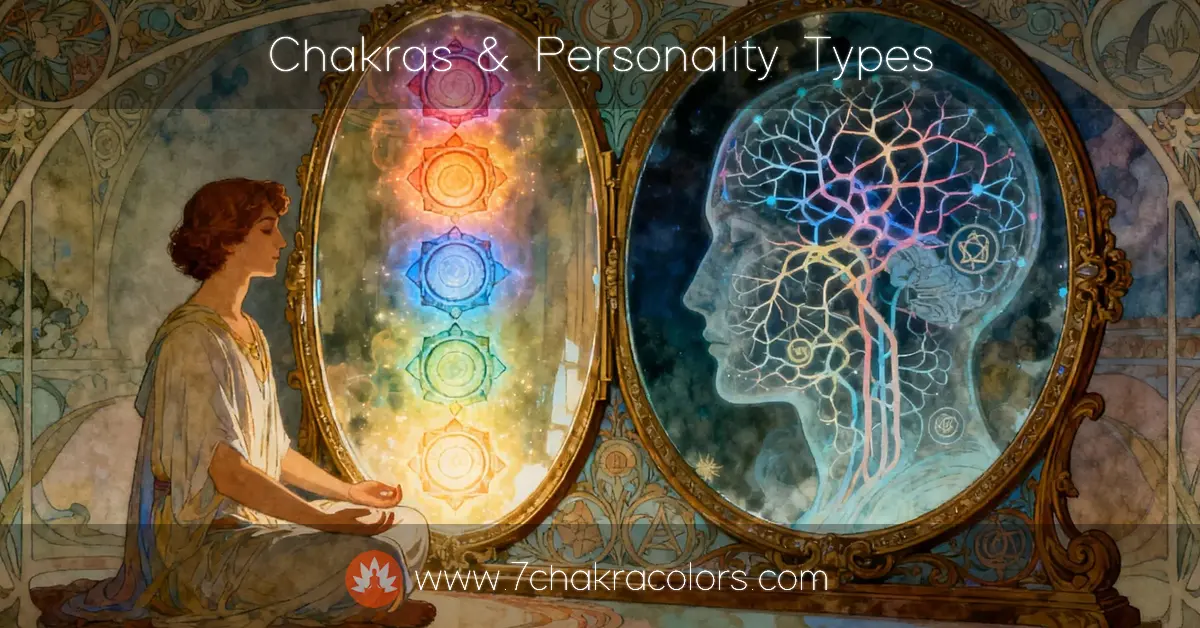
Chakras & Personality Types: Why Some Meditations Don’t Work for You
Why Your Meditation Fails: Discover how Jung’s personality types reveal which chakras you’re blocking and why generic practices don’t work for you.
Table Of Contents
The Frustration Nobody Talks About
You sit down to meditate. Follow the instructions perfectly. And it feels … wrong.
Not wrong like you’re doing it badly. More like you’re fighting something. The breathing pattern that’s supposed to open your heart – it tightens your chest instead. You do everything right. Follow every step. And it still doesn’t land. That voice kicks in: I’m broken. This doesn’t work for people like me.
Here’s what gets blamed: your discipline. Your spirituality. Your readiness.
None of that’s actually the problem.
The real issue?
You’re using a meditation designed for someone else’s brain. Spiritual practices fail not because you’re failing them – but because they don’t match how you’re actually wired. Your personality isn’t a limitation. It’s data. And when you understand it, everything shifts.
Your Psychology Is Part of Your Energy System
Chakras describe where energy moves through your body. Jung’s model describes how energy moves through your mind. Same energy. Different map.

Your personality shapes your spiritual practice. It’s not separate from it – it runs through everything. You process things a certain way. That’s just how you work. And early on, those patterns got locked in. They made sense for what you were dealing with. Now they shape which practices feel natural and which ones feel impossible.
People say meditation doesn’t work for them. They sit down. Something inside says no. Chest tightens. Mind won’t quiet. Body refuses to cooperate. It tightens up. Resists. Won’t cooperate. Their body gets tired. Nothing changes. So they quit.
Your personality type isn’t a box limiting you. It’s a map showing you where you actually have power.
Understanding Your Cognitive Functions First
There are four main ways people process the world. Thinking. Feeling. Sensing. Intuition. Most people lean hard on one or two – that’s your preference. And each one connects to different chakras.
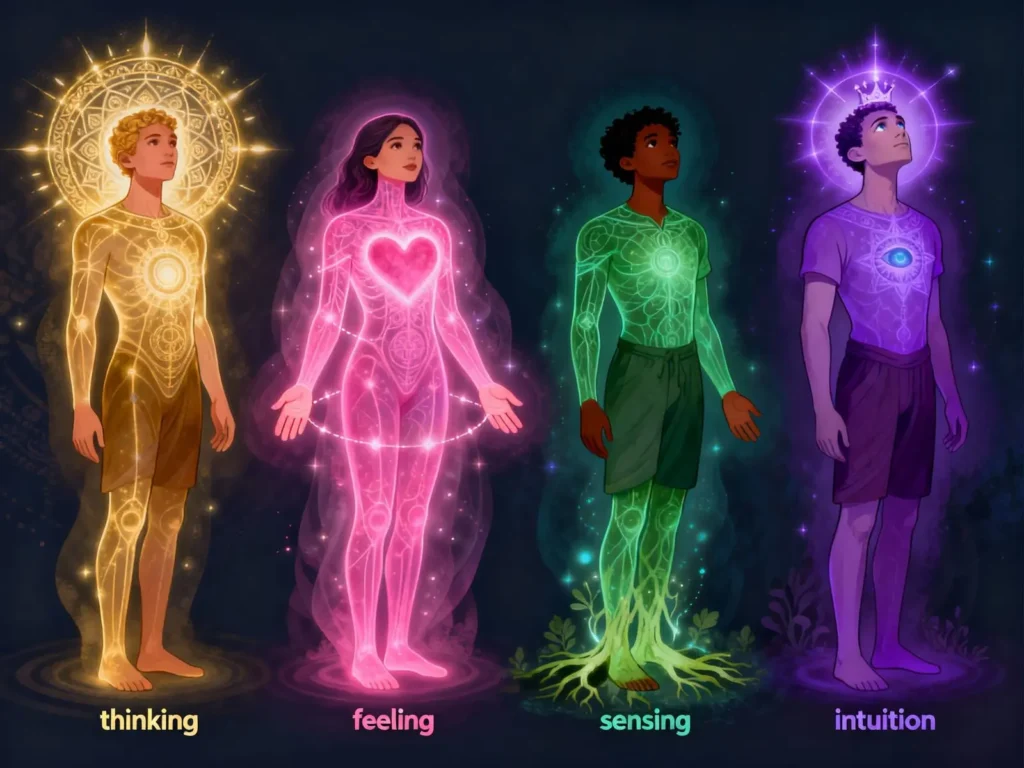
Here’s what matters: these aren’t strengths or weaknesses. They’re just different. A Thinking-dominant person processes reality one way. A Feeling-dominant person processes it another. One’s not better. But they route energy differently through your body.
When you meditate against your preferences instead of with them, you’re fighting your own wiring. Your attention gets tired. Your body resists. And chakras that should be flowing feel blocked.
Ready to see how your personality type actually maps to your chakra system?
Understanding your cognitive functions takes solving one test. This test is based on theories developed by Carl Jung and later enhanced by Isabel Myers and Katharine Briggs, and it defines 16 different personality types. It is free, practical, and it explains why certain practices either click or feel impossible:
👉 Take the Jung Personality Test
Once you know your type, everything in this article makes sense. The practices that frustrated you. The chakras that always feel stuck. The resistance nobody else seems to experience.
| Jung Function | Psychological Focus | Primary Chakra | Common Imbalance |
|---|---|---|---|
| Thinking | Logic, analysis, systems, objectivity | Solar Plexus & Third Eye | Heart closed off, emotions avoided, disconnected |
| Feeling | Values, empathy, relationships, meaning | Heart & Throat | Root unstable, power missing, grounding weak |
| Sensing | Present moment, concrete details, practical reality | Root & Sacral | Third eye blocked, intuition dismissed, vision unclear |
| Intuition | Patterns, possibilities, meaning-making, future | Third Eye & Crown | Root disconnected, sacral suppressed, ungrounded |
How Your Psychological Patterns Become Energetic Patterns
Your personality came from somewhere. Early on, you figured out what worked. Logic worked. Or feeling things. Or staying present. Whichever tool kept you safe, you grabbed it. Used it over and over. Eventually it became automatic.
Your chakras are locked in the same way. To further understand how your system is wired, you can take the chakra test and compare the results.
A person who learned to survive through logical analysis (Thinking-dominant) develops different chakra patterns than someone who learned to navigate the world through emotional attunement (Feeling-dominant). The Thinker’s energy pools in the solar plexus and third eye – power and clarity. The Feeler’s energy centers in the heart and throat – connection and expression.
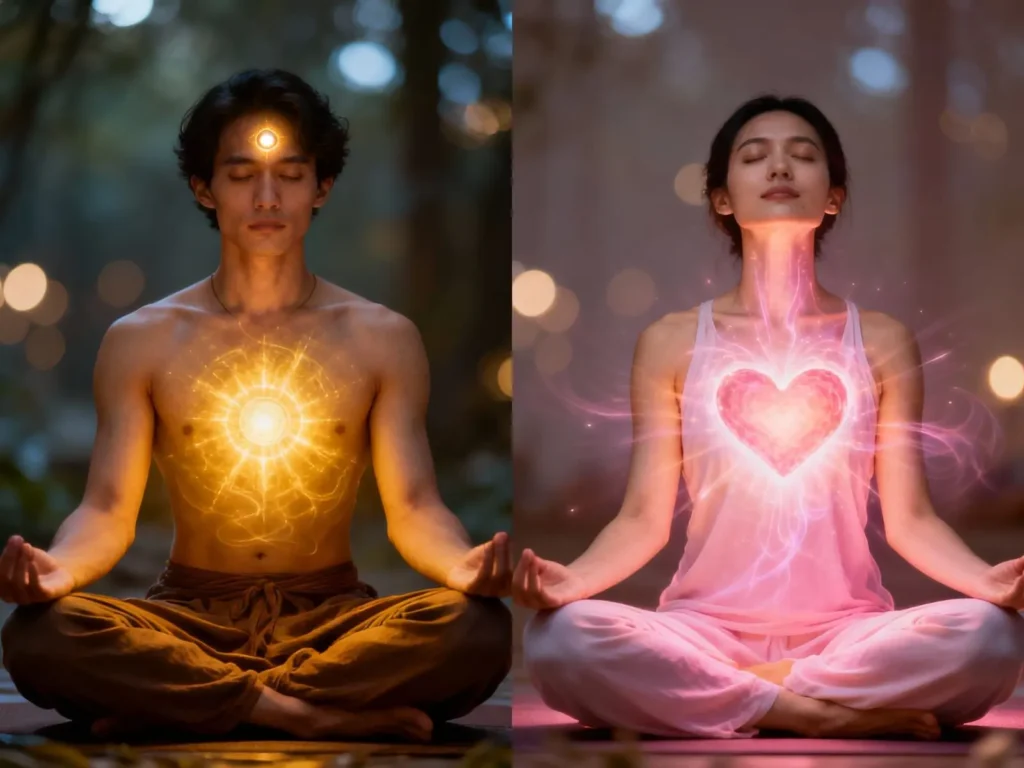
Neither pattern is wrong. But when you meditate, you’re not working with neutral energy. You’re working with energy that’s already shaped by years of psychological patterns.
That’s why forcing yourself into a generic meditation fails. Your body’s learned to move a certain way. Trying to change that path feels wrong. Like your whole system’s telling you to stop.
The Pattern: How Personality Shapes Your Chakra Tendencies
Thinking-dominant types stay locked in the solar plexus and third eye. Logic and clarity feel safe. Emotions? Messy. Unpredictable. You avoid them. Heart and sacral chakras barely get attention. Meditations that ask you to feel something just make you irritated.
Feeling-dominant types (empathetic, values-based, relational) live primarily in the heart and throat. These chakras feel natural. The root and solar plexus – grounding and personal power – often feel uncomfortable or foreign. Meditation that asks for emotional release works. Grounding work feels tedious.
Sensing-dominant types (practical, present, concrete) connect most naturally with the root chakra – that direct, physical, here-now energy. Abstract visualization, chakra theory, anything too ethereal creates resistance. They need practices they can feel immediately.
Intuitive-dominant types live up in the third eye and crown. You get the theory. Love it, actually. All the symbolism and meaning. But sit you down and ask you to ground into your root chakra and you want to leave. Too boring. Too practical. Too small.
See yourself? Most people do. And here’s the important part: noticing this pattern is the breakthrough. Because now resistance makes sense. It’s not laziness or spiritual failure. It’s a mismatch.
Why Chakra Imbalances Often Hide Personality Defenses
A blocked chakra isn’t always broken. Sometimes it’s protected.
Jung called this the “shadow” – the parts of ourselves we learned were unsafe to express. Early life teaches us quickly which emotions are acceptable, which thoughts are dangerous, which desires get punished. We build walls around certain chakras to survive.

A Thinking-dominant person who grew up in an environment where emotions weren’t safe might lock down their heart chakra. Not as punishment. As survival. That wall kept them functional when vulnerability would’ve been dangerous.
The problem comes later. When those defenses stop serving you. When you actually want to feel connected, but your body won’t let you because it remembers the lesson: feeling equals danger.
Meditation that tries to force those walls open feels violating. Chakra work that honors the defense while gently expanding it – that actually works.
This is why generic meditation fails. It doesn’t account for the wisdom your body encoded. Your chakra patterns aren’t mistakes. They’re intelligent responses to what you experienced. The goal isn’t to erase them. It’s to integrate them.
Choosing Practices That Actually Fit You
Start here: identify your dominant cognitive function. That’s your entry point.
- Thinking-types work best with meditation that includes structure, clear steps, measurable results. Give them a framework. Their resistance to feeling-based practices drops when they understand the mechanism behind it.
- Feeling-types thrive with meditation that emphasizes connection and meaning. Visualization works if it connects to values. Solo practice often feels hollow – they need purpose.
- Sensing-types need short, direct practices. Five minutes of root chakra breathing beats thirty minutes of abstract visualization every time. They want to feel the difference immediately.
- Intuitive-types engage with the bigger picture and symbolism. They love understanding why something works. Practices that incorporate mythology, personal meaning, or future vision pull them in.
Then start with your least comfortable chakra. Not punishment. Just curiosity about what you’ve been avoiding. See what comes up when you breathe into it.
Change how you do the practice. Shorter if it feels long. Different imagery. Faster or slower. Whatever makes it actually feel like something you’d do instead of something you should do.
Personality Types Are Maps, Not Boxes
Real important: don’t confuse understanding with identity.
Understanding your type just means you see the pattern. Seeing it means you can do something else if you want to.
A Thinking-type can develop emotional sensitivity. A Feeler can build logical clarity. The difference is you’re not starting from zero. You’re building capacity in your least-developed area, not pretending your preferences don’t exist.

Balanced chakra work actually softens rigid personality traits. The more you engage with avoided chakras, the more flexible you become. You don’t abandon who you are. You become fuller.
Integration: Where Psychology Meets Spirituality
Here’s what changes everything: resistance isn’t failure. It’s information.
When meditation feels uncomfortable, that’s information. Your body’s pushing back. Maybe it’s fighting you. Maybe it’s protecting something. Maybe it’s showing you exactly what needs attention.
Psychology explains the resistance. Chakra work transforms it. They’re not competing systems. They’re two languages describing the same energy.
Your personality isn’t what’s blocking your spiritual growth. It’s what carries that growth forward.
Now, go back to your meditation practice with this lens. The one that frustrated you. See it differently. Understand what you were actually resisting – and why. Then adapt it to match how you actually work.
Take or retake the Jung Personality Test with this new understanding. Look at your type again. Not as a label. As a map of your energetic patterns. Where you naturally move energy. Where you’ve built walls. Where you’re ready to expand.
The meditation that works is always the one you’ll actually do. And you’ll do it when it respects how you’re wired.
Frequently Asked Questions About Carl Jung Personality Types and Chakras
1. Why do some meditation techniques feel uncomfortable or ineffective for me?
Meditation techniques interact differently with different personality types. Practices that focus on emotions, visualization, or surrender may clash with thinking-dominant personalities, while highly structured or analytical practices can frustrate feeling-oriented types. When a meditation does not match your psychological wiring, resistance often shows up as restlessness, boredom, or emotional shutdown.
2. How are Jung personality types connected to chakra imbalances?
Jung’s cognitive functions describe how mental energy is processed, while chakras describe where energy tends to accumulate or become blocked in the body. Over time, dominant personality traits can overdevelop certain chakras and neglect others. For example, intuitive types often emphasize upper chakras, while sensing types may focus heavily on lower chakras.
3. Does my MBTI or Jung type mean some chakras are permanently blocked?
No. Personality types describe tendencies, not fixed limitations. A Jung type shows where energy flows easily and where it avoids challenge. Chakra imbalances are adaptive patterns, not permanent conditions. With awareness and balanced practice, any chakra can be developed regardless of personality type.
4. Should I only meditate on chakras that feel comfortable to me?
Comfortable chakras usually reflect already-dominant energy patterns — if you want to explore this further, there are 3 books that reimagine chakras beyond the standard rainbow model and offer fresh perspectives on your energy type. While working with them feels good, growth often happens when gently engaging the chakras you tend to avoid. The key is balance: grounding practices for intuitive types, emotional opening for thinking types, empowerment work for feeling types, and intuitive practices for sensing types.
5. Can taking a Jung Personality Test really improve my meditation practice?
Yes, when used as a self-awareness tool rather than a label. A Jung Personality Test can help you understand why certain practices feel natural and others feel difficult. This insight allows you to choose chakra and meditation practices that work with your nervous system instead of against it.
6. Is resistance during meditation a sign I am doing something wrong?
Not necessarily. Resistance often points to psychological or energetic avoidance rather than failure. From a Jungian perspective, resistance can indicate shadow material or underdeveloped functions. From a chakra perspective, it may signal an imbalanced or underactive energy center that needs patience and gradual engagement.
7. How can I combine personality awareness with chakra healing effectively?
Start by identifying your dominant cognitive function and the chakras you naturally gravitate toward. Continue supporting those strengths, but intentionally include gentle practices for neglected chakras. Personality awareness helps you avoid spiritual bypassing and creates a more integrated, sustainable path of meditation and self-development.
The Path Forward
To deepen your understanding of chakras and personality, also read this article.
Next – work on your chakras. Start at your root. Get it grounded and solid. Then work your way up through the rest of the system as things are ready to move. Add therapy when you need it. Keep going with both until the stuck stuff actually loosens, until your nervous system stops treating every moment like a threat, until you can think about what happened without your body hijacking the process.
This works. Your chakras know how to heal. You just have to actually do it.
Blog Categories:
About the Author: