

How Yoga and Meditation Can Help Improve Focus in Research
Discover how yoga and meditation improve research focus and cognitive function. Perfect for students and researchers looking to boost performance.
Table Of Contents
Have you ever stared at a research paper, reading the same sentence repeatedly, yet still feeling completely lost? Trust me, you’re not alone. Keeping your focus can be a real challenge, whether you’re a student, a researcher, or just someone tackling a project.
That’s where yoga and meditation step in – not just buzzwords in the wellness world but powerful tools that can actually help rewire your brain and boost your cognitive skills. Let’s dive into how these age-old practices can truly enhance your research abilities.
The Science Behind Focus and Cognitive Function
Let’s discuss how the brain functions before moving on to examining yoga poses and meditation. More than just willpower is needed to maintain focus. The process of focusing has a close relationship to the way your brain controls emotion, memory, and attention. And you know what? Stress, sleep, and general mental sharpness all have a huge impact.
It has been found that if you meditate on a regular basis, you can increase grey matter density in regions that are linked to memory and attention. Furthermore, if you practice yoga, it will improve blood circulation and oxygen flow to the brain. More oxygen facilitates information processing and alertness. Looking at it this way, yoga is much more than just sitting cross-legged and stretching – it’s brain fuel.
It is interesting that colleges and universities across the United States are also recognizing the importance of such practices. Many institutions have embraced yoga and meditation as integral components of student life, academic programs, and wellness initiatives.
Academic Programs and Degrees
Some institutions have incorporated yoga and meditation into their academic curricula. For example, Naropa University in Boulder, Colorado, offers a Bachelor of Arts in Yoga Studies, allowing students to align their academic pursuits with their personal yoga practice. Similarly, Loyola Marymount University in Los Angeles provides a Master of Arts in Yoga Studies, focusing on the academic study and practice of yoga through both residential and low-residency formats. This is a very interesting point because now this university has a truly full-fledged department that can do research in this field, hundreds of students submit coursework for specialized essays using the Papersowl writing service for students and graduates, thus creating truly competitive work in this field. These programs delve into yoga’s history, philosophy, and therapeutic applications.
Wellness Initiatives and Campus Programs
Some universities have included yoga and meditation in their student wellness programs outside of official academic courses. For example, the University of Florida offers free online guided meditation courses via UF Health Integrative Medicine. The aim is to encourage stress reduction and improve awareness among faculty members and students. Emphasizing the university’s dedication to whole health, they also provide free yoga courses to UF and UF Health staff members.
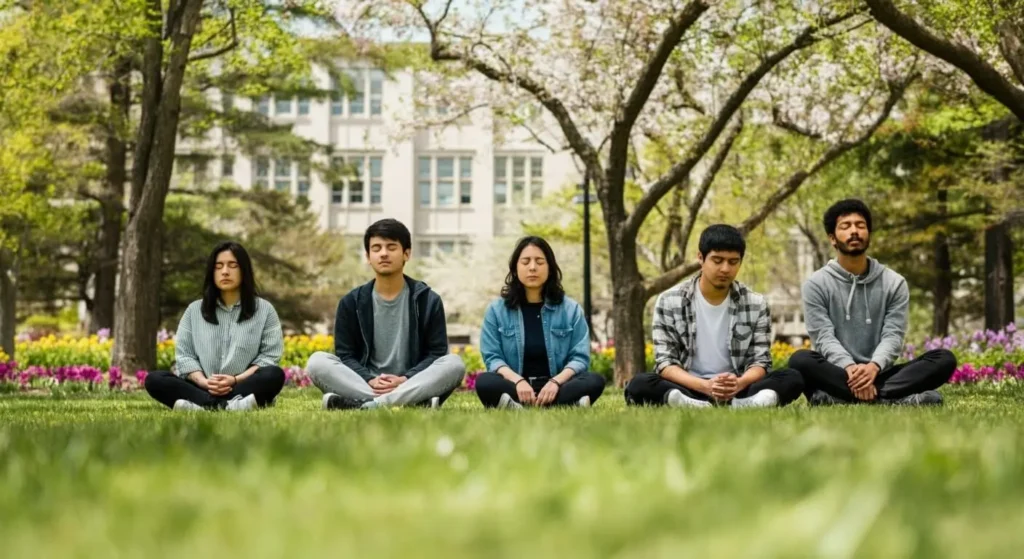
MindfulNYU, hosted by New York University (NYU), also provides a range of free yoga classes and courses throughout the academic year. These programs, which are open to staff, faculty, and students, help to build a community around mindfulness and physical well-being.
Stanford University offers yoga and meditation classes and other self-reflecting activities via its Office for Religious & Spiritual Life. These initiatives provide a safe space for self-reflection and relaxation among academic pressures, helping students’ mental and emotional health.
Dedicated Institutions
In a similar fashion, there are also specialized universities that offer psychology studies combined with spirituality and contemplative practices.
One such example is CIIS, which is located in San Francisco, California. This institution offers various graduate degrees focused on mind, body, and spirit. CIIS has courses on East-West Psychology or Integral Counseling Psychology, among others.
Another example is Maitripa College in Portland, Oregon. They offer a unique educational experience based on contemplative traditions. In their programs, they integrate meditation, Buddhist philosophy, and volunteer work while specializing in Tibetan Buddhist studies.
Yoga: More Than Just Flexibility
When people hear the word “yoga”, they often imagine someone performing a handstand on a beach at dawn or performing some ‘exotic’ asana pose.

Don’t worry, though – you can still reap the benefits without twisting into a pretzel. At its simple core, yoga is about connecting your mind and body through movement and breath.
1. Yoga Enhances Physical and Mental Endurance
Researching for hours at a time can be physically taxing. Slumped posture, sore neck, tired eyes—it all adds up and zaps your focus.
By coordinating breath with movement, yoga can:
- Sharpen mental clarity
- Increase energy and decrease fatigue
- Improve posture and lessen physical discomfort
You can improve your productivity and focus even with a 15-minute morning practice. Before you start cranking out your next research discovery, consider it like lubricating the gears. Once you start practicing, the difference will be so big that you won’t know how you managed to function without it.
2. Specific Poses That Help Focus
There are some yoga poses that are especially beneficial for focus and concentration. Here are just a few:
- Vrikshasana (tree pose): Promotes mental stability and balance
- Balasana (child’s pose): Soothes the nervous system
- Paschimottanasana (seated forward bend): Relieves tension and aids in mental centering
It is widely known and recognized that yoga brings many physical and mental health benefits. Lately, in this fast-paced world we live in, the focus is on how yoga helps enhance concentration and cognitive functions. Especially in settings that deal with research and high productivity that call for intense focus.
By combining physical postures, breathing techniques, and meditation, yoga practice creates a connection between body and mind. Parts of the brain that are responsible for attention, memory, and learning get activated. Performing and maintaining postures (asanas) while concentrating on breathwork will ground you in the present moment and promote mindfulness and mental clarity. By breathing consciously, yoga induces the body’s relaxation, lowering stress and anxiety. Stress reduction, in turn, has a direct effect on cognitive function, which improves focus and clarity of thought – the two qualities that are very important in research environments.
Meditation: The Mental Gym for Your Brain
Meditation Reduces Mental Clutter
While meditation can be a stand-alone practice, it complements yoga very well. Here, the goal is to train your mind to stay focused and in the present. By gradually learning how to control your thoughts, you are teaching the brain to focus for extended periods. This will help you improve attention and control external distractions. Adding the right audio environment helps too — learning to deepen your meditation practice by using effective meditation music can significantly reduce the time it takes to settle into focus.

Again, these are the qualities important for researchers, where maintaining focus is frequently a necessary feature. Meditation also has an effect on the brain’s capacity to remember and retain information. It improves short and long-term memory, which is important when working with complex research material. Additionally, meditation helps you maintain emotional balance, again reducing stress and anxiety. A welcome trait that will help you stay focused and productive during challenging mental tasks.
Easy Meditation Techniques for Researchers
To get the fastest results, you can try these simple techniques:
- Focused Attention Meditation: Focus on a single point, such as a mantra (mental/sound) or a candle flame (visual). While doing this, pay attention to your natural breathing. Excellent for training your focus.
- Mindfulness Meditation: Observe your thoughts without trying to affect them. Ideal for raising awareness of distractions and practicing mindfulness.
- Body Scan Meditation: Focus on every individual bodily part in your mind while imagining you are breathing into it. Relax as you exhale. Enhances the mind-body connection and aids in stress relief.
Start with just 5 minutes a day. Trust me, that tiny habit can build massive mental stamina over time.
To sum up, yoga and meditation are two very effective ways to help you enhance mental clarity, concentration, focus, and memory. In addition to being good for overall health, these practices are just perfect for research participants or people conducting challenging mental tasks.
Yoga and meditation can improve researchers’ performance by fostering mindfulness, lowering stress, and improving cognitive function. Undoubtedly, if you practice these techniques, you will be more successful in your academic and professional pursuits. For those who want a more structured sonic environment for their sessions, creating chakra meditation tracks that actually work offers a practical framework for building that foundation.
Meditation is the deep focus exercise, and yoga is the warm-up. It all comes down to teaching your mind to stop straying, which is, let’s face it, its favorite hobby.
How These Practices Directly Improve Research Productivity
What is the actual impact of yoga and meditation on research productivity? Let’s break it down:
- Improved Focus = Less Time Wasted: You’ll be able to learn faster and retain more information with fewer rereads.
- Enhanced Memory Function: Meditation improves your working memory and ability to solve problems, making it easier to process complex ideas and references.
- Increased Creativity: Both practices encourage divergent, out-of-the-box thinking, which is fantastic for tackling problems from another angle and brainstorming new ideas.
- Lower Stress = Better Performance: Let’s be honest; research can be pretty stressful. Imagine reducing this stress by at least half, if not more.
By managing your cortisol levels on a hormone level, these techniques will help you stay calm and collected, even when facing deadlines. Just picture this: You sit down, eliminate distractions, absorb information faster, and enjoy the creative process. It’s all about achieving that flow state, not just cranking out productivity.
Yoga and Meditation Benefits Comparison
| Yoga Benefits | Meditation Benefits |
|---|---|
|
|
Creating Your Personalized Mind-Body Routine
Here’s a simple routine you can start tomorrow:
- Morning (10–15 minutes): Light yoga stretch + 5 minutes of meditation
- Midday (optional): Quick standing stretch or a short walk + 2-minute breathing exercise
- Evening (10 minutes): Gentle yoga flow + mindfulness meditation
You don’t have to go full monk mode. Just start small and be consistent. Think of these habits like charging your internal battery—because let’s be honest, running on 2% brainpower isn’t sustainable.
Yoga and Meditation Are Your Research Superpowers
The end goal you want to achieve with these practices is to develop constant effective stability. At the end of the day, research is a marathon, not a sprint. To get through the mental haze and make those breakthroughs more effortless, you need endurance, focus, and clarity. Meditation and yoga will help you achieve these goals without burning out.

Try it out for a few days. You have nothing to lose. Get out your yoga mat and do a few basic stretches. Next time you’re lost in a paper and out of focus, play some relaxing music, close your eyes, breathe, and let go for a brief meditation reset. You might be pleasantly surprised at how much more focused and relaxed you will feel.
Are you prepared to take your research to the next level? Your cushion and mat are calling.
Blog Categories:
About the Author: