
What Your IQ Test Score Reflects About Your Inner State
Your IQ test score reflects ability, but your inner state shapes how it shows up. Explore calm, focus, and alignment behind real IQ results.
Table Of Contents
Your IQ score tells you something real about how your brain works – but it doesn’t tell the whole story. How grounded you are in that moment, whether your mind’s actually present or spinning somewhere else, that changes everything. Same brain. Different state. Different number.
I was invited by a friend recently to take an IQ test. Nothing dramatic, just one of those invitations that land quietly in your chat and make you pause for a second. I remember I was good at this in high school. However, I hadn’t taken one in years, so curiosity won.
I clicked the link, sat down properly, and started. Seventeen minutes later, it was done – which surprised me. Not because it was rushed, but because I never felt that mental drag you get when tests stretch too long. It just moved. There were a few answers I was not 100% sure about, and I played them by intuition.
When I finished, I expected the usual friction. Payment walls. Delayed results. Some kind of “unlock your score” nonsense.
None of that happened.
The test I took was the International IQ Test (https://international-iq-test.com/). Results appeared instantly. Completely free. No email games. No pressure. Just a score and an explanation.
What This IQ Test Actually Does
This test focuses on logical reasoning, visual patterns, and abstract relationships. You’re not tested on vocabulary, cultural knowledge, or education. You’re solving problems that depend on how efficiently your mind recognizes structure.
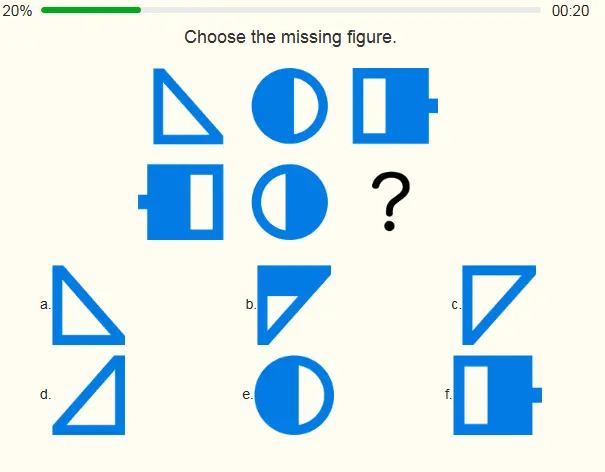
It’s also standardized, which matters more than most people realize. Standardization means your score is normalized against a large reference group, using the familiar framework of an average IQ of 100 with a standard deviation of 15.
In simple terms, you’re not getting a random number. You’re seeing where your performance lands relative to a broad population. The site even publishes internal documentation explaining how this calibration works, which builds trust quickly.
Here’s what shifts everything – because the results arrive instantly and cost nothing, you stop feeling like you’re being judged. It becomes more like checking where you stand rather than getting a verdict handed down. That matters more than you’d think.
My Result, and Why It Caught My Attention
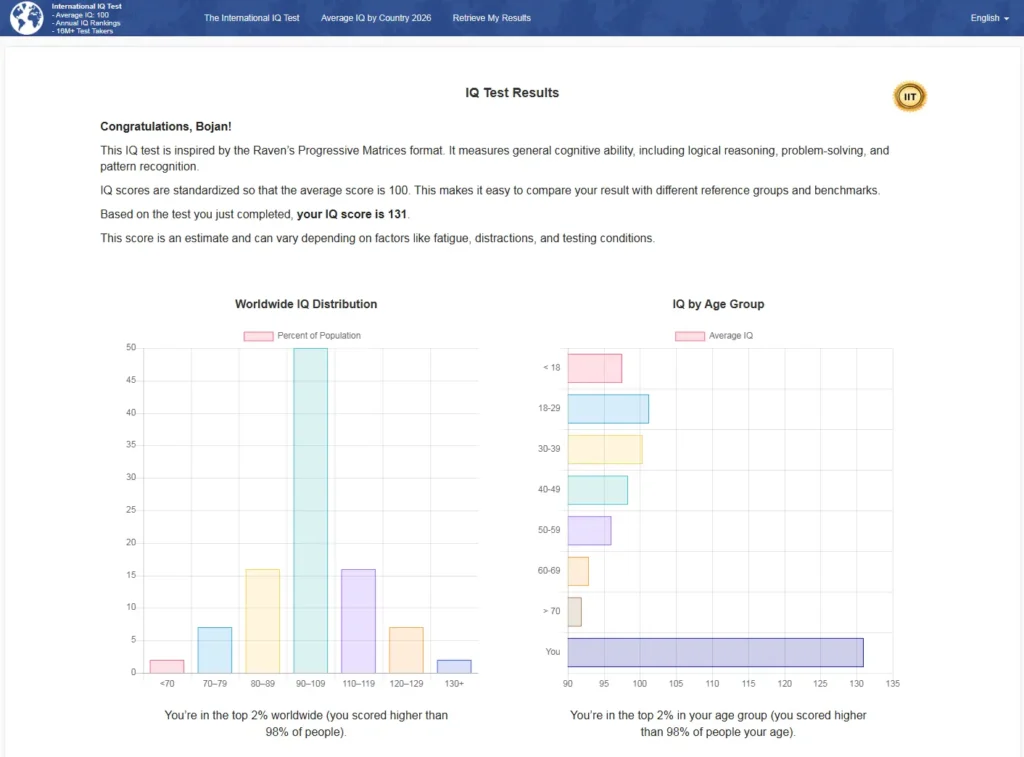
I scored 131. Sorry, had to say it. I know some of you were interested. It is good for the EGO, but not resting on it 😉
Now, I have to say, I didn’t go in expecting that. Not because the number is relatively high, but because I wasn’t trying to optimize anything. I wasn’t rushing. I wasn’t stressed. I wasn’t mentally split between the test and whatever came next.
I was calm. Focused. Present.
What really struck me wasn’t the score. It was how different this felt compared to other tests I’ve taken while actually tense or distracted. Like, for example, tests in high school. Completely different experience.
Like your mind’s working from a different operating system.
Was it because I just finished my morning meditation?
This is what actually made me think and encouraged me to write this article.
Why Calm Nervous System Performs Better?
Your brain doesn’t work alone. It never has.
When your nervous system is on edge, thinking narrows. Working memory shrinks. Pattern recognition slows down. You second-guess answers that were right the first time. You second-guess them again. You know that feeling – shoulders tight, breath sitting high in your chest, that tension that makes thinking feel stickier than it actually is.

When the system settles, the opposite happens. Attention widens. Thoughts connect faster. Decisions land with less friction. That doesn’t make you smarter. It lets you use what’s already there.
This works because cognition depends on coordination, not just speed.
Chakras as Functional Alignment
Chakras are often explained in abstract language, but at their core they describe how different parts of your system organize experience. Nothing mystical required.
Several of them directly affect how you perform on cognitive tasks:
- Root chakra – grounding and safety. When unstable, attention scatters and urgency takes over.
- Sacral chakra – mental fluidity and adaptability. When tight, thinking becomes rigid.
- Solar plexus – confidence and decisiveness. When weak, doubt interrupts clarity.
- Third eye – pattern recognition and insight. Central for abstract reasoning.
When these centers are reasonably balanced, energy moves. Thoughts connect. You don’t force solutions. They arrive.
How Internal State Affects the Test Results?
During the test, I noticed simple things. My breath stayed low. My jaw wasn’t clenched. My shoulders didn’t creep upward as time passed.
That internal quiet made thinking feel clean. Not rushed. Not sticky. Just responsive.
You’ve probably experienced this on random days when your mind feels sharp for no obvious reason. And other days when even simple problems feel oddly heavy. Same intelligence. Different internal weather. That connection between energetic state and cognitive performance is exactly what chakra practices for learning and improving academic performance explores in practical terms.
Simple Ways to Align Before Taking an IQ Test
This isn’t about rituals or hacks. It’s about removing noise.
- Sit upright. Both feet flat on the floor. Let your weight actually settle down instead of perching.
- Breathe slowly for a couple minutes. Nothing forced or dramatic. Just steady.
- Check your jaw and shoulders. That’s where most people hide tension without realizing it. Release it.
- Clear your visual field. A messy desk pulls your attention sideways without you noticing.
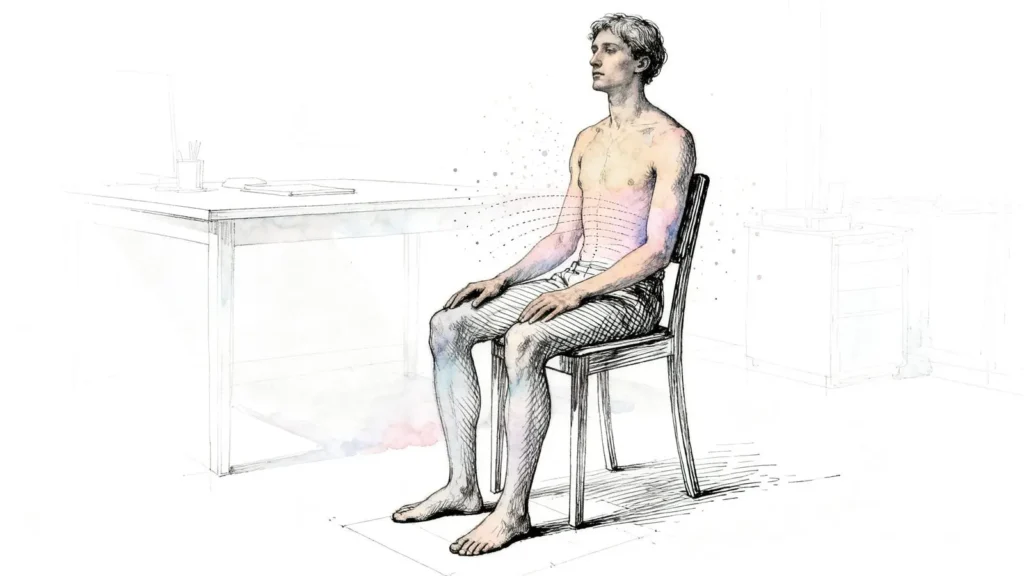
Small adjustments. But they shift your baseline.
High IQ Through History
People with exceptionally high IQs weren’t just fast thinkers. They tended to value inner space and sustained focus.
- Albert Einstein – estimated IQ around 160. What people miss is that he thought slowly, in images and intuitions, not rapid calculations.
- Nikola Tesla – often estimated between 160–185. Relied heavily on internal visualization, working through problems entirely in his mind before building anything.
- Leonardo da Vinci – estimated around 180+. Moved fluidly between art, science, and engineering because he wasn’t confined to how one discipline thought.

Different eras. Different personalities. A shared pattern of deep focus and inner coherence.
What Most People Misunderstand About IQ Scores
An IQ score can fluctuate slightly depending on sleep, stress, and timing. Retaking a test doesn’t always yield the same result, especially if your internal state changes.
That doesn’t make IQ tests unreliable. It makes them contextual. They measure how intelligence expresses itself under specific conditions. Understanding this kind of inner state awareness is also central to guiding others — something worth exploring if you want to pursue a career as a life coach.
The number isn’t your identity. It’s feedback.
Use The Test as an Experiment, Not a Label
Take the test once as you are. Then take it again another day, after rest or grounding. Compare how it feels, not just what number appears.
Notice where thinking flowed and where it snagged. That information is more valuable than chasing a higher score.
Intelligence expresses itself best when the system underneath it is aligned. Calm doesn’t inflate ability. It reveals it.
Once you see that, IQ tests stop being intimidating. They become tools.
Frequently Asked Questions About IQ Tests
1. Can your inner state really affect an IQ test result?
Yes. Not because intelligence changes from minute to minute, but because access to it does. When your nervous system is tense, working memory shrinks and attention narrows. When you’re calm and grounded, the same cognitive ability is easier to use.
2. Does this mean IQ tests aren’t reliable?
No. IQ tests are reliable at measuring cognitive performance under specific conditions. What they don’t capture is how sleep, stress, emotional load, or tension influenced those conditions on the day you took the test.
3. If I take the IQ test again later, should I expect the same score?
Not always. Small variations are normal, especially if your internal state changes. That doesn’t invalidate the test. It simply gives more context about how your mind performs under different conditions.
4. Do I need to believe in chakras for this to make sense?
No. Chakras are just one way to describe functional states in the body and nervous system. Grounding, confidence, fluid thinking, and insight exist whether you use that language or not.
5. Can calming down actually increase my IQ?
Calm doesn’t increase raw intelligence. It removes interference. What happens is you stop fighting your own system, and cognition runs closer to its natural capacity.
6. Is it useful to take an IQ test more than once?
It can be, if you treat it as an experiment rather than a label. Taking the same test under different internal conditions often reveals more about how you think than the number itself.
Blog Categories:
About the Author: