

Tips for Nurturing Your Spiritual Growth
Discover practical tips for nurturing your spiritual growth through community, daily practices, prayer, and meditation.
Table Of Contents
Spirituality has been an integral part of my life since I was a kid. But I didn’t know anything about spiritual schools, religion, or spiritual practices.
So what is spirituality exactly, and what are the ways to achieve spirituality?
I guess it is some aspect of our lives we cannot quite pinpoint, but I can observe that a lot of people have forgotten or let go of the spiritual aspect of their lives.
The ‘average person’, the one who lives in the system and for the system, is usually focused on other things that are more superficial and materialistic. Don’t get me wrong – there’s nothing wrong with living this way. I am simply saying that nurturing your spiritual side is something that can greatly improve your well-being, giving you the peace of mind, purpose, and meaning that everyone longs for.
There are numerous religious and spiritual communities based on various traditions that can help ‘lost souls’ find deeper meaning and connection.
No matter what you are drawn to – established religions, alternative spiritual movements, or secular approaches to inner growth – finding the right community for you can be very transformative for your spiritual journey.
If you recognize yourself as a person who lacks spiritual meaning, this short article might give you some ideas about where to start looking. I will try to offer advice that’s designed to help you regain your spiritual aspects, develop them, and re-establish your inner peace.
Find A Community That Shares The Same Values
What are your values? What is your view of the world, society, life, and ethics?
A person can easily feel lost and isolated these days. People seem to be ever more emotionally numb and mentally distracted, and distant.
But then again, there are communities where those who are looking for meaningful connections meet. People who share the same values can find solace in various spiritual and religious communities.
The beauty of getting involved in a spiritual religious community lies in the diversity of options available. Everyone can find something that matches their personal perspectives on growth, meaning, and connection.

Let’s look at some religious communities first.
Jewish Communities
Those who are yearning for deeper connections, bonding, and finding people who share the same values usually turn to Reform Jewish Temple Philadelphia, or similar places, because they know that there they’ll find a safe space where they can learn lots of useful things and, simultaneously, work on enhancing themselves spiritually.
In general, Jewish communities emphasize the importance of questioning, learning, and continuous growth. For these purposes, they study their sacred texts – Torah and the Talmud.
Tikkun olam (repairing the world) is the Jewish concept that encourages members to engage in social activities and community service as material expressions of their spiritual values. Many Jewish congregations offer secular and spiritual activities, such as study groups, holiday celebrations, and lifecycle ceremonies that establish deeper connections between their members.
Christian Communities
Christian churches and communities also work towards developing spiritual growth through fellowship, worship, and service.
From contemplative practices in Episcopal traditions to the enthusiastic worship of Pentecostal communities, Christianity provides diverse approaches to connecting with the divine.
You can study the Bible in small study groups, engage in prayers, or even step deeper into mission work as a way to serve the community. Christianity is also about deepening your faith, letting go, following a higher purpose, and through these actions building meaningful relationships with others on the same spiritual path.
Buddhist Communities
Buddhist communities are focused on various meditative practices, devotion, mindfulness, and the search for enlightenment. Group meditation sessions are offered, often with a focus on chakras, and various retreats where participants can focus on their inner peace and search for wisdom within.
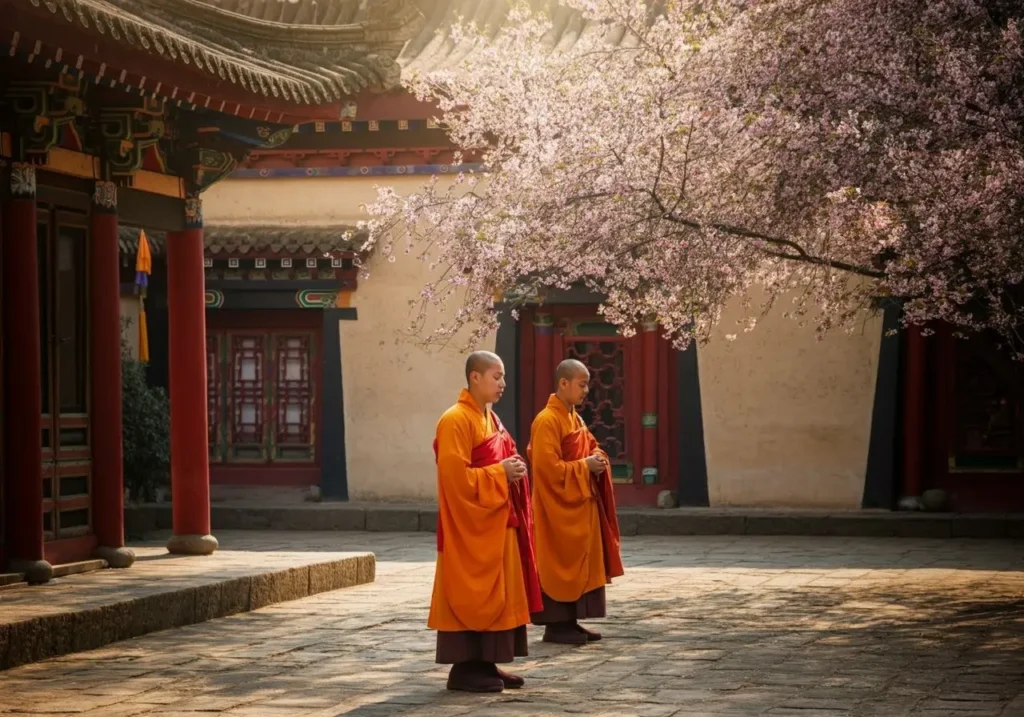
Buddhist tradition emphasizes values such as compassion, non-attachment, and awareness of the present moment.
Islamic Communities
Muslim communities have their base in mosques and Islamic centers.
Muslims engage in daily prayers, they study the Quran as their major religious text, and generally follow the specific rules advocated by their religion in daily life quite strictly.
The five daily prayers create a habit of having daily moments of inner spiritual reflection. Besides that, there are also community gatherings. These are usually on Fridays and religious holidays. At such gatherings, stronger bonds among believers are created through different religious practices.
Islamic communities often emphasize the importance of charity (zakat), pilgrimage, and continuous learning as the main paths to follow for spiritual development.
Agnostic and Alternative Spiritual Communities
Not all spiritual seekers will find their fit in religious communities. If you are looking for spirituality, but dislike religious environments, numerous communities exist that focus on universal spiritual principles – without specific doctrinal requirements.
For example, Unitarian Universalist congregations are open to people of different backgrounds and of all beliefs. The emphasis is on personal spiritual exploration.
Such ‘mindfulness communities’ are not tied to different dogmatic texts or rules – the practices they focus on for seeking inner peace are, for example, meditation and present-moment awareness.
Here we can also list ‘New Age’ and ‘metaphysical communities’ which explore spiritual practices such as crystal healing, sound healing, energy work, and other alternative healing practices.
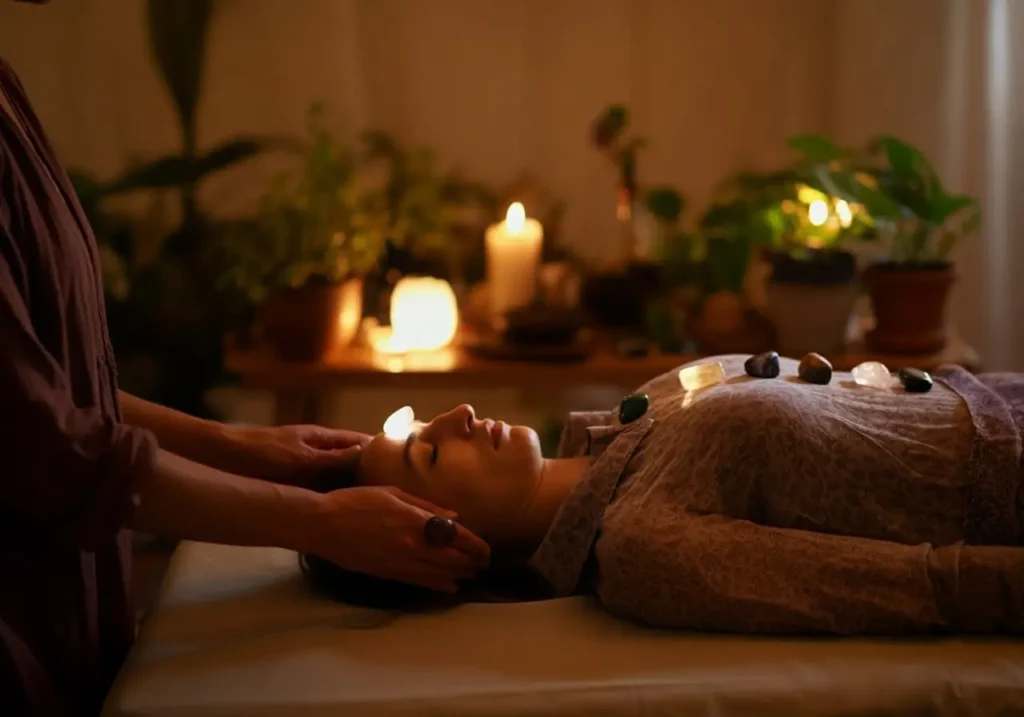
Personal development and work on yourself comes first – often encouraging you to find your own way through finding your personal power, developing your intuition, and establishing a connection with your higher self and universal consciousness.
Spiritual communities that are closely tied to nature and nature’s principles focus on earth-centered practices – following the rhythms of nature, celebrating seasons and stellar events, etc.
It is not easy – you have to have motivation and will to seek and change – but finding your group of people, making connections with them, supporting them, and opening up to receive support, can be a life-saving process. If you are unsure, the path is widely open – explore different options and communities, try them out, and see what resonates. If you are in true search, the universe will open a door for you, and you might come through to the other side as a new, fully empowered person.
Developing Daily Spiritual Practices
While community involvement offers one established path to spirituality, cultivating your personal daily practices is a necessary foundation of sustained spiritual growth. Think of these practices as gaps in your daily routine – special mindful moments when you connect to your inner sacred space.
Practicing spiritual rituals on a daily basis will help you establish a connection to your higher self and balance your energy throughout the day.
Morning Rituals and Intention Setting
The best time of day to start is in the morning. Begin the day by setting your intentions for the day. Center your mind and ground your energy. There are many ways to do that. For example, when you wake up, you can first write down three things you’re thankful for – just to establish a positive mindset.
Then visualize your day and your emotional state in different situations you might encounter. Set your goals and intentions. This process helps align your actions with your spiritual values and stimulates mindfulness throughout your day.
Many spiritual traditions emphasize the power of sunrise as a time for prayer, meditation, or contemplation. Five minutes of quiet reflection, even while drinking your morning coffee, can become more than a habit. It becomes a sacred ritual that grounds you and prepares you for the day ahead. That grounding connects to something larger — the earth’s orbit and its spiritual frequency: the cosmic Om explores how planetary rhythms underpin the stillness you’re reaching for.
Evening Reflection and Gratitude
Evening holds a different energy. The day is over, and everything is slowing down. Time for yourself. Time to reflect again and end the day with another spiritual practice of your choice. For example, you can mentally review your day, do some breathing exercises, and let go of any negative emotions that arose in difficult situations you might have encountered during the day.
Then slow down, relax, meditate, let go. A simple prayer or gratitude expression in one way or another will definitely help balance your energy before going to bed.
Keeping a journal of your insights and revelations is very helpful for keeping track of your spiritual growth over time.
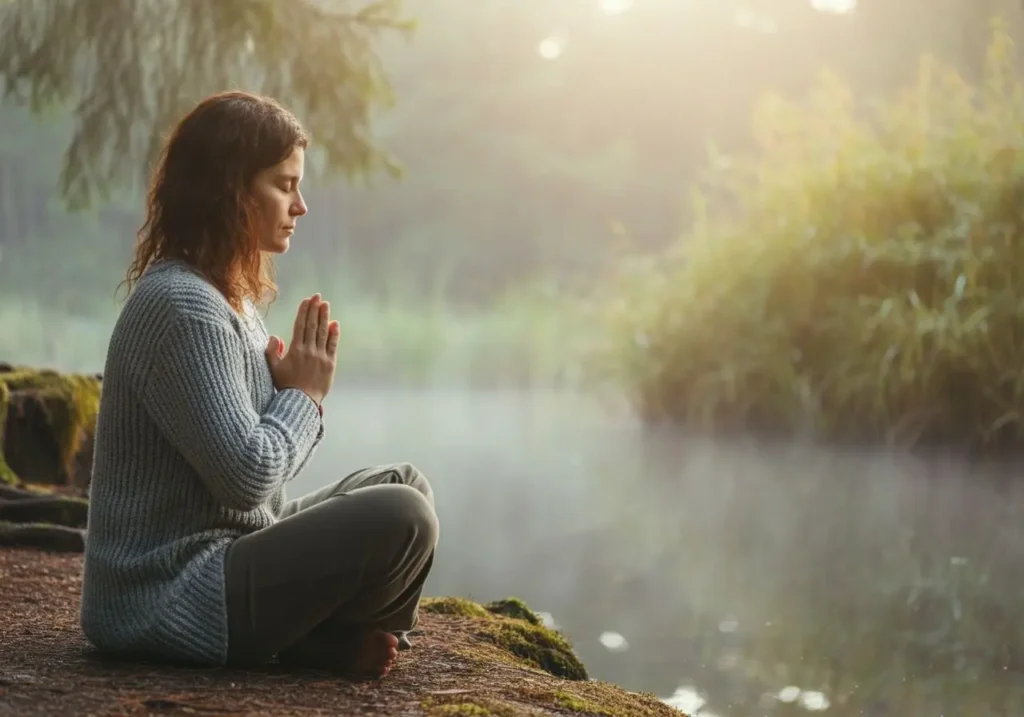
Turning To Prayer Can Be Highly Beneficial, As Well!
I mentioned prayer before, but I want to get into this a bit deeper.
If you look at any religion, prayers are an essential part, a cornerstone of any religious practice. Why is that?
Now, lots of people think that there’s a certain way a person should pray – but the truth is that you do not need to follow any particular rules. The only importance is that you engage in it mindfully and truthfully.
You’re the one who decides whether you’ll do something more conventional or come up with something on your own. In fact, I would encourage you to find your own ways and methods, the ones that feel good and work for you.
Whatever you decide, the point is that if you make prayer a habit, you’ll become a lot more connected with your spiritual side.
Service and Compassion as Spiritual Practices
Some people choose to do good, to help and serve, as part of their spiritual practice. You can do this within the framework of religious communities, as mentioned before, but you can also do this on your own. Even small deeds count.
Many spiritual traditions teach that when you selflessly serve others, you are actually serving the divine. This way of understanding can make volunteer work and random acts of kindness a powerful spiritual practice.
When you give something (not necessarily material) without expectation of return, it helps dissolve ego boundaries. Many people say that their most profound spiritual experiences occurred while serving others in need, and some even set this as their life’s mission.
Learning Encourages Growth
There are multiple paths to becoming whole. While one is the way of developing intuition, serving, praying, and so on, there is also a path of knowledge. This path is an essential component of the teaching of many spiritual masters (for example, Gurdjieff). One of the most enduring texts on this subject is explored in the timeless wisdom of the Bhagavad Gita — a guide to action, duty, and inner knowledge that remains as relevant as ever.
Learning is done through focus and persistence – things we lack ever more in modern times, surrounded by technology and fast media outlets that are shortening our attention span.
Instead, you should consider reading things – philosophy books, scientific literature, religious texts, books about spirituality, … Of course, this doesn’t mean that you should stick with these things only. Knowledge can be obtained in many ways. The importance is that you train your mind to be present and focused on what you are doing.
Nature as a Spiritual Teacher
Many spiritual traditions recognize nature as a profound teacher and source of divine connection. Personally, based on my experience, I would say nature is the greatest teacher of all. The only problem is we don’t understand it, because it operates on a different frequency and speaks a language we don’t understand. But we can learn. Spending time in nature, walking in the woods, swimming in the sea, hiking mountains – all activities in nature can provide perspective, peace, and a sense of belonging to something greater than ourselves – we just have to open ourselves to it.
Outdoor Meditation and Contemplation
Speaking of nature, taking your meditation practice outdoors is an excellent idea. It will deepen your connection to the earth, help you immerse yourself in the energy of nature, and make you feel a part of the natural world’s rhythm.
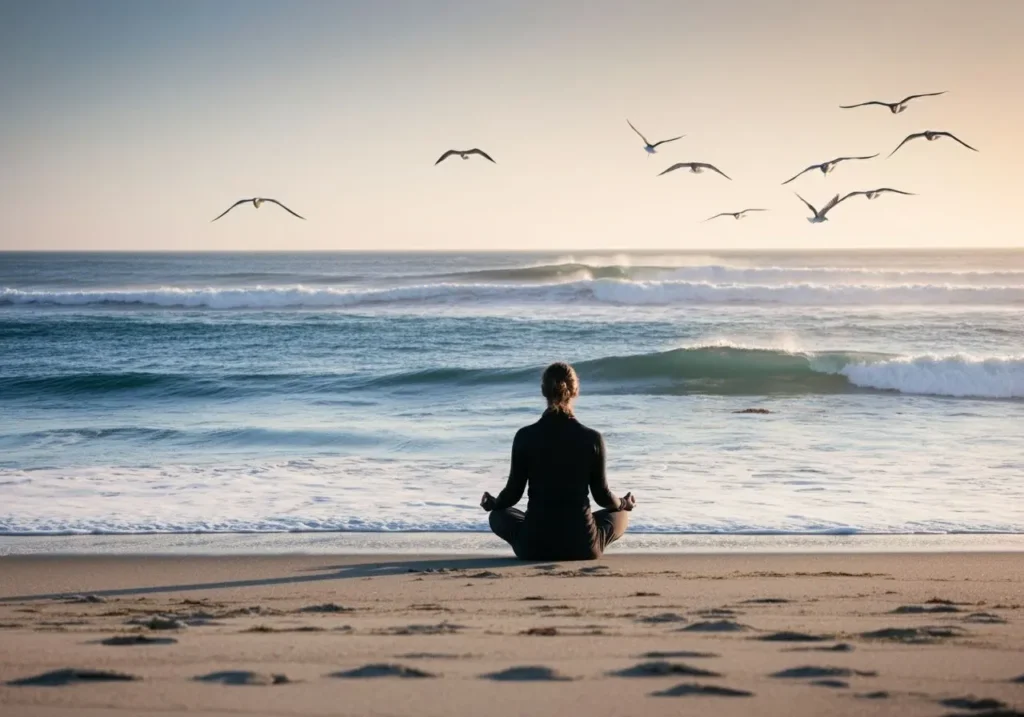
Walking meditation through forests, or just sitting by the lake or river, gazing into the water, or simply observing the night sky, can be a powerful immersive experience that helps you ground yourself and balance your energy and emotions.
Sacred Relationship with the Earth
If you engage in practices that help you connect with nature, you will learn that the earth is not just a resource, but is a living system full of consciousness and wisdom that deserves respect and care.
Opening up to such a perspective often leads to more sustainable living practices. And not only that, if you learn to serve and protect nature, nature will serve and protect you. You can find all your spirituality in discovering that simple principle.
Meditation
We can’t end this article without mentioning meditation. One of the best tools that allows you to connect with the universe and achieve inner peace. I won’t elaborate on what meditation is here – I’ll let you discover this on your own.
Integration and Living Your Spiritual Values
So what is the goal of spirituality or spiritual growth? I’d say it is not just about finding personal peace and enlightenment. To make it sustainable, it is also about the integration of spiritual principles into every aspect of your daily life.
This means bringing mindfulness, compassion, and wisdom into your work, relationships, and decision-making processes.
Mindful Living
So this brings us to the concept of ‘mindful living‘. First of all, I would say that this is the awareness that you are the one making choices in life – what you take from it, what you give, and what is not of your concern.
Furthermore, mindfulness involves bringing conscious awareness to everyday routine activities – like eating, walking, talking, gardening, etc. Do what you do, but be aware of what you are doing in every moment. This way, many ordinary moments will be transformed into opportunities for spiritual growth.
Spiritual Growth Tips Summary
Finding Community
- Find a spiritual community that shares your values and beliefs
- Explore Jewish communities for questioning, learning, and tikkun olam (repairing the world)
- Join Christian communities for fellowship, worship, Bible study, and mission work
- Connect with Buddhist sanghas for meditation, mindfulness, and compassion practices
- Participate in Islamic communities for daily prayers, Quran study, and charitable giving
- Consider agnostic/alternative communities like Unitarian Universalist congregations
- Explore New Age and metaphysical communities for crystal healing and energy work
- Join nature-based spiritual communities for earth-centered practices
Daily Spiritual Practices
- Create morning rituals with intention setting and gratitude journaling
- Practice evening reflection and gratitude to process the day
- Keep a spiritual journal to track insights and growth
- Establish consistent prayer habits in your own personal way
- Engage in service and compassion as spiritual practices
- Volunteer and help others as a way of serving the divine
Learning and Growth
- Read philosophy books, religious texts, and spiritual literature
- Focus on continuous learning through various knowledge sources
- Train your mind to be present and focused
- Practice self-observation and critical self-assessment
Nature Connection
- Recognize nature as a profound spiritual teacher
- Practice outdoor meditation and contemplation
- Try walking meditation through forests
- Sit by lakes, rivers, or observe the night sky
- Develop a sacred relationship with the earth
- Engage in sustainable living as spiritual practice
Integration
- Practice mindful living in everyday activities
- Bring consciousness to routine tasks like eating, walking, talking
- Integrate spiritual principles into work and relationships
- View spirituality as a lifelong journey requiring patience and persistence
Conclusion
Achieving spirituality isn’t something you can do in one take, overnight, or by engaging in some ‘spiritual’ activity. It is a process that takes time and involves many things – one of the most important being self-observation, the ability to critically assess yourself without too much interference from the ego. You can lie to others, just don’t lie to yourself. Then, coming from this perspective, be persistent, be flexible, work, but don’t expect the rewards. Be humble and true. And after all that, expect to be tested – once, twice, many times. And as this happens, stay true – and then the rewards will come. But not in the form you expected when you started the path. They will be much, much better.
You should perceive it as a lifelong journey that’s going to give you the balance and serenity in this lifetime and beyond.
Blog Categories:
About the Author: