


Longevity Biohacking: The Science of Reversing Aging
Discover how longevity biohacking reverses aging. Explore Bryan Johnson’s Blueprint protocol, peptide therapies, and science-backed strategies to extend your healthspan
Table Of Contents
You’ve probably heard about Bryan Johnson. The tech entrepreneur who spends around $2 million every year trying to turn back time. Not metaphorically – literally reversing his biological age through one of the most exhaustive self-experiments ever documented.
Here’s what makes his story stick with people. Johnson has reduced his epigenetic age through his Blueprint protocol, with one test subject showing biological age reversal from 36 to 33 in just one month. His heart now functions like a 37-year-old’s. His lung capacity mirrors an 18-year-old’s. Chronologically he’s in his late 40s, but his cells? They’re telling a different story.
This isn’t science fiction anymore. It’s happening right now.
Understanding the Blueprint Protocol
Johnson’s approach sounds radical because it is. His daily routine involves taking more than 100 supplements, eating his last meal at 11 a.m., always sleeping alone, and subjecting himself to blood plasma transfusions, microneedling, full-body LED exposure, and MRI scans. Most people won’t adopt his entire protocol – it’s extreme, expensive, and demands obsessive tracking.
But here’s what matters. The underlying principles? Those actually work.
Johnson’s data-driven approach reveals something crucial about aging. It’s not inevitable. Your body doesn’t just deteriorate because time passes. Aging accelerates or slows based on what you’re actually doing – what you eat, how you sleep, whether you move, your stress levels, even how much intentional recovery you build in.
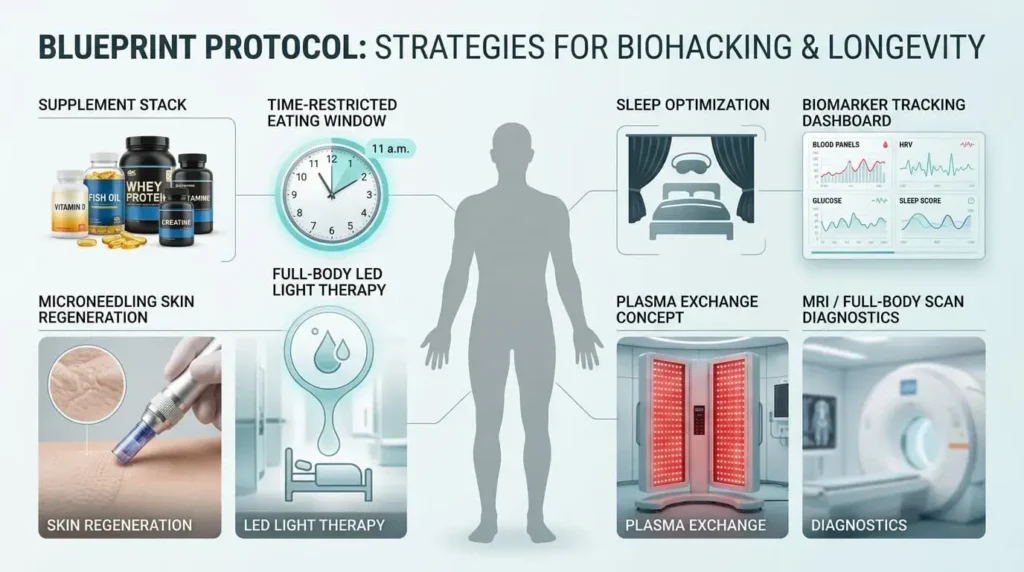
The Blueprint protocol combines elements that longevity researchers have been studying for years. Time-restricted eating. Precision supplementation. Sleep optimization. Exercise at the right intensity. What Johnson does differently is measure everything obsessively – tracking how each intervention shifts his biological markers.
What Modern Longevity Research Actually Shows
The exciting part? You don’t need Johnson’s millions to access legitimate longevity science. Decades of research point to several proven approaches that genuinely extend both lifespan and healthspan – that’s the years where you’re actually functional and thriving, not just existing.
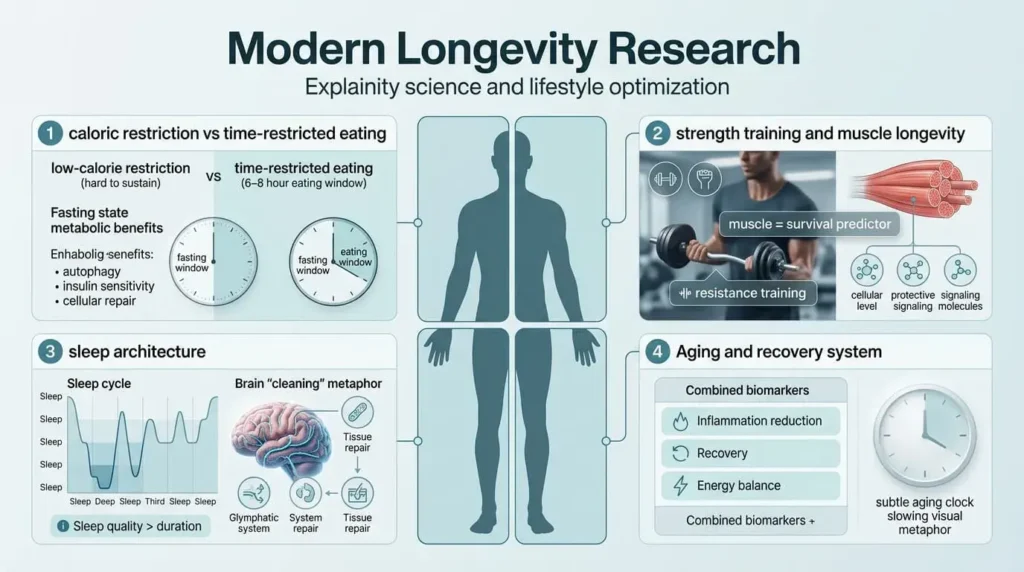
Caloric restriction showed up in studies first. Organisms from yeast to primates lived measurably longer when fed fewer calories. But here’s the catch – it’s brutal to stick with long-term. Which led researchers toward something more practical: time-restricted eating.
Time-restricted eating works differently. Instead of eating less overall, you eat normally within a specific window. Most research shows windows between 6-8 hours work best. Your body enters deeper repair cycles during the fasting period – autophagy kicks in, cellular cleanup happens, insulin sensitivity improves. You’re not starving yourself. You’re just giving your metabolism actual rest.
Strength training emerged as surprisingly important for longevity. More important than steady cardio, actually. Muscle mass predicts survival rates. People with more muscle live longer, recover better from illness, maintain independence in old age. It’s not about looking strong – it’s that muscle tissue itself produces compounds that protect you at the cellular level.
Sleep quality matters more than you’d think. Not just how many hours, but the architecture of your sleep – deep stages where your brain physically clears out metabolic waste, where your body repairs tissue damage. Poor sleep accelerates aging measurably. Good sleep reverses it.
The Role of Peptides in Longevity
Then there’s the peptide frontier. These short chains of amino acids are increasingly central to modern longevity protocols.
Peptides work because they signal your body at a molecular level. Some peptides optimize mitochondrial function – your cells’ energy factories. Others improve blood flow, enhance recovery, or trigger growth hormone release. They’re not replacement therapy like testosterone or HGH injections. They’re more like targeted messages telling your body to activate its own repair systems.
The science behind peptide protocols is increasingly well-documented. Bioavailable formulations are designed to actually reach your cells and trigger the intended effects. The peptides researchers work with most things like BPC-157, TB-500, and others, have been studied for their impact on tissue repair, neurological function, and recovery optimization.
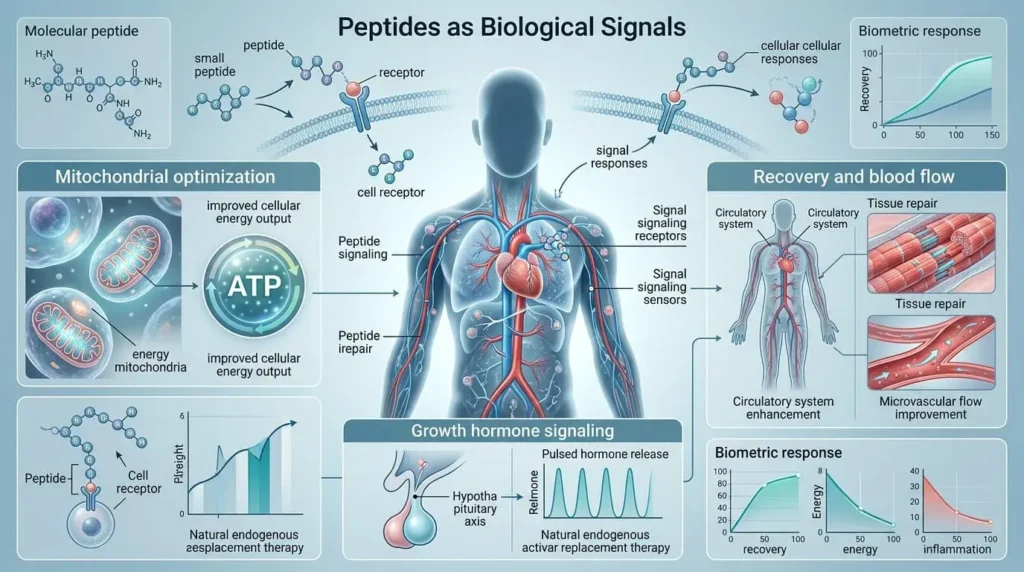
What appeals to longevity-focused people about peptides is measurability. You can track blood markers before and after. You can feel the difference in recovery time, energy levels, muscle development. Unlike some biohacking approaches that rely on anecdotes, peptide effects show up in objective data.
This doesn’t mean peptides are magic. They work best alongside everything else – proper sleep, good nutrition, consistent training. But they accelerate what’s already happening. They’re a tool for people serious about the science.
Genetics Versus Behavior – What Actually Determines Aging
People often ask: isn’t aging mostly genetic? If your parents aged poorly, aren’t you doomed?
Wrong. Studies show that genetics loads the gun. Behavior pulls the trigger.
Your genes account for roughly 30% of aging variation. The other 70%? That’s you. Your choices compound. A sedentary lifestyle accelerates aging. Chronic stress accelerates it. Poor sleep, excess inflammation, bad nutrition – they all add up. But the reverse is true too. Good choices compound in your favor.
This is what Johnson’s data demonstrates so clearly. His genetics aren’t superhuman. His discipline is. His willingness to track, adjust, and optimize relentlessly – that’s what’s moving his biological age backward.

You don’t need his intensity to see results. Small consistent choices matter more than rare extreme efforts.
Building Your Own Longevity Protocol
Start simple. Don’t adopt everything at once.
First: nail your sleep. Non-negotiable. Consistent bedtime, consistent wake time, dark cool room, no screens before bed. This alone shifts aging markers measurably. Give it 30 days of consistency before adding anything else.
Second: move deliberately. Not just cardio. Add strength training 2-3 times per week. Even basic resistance work – bodyweight, dumbbells, whatever – maintains muscle mass and triggers longevity hormones.
Third: eat in a time window. Not necessarily extreme restriction. A 6-8 hour eating window with normal calorie intake often works. Your body gets consistent fasting periods without the suffering of traditional calorie cutting.
Fourth: dial in nutrition quality. Not about perfection. Just emphasizing whole foods, reducing processed stuff, getting enough protein. Your cells need raw materials to rebuild themselves.
Fifth: add selectively. Once those four are solid, then consider supplements, peptides, or other interventions. Stacking everything at once creates noise – you can’t track what actually helps.
| Approach | Monthly Cost | Time & Effort | Expected Results |
|---|---|---|---|
| Sleep Optimization | $0-50 | 30 min daily routine setup, minimal ongoing effort | Faster recovery, better mood, improved markers within 4-6 weeks |
| Strength Training | $0-100 | 30-45 min, 3x per week | Muscle gain visible week 4-6, improved metabolic markers by week 8-12 |
| Time-Restricted Eating | $0-50 | Habit building for 2-3 weeks, then automatic | Improved insulin sensitivity, weight management, better energy by week 4 |
| Blood Work Tracking | $100-200 | 3-4 times yearly, 30 min per test | Objective data on inflammation, metabolic health, aging markers |
| Strategic Supplementation | $50-150 | 5 min daily for vitamins and targeted compounds | Fill nutritional gaps, support recovery, synergize with other protocols |
| Peptide Protocols | $200-500 | Daily administration, medical oversight needed | Accelerated recovery, tissue repair, potential aging reversal markers |
| Full Blueprint Protocol | $2,000,000+ | Full-time commitment, constant optimization | Dramatic biological age reversal, organ-specific optimization, extreme results |
What Makes Longevity Biohacking Different From Self-Help
The difference matters. Self-help is usually about motivation or mindset. Biohacking is about measuring and manipulating your actual biology.
Longevity biohacking requires tracking. Blood work. Body composition. Biomarkers. You’re not guessing whether something works – you’re looking at data. Did your fasting protocol lower inflammation markers? Check the blood test. Did your strength training increase IGF-1? You’d see it in the numbers.
This data obsession separates serious longevity work from wellness theater. Anyone can claim they feel better. Your C-reactive protein levels don’t lie.
Johnson’s approach seems extreme because it is. But the foundation – measure, adjust, repeat – that’s available to everyone. You don’t need a $2 million budget to implement that methodology.
The Reality Check: What’s Actually Sustainable
Here’s where most biohacking fails. People adopt everything at once, get overwhelmed, quit.
Johnson can sustain his protocol because it’s his life’s work and he has unlimited resources. Normal people need sustainability. That means building gradually, choosing interventions you actually want to stick with, creating systems that don’t require willpower – they just become routine.
The longevity interventions with the strongest evidence are the basic ones. Sleep. Movement. Nutrition. Community connection. Stress management. Nothing sexy about those. But they’re what actually predict lifespan in population studies.
Advanced stuff like peptides, plasma exchange, or cutting-edge supplements? They can add value. But only on top of the fundamentals. Skip the fundamentals and add fancy interventions, and you’re just throwing money at feeling good.
Why Longevity Biohacking Matters Now
Medicine has always been reactive. You get sick, then you treat it. Longevity biohacking flips that. Prevention at the cellular level.
Your 40-year-old self today could have the biomarkers of someone 50 years old. Or of someone 30. The difference? What you did in your 30s and 40s. The gap widens over time.
That’s not depressing. It’s liberating. It means you have leverage. Your future self’s quality of life depends heavily on what you do now. Not genetics. Not luck. Your actual choices.
Johnson spent millions to prove what researchers have been saying for years: aging is tractable. It responds to intervention. You can slow it. You can reverse it.
The question isn’t whether longevity biohacking works. Johnson’s data proves it does. The question is what approach fits your life and what you’re willing to commit to.
Key Takeaways for Your Longevity Journey
Start with foundations – sleep, movement, nutrition. These deliver 80% of the results with 20% of the effort.
Track something. Blood work, body composition, performance metrics. You can’t optimize what you don’t measure.
Build gradually. Add one intervention at a time. Wait 4-6 weeks before adding the next. Let your body adapt.
Remember the 70% rule. Your genetics matter, but your behavior drives most aging variation. That’s your leverage.
Advanced interventions like peptides work, but they’re additions to solid basics, not replacements.
Sustainability beats intensity. A consistent reasonable protocol beats an extreme protocol you quit after three months.
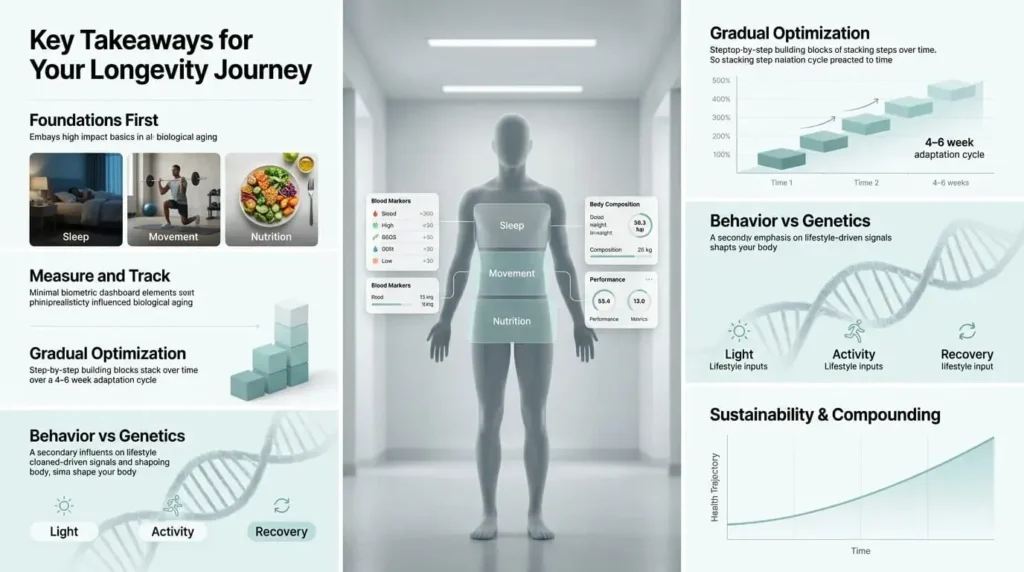
Your biological age isn’t fixed. It responds to what you do. That’s the real message from Johnson’s Blueprint protocol. Not that you need to spend millions. That your cells are listening. They’ll speed up or slow down aging based on the signals you send through your choices.
Start today. Measure in 90 days. Adjust based on data.
That’s longevity biohacking.
Frequently Asked Questions About Longevity and Biohacking
How much does it cost to start a longevity biohacking protocol?
The basics cost almost nothing. Sleep optimization, consistent training, eating whole foods – these are free or minimal investment. Blood work runs 100-500 dollars, depending on what you track. If you add peptides or supplements, costs climb. Bryan Johnson spends $2 million annually, but that’s extreme. Most people see meaningful results with 50-200 dollars per month for foundational approaches plus periodic blood tests. You’re paying for what moves your biological markers, not for status.
Can you really reverse aging, or is it just slowing it down?
The data shows actual reversal on some measures. Epigenetic age – measured by how your cells’ gene expression patterns have aged – has decreased in people following intensive protocols. One test subject went from 36 to 33 biological years in one month. That’s reversal, not just slowing. But here’s the nuance: you’re not becoming biologically younger in all ways simultaneously. Your organs can show different aging rates. The good news is your body’s aging isn’t locked in. It responds to what you’re doing right now.
Do I need blood work to track progress?
Blood work gives you objective data, which is the whole point of biohacking. But it’s not required to start. Track what’s measurable: body composition, strength improvements, sleep quality, energy levels, how clothes fit. Once you’ve established consistency with basics – usually 3-6 months – then get blood work done. You’ll have context and know what markers matter to you. Blood tests are most useful when you’re adding advanced interventions and need to verify they’re actually working.
Are peptides safe for longevity optimization?
Research-backed peptides like those used in legitimate protocols show positive safety profiles, particularly when sourced from reputable organizations focused on quality and bioavailability. That said, they’re not FDA-approved for most uses, so you’re working in a gray area legally. If you’re considering peptides, work with someone knowledgeable – either a longevity-focused doctor or a research organization that specializes in them. Your baseline health and any existing conditions matter. Peptides are a tool, not a shortcut, and they work best for people already nailing fundamentals.
How long before you see results from biohacking?
Some changes are immediate. Sleep better, you feel different that same week. Strength training, you notice slightly more energy after a few sessions. Real biological marker changes – inflammation, metabolic markers, aging clocks – typically take 8-12 weeks at minimum. Give yourself 90 days of consistent effort before checking blood work. Body composition shifts usually show up around week 4-6. Energy and mental clarity often improve faster than physical metrics. The key is consistency. Sporadic effort won’t move markers.
What if I have existing health conditions – is biohacking still applicable?
More than ever. Longevity protocols often reverse or manage conditions – improved sleep helps autoimmune issues, strength training helps diabetes management, time-restricted eating helps metabolic dysfunction. But the implementation changes. Talk to your doctor before starting anything new, especially if you’re on medications. The fundamentals – better sleep, appropriate movement, good nutrition – help almost everyone. Advanced stuff like peptides or aggressive fasting needs medical oversight if you have conditions. Biohacking shouldn’t conflict with treating your health; it should complement it.
Is Bryan Johnson’s approach realistic for normal people?
His is an extreme self-experiment – $2 million annually, over 100 pills daily, constant testing. Not realistic for most people. But the principles underlying his protocol? Those are accessible. Time-restricted eating, strength training, sleep optimization, tracking progress, being disciplined about nutrition – these work for anyone. You don’t need his intensity or resources to see significant results. His data proves the science works. Your job is applying 80% of his methodology in a way that fits your life.
Blog Categories:
About the Author: