


Creating a Stronger Foundation for a Healthier Future
Build a healthier future the slow way – realistic goals, daily habits, mental health and the right support system that makes healthy changes actually stick.
Table Of Contents
Nobody wakes up on a Tuesday and announces, “Right, healthier future – starting now.” Well, some people do. They usually last about nine days, because a decision that size doesn’t come with a switch you can flip. Change turns up in pieces instead, and most of those pieces get laid down on mornings when you weren’t remotely in the mood.
That slowness is the point. Anything that happens fast – crash diets, seven-day resets, the workout plan you swore you’d do twice a day – tends to collapse just as fast, because nothing underneath it was built to hold weight. So whatever you’re trying to change about your health, start with the foundations of health rather than the finish line. That’s the only place where progress actually feels like progress.

None of this is only about dodging illness, either. A genuinely healthy lifestyle is whatever carries you through the boring weeks, the brutal ones, and the ones where the car dies and somebody schedules a meeting for Friday at five. What follows is how you lay those pieces down, one layer at a time.
You Cannot Set Goals That Are Difficult To Achieve
Start by sitting down and working out what you actually want to change. Sounds obvious. Most people skip straight past it and go buy trainers instead.
The temptation – especially when you’re hungry for a fresh start – is to write a list long enough to need its own spreadsheet. Resist that. Overhauling your entire life at once is the quickest road to burnout, and burnout has a nasty habit of feeling like failure when it’s nothing of the kind.
So pick two priorities. Three if you’re stubborn. And keep each one small enough that one rotten day can’t knock it over.
- Movement: a 15-minute walk after dinner. Not “an hour at the gym, five days a week.”
- Sleep: phone charging in another room – instead of promising yourself eight flawless hours as of tonight.
- Food: one home-cooked meal added per week, not “no sugar, ever again.”
- Stress: ten quiet minutes before the day starts, not “learn to meditate properly.”
- Routine: one fixed anchor – same wake-up time – rather than a colour-coded schedule you’ll abandon by Thursday.
Small goals hand you the feeling of winning without turning the whole thing into a mountain. They stack, too. Whoever’s walking fifteen minutes a night in March is very often the same person jogging in October – and there was never one heroic moment in between.
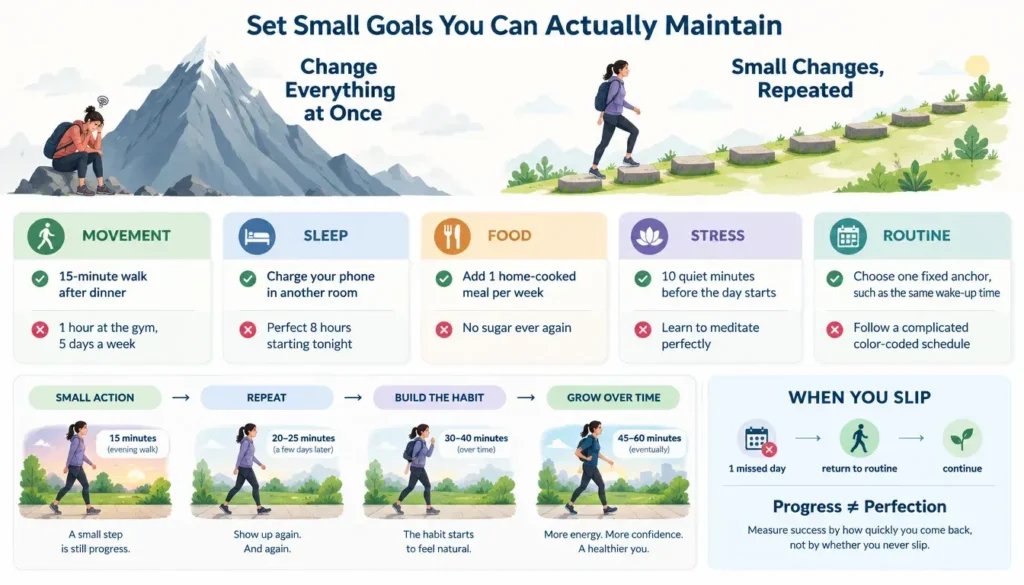
Progress isn’t the same thing as perfection, either. You’ll have rough days. Rough weeks, some of them. A change that lasts has slack built into it, so a single skipped workout doesn’t get promoted into proof that the whole idea was daft. After a slip, quit asking why you failed. Ask how fast you came back. Three days beats three weeks, and nobody else ever has to know about either one.
Additional Support Is Frequently Necessary
Sometimes a person lives unhealthily because of obligations, exhaustion, or plain inertia. But there are also people whose habits grew out of something heavier – grief, trauma, chronic stress, dependency – and willpower alone was never going to be the answer for them.
Professional help in those circumstances is more than welcome, because it provides structure and accountability at exactly the moments you can’t provide them yourself. Luckily, Cornerstone Wellness & Recovery, just like many others of this sort, can be a support system that you’ve been longing for. They can help you make a change that’s going to “stick” with you forever, or at least for a very long time.

Not everyone needs that level of guidance. Plenty of people get where they’re going with a friend, a decent routine, and time. But if you’ve concluded you need support, don’t talk yourself out of it. A few signs it’s worth looking into:
- You’ve restarted the same change three times, four times, five – and never made it past week two.
- The habit is tangled up with how you handle stress, sleep, or feelings you’d rather not sit with.
- Your body has already started keeping score, and you keep postponing the appointment that would tell you by how much.
- The thought of doing this on your own fills you with dread. Not reluctance. Dread.
Every person is different, with different problems and different preferences. That’s the whole argument for professional assistance – it’s shaped around you, your goals, and your needs, rather than around whatever worked for somebody else on the internet.
Healthy Daily Habits Should Be Established
What shapes your health over the long haul is the dull, repetitive stuff you barely notice doing. Moving your body, eating decent meals, getting enough sleep, and actually making time to chill out might not sound super exciting, but these basic habits build the absolute foundation for how good you feel.
Take exercise. It doesn’t mean locking yourself in a gym for two hours at a stretch. Walking counts. So does cycling, stretching, swimming, dancing round the kitchen while the pasta boils, or playing five-a-side badly with people you like. The best exercise is whichever one you’ll do again next week without having to argue yourself into it first.
Food works the same way. Drop the punishing diets and build balanced eating habits sturdy enough to survive a Tuesday where everything runs late. Starting from nothing, this order tends to hold up:
- Fix the timing before the food. Eating at roughly consistent hours steadies your energy and cuts the late-night raiding of the fridge.
- Add before you subtract. More vegetables, more protein, more water. The crowding-out effect handles a surprising amount of the rest.
- Cook one more meal a week than you do now. Not five. One. Then hold it for a month.
- Guard your sleep the way you’d guard a dentist appointment. Sleep badly for a fortnight and your appetite, your mood, and your willingness to do any of this go sideways together.
- Leave one evening completely unplanned. Rest belongs inside the routine. It isn’t a prize you collect for finishing it.
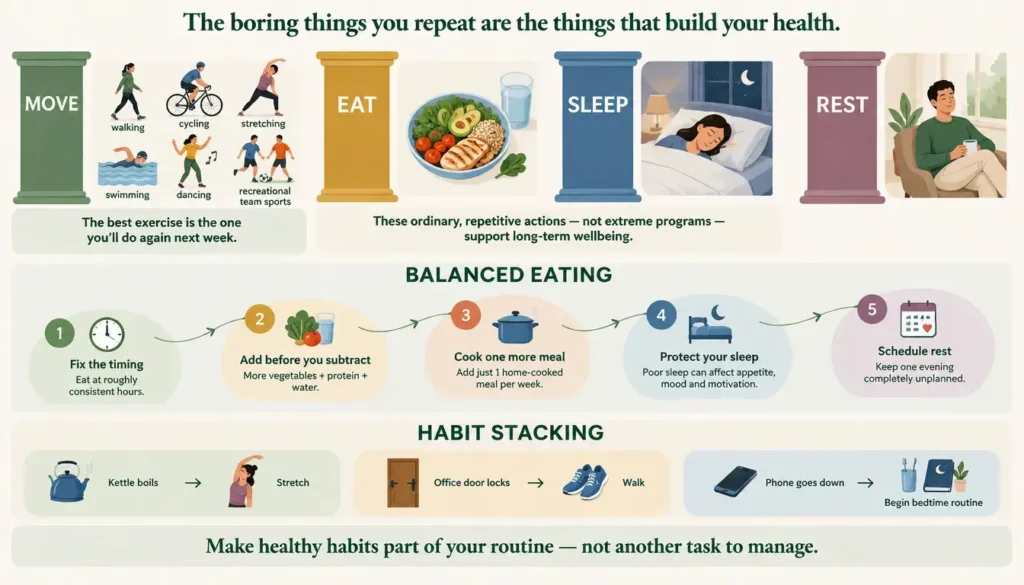
Bolt each new habit onto something you already do – stretch while the kettle boils, walk once you’ve locked the office door – and it stops depending on how you feel that morning. That’s most of the trick, really. A routine that props your health up without turning your day into a logistics exercise.
Mental Health Is So Crucial!
Lots of people primarily think of the physical aspect of their being whenever they want to enhance their overall health. What they miss is that there’s no competition between physical and mental health. Both matter, and they feed each other constantly – a badly slept week makes everything heavier, and a heavy month makes cooking, moving, and answering messages feel impossible.
So both go in the plan. Depression, anxiety, stress that never really switches off – these can take a life apart, and treating them as something mild that’ll wander off eventually mostly gives them time to dig in. They don’t clear up on a schedule. Waiting isn’t a strategy.

Mental health work doesn’t have to be dramatic, either. Naming what you’re feeling instead of pushing past it. Talking to one person you trust. Getting outside before noon. Writing three lines at the end of the day so the week doesn’t blur into one long grey stretch. And speaking to a professional when the low patches stop lifting on their own – that’s maintenance, not weakness.
A Good Support System Is Very Much Needed
The environment you wrap yourself in plays a massive role in whether your healthy habits actually stick or completely fall apart. So look honestly at the people, the places, and the routines you move through in an average week. Is the good choice the easy one there – or do you have to win a small argument with yourself before you can make it?

The right people change the maths completely on days you’d rather not bother. The wrong surroundings do the reverse, and every bit of progress becomes something you’re dragging uphill on your own.
That’s not an argument for cutting anybody off. Usually it’s far smaller than that – drawing a line somewhere, telling one person what you’re working on, spending a bit more time with whoever’s genuinely pleased you’re trying. Rearranging your stuff helps more than people expect, too. Fruit where you’ll see it. Trainers by the door the night before. The café that isn’t next to the bakery. You’re removing friction, one small piece at a time.
Give It Time, and Measure the Right Things
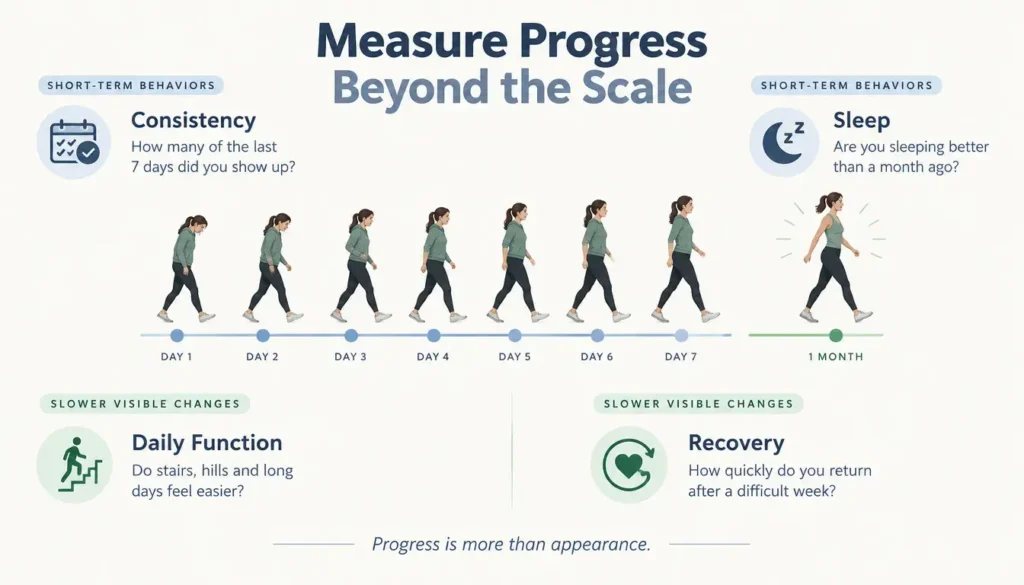
Most people jump ship somewhere between week two and week six. The novelty’s gone by then, nothing visible has arrived yet, and that’s a miserable combination to sit in. The gap is completely normal, though, and you can ride it out – provided you’re watching something other than the bathroom scale.
- Out of the last seven days, how many did you actually show up?
- Are you sleeping better than you were a month ago?
- Do stairs, hills, and long days feel any different?
- How fast are you recovering after a bad week?
Those signals move long before appearance does, and they’re a far better guide to whether your foundation is holding.
None of this is going to be easy, and pretending otherwise would be doing you a disservice. But it’s worth the attempt, because with the strategies above you’ll build a routine that quietly improves the quality of your life – not for a fortnight, but for the long run. Start with one change this week. The rest of the foundation gets built on top of it.
Frequently Asked Questions About Building a Healthier Future
How long does it take to build a habit that actually sticks?
Longer than the popular three weeks, and it depends heavily on the habit. Something simple and low-effort – a glass of water after you wake up – can feel automatic in a couple of weeks. Anything that demands time, energy, or a change in your schedule usually takes two to three months before it stops feeling like a decision. The stretch between weeks two and six is where most people quit, because the novelty has faded and the visible results haven’t arrived yet. Expect that gap instead of being surprised by it, and keep the habit small enough that a bad week can’t end it.
How many health goals should I work on at the same time?
Two, maybe three. Beyond that you’re splitting attention rather than building anything. Pick the change that would have the biggest knock-on effect – for most people that’s sleep, because poor sleep quietly undermines appetite, mood, and motivation all at once – and make one smaller change alongside it. Once the first two run on their own without effort, add the next. It feels slow in month one and remarkably fast by month six.
How do I know if I need professional support rather than just more discipline?
A few signals are worth taking seriously. You’ve started the same change four or five times and never made it past the first fortnight. The habit you’re trying to break is tied to how you cope with stress, sleep, or difficult emotions. Your physical health is already affected and you’re avoiding finding out how much. Or you feel real dread at the thought of doing this alone. None of those mean you lack willpower – they mean the problem has more moving parts than willpower can handle, and structure from outside tends to work where self-discipline keeps stalling.
What should I do after I slip up or miss a week?
Restart at the smallest possible version of the habit, and do it today rather than next Monday. The damage from a missed week is almost never the missed week itself – it’s the story that follows, the one where you decide the whole attempt was pointless. A useful measure is how fast you come back: three days is a hiccup, three weeks is a restart. Nobody builds a long-term routine without gaps in it. The people who keep going are simply the ones who stopped treating gaps as verdicts.
Can I get healthier without a gym membership or a strict diet?
Yes, and for a lot of people that’s the more durable route. Walking, cycling, stretching, swimming, dancing around your kitchen, or playing a sport you enjoy all count as real movement. On food, adding tends to beat subtracting – more vegetables, more protein, more water, one extra home-cooked meal a week – because it doesn’t rely on restriction you’ll eventually rebel against. Consistency is doing far more of the work than intensity, and the exercise you’ll repeat next week beats the perfect programme you’ll abandon.
Why does mental health belong in a physical health plan?
Because the two aren’t separate systems. A stretch of bad sleep or unmanaged stress makes cooking, moving, and even answering messages feel heavier, and that’s usually what ends a routine – not a lack of interest in being healthy. Working on the mental side doesn’t have to be dramatic either: naming what you’re feeling instead of pushing past it, talking to someone you trust, getting outside before noon. And when the low patches stop lifting on their own, speaking to a professional is maintenance, the same as seeing a doctor about a knee that won’t settle.
How should I track progress if the scale isn’t moving?
Track the things that shift first. How many days out of seven you actually did the thing. How you’re sleeping compared to a month ago. Whether stairs, hills, or long days feel different. How quickly you recover after a rough week. These move well before appearance does, and they tell you whether the foundation is holding. Weight is a slow, noisy signal that’s affected by water, hormones, and timing, so judging a month of solid effort by it is a reliable way to quit something that was working.
Blog Categories:
About the Author: