


Building Sustainable Habits for Long-Term Weight Management
Lasting weight management comes from daily habits, not strict diets. Practical guidance on protein, movement, sleep, stress and tracking progress.
Table Of Contents
Losing weight isn’t usually the hard part. Keeping it off is. Anyone who has dropped ten kilos on a strict plan, then watched them creep back over the following year, already knows how that story ends – and it repeats often enough that people start treating it as a personal failing. It isn’t. Restrictive eating plans deliver fast early results and then collapse the moment the rules stop, because rules borrowed from somebody else’s life were never built to survive yours.

What holds up instead is fairly unglamorous. Daily choices, repeated, adjusted when they stop fitting. Sustainable weight management comes from small actions practiced consistently, and those actions get you further than any six-week program because they don’t demand the kind of willpower nobody can sustain past February.
Setting Practical Goals for Habit Formation
Realistic expectations are the foundation of any lifestyle change that lasts longer than a month. Seeking support at a professional facility, such as the Healing Sanctuary clinic, provides personalized guidance to align personal targets with medical health standards. That outside perspective matters more than people expect, mostly because it replaces guesswork with benchmarks you can actually hit week after week.

Ambitious targets feel motivating for about eleven days. After that they turn into a source of stress, and stress is what pushes most people to abandon a routine entirely rather than scale it back. Breaking a larger goal into small daily actions keeps progress visible, and visible progress is what keeps you going when motivation thins out.
A few examples of goals small enough to survive a bad week:
- A twenty-minute walk after your evening meal, five days out of seven
- Protein at breakfast instead of whatever’s fastest
- One home-cooked dinner more per week than you managed last week
- Lights out at roughly the same hour, weekends included
Your body also needs time to adapt, and that adaptation isn’t always linear. Fixed daily patterns reduce how much you have to rely on willpower during the weeks that get away from you – and those weeks always come. Consistency in simple choices is the real engine here, not intensity.
Understanding Global Weight Management Realities
Managing body mass is a health priority for a striking share of the world’s population right now. Global health statistics from the World Health Organization report that 2.5 billion adults aged 18 and older were overweight in 2022, including 890 million individuals living with obesity.

Numbers that large tell you something useful. If conventional dieting worked reliably, the figures would look different. Rigid daily rules rarely hold up across years, which is exactly why individualized habit building has become the more practical route for most people.
Your metabolic health responds to your circumstances, not to a generic template. Shaping your home environment so the better choice is also the easier one – fruit visible on the counter, walking shoes by the door, the snack drawer restocked with something you’d actually eat – does more for long-term results than any single food rule. Progress tends to come from changes that slot into existing family and work commitments rather than fighting them.
Optimizing Daily Protein Intake for Satiety
Protein does two jobs at once during weight loss. It keeps you full, and it protects the lean muscle you’d otherwise lose alongside fat. That second job gets overlooked constantly, and it’s the one that determines how you feel a year from now.
A clinical trial published by PMC showed that adults consuming 1.4 grams of protein per kilogram of body weight daily achieved a 3.3 percent reduction in weight with significantly less lean mass loss compared to lower intake levels. Holding onto active muscle supports your resting metabolic rate, which is a polite way of saying it keeps your body from fighting you as hard.

Spreading quality protein sources across every meal manages appetite without the hunger spikes that lead to a 9pm raid on the pantry. Keeping these on the weekly grocery list makes the whole thing close to automatic:
- Eggs, Greek yogurt, or cottage cheese during morning meals
- Lean poultry, salmon, or tofu during lunch hours
- Lentils, black beans, and edamame for hearty evening dinners
Establishing Consistent Physical Activity Routines
Exercise supports cardiovascular health, sure. But for weight maintenance specifically, the deciding factor is whether you’ll still be doing it in eight months. Pick active movement routines you don’t dread, even if a different activity burns more calories on paper.
A health report from News-Medical notes that individuals who maintain weight loss successfully perform 200 to 300 minutes of moderate-intensity aerobic exercise each week. That sounds like a lot until you divide it – roughly 30 to 45 minutes a day of brisk walking, cycling, or swimming, which fits into an ordinary schedule without much rearranging.

Splitting the weekly total into manageable daily sessions also protects your joints and keeps fatigue from stacking up. Training partners help more than most people admit, too. Having someone expecting you at 7am turns a decision into an appointment, and appointments get kept.
Restructuring Mindful Daily Eating Habits
Mindful eating means paying attention to hunger signals and to the food itself, without a screen competing for your focus. Eating quickly in front of a laptop routinely leads to overeating, because fullness registers late and the plate is empty long before your brain gets the message.
Chewing thoroughly gives that signal time to arrive. Cooking at home gives you control over ingredients, oil, and portion sizes – three variables that quietly decide a large share of your weekly intake. Neither habit requires any special knowledge. They just require slowing down slightly.

Planning meals ahead removes the decision fatigue that sends people toward processed convenience food on a Wednesday night. Prepping a few options in advance keeps the better choice within reach for everyone in the house:
- Fresh apples, berries, and unsalted almonds for quick snacks
- Crisp sliced vegetables paired with homemade chickpea hummus
- Whole grain oats topped with chia seeds and cinnamon
Managing Daily Stress for Metabolic Health
Unmanaged stress raises cortisol, and elevated cortisol brings cravings for dense comfort food. That connection is physiological, not a matter of discipline. Sustained pressure also makes every healthy routine harder to maintain, which compounds the problem over time.
Short recovery periods built into the day help settle the nervous system before emotional eating takes over. Deep breathing, light stretching, a quiet walk outdoors – none of it is complicated, and ten minutes does more than you’d think.

Drawing a clear line between work and personal time protects mental energy across the week. Your body needs genuine downtime to recover from mental demands, not just physical ones. Hobbies that have nothing to do with productivity tend to be the most effective, largely because they give you somewhere to put stress that isn’t the kitchen.
Prioritizing Quality Sleep Hygiene
Short sleep disrupts the hormones that regulate appetite and fullness, which is why a bad night so often turns into a day of sugar cravings you can’t explain. Well-rested people make balanced food choices with far less effort, not because they’re more disciplined but because their hunger signals are working properly.
Seven to eight hours supports healthy metabolic function for most adults. Going to bed and waking at consistent hours matters nearly as much as the total, since a steady circadian rhythm is what makes that sleep restorative rather than merely long.
Keeping screens out of the bedroom improves sleep quality noticeably. A dark, quiet, cool room encourages the deeper cycles your body uses for repair – and better sleep hygiene pays forward directly into your energy for training the next day.
Measuring Long-Term Progress Beyond Scale Numbers
Weight fluctuates daily with hydration, sodium, and ordinary muscle repair. Reading too much into a single morning number is how people talk themselves out of a plan that’s actually working, particularly during a plateau.
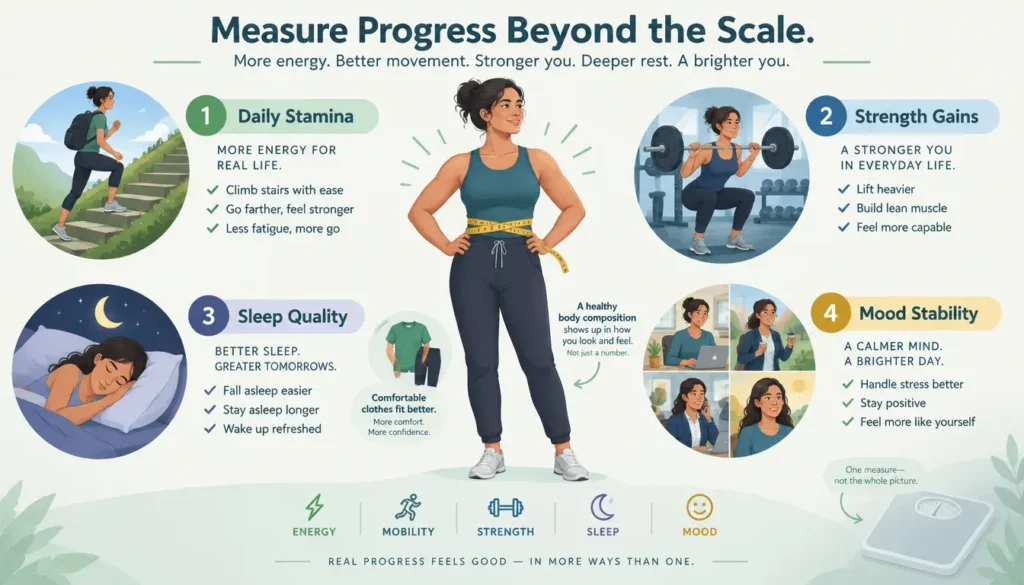
Waist measurements give a clearer picture of what’s changing underneath. So does the way your clothes fit, which is often the first honest feedback you get. Both track body composition better than a scale ever will.
Worth watching alongside them:
- Daily stamina – stairs, hills, the walk from the far parking spot
- Strength gains in whatever training you’re doing
- Sleep quality and how you feel on waking
- Mood stability across an ordinary work week
Celebrating non-scale wins reinforces the habits that produced them. Real physical wellness shows up as energy, mental clarity, and mobility you can use – the number is just one narrow measure of it.
Staying Consistent Through Real Life
This is a long game, and it asks for flexibility rather than perfection. Routines get disrupted – illness, deadlines, a week of travel – and what determines the outcome isn’t whether the disruption happens but how quickly you return to your baseline afterward.
Focusing on one small positive decision at a time prevents the overwhelm that builds during heavy weeks. Adapting habits around holidays and travel preserves your progress without turning every trip into an exercise in restriction. Those consistent daily choices accumulate quietly, and over the years they add up to something no short-term diet can match.
Frequently Asked Questions About Sustainable Weight Management
How long does it take for a new habit to stick?
Longer than the three weeks people usually quote, and it varies a lot by habit. Simple ones tied to an existing routine – protein at breakfast, a walk after dinner – tend to feel automatic within a month or two. Habits that require rearranging your schedule take considerably longer. The useful signal isn’t a number of days but how much thinking the habit still demands. Once you stop negotiating with yourself about it, it’s established.
Is it better to change one habit at a time or several at once?
One or two, in most cases. Changing five things simultaneously works for about a fortnight and then collapses under its own weight, and when it collapses you usually lose all five rather than four. Start with the habit that’s causing the most friction right now – often sleep or protein intake – and let it settle before adding the next. Slower sequencing feels inefficient, but it leaves you with more habits standing at the end of the year.
How much protein do I actually need each day?
Research on weight management commonly points to intakes around 1.4 grams per kilogram of body weight daily for preserving lean mass during fat loss, which is noticeably higher than standard minimum recommendations. For a 70 kg adult that works out to roughly 100 grams a day, spread across meals rather than loaded into dinner. Individual needs vary with age, activity level, and kidney health, so it’s worth confirming your own target with a doctor or dietitian before making large changes.
Why did my weight loss stall even though nothing changed?
Plateaus are normal and usually have several overlapping causes. A smaller body needs fewer calories, so the deficit that worked in month one is narrower by month four. Water retention from sodium, stress, or increased training can mask fat loss for weeks at a time. Portion sizes also drift upward gradually without anyone noticing. Before cutting food further, check your measurements and your sleep – stalls frequently trace back to recovery rather than intake.
Can I manage my weight without formal exercise?
You can lose weight through dietary changes alone, but keeping it off is considerably harder without regular movement. The activity doesn’t need to look like a gym session. Walking, cycling to work, gardening, and manual household tasks all count toward the weekly total, and people who maintain losses long term tend to accumulate a substantial amount of moderate activity each week in exactly this way. Choose whatever you’ll repeat.
How do I get back on track after a holiday or a bad week?
Return to one anchor habit rather than attempting to restart everything at once. Usually that means your next meal, not your next Monday. Resist the urge to compensate by eating less than normal for a few days – that pattern tends to trigger the same restrict-and-rebound cycle you’re trying to leave behind. A week off doesn’t undo months of progress. Reacting to it with extreme measures often does more damage than the week itself.
Should I weigh myself every day or less often?
Either approach works, provided you interpret the data correctly. Daily weighing is useful if you track the weekly average and ignore individual readings, since fluctuations of one or two kilos from hydration and sodium are routine. If the number affects your mood or your eating for the rest of the day, weigh weekly or step back from the scale entirely and track waist measurements instead. How clothes fit is an honest measure and it never gives you a false alarm at 7am.
Blog Categories:
About the Author: