
Creative Expression Through Digital Tools and AI
Spirituality and digital creation aren’t opposites. How sacral and throat chakra energy moves through AI tools, image to video, and a day that ends in a river.
Table Of Contents
Ask ten people what self-expression means and you’ll get ten answers about art. Painting, dancing, singing, writing. All true, all incomplete. Self-expression is really just the movement of something inward becoming something outward – an impulse that starts as a feeling and ends up as a thing other people can see, hear, or hold.
In the chakra system, that movement runs through two centers. The sacral chakra, sitting a couple of inches below your navel, is where the creative impulse lives. It’s the pull. The urge to make something that didn’t exist yesterday. Then the throat chakra takes over and handles the harder part – actually getting it out into the world, in a form, where it can be judged and loved and ignored. One generates. The other delivers.
Neither of them cares what medium you use.
That last point matters more than people give it credit for. There’s a quiet assumption floating around spiritual circles that authentic expression has to be analog – clay under your fingernails, a real brush, a real drum, a body moving in real space. Anything mediated by a screen gets treated as a lesser cousin. Somehow less soulful.
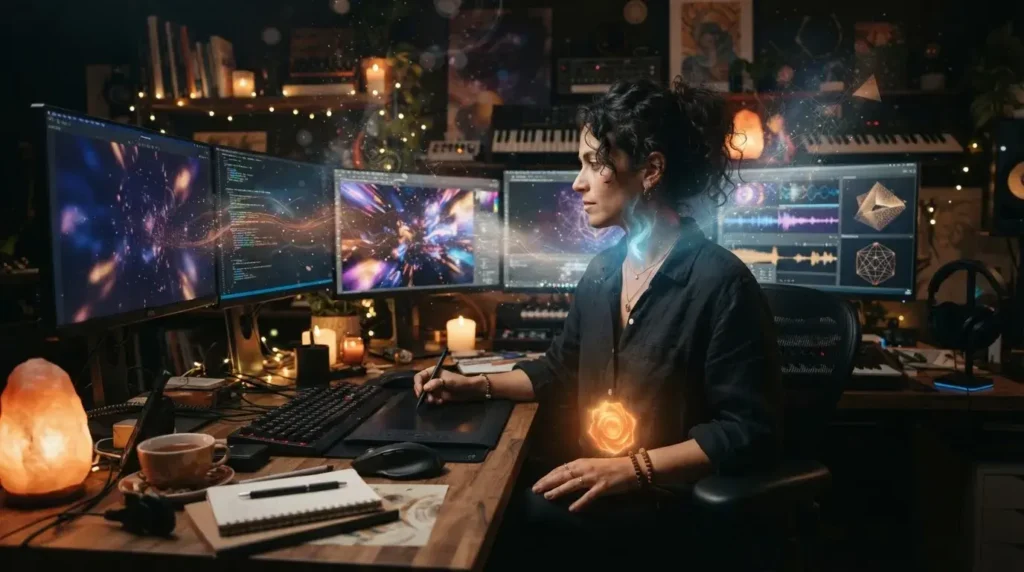
I’ve never found that to hold up. The sacral chakra doesn’t run a materials check before it fires. It just pushes. And whether that push comes out as a watercolor or a piece of software or a thirty-second animation, the underlying movement is identical – something in you wanted out, and you gave it a shape.
Being a Digital Creator and a Spiritual Person at the Same Time
I’ve worked digitally my whole adult life. Motion graphics, design, video, code. Screens have been the room I work in for as long as I can remember.
I’ve also had a lot of experiences that don’t fit neatly inside that world. The kind of moments that rearrange your sense of what’s actually happening here – deep meditation states, energy shifts you feel in your body before your mind catches up, that particular stillness that shows up uninvited and changes how you see everything for a while after.
For years I half-expected those two tracks to collide. They never did.
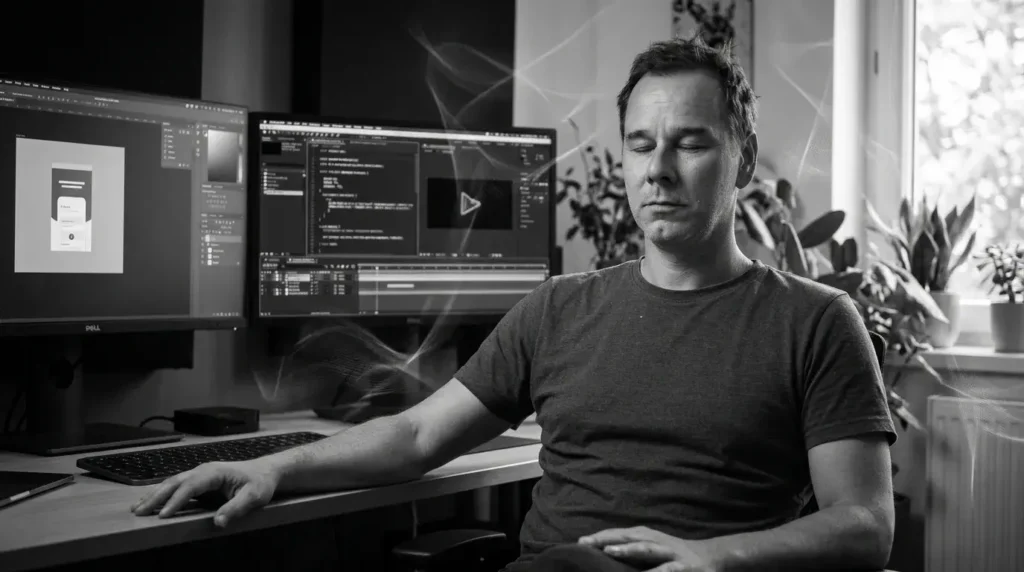
What happened instead is that they started feeding each other. The spiritual work sharpened how I pay attention, and attention is the raw material of every creative decision I make. The digital work gave me a way to take what I learned inwardly and build something out of it that someone else could actually use.
Right now that’s literal. I’m building a meditation tool – software, properly digital, running on the same machines everyone stares at all day. And it exists because of the inner work, not in spite of it. Every design choice in it comes from having sat with the practice long enough to know what actually helps and what’s just decoration. The technology isn’t diluting the practice. It’s the delivery mechanism, the thing that lets a practice reach people who’d otherwise never encounter it.
That’s throat chakra work, if you want to name it. Taking something interior and giving it a form that travels.
The Tool Was Never the Point
Here’s something worth sitting with. Every creative tool humans have ever used was, at some point, brand new technology that somebody distrusted.
Pigment ground from minerals. The printing press. Recorded sound. The synthesizer, which got called soulless for a solid decade before it became the backbone of most of the music people love. Photoshop. Every single one arrived to a chorus of people insisting real artists wouldn’t need it.
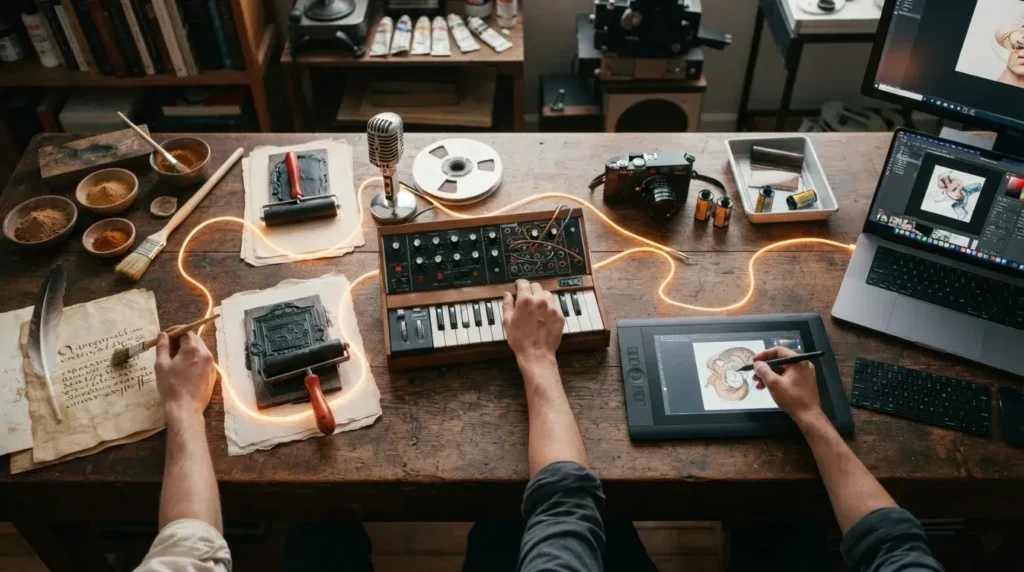
They were always wrong, and always for the same reason. The tool doesn’t supply the impulse. You do. The tool just determines how much friction sits between the impulse and the finished thing.
And friction is not the same as sacredness. Difficulty doesn’t sanctify creative work – it just slows it down. Sometimes that slowness teaches you something. Often it just costs you three days you’ll never get back.
What Used to Take Three Days
Let me give you a concrete example, because this is where the shift became obvious to me.
Back in my motion graphics years, animating a logo was a project. A real one. I’d model the mark in 3D Studio Max, bring it into After Effects for lighting and glow and the actual reveal timing, then cut it together in Premiere. Every keyframe placed by hand. Every render a gamble, because you’d wait forty minutes to find out the lighting was slightly wrong and start again.
Three days. Sometimes more, for a five-second animated logo intro.
I loved that work. I’m not romanticizing it though – most of those three days weren’t creative. They were technical labor in service of a creative idea I’d already had in the first twenty minutes.
Recently, as a side-step from the meditation project, I went back to that same problem for my own brand. Same goal, animated logo intro. Completely different process.
Image to video technology finally lets a logo do more than just sit still at the start of a video. Dreamina, powered by its latest and most advanced video generation model, Seedance 2.5, turns a flat logo file into a proper animated intro in a matter of minutes.
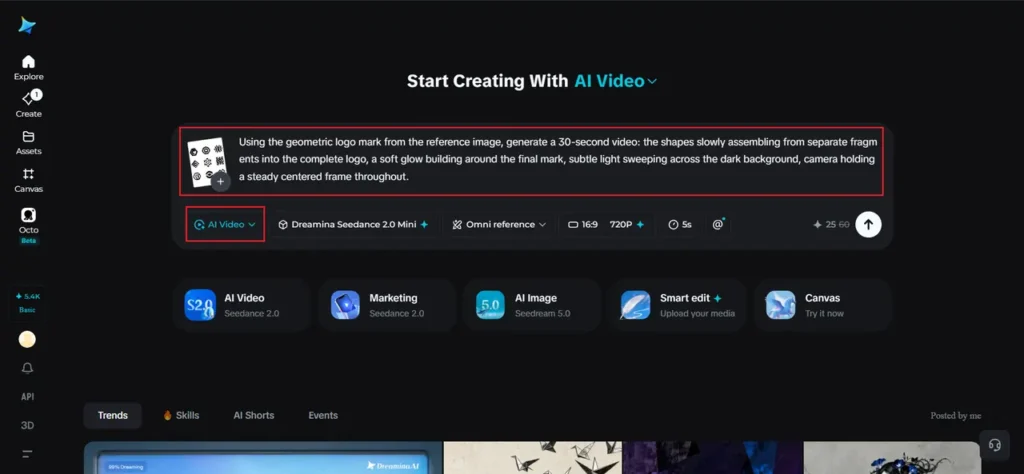
The workflow comes down to three moves. You upload your logo as a reference image and describe the reveal you want in a prompt – the fragments assembling into the complete mark, a soft glow building around it, light sweeping across a dark background, camera holding steady. Then you pick the Seedance 2.5 model, set your length and aspect ratio depending on whether it’s going to YouTube or TikTok, and let it generate. After that you polish – upscale for resolution, generate a soundtrack if the clip needs one – and export.
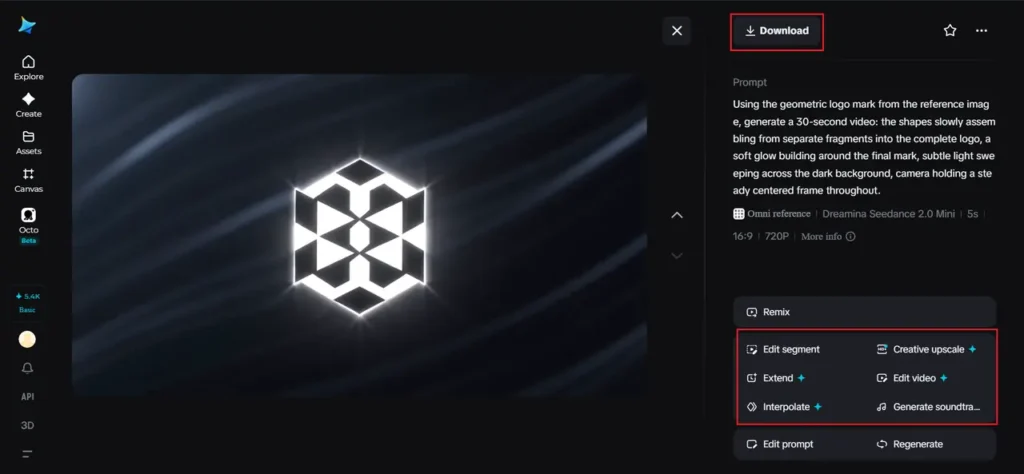
What surprised me was how well it handled the specific thing logos need. Clean geometry. Sharp edges that stay sharp through motion instead of going soft and mushy the way early AI video did. Seedance 2.5 also takes a much wider brief than a single image – brand guidelines, color references, style boards – so the animation gets built from actual creative direction rather than the logo file alone. And when something’s slightly off, a small asymmetry or an artifact in one corner, you can fix that region without regenerating the entire clip.
The part that stayed with me: my creative decisions didn’t change at all. I still had to know what motion style suited the brand – sharp and confident versus slow and calm – and I still had to know that an intro’s job is to introduce, not to overstay its welcome. That judgment came from twenty years of doing it the hard way. The AI just removed the three days of clicking.
Visual Expression, and the Day I Made a Breakbeat Track
The meditation tool needs a visualizer. That’s the part where sound and motion carry someone into a state rather than just accompanying it, and getting it wrong means the whole thing feels like a screensaver.
So I used image-to-video generation there too. Feeding still frames in, pulling flowing abstract motion out, testing which movements actually settle the nervous system and which ones just look pretty. That’s not a question you can answer theoretically – you have to build it and sit with it.
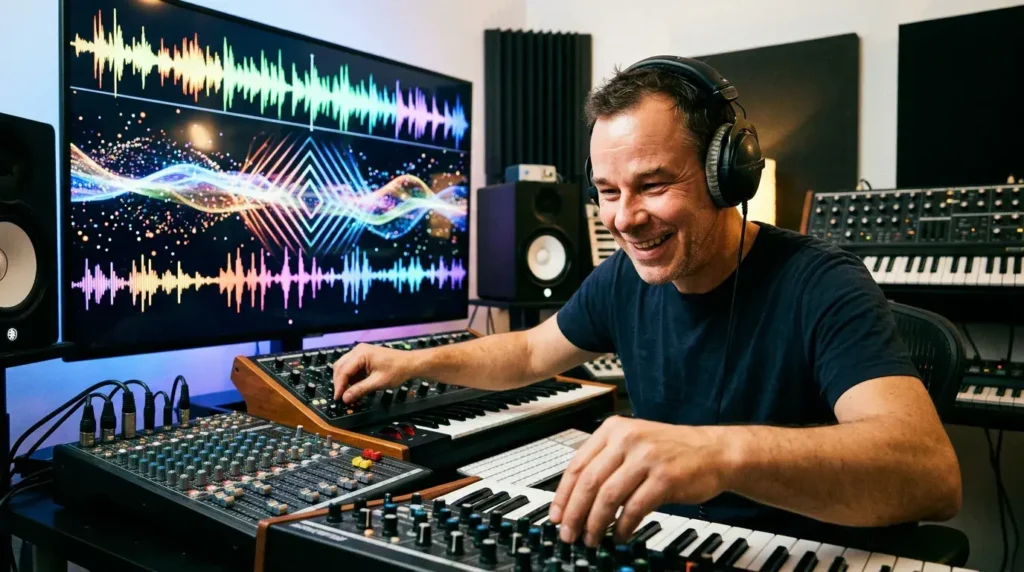
Then, testing what the program could really handle, I did something that had nothing to do with the roadmap.
I made a breakbeat track – check it out on my personal YouTube channel here: https://www.youtube.com/watch?v=5QWt9hMW3WY.
Wrote it, produced it with AI, generated visuals to run alongside it, cut the whole thing together. Start to finish, maybe an hour.
And I want to be honest about what that hour felt like, because it’s the whole point of this article. It was pure joy. Full, absorbed, lost-track-of-time joy – the kind where you look up and the light in the room has changed. Sacral chakra wide open, doing exactly what it’s built for.
AI helped me make it. That fact doesn’t reduce the joy by a single percent.
I think a lot of people assume it should. That there’s some conservation law where the more the machine does, the less real your satisfaction is allowed to be. I’ve now tested that directly, and it isn’t true. The joy comes from the making – from choosing, shaping, hearing something in your head and then hearing it outside your head. The tool determines how fast you get there. It doesn’t determine whether it counts.
Then I Closed the Laptop
That was the work day. Prompts, renders, a track that didn’t need to exist, a visualizer inching closer to what I actually want it to be.
By afternoon the sun was out properly, so I shut everything down and took the kids to the river nearby. Cold water. Stones underfoot. That specific shock when you go under, and the way your whole nervous system resets on the way back up.
No screen. No prompt. Just a body in moving water and children shouting about how cold it is.
And that’s the balance I’ve landed on after years of trying to make these two sides of my life argue with each other. They don’t have to. The morning at the screen and the afternoon in the river aren’t opposites – they’re the same energy in two different rooms. One creates. One restores. Skip either and the other starts to hollow out.
Spirituality has never asked anyone to reject their tools. It asks something harder – that you stay present while you use them, that you know why you’re making what you’re making, and that you’re able to put the thing down and go outside when the day is beautiful.
Make things. Use whatever helps you make them. Then go swim.
Frequently Asked Questions About Creative Expression and Digital Tools
Which chakra actually governs creativity and self-expression?
Both the sacral and the throat chakra are involved, and they do different jobs. The sacral chakra, sitting a couple of inches below your navel, is where the creative impulse originates – the pull to make something. The throat chakra handles expression itself, meaning the act of getting that impulse out into a form other people can actually experience. When someone has plenty of ideas but never finishes anything, that’s usually a throat chakra issue rather than a sacral one. When someone feels flat and uninspired to begin with, look at the sacral.
Does using AI make creative work less authentic or less spiritual?
The impulse behind the work is what makes it yours, and no software supplies that. You still decide what to make, why it matters, what it should feel like, and when it’s finished. AI changes how much technical friction sits between the idea and the finished thing. Every creative technology in history – pigment, the printing press, recorded sound, the synthesizer – arrived to the same accusation and outlived it. Difficulty and sacredness aren’t the same thing. Slow work isn’t automatically holier work.
Can someone be genuinely spiritual and still work entirely in digital media?
Yes, and plenty of people do. There’s an assumption that authentic expression has to be analog – clay, canvas, a body in real space – and that screens are somehow a lesser vessel. The creative energy running through you doesn’t run a materials check before it fires. What matters is presence, intention, and knowing why you’re making what you’re making. A meditation app built with care can carry as much of that as a hand-thrown bowl.
How much faster is AI logo animation compared to doing it manually?
The difference is dramatic. Animating a logo the traditional way meant modeling in 3D software, building lighting and reveal timing in After Effects, then editing in Premiere – typically two to three days for a five-second intro, with long render waits between every adjustment. Image-to-video tools handle the same result in minutes from a still logo file and a written prompt. What hasn’t changed is the judgment part: knowing what motion style suits a brand, and knowing how short an intro should actually be.
What makes a good prompt for animating a logo?
Describe the reveal in concrete visual terms rather than adjectives. Say what the shapes do – assembling from fragments, a glow building around the final mark, light sweeping across a dark background, the camera holding a steady centered frame. Also name the personality you want, because a finance brand usually suits sharp confident motion while a wellness brand calls for something slower and softer. Naming that directly stops the model from defaulting to one generic animation style.
Can creative work done with AI still feel genuinely fulfilling?
It can, and that surprises people. There’s an assumption that satisfaction is somehow rationed – that the more the machine handles, the less real your enjoyment is allowed to be. In practice the joy comes from the making itself: choosing, shaping, hearing something in your head and then hearing it outside your head. Making a track and its visuals in an hour with AI assistance produced exactly the same absorbed, lost-track-of-time feeling as spending three days on it manually.
How do you keep balance between screen-based creative work and real life?
Treat them as two halves of the same energy rather than as opposites. Creative work at a screen empties something out of you; time outdoors, in water, with people you love, fills it back up. Skip either one for too long and the other starts to hollow out. A practical version of this is simply ending the work day at a set point and going somewhere with no screen involved – a river, a walk, a garden. The ability to put the thing down is part of the practice, not a break from it.
Blog Categories:
About the Author: