
Rudraksha Beads and the 7 Chakras: Which Mukhi for Each Chakra
Rudraksha beads and the 7 chakras: which mukhi is paired with each chakra, how to choose and wear your bead, and how to tell real rudraksha from fakes.
Table Of Contents
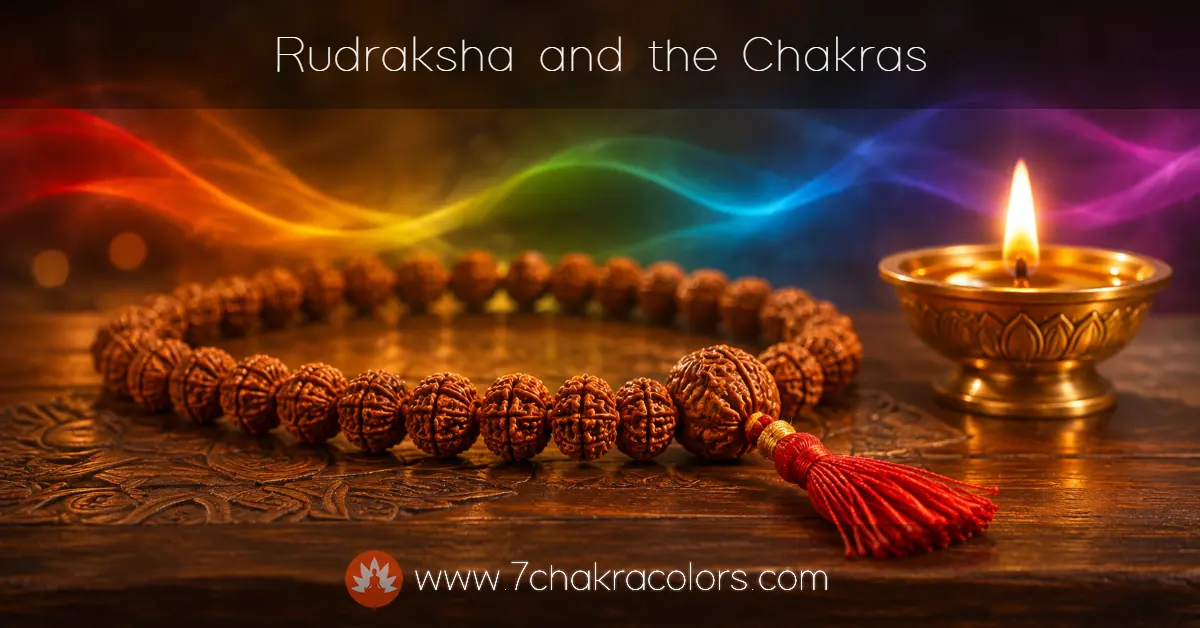
Hold a genuine rudraksha bead and the first thing you notice is that it doesn’t feel like jewelry. It’s a dried seed, rough and warm, with deep grooves running from top to bottom like the segments of a tiny pumpkin. Those grooves are what everything else depends on. Their number, called the mukhi or face count, decides which deity, planet and – in modern practice – which chakra a bead is linked with.
This guide covers what rudraksha beads are, which mukhi is traditionally paired with each of the seven chakras, how to choose and wear one, and how to tell a real bead from the many fakes on the market.
What Are Rudraksha Beads?
Rudraksha beads are the dried stones of the fruit of Elaeocarpus ganitrus, a large evergreen tree also listed under the name Elaeocarpus sphaericus. The blue fruit is soaked and cleaned until only the hard, grooved stone is left. A study in the journal Molecules notes that the tree is grown in the Assam and Himalayan region of India for its fruit stones and its uses in folk medicine. It also grows in Nepal and Indonesia. Nepali beads tend to be larger, and Indonesian beads small and smooth, which is why so many malas use them.
The name joins two Sanskrit words: Rudra, an early name of Shiva, and aksha, meaning eye. The best-known story says the first beads grew where Shiva’s tears fell to earth after a long meditation, made out of compassion for the world. For this reason rudraksha is worn by Shaivite monks, yogis and householders alike, and a traditional mala holds 108 beads plus one guru bead.
Rudraksha is revered in Hindu and Buddhist traditions as a sacred aid to meditation and protection. The claims made for it – calming the nerves, absorbing negative energy, balancing the chakras – belong to that tradition and to the experience of people who wear it. They haven’t been shown in clinical research, and a bead isn’t a treatment for any health problem.
What Does Mukhi Mean?
A mukhi is one natural groove running from the top of the bead to the bottom. Beads range from one mukhi to 21 or more. The five mukhi bead is by far the most common, which is why it’s cheap and why most malas are made of it. The rarer counts, especially one mukhi round beads and anything above 14, are expensive and the most often faked.
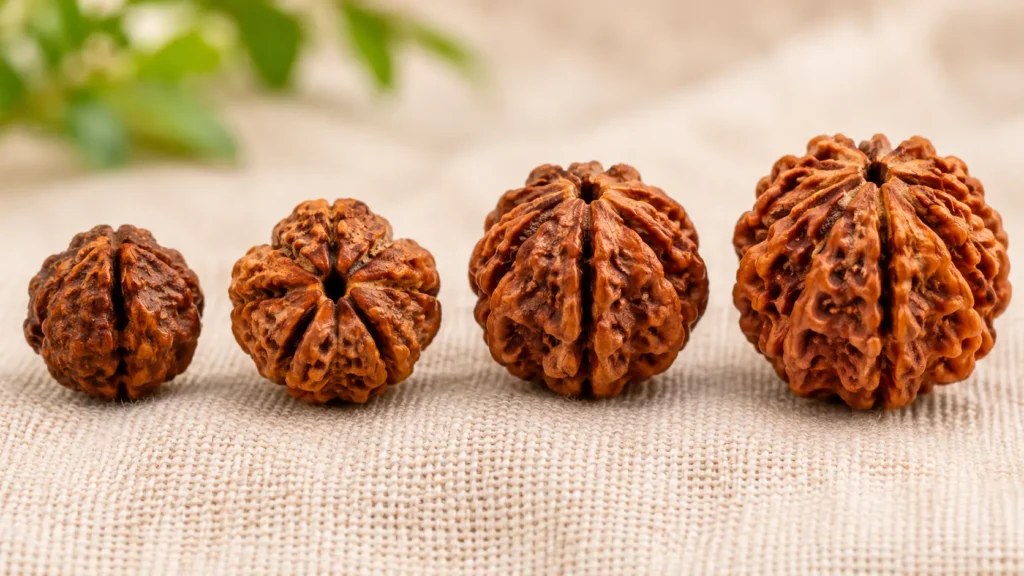
Each mukhi count has a traditional ruling deity and, in Vedic astrology, a ruling planet. The five mukhi bead belongs to Kalagni Rudra, a form of Shiva, and to Jupiter. The six mukhi belongs to Kartikeya and Venus, the seven mukhi to Mahalakshmi and Saturn, the eight mukhi to Ganesha and Rahu. These associations go back much further than the chakra pairings, which are largely a modern addition.
Understanding Chakras and Rudraksha
Rudraksha is often worn as a support for work with the energy centers of the body known as chakras. In yoga tradition they’re described as seven energy centers along the spine, each linked with a part of the body and an area of life – safety at the root, creativity at the sacral, confidence at the solar plexus, love at the heart, expression at the throat, intuition at the third eye and spiritual connection at the crown.
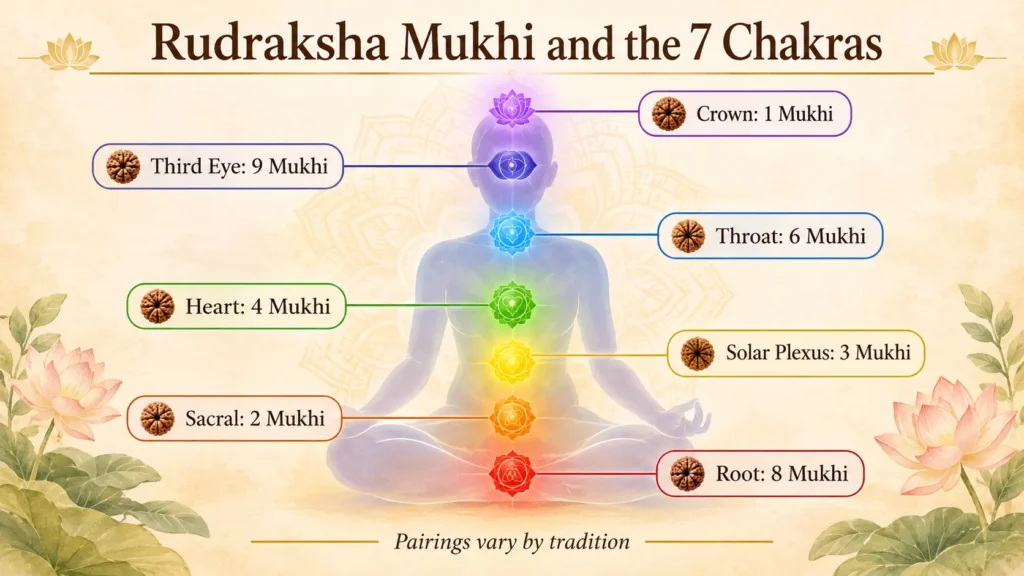
The idea behind pairing beads with chakras is simple: each mukhi is said to carry a vibration that supports the qualities of one center. Different sellers and teachers pair them differently, though, so you’ll often see the same bead linked to two or three chakras. The table below shows the pairings that come up most often. When a source gives a different pairing, that’s normal, not a mistake on either side.
| Chakra | Mukhi Most Often Paired | Traditional Focus |
|---|---|---|
| Root | 8 Mukhi (also 1 and 10) | Stability, removing obstacles, protection |
| Sacral | 2 Mukhi (also 6) | Emotional balance, harmony in relationships |
| Solar Plexus | 3 Mukhi, 12 Mukhi (also 7) | Confidence, willpower, letting go of guilt |
| Heart | 4 or 5 Mukhi, 13 Mukhi (also 6) | Inner peace, love, compassion |
| Throat | 5 Mukhi, 6 Mukhi (also 7) | Clear speech, learning, self-expression |
| Third Eye | 9 Mukhi, 11 Mukhi (also 6) | Focus, courage, clear decisions |
| Crown | 1 Mukhi, 14 Mukhi | Higher awareness, spiritual connection |
It’s very important to wear genuine rudraksha to get those benefits, so make sure to buy rudraksha online from trusted stores like Eka Rudraksha or other trustworthy stores that provide authentic rudraksha at reasonable prices.
Which Rudraksha Is Best for Each Chakra?
Rather than give every chakra the same treatment, it helps to look at where people most often get confused.
Root and sacral chakra
For the root chakra, the eight mukhi bead of Ganesha, remover of obstacles, is the classic choice, linked with stability and steady progress. Some lists add the one mukhi for grounding focus and the ten mukhi for protection. For the sacral chakra, the two mukhi bead, ruled by Ardhanarishvara – Shiva and Parvati joined in one body – is linked with harmony in relationships and emotional balance.
Is 6 mukhi rudraksha for the throat or the heart chakra?
This is the question people ask most, and the honest answer is that both pairings exist. The six mukhi bead is ruled by Kartikeya and by Venus, the planet of love, beauty and art. Sellers who focus on its Venus side link it to the heart and sacral chakras. Those who focus on its use for clear, confident speech and learning link it to the throat. Some also connect it with the third eye for focus. If you’re drawn to six mukhi, choose it for the quality you want – expression or warmth – rather than worrying about which chart is “right.”
Solar plexus chakra and the 7 mukhi
The three mukhi bead of Agni, the fire god, matches the fiery solar plexus and is linked with confidence and letting go of past guilt. The twelve mukhi of Surya, the sun, is paired with willpower and leadership. The seven mukhi, ruled by Mahalakshmi and Saturn, is often linked with the solar plexus too, for steady effort and prosperity, and some lists place it at the throat.
Heart, third eye and crown
The heart chakra is usually paired with the four or five mukhi for calm and inner peace, and the thirteen mukhi for love and attraction. The third eye gets the nine mukhi of Durga and the eleven mukhi of Hanuman, linked with courage and clear decisions. The crown is linked with the one mukhi of Shiva himself and the fourteen mukhi, both rare, both associated with higher awareness.
How to Choose Your First Rudraksha
If you’re new to rudraksha, most teachers suggest starting with a five mukhi bead or mala. It’s considered safe for everyone, it’s affordable, and it’s linked with general calm and meditation. Wear it for a few weeks and notice how it feels before buying anything rarer.
When you’re ready to work with a specific chakra, choose the quality you want to support rather than the bead with the most impressive claims. A few practical points:
- Size and origin. Nepali beads are larger and heavier, and Indonesian beads lighter and easier to wear as a mala. Neither is better.
- Clear grooves. The mukhi lines should run cleanly from the top hole to the bottom, without breaks or extra carved lines.
- A natural hole. Many beads have a natural channel through the center. A drilled hole is fine, but it should be clean and centered.
- Price. Very cheap rare beads are a warning sign. A one mukhi bead sold for a few dollars is almost certainly fake.
How to Tell If Rudraksha Is Real
Fakes are common, especially for rare mukhi. Sellers carve extra lines into five mukhi beads, glue two beads together, or press “beads” from resin or wood. Popular home tests don’t help much. The water float test, where a real bead is said to sink, is unreliable: real beads can float and fakes can sink. Boiling or the copper coin test isn’t reliable either.
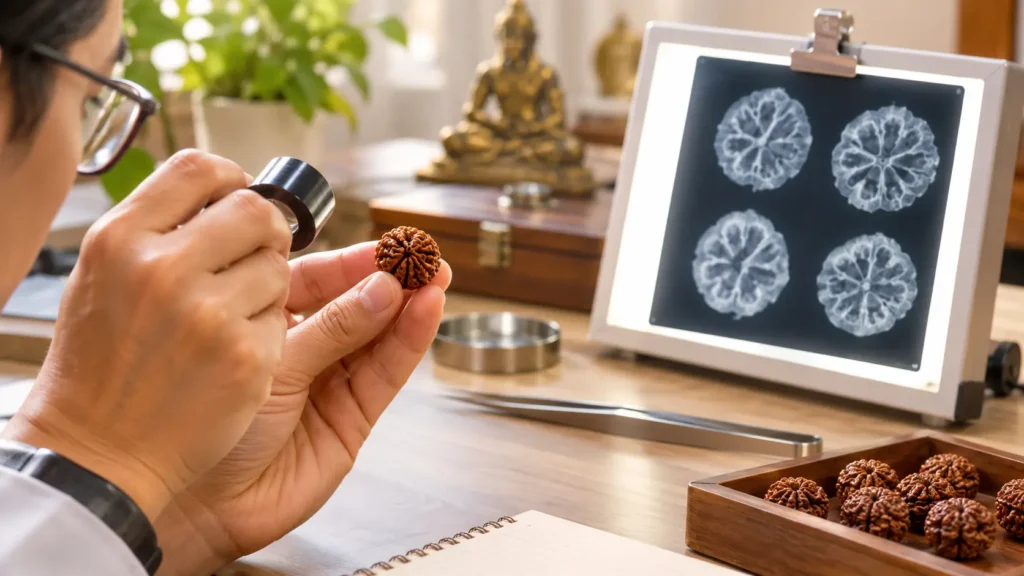
The most reliable check is an X-ray or a lab certificate. Inside a genuine bead, the number of seed compartments matches the number of mukhi, which an X-ray shows clearly. For an expensive bead, ask for an X-ray report from an independent lab, and look closely at the grooves with a magnifying glass. Carved lines look sharp and even, while natural ones are slightly irregular.
Correct Ways to Wear Rudraksha
Tradition gives a lot of rules, and families and teachers differ on them. The core points most agree on:

- Bracelet or necklace. A bracelet keeps the bead in daily view. A necklace or mala at heart level is the traditional choice for meditation and for heart chakra work.
- Skin contact. The bead is meant to touch the skin. Silk, cotton thread, or silver or gold wire are all common, and red or black thread is traditional.
- Start with intention. Many people begin wearing a new bead on a Monday, Shiva’s day, after washing it and chanting Om Namah Shivaya a few times.
- Know when to take it off. Some traditions remove rudraksha while sleeping, bathing with soap or at funerals. Follow the custom you’ve been taught, or what feels respectful to you.
Caring for Your Rudraksha Beads
Rudraksha is organic and dries out over time. Keep it away from soap, perfume and chlorine. Every month or two, brush it gently with a soft toothbrush to clear sweat and dust from the grooves, then rub in a drop of sandalwood, mustard or olive oil and let it rest for a day. Like any sacred object you wear regularly, knowing how to cleanse and recharge your chakra jewelry for best results keeps its energy clear and effective.
If a bead cracks, the tradition is to retire it with respect, often by placing it in a river or burying it under a tree, rather than throwing it away.
Working With Your Bead
The simplest way to use rudraksha with the chakras is as an anchor for attention. Hold your bead or mala, bring your attention to the chakra you’re working with, and repeat a mantra on each bead – Om Namah Shivaya, or the seed sound of that chakra, such as Lam for the root or Yam for the heart. Even five minutes a day builds a link between the touch of the bead and a calmer state of mind. If you’re drawn to working with stones for personal growth, exploring birthstones meaning and the personal power they carry offers another layer of energetic self-understanding.
Frequently Asked Questions About Rudraksha Beads and the Chakras
Which rudraksha is best for beginners?
The five mukhi rudraksha is the usual first choice. It’s the most common bead, so it’s affordable and easy to find genuine, and tradition considers it safe for anyone to wear. It’s linked with calm, health and meditation rather than one narrow goal. Wear it for a few weeks and see how it feels before you buy rarer beads for specific chakras.
Can I wear rudraksha for all chakras at once?
Yes. Some people wear a combination bracelet or mala that includes several mukhi, often called a chakra or siddha combination. A simpler route is a five mukhi mala, which tradition treats as a general bead for overall balance. If you want to focus on one area, a single bead for that chakra is easier to work with than a large mix.
Is 7 mukhi rudraksha for the solar plexus chakra?
Often, yes. The seven mukhi bead is ruled by Mahalakshmi and Saturn, and it’s linked with steady effort, patience and prosperity, which many sellers pair with the solar plexus. Some charts place it at the throat instead. Both appear in modern lists, because chakra pairings for rudraksha are newer than the deity and planet links and vary between teachers.
Who should not wear rudraksha?
Tradition places few hard limits on rudraksha, and most beads, especially five mukhi, are considered fine for anyone. Some families have customs around wearing it during menstruation, at funerals or while eating meat or drinking alcohol, and these differ widely. If you belong to a particular lineage, follow its guidance. A rudraksha isn’t a medical treatment and shouldn’t replace one.
How do I know if my rudraksha is energized?
In tradition, a bead is energized through a short ritual: washing it, offering it to Shiva and chanting a mantra such as Om Namah Shivaya, often 108 times, on a Monday. Many sellers do this before shipping. There’s no physical test for it. What matters most in practice is the intention you bring and how regularly you use the bead in prayer or meditation.
Does real rudraksha sink in water?
Not reliably. The popular test says a real bead sinks and a fake floats, but density depends on the bead’s age, dryness and size, so real beads can float and some fakes sink. The water test is best ignored. An X-ray showing seed compartments that match the mukhi count, or a certificate from an independent lab, is far more trustworthy.
How often should I oil my rudraksha?
Every one to two months is enough for most beads. First brush the grooves with a soft, dry toothbrush to remove dust and sweat. Then rub in a few drops of sandalwood, mustard or olive oil and leave the bead to absorb it for a day before wearing it again. Oiling keeps the seed from drying out and cracking.
Blog Categories:
About the Author: